

Oh look, a shill shilling. Ironic.
Results 12,101 to 12,125 of 15707
Thread: Ukraine war mega thread
-
13-01-2023, 05:07 AM #12101Heading down to Dino's



- Join Date
- Jun 2009
- Last Online
- @
- Posts
- 35,412
-
13-01-2023, 05:18 AM #12102Thailand Expat

- Join Date
- Feb 2006
- Last Online
- @
- Posts
- 40,667
Happiness is a warm gun. Again, Russia has more tanks than the rest of Europe combined. But neither Europe or the US have a single hypersonic missile. So lets have some more war porn, a la snubski-
Louis Mazzante
Tue, January 10, 2023 at 3:59 AM GMT+10:30·16 min read
Earlier this year, Russia fired its newest and most dangerous weapon from the belly of a MiG-31 fighter jet. When the hypersonic Kinzhal missile lit its rocket engines and shrieked across the sky at speeds up to Mach 5 toward a target in the Ukraine, it marked the first time a hypersonic weapon has been used in a conflict.
The Kinzhal and missiles like it are at the tip of a technological revolution in weapon development. These hypersonics can reach speeds up to Mach 10, but more importantly are highly agile. Existing ballistic missiles travel faster, reaching Mach 20 as they sail high above the earth’s atmosphere, where there’s less drag to slow them down. But to reach those speeds, ballistic missiles fly in predetermined arcs, like a cannonball, which makes them easy to track and shoot down. The next-gen hypersonic missiles can fly low (below 60,000 feet), adjust course midflight, and maneuver around missile-defense systems. Military analysts have called them “unstoppable.”
“Hypersonic weaponry represents the most significant advancement in missile technology since [Intercontinental Ballistic Missiles] ICBMs,” wrote the authors of a 2021 report by security think tank RUSI. “[They] are on their way to undermining nuclear-deterrence postures and creating cracks in strategic stability by the mid-2020s.”
Russia is already testing a successor to the Kinzhal that uses air-breathing engines, like a jet, to fly at speeds up to Mach 9, making it even harder to detect and defend against. In all, Russia has three hypersonic weapons in use or development; China has three. The United States has yet to produce a fully functional hypersonic missile but is reportedly developing at least eight of them.
1. Kh-47M2 Kinzhal
Alamy
Nation: Russia | Length: 26 ft. (est.) | Weight: 4,400 lb. (est.)| Range: 1,200 miles (est.) | Speed: Mach 10
Russia broke through the hypersonic missile barrier first, launching the Kinzhal (“Dagger”) from a MiG-31 fighter jet earlier this year. The Kinzhal is a modified version of the country’s Iskander, a ground-launched ballistic missile, but it has new aerodynamics and guidance systems that give it greater maneuverability. An advanced tail section and rudders allow the Kinzhal to evade air defenses, including the U.S. Patriot surface-to-air missile.
“We had to create these weapons in response to the U.S. deployment of a strategic missile defense system, which in the future would be capable of virtually neutralizing, zeroing out all our nuclear potential,” Russian President Vladimir Putin stated in 2020, referring to his country’s new hypersonic missiles.
Kinzhal can carry either a conventional warhead with 1,100 pounds of explosive, or a nuclear device of up to 500 kilotons. And Russia seems intent on showing off the weapon’s capabilities. This year, Russia has fired at least three Kinzhals with conventional warheads during the war against Ukraine. The effect so far has been underwhelming—one of those rockets misfired and landed inside Russia, injuring six civilians, including a firefighter. Some defense analysts have even called the Kinzhal “quasi-ballistic,” suggesting that it is less maneuverable than Russia claims.
2. 3M22 Zircon
AP
Nation: Russia | Length: 30 ft. | Weight: 4,400 lb. | Range: 540+ miles | Speed: Mach 9
The first hypersonic weapon that launches and attacks entirely with its own propulsion system will be entering service soon. Unlike the Kinzhal, which catches a ride on a conventional missile, Russia’s Zircon uses a supersonic combustion ramjet engine—or scramjet—to reach speeds up to Mach 9. Unlike rockets, which are propelled by an internal mixture of fuel and oxidizer, this air-breathing engine ingests and compresses oxygen just like a jet engine. Zircon reportedly will carry nuclear or conventional warheads, and it has a greater range and more maneuverability than Russia’s conventional short-range missiles.
Russia says the weapon can be launched from submarines and ships, and a land-based version is reportedly also in development. Russian officials also claim that they have successfully tested Zircon and begun production, but it has yet to enter service. Admiral Nikolai Yevmenov, Commander-in-Chief of the Russian Navy, told Russian news agency RIA Novosti in 2021 that the weapon has problems that need to be resolved before it’s ready for combat.
3. Objekt 4202 Avangard
Russian Defense Ministry Press Service via AP
Nation: Russia | Length: 18 ft. (est.) | Weight: 4,400 lb. (est.) | Range: 4,000+ miles | Speed: Mach 20
If Russia were to use nuclear weapons in its war against Ukraine, they likely would be delivered by the country’s newest hypersonic missile, called Avangard, according to Dmitry Medvedev, deputy head of Russia’s Security Council.
This hypersonic glide vehicle (also known as Objekt 4202)—it hitches a ride on a conventional ballistic missile, then detaches to “glide” at hypersonic speeds toward its target—is a new warhead for ICBMs. Russian officials say it could be fitted on the country’s RS-28 Sarmat Heavy ICBM, known by NATO as Satan-2, which has a range of more than 11,000 miles.
Normal ICBM warheads follow a predictable path, which means they can be easily intercepted. But Avangard has jet-like moving control surfaces that allow it to change direction. Russian officials quoted in the country’s TASS news agency have claimed that it is “invulnerable to any missile defense system.”
Avangard reportedly can carry a two-megaton warhead. That’s about twice as powerful as the biggest U.S. nuclear weapon and about 130 times more destructive than the atomic bomb dropped on Hiroshima.
4. Dongfeng-17
Alamy
Nation: China | Length: 36 ft. | Weight: 33,000 lb. | Range: 1,100+ miles (est.) | Speed: Mach 5+
Like Russia, China is ambitiously developing hypersonic weapons. One of the most significant is the DF-ZF hypersonic glide missile, which is carried by the country’s DF-17 “aircraft-carrier killer” rocket. While U.S. carrier groups have defenses that can shoot down traditional missiles, this combo would be far more challenging. Unlike most ballistic missiles, the DF-17 has a flat trajectory. It cruises at relatively low altitudes—below 60,000 feet or so—making it difficult to detect at long range. The DF-ZF would then detach and glide toward the target at speeds above Mach 5.
China based the DF-17 on its existing DF-16B short-range ballistic missile and unveiled the new weapon in 2019, when it was seen being transported by a 10-wheeled launch vehicle. China claims the missile is already in service. That should worry opposing naval fleets: The speed and mass of the weapon make it more destructive than existing anti-ship missiles (the DF-17 is about 20 times the size of America’s most common anti-ship missile, the 12-foot-long Harpoon), and the kinetic impact alone of one striking a ship at a mile per second would likely inflict catastrophic damage.
5. Xingkong-2
Image believed to be the Xingkong-2Getty Images
Nation: China | Length: N/A | Weight: 6,000+ lb. (est.) | Range: N/A | Speed: Mach 6+
In 2018, China claimed it successfully tested a new hypersonic cruise missile unlike anything else. Similar to Russia’s Zircon, the Xingkong-2 (Starry Sky-2) uses a scramjet engine, and it has the sleek silhouette of a stealth plane. But instead of wings, this missile is a “wave rider.” The missile effectively surfs on its own hypersonic shockwaves, generating lift without the increased drag that wings create.
The U.S. tested similar designs on the experimental X-51 from 2005 to 2013 but never produced a viable weapon. The Xingkong’s scramjet engine and wave-riding design should make it highly agile with a long range, potentially with intercontinental reach. But despite successful testing, most analysts expect that this hypersonic is several years away from entering service.
6. WZ-8
Alamy Stock Photo
Nation: China | Length: 67.5 ft. | Weight: N/A | Range: N/A | Speed: Mach 6 to 7 (est.)
China unveiled another ambitious hypersonic project in 2019. Known as WZ-8, this uncrewed reconnaissance drone is believed to be the world’s only hypersonic aircraft. It is similar to the U.S.’s air-launched D-21 drone that is capable of Mach 3—but even faster. The WZ-8 is carried by a mothership, such as the H-6K, a twin-engine bomber that China has flown since 1969. After release, the WZ-8 ignites rocket motors and cruises at speeds around Mach 7 at altitudes higher than 80,000 feet before returning for recovery. WZ stands for Wu Zhen, or “no detection,” a name generally applied to stealth drones, so the WZ-8 likely will include stealth features. Like the SR-71 before it, the WZ’s speed and high ceiling should allow it to outrun surface-to-air missiles, making it a capable spy drone. However, some analysts believe China may equip the WZ-8 with a warhead, using its disguise as an intelligence-gathering drone to carry out a surprise attack.
https://news.yahoo.com/hypersonic-missiles-terrify-u-military-172900827.html
Tanks are so, yawwn, last century. Most of those belching stinkboxes were developed before we had decent video games.
We haven't had such expensive human sarcophagi since the Age of the Pharaohs. So go on then, give all yours to Ukraine- hopelessly outnumbered though they are- and go buy some more, like good shills. Who needs schools and hospitals, when you've got war toys to play with and masturbate over.Last edited by sabang; 13-01-2023 at 05:35 AM.
-
13-01-2023, 05:41 AM #12103Thailand Expat
- Join Date
- Feb 2006
- Last Online
- @
- Posts
- 40,667
You only need Dark web access and Bitcoin to buy one yerself cowboy. Waddya waiting for- it's a buyers market.

-
13-01-2023, 05:42 AM #12104Heading down to Dino's
- Join Date
- Jun 2009
- Last Online
- @
- Posts
- 35,412
-
13-01-2023, 05:52 AM #12105Heading down to Dino's
- Join Date
- Jun 2009
- Last Online
- @
- Posts
- 35,412
Another snivelling, hysterical reactionary post from the useful idiots. Russian tanks are utter shit, so it does not matter how many they have. Most have already been destroyed by the Ukrainians.
Your post is not news either.
-
13-01-2023, 06:00 AM #12106Thailand Expat
- Join Date
- Feb 2006
- Last Online
- @
- Posts
- 40,667
Most have already been destroyed by the Ukrainians. Russia has more tanks than the whole of Europe.
Post, kettle, black. It's much more interesting war porn than your WW2 era stuff anyway.Your post is not news either.
Ukraine is the first actual war in which hypersonic missiles have been used. Tanks- that was WW1. Nukes, WW2.
-
13-01-2023, 06:06 AM #12107Days Work Done!

- Join Date
- Oct 2007
- Last Online
- Today @ 06:41 AM
- Location
- Roiet
- Posts
- 36,058
Only needed 2 to do the trick. Originally Posted by sabang

-
13-01-2023, 06:10 AM #12108Thailand Expat
- Join Date
- Feb 2006
- Last Online
- @
- Posts
- 40,667
As opposed to the 40,000 tanks involved in the Battle of Kursk.
-
13-01-2023, 07:13 AM #12109Thailand Expat

- Join Date
- Nov 2005
- Last Online
- @
- Posts
- 17,369
Big Lesson of the Ukraine War: There’s Only One Superpower
The effort against Russia has illustrated what a world without American power would look like — and what it looks like when America uses its unmatched power well.
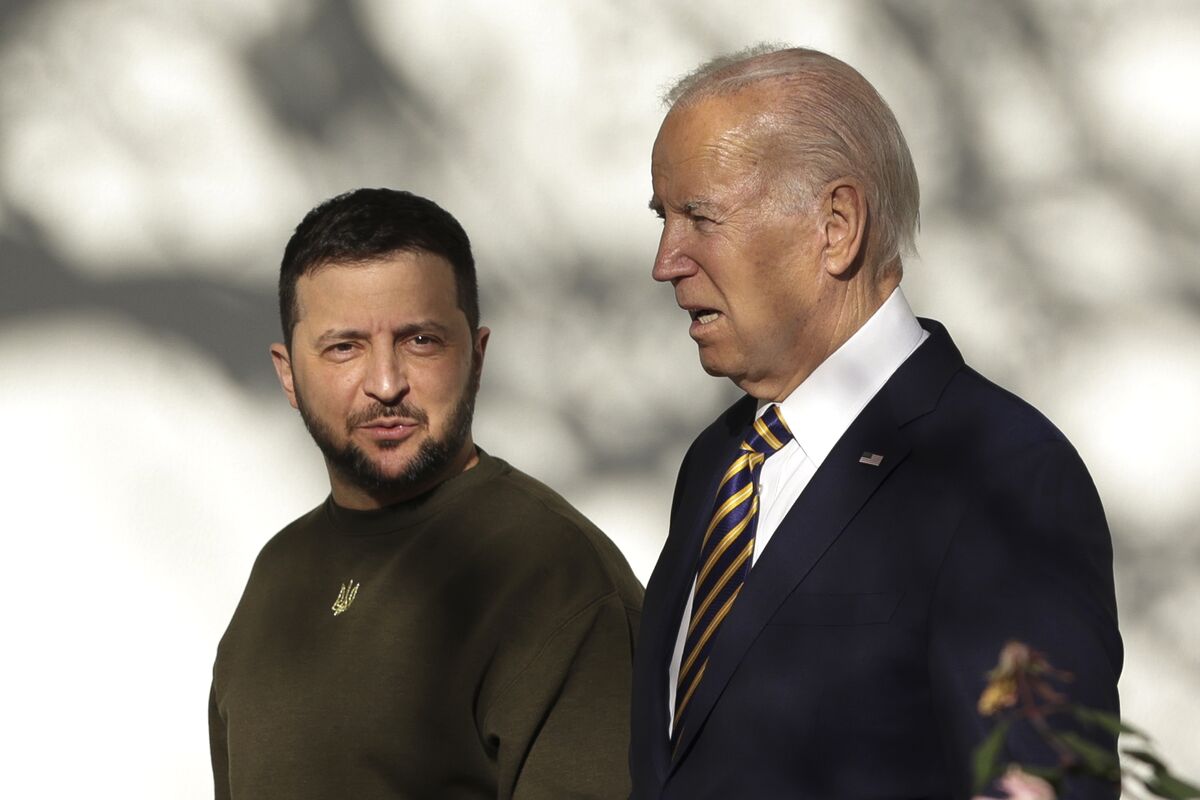
War leaders.Photographer: Alex Wong/Getty Images
By
Hal Brands
January 12, 2023 at 6:00 PM GMT+7
Listen to this article
5:00
Share this article
New
Gift this article
Follow the authors
Hal Brands is a Bloomberg Opinion columnist. The Henry Kissinger Distinguished Professor at Johns Hopkins University’s School of Advanced International Studies, he is co-author, most recently, of "Danger Zone: The Coming Conflict with China" and a member of the State Department's Foreign Affairs Policy Board.
+ Get alerts forHal Brands
It feels ghoulish to look for good news in Russia’s war in Ukraine, given how much misery that conflict has inflicted. But geopolitical tragedies can serve pedagogical purposes. If nothing else, this war has illustrated what a world without American power would look like — and what it looks like when America uses that unmatched power well.
My day job involves teaching Johns Hopkins University undergrads and grad students about international relations. I periodically have to remind myself that one can forgive millennials and members of Gen Z for having a jaded view of America’s global role.
More from
BloombergOpinion
When Terminator Robots Police Loan Markets
Elon Musk's New Year’s Resolution Is to Stop Selling Shares
Japan’s Standing Is Rising. Not So Its Leader’s
The Document That Separates Biden and Trump
For two decades, the standout events in US foreign policy were costly, failed wars in Iraq and Afghanistan. If you’re not old enough to remember the reunification of Germany in 1990 or the Persian Gulf War of 1990-91, you may struggle to think of an international mega-crisis Washington managed with aplomb.
This isn’t to give credence to overwrought critiques of American statecraft in the two decades after the Cold War. Many foreign policy successes are invisible, because they involve preventing awful outcomes — perhaps additional, catastrophic terrorist strikes after 9/11; or a global depression in 2008-09 — as well as achieving good ones.
But if your consciousness of US foreign policy is bookended by the Iraq invasion in 2003 and the humiliating withdrawal from Afghanistan in 2021, you might wonder whether Washington really knows what it is doing. And if you grew up in a post-Cold War world where the global wars and vicious rivalries of the 20th century seemed like ancient history, you might ask what the value of the American-led international order really is.
The Ukraine War has been doubly enlightening. First, it starkly illustrates just how grim and brutal a post-American world might be. A Ukraine left to its own devices would have quickly succumbed to President Vladimir Putin’s invasion. It would now be suffering show trials, the execution and imprisonment of its leaders, and harsh punishment of anyone who resisted Russian rule.
The reason so many Eastern European countries have clamored to get into America’s alliance network over the past 25 years is that they understand that the sort of aggression and barbarism we have seen in Ukraine have been the norm for much of human history. Such outrages have simply been suppressed, to an unprecedented degree, by America’s self-interested but comparatively benign leadership since World War II.
Fortunately, the Ukraine war has also offered a timely case study in just how mighty and effective an engaged America can be. President Joe Biden’s administration hasn’t gotten everything right: Its early assessments of Ukraine’s will to fight were far too pessimistic, for instance, and its initial efforts to deter Russian nuclear escalation were muddled and confusing. But the overall performance has been pretty good, helping Ukraine thrive in a war it wasn’t supposed to survive, and demonstrating that the world won’t be truly multipolar anytime soon.
The US intelligence community usually makes news when it gets things wrong. But what other country has an intelligence establishment that could have gotten so much right about events half a world away?
America’s spies sniffed out Putin’s aggression months in advance and gave Ukraine critical warning on how the invasion would unfold. The US has delivered real-time information that has allowed Kyiv to plan its most effective offensives and carry out its most spectacular strikes. That performance is presumably not lost on President Xi Jinping of China, who now must worry that any bid to attack Taiwan might quickly become the worst-kept secret on earth.
The war is also a testament to the influence America’s global alliance network provides: Washington rallied dozens of advanced democracies in multiple regions to support Ukraine and sanction Russia.
That response, in turn, has advertised America’s capacity to inflict economic pain. The sanctions and export controls that Washington and its friends have imposed may not force Putin out of Ukraine, but they will force his country into a future of stagnation and technological backwardness.
Then there is the contrast between Russian military gear — tanks that combust catastrophically when hit, missiles that don’t get close to their targets — and American military equipment. By providing just 20 HIMARS rocket launchers, Washington helped Kyiv turn the tide of Europe’s largest land war since 1945; one wonders how much damage Ukraine might be doing with 40 of them instead.
None of this slights the performance of the Ukrainians, whose skill, resilience and creativity have been simply awesome. But even here, the war is a useful antidote to some recent American pessimism: Contrary to what one may have thought after the dispiriting denouement in Afghanistan, some US security partners are quite competent and committed after all.
Overconfidence can be deadly, and what has happened in Ukraine is no guarantee that Washington will succeed in the next crisis with Beijing, Moscow or Tehran. But a war in which the US is not even directly involved has provided a vital lesson for America and its rivals: There’s still just one superpower.
Majestically enthroned amid the vulgar herd
-
13-01-2023, 07:55 AM #12110Thailand Expat
- Join Date
- Feb 2006
- Last Online
- @
- Posts
- 40,667
True, but it's a new Era. Now it's costly, failed war in Europe.For two decades, the standout events in US foreign policy were costly, failed wars in Iraq and Afghanistan.
-
13-01-2023, 07:57 AM #12111Heading down to Dino's
- Join Date
- Jun 2009
- Last Online
- @
- Posts
- 35,412
For Russia. Originally Posted by sabang
-
13-01-2023, 08:46 AM #12112Thailand Expat
- Join Date
- Feb 2006
- Last Online
- @
- Posts
- 40,667
For Europe, including Russia. Europe is now officially a has-been.
-
13-01-2023, 09:15 AM #12113Thailand Expat
- Join Date
- May 2008
- Last Online
- @
- Posts
- 14,694
Is it a joke ? Originally Posted by sabang
Sounds like a somewhat inflated number to meLast edited by helge; 13-01-2023 at 09:44 AM.
-
13-01-2023, 09:42 AM #12114Elite Mumbler

- Join Date
- Apr 2008
- Last Online
- @
- Location
- Isolation
- Posts
- 8,829
Sabang has lost his mind. Originally Posted by helge
The Battle of Kursk was the largest tank battle in history, involving some 6,000 tanks
Battle of Kursk | World War II | Britannica
-
13-01-2023, 10:08 AM #12115Thailand Expat
- Join Date
- Feb 2006
- Last Online
- @
- Posts
- 40,667
Yeh, it was a mere 6k or so. We can beat that in the ukie!
-
13-01-2023, 11:19 AM #12116Member

- Join Date
- May 2007
- Last Online
- 27-05-2026 @ 02:30 PM
- Location
- Udon
- Posts
- 488
Maybe Russia should apply for the Lend Lease program. It seemed to work for them the last time.
-
13-01-2023, 01:50 PM #12117Thailand Expat

- Join Date
- Sep 2009
- Last Online
- @
- Posts
- 108,163
Just more sabang bullshit. Originally Posted by helge
-
13-01-2023, 04:15 PM #12118Thailand Expat

- Join Date
- Mar 2007
- Last Online
- 21-10-2023 @ 08:08 AM
- Location
- Way, Way South of the border now - thank God!
- Posts
- 33,190
According to you . . . Good God, you are vacuous. Originally Posted by sabang
As above . . . and why do you feel the compulsion to lie in every single post? Originally Posted by sabang
-
13-01-2023, 04:18 PM #12119Thailand Expat

- Join Date
- Jan 2010
- Last Online
- @
- Posts
- 32,878
just how have they been performing on the battlefield, you really should change that to Russia has more outdated and irrelevant equipment than the whole of Europe Originally Posted by sabang
-
13-01-2023, 04:19 PM #12120Thailand Expat
- Join Date
- Nov 2005
- Last Online
- @
- Posts
- 17,369
...he needs the affirmation of folks responding to his provocative nonsense: ignore him, I suspect, and he'll return to reason...if he can find it... Originally Posted by panama hat
-
13-01-2023, 05:02 PM #12121Thailand Expat
- Join Date
- May 2008
- Last Online
- @
- Posts
- 14,694
Well a bit of provocation can't be bad; might wake you up, but probably not Originally Posted by tomcat
Speaking for myself, I do get...very provoked by those posters on TD, who slavic follow the line their governments and corporate massmedia has rolled out for them.
Russians- bad
Ukrainians-Nato-good
I don't know where you originate from and it could be, that you have been fortunate enough, never to have massmedia or government lie to you before.
Not so in my case and I learned my lesson
-
13-01-2023, 05:17 PM #12122Heading down to Dino's
- Join Date
- Jun 2009
- Last Online
- @
- Posts
- 35,412
Why do you persist in being an idiot? You do not have to utilize any corporate media to come to the logical deduction that Russia is evil. The real question is why a person would think otherwise. I mean, it is not like Russia and Russians have many friends on the planet. Lots of ways for intelligent people to gather information independently. Originally Posted by helge
The problem with useful idiots like yourselves is you suffer from massive cases of confirmation bias.
Why are you on your knees in front of a dictator's penis?
-
13-01-2023, 05:24 PM #12123Thailand Expat
- Join Date
- Feb 2006
- Last Online
- @
- Posts
- 40,667
How Western Sanctions Blow Back, Hurting Europe, Deepening Asian Integration
Western sanctions led Russia to greatly increase trade with Asia, while devastating Europe’s economy. The US tech war against China is damaging its own industry.
Economic coercion, through the imposition of sanctions, is an act of war. Many of these sanctions have caused hardship, especially for the civilian populations of targeted countries.
But just as a rifle recoils on the shooter’s shoulder, potentially causing injury, so too can sanctions backfire on the user. That is the title of a new book, “Backfire: How Sanctions Reshape the World Against U.S. Interests.”
This is not to say that sanctions don’t cause suffering, but they have a mere 13% success rate in altering a targeted state’s behavior in the way desired.
The failure of sanctions has long been recognized, although that seems not to have dampened U.S. persistence in adding ever more of them.
The blowback effect has begun, and more is predictably on the horizon. This present analysis will focus on the two main geopolitical targets of U.S. policy: Russia and China.
‘Extending’ Russia into Ukraine
At the moment, the U.S. is in a proxy war with Russia, with Ukraine in the military forefront. Before that, and alongside it now, is a running war of sanctions.
The longest cause was the rise to power of Vladimir Putin, who restored Russia’s economic power and sovereignty by undoing some of the predatory effects of Russia’s privatization following U.S.-supported “shock therapy.”
An early “Western” strategy to prevent a return of Russia as a great power was to bring many of its bordering states in Eastern Europe into NATO. Ukraine would be the last piece in what Russia perceives to be a military front of potential aggression. Whatever the outcome of that fight will be, sanctions are likely to continue.

The U.S. first sanctioned 60 Russian individuals in 2012 with the Magnitsky Act, to punish those supposedly responsible for the death of Sergei Magnitsky, an accountant for a tax-evader who was charged with corruption, and who was also politically linked to Russian opposition leader Alexei Navalny – himself later a cause for further sanctions.
In 2014, a U.S.-backed coup in Ukraine led to eight years of civil war, giving rise to separatist movements in the east of the country.
Apparently following the 2019 report “Extending Russia” from the Pentagon-backed RAND Corporation, the U.S. selected Ukraine as the best option among neighboring countries to provoke Russia into over-extending itself.
This proposed strategy seemed confirmed in December 2022 by Germany’s former chancellor, Angela Merkel, in an interview with the newspaper Die Zeit. She admitted that the “2014 Minsk agreement was an attempt to buy time for Ukraine. Ukraine used this time to become stronger.”
The Minsk agreements had been overseen by Germany and France. Former French President François Hollande confirmed the same soon after, stating, “Angela Merkel is right on this point.”
Their strategy succeeded in “extending Russia” into Ukraine in February 2022.
Western sanctions lead to more Russian self-sufficiency
Sanctions have been raining down on Russia ever since, against individuals, companies, and government agencies, most importantly against its oil exports, but also against its sale of aluminum, uranium, and agricultural goods.
Initial harm included a sizeable drop in Russia’s GDP and living standards, the loss of foreign investment, a sharp increase in inflation, and a temporary depreciation of the ruble.
The U.S. later restricted Russia’s access to capital markets and to oil and gas extraction technology, which can inhibit Moscow’s financing of oil field development, notably in the Arctic, where Russia has the longest shoreline.
However, Putin turned much of this around with policies of import substitution, government subsidies, and the nationalization of private oil companies, which by 2018 had grown back up to almost 40% more than before sanctions.
In fact, the value of Russian exports grew after the 2022 sanctions.
Russian farmers gained from import substitution and ensured the country’s food security.
And while Russia exports less now to Britain, Sweden, the U.S., South Korea, and Germany, it exports more to Brazil, Japan, China, India, Turkey, Spain, the Netherlands, and Belgium.
India and China have increased their purchase of Russian oil; France relies on Russian uranium; Belgium still trades in diamonds with Russia; and the Netherlands offers access to Dutch ports for such cargo, the New York Times reported.
Financial sanctions have also fallen short of their goal.
The Bank of Russia’s reserve system has a surplus of pre-war levels. By the end of 2022, Russia’s foreign-exchange reserves were $581.7 billion USD, the fourth-highest in the world – while its ally China remained firmly in first place, with more than $3 trillion USD worth of assets.
Western sanctions on Russia backfire in Europe
By contrast, Germany is facing the most collateral damage from the loss to its markets and the sanctions on energy, notably bringing an end to the supply of cheap Russian gas through the Nord Stream 1 pipeline.
In 2020, U.S. Congress imposed secondary sanctions on banks that processed transactions related to the Nord Stream 1 and 2 pipelines and on ship insurers that serviced them.
When construction of Nord Stream 2 was finished in 2021, Washington imposed new sanctions on insurance and certification companies to keep it from opening.
Finally, both pipelines were sabotaged in an undersea explosion in September 2022.
As a result, the industries that had made Germany preeminent in Europe, such as steel, chemicals, machinery, and automotives, are suffering from high energy costs and the loss of Russia’s aluminum, titanium, and palladium.
As a consequence, one in four German companies is considering moving production to other countries, amid the energy crisis.
While European nations like Germany and France appear publicly to support U.S. attempts to weaken the Russian government, they are furious at the cost to themselves in the form of lost trade agreements and investment opportunities.
Their unease is compounded by suspicion of U.S. cupidity in substituting its energy sources – like liquified natural gas (LNG), which is several times more expensive – for cheaper Russian ones, and by record U.S. profits from selling more weapons.
Furthermore, the Joe Biden administration’s attempt to re-shore manufacturing through its “Made in America” policy has led U.S. allies to charge that such protectionism violates international trade laws.
In addition to the mounting costs of production due to the higher price of U.S. energy, this could push Europe into relative deindustrialization.
Some countries have reacted by moving their factories to the U.S. to take advantage of the “Inflation Reduction Act”, which would subsidize a factory in the U.S. by up to $800 million.
A move to the U.S. may save some companies, but will only further deindustrialize Europe.
Another strategy being considered is European protectionism, which may put the trans-Atlantic political alliance on shakier footing.
Western sanctions fuel Asian integration
It is not just Europe that is mobilizing against U.S. protectionism. China, much of Southeast Asia, and some Latin American countries are acting similarly.
The Regional Comprehensive Economic Partnership (RCEP) is a political and economic union created by the Association of Southeast Asian Nations (ASEAN). Larger than the European Union and the U.S.-Mexico-Canada Agreement, RCEP includes China, the Philippines, Laos, Vietnam, Brunei, Cambodia, Singapore, and Thailand, as well as U.S. political allies Australia, New Zealand, Japan, and South Korea.

Members of the Regional Comprehensive Economic Partnership (RCEP) trade bloc
Of course, this pits political and economic interests against each other in some cases, causing tensions that are a feature of blowback to U.S. economic coercion.
The U.S. Congress has also used the financial sector to enforce its policies, imposing secondary sanctions on banks that process transactions with sanctioned parties.
Secondary sanctions are imposed on countries that attempt to trade with the targets of primary sanctions. They are technically illegal, but many countries observe them out of fear of U.S. retaliation.
Importantly, shipping companies and insurers often over-comply with sanctions that may not technically apply, which has delayed shipments of grain and fertilizer that are needed to prevent famine, notably in Africa.
However, blowback looms in global finance, which could eventually erode U.S. power as exercised through the hegemony of the dollar.
Western sanctions accelerate development of new financial systems
One of the ways to avoid primary and secondary sanctions is by trading in local currencies, rather than by using SWIFT (Society for Worldwide Interbank Financial Telecommunications), a member-owned system made up of banks and financial institutions worldwide, widely used for transactions that are denominated in dollars.
SWIFT blocks payments that breach U.S. sanctions. Thus, more and more countries are trading in other currencies.
Russia trades with India in rubles and rupees, and with China in rubles and renminbi.
Also trading in national currencies are members of the Shanghai Cooperation Organization, which includes China, India, Pakistan, Russia, Iran, and numerous Central Asian states, making up half the world’s population.
Alternative financial networks are being formed. The BRICS countries (Brazil, Russia, India, China, South Africa) are working to develop a new reserve currency based on a basket of their national currencies.
China has formed CIPS (Cross-Border Interbank Payment System), a SWIFT-like payment network to internationalize the renminbi. Its co-founders included even some Western banks like Citi, Deutsche Bank, HSBC, along with numerous Asian and African banks. With about 1,300 banks in all, it is a challenge for the future.
, which would push the dollar into being only one member in a basket of currencies, rather than the dominant currency used in trade.
Finally, there is the growth of digital currencies – electronic state-backed national currencies that act like cash, not to be confused with blockchain cryptocurrencies.
National digital currencies will allow countries to trade directly, without having to go through mechanisms like SWIFT.
The decline of dollar hegemony is expected, but with a long time horizon of two or three decades.
However, the weaponization of finance has cost the U.S. a loss of trust. When foreign reserves can be frozen, as they have been for Russia, Venezuela, Iran, and Afghanistan, then no country can feel that its assets are safe.
Many central banks, including China’s, have been buying gold for their reserves and selling U.S. securities.
US sanctions on China risk global trade war, hurting Western industries
One important, contradictory result of the measures taken so far has been the growing closeness of Russia and China, who now hold joint military exercises.
In terms of Beijing, whose spectacular growth presents a clear challenge to U.S. global dominance, Washington has begun a stronger form of economic coercion: export controls.
Here the danger of blowback is even greater, possibly leading to a long-lasting trade war over semiconductors or microchips, the key to advanced civilian and military technology.
In October 2022, the U.S. Commerce Department barred Chinese chip, biomedical, and chemical companies from importing highly advanced American chip design and manufacturing tools. The goal is to prevent Chinese companies from developing their own ability to manufacture comparable technology.
Should secondary sanctions be applied in this case, other technology companies may be affected – like Samsung and Taiwan Semiconductor Manufacturing Company (TSMC), which trade with China’s large market.
However, a considerable illicit trade of chip smuggling is going on. An amusing, miniature version of this was the attempt to bring in chips in a fake baby bump.
One possible blowback to U.S export controls could be China potentially retaliating by denying the U.S. rare earth minerals that are needed for the batteries used in most modern technological products. China oversees 60% of rare earth production.
U.S. business interests have expressed concern about the consequences, especially given that Washington has failed to persuade its allies to adopt similar export controls.
Moreover, the loss of the China market would be a “death warrant” for some U.S. semiconductor firms, whose decline in revenue could lead them to reduce their investment in research and development, and thus decline.
Hence, the semiconductor industry prefers a narrower target on China’s defense and security industry.
Finally, who sets the standards for microchips also holds considerable power. Chinese engineers are increasingly influential in the International Organization for Standardization and International Electrotechnical Commission, which gives Beijing a presence in help setting the rules.
China has even set up a competitor to WiFi on its Digital Silk Road. And its global positioning system, Beidou, is three times more accurate than GPS.
Decoupling into two world systems of technology would probably backfire on many levels. Semiconductor production consists of a highly integrated global network of resource extraction, design and manufacture.
At present, Taiwan’s TSMC has the largest concentration of production, amounting to 92% of the most advanced chips. That makes Taiwan a key factor in the U.S.-China competition. And, for now, it provides the island with a “silicon shield” from military operations.
It is becoming increasingly clear that the U.S. sanctions policies to maintain global dominance, although harmful and escalating, may have passed the peak of their effectiveness.
Export controls could be more effectively destructive, but even their outcome is likely to fall short of the ultimate goal.
Most observers consider that, in two or three decades, the U.S. will have come to terms with being only one of several important powers. The dollar will become one part of a basket of reserve currencies.
The question is if Washington can commit itself to cooperation rather than competition, in matters of concern to humanity at large.
The benefits could be enormous.
https://scheerpost.com/2023/01/12/ho...n-integration/
-
13-01-2023, 05:33 PM #12124Heading down to Dino's
- Join Date
- Jun 2009
- Last Online
- @
- Posts
- 35,412
Oh, look more complete crap.
Russia hardly has a manufacturing base. It can not even manufacture fine machine tools, semiconductors, ball bearings etc. etc. Originally Posted by sabang
The entire article is utter nonsense for morons. As mentioned in my post above, you morons suffer from confirmation bias. Thanks for proving my point, dumbass.
-
13-01-2023, 05:39 PM #12125Thailand Expat
- Join Date
- Feb 2006
- Last Online
- @
- Posts
- 40,667
^ I just carelessly plonked this one in the megathread because of the 'currency' of the Ukraine situation. But really, it deserves a thread of it's own- I mean, currently the US is sanctioning one third of the world's population. Is it working? Does it help 'us'?
What do you think Mods?I cant change anything in the doghouse.

 Reply With Quote


Thread Information
Users Browsing this Thread
There are currently 18 users browsing this thread. (0 members and 18 guests)
