

^
Putin’s forces are reportedly leaving, perhaps providing an opening for the diplomacy Zelensky says he now supports.
NOVEMBER 10, 2022
Will the Russian withdrawal from the key city of Kherson this week continue what appears to be momentum toward a diplomatic end to the war in Ukraine? The signs may be pointing in that direction.
In late September, Russia declared its annexation of the Donbas republics of Donetsk and Luhansk as well as the eastern regions of Kherson and Zaporizhzhia. Ukrainian President Volodymyr Zelensky responded by signing a decree banning any negotiations with Putin. Zelensky said that Ukraine is “ready for dialogue with Russia, but with another president of Russia.”
That decree posed a problem, particularly for the United States, which is trying to maintain a coalition assembled to support Ukraine militarily, financially, and through sanctions on Russia. Since imminent regime change in Moscow has appeared unlikely, waiting for another president might mean a potentially endless war. And that’s a hard sell for weary European allies — who are heading toward a cold winter — no matter their commitment to the cause of defending Ukraine.
So, in a shift from its position that it had “ruled out the idea of pushing or even nudging Ukraine to the negotiating table,” the Biden administration reportedly began urging Zelensky to “signal an openness to negotiate with Russia and drop his government’s public refusal to engage in peace talks unless President Vladimir Putin is removed from power,” according to the Washington Post.
At first, Ukraine publicly rejected the pressure. Zelensky adviser Mykhailo Podolyak reiterated the promise that Ukraine will only “talk with the next leader” of Russia, and told the Italian newspaper La Repubblica that talks could only resume once the Kremlin relinquishes all Ukrainian territory and that Kyiv would fight on even if it is “stabbed in the back” by its allies.
But the pressure may have been strong. Several days of talks between Kiev and Washington culminated in a visit by National Security Adviser Jake Sullivan with Zelensky. Perhaps coincidentally, Sullivan has also reportedly “been in contact with Yuri Ushakov, a foreign-policy adviser to Mr. Putin” and with Russia’s Security Council Secretary Nikolai Patrushev. U.S. officials reportedly told Zelensky that Kiev “must show its willingness to end the war reasonably and peacefully.”
On November 8, the messaging from Ukraine suddenly changed dramatically. Zelensky announced that he is now open to diplomacy with Putin and urged the international community to “force Russia into real peace talks.” Zelensky insisted that his preconditions for talks are “restoration of (Ukraine’s) territorial integrity … compensation for all war damage, punishment for every war criminal and guarantees that it will not happen again.”
Washington insists that its message was not an attempt to push Ukraine to the negotiating table, but rather an attempt to manage international perceptions. The plan was to “reinforce to the world that it’s Ukraine, not Russia, that wants to resolve the conflict.” One official said, “That doesn’t mean they need to go to the negotiating table right now. We don’t even think right now is the right time based on what Russia is doing.
But that sounds like perception management and posturing, a charge the State Department had leveled against Moscow a month ago. When Russian Foreign Minister Sergei Lavrov responded to a Turkish offer in mid-October to mediate talks by claiming Russia would be open to that suggestion and “was willing to engage with the United States or with Turkey on ways to end the war,” the State Department dismissed his statement at the time as “posturing” and replied that Washington has “very little confidence” that Lavrov’s offer is genuine.
A lot can happen in a month.
The Biden administration has long insisted that its goal is to back Ukraine “on the battlefield” until “facts on the ground” put Ukraine “in the strongest possible position at the negotiating table.” On November 9, as reports signaled that the Russians were leaving Kherson City, Ukraine may be seeing some of those advantageous “facts on the ground” coming into focus. Zelensky’s preconditions for talks will be hard to achieve at the table. But that’s how talks start. If the U.S. pressure that changed Zelensky’s position on talking to Putin is more than posturing, and if Moscow’s signals of willingness to talk are more than posturing, then being willing to talk could be the beginning.
https://responsiblesta.wpengine.com/...on-the-ground/
Results 10,251 to 10,275 of 15707
Thread: Ukraine war mega thread
-
14-11-2022, 04:29 AM #10251Thailand Expat


- Join Date
- Feb 2006
- Last Online
- @
- Posts
- 40,667
Will a Russian Kherson exit create the right ‘facts on the ground’?
-
14-11-2022, 04:39 AM #10252Heading down to Dino's



- Join Date
- Jun 2009
- Last Online
- @
- Posts
- 35,425
Indeed, there are tons of OSINT (open source intelligence) and it is prolific, so pushing crap propaganda like Sabang and these other stooges is laughable because anyone who does a bit of digging knows they are full of shit. Originally Posted by pickel

Just calling them as I see them. Not the first time my reading of the tea leaves has been correct. Really triggers some of the apologists on here. Originally Posted by pickel

Oh you know that it does. Originally Posted by pickel
Him and someone else on here.

-
14-11-2022, 05:10 AM #10253Thailand Expat

- Join Date
- Aug 2011
- Last Online
- @
- Location
- Fuente del Berro
- Posts
- 27,925
A universal truth , you seem to make more sense the less I drink or have your analyses ameliorated as my bong cooled ? Originally Posted by bsnub
-
14-11-2022, 05:28 AM #10254Heading down to Dino's
- Join Date
- Jun 2009
- Last Online
- @
- Posts
- 35,425
The bong imparts wisdom, dear sir. Originally Posted by david44
-
14-11-2022, 09:10 AM #10255Thailand Expat

- Join Date
- Sep 2009
- Last Online
- @
- Posts
- 108,187
Translation: Russia is now starting to talk about "negotiation" because its getting its arse kicked. Originally Posted by sabang
-
14-11-2022, 09:13 AM #10256Heading down to Dino's
- Join Date
- Jun 2009
- Last Online
- @
- Posts
- 35,425
Exactly. Originally Posted by harrybarracuda
-
14-11-2022, 09:29 AM #10257Heading down to Dino's
- Join Date
- Jun 2009
- Last Online
- @
- Posts
- 35,425
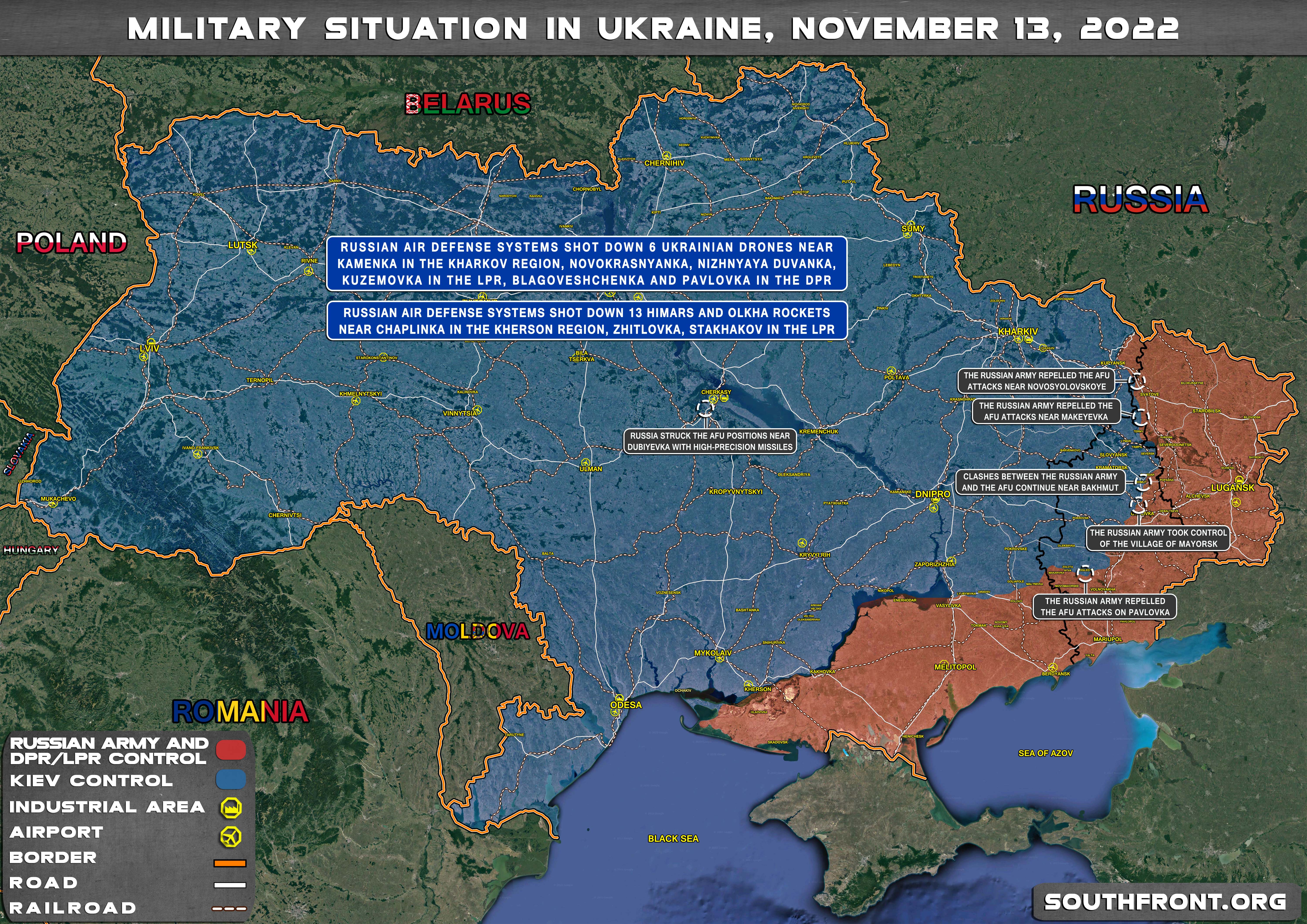
IZIUM AXIS /1715 UTC 13 NOV/ Despite piecemeal RU attacks along the line of contact, UKR forces have advanced to within 2 Km of the P-66 HWY east of Karmazynivka. UKR Partisans and SOF continue to identify lucrative targets deep in the occupied zone.
-
14-11-2022, 10:21 AM #10258Thailand Expat
- Join Date
- Feb 2006
- Last Online
- @
- Posts
- 40,667
-
14-11-2022, 10:22 AM #10259Thailand Expat
- Join Date
- Feb 2006
- Last Online
- @
- Posts
- 40,667
-
14-11-2022, 10:26 AM #10260Elite Mumbler

- Join Date
- Apr 2008
- Last Online
- @
- Location
- Isolation
- Posts
- 8,845
^
If the US was actually fighting in this war it would already be over.
-
14-11-2022, 10:38 AM #10261Thailand Expat
- Join Date
- Sep 2009
- Last Online
- @
- Posts
- 108,187
Ah it's just the fat slapper sabang has pictures of on his bedroom ceiling. Nothing to be taken seriously. Originally Posted by pickel
-
14-11-2022, 10:39 AM #10262Thailand Expat
- Join Date
- Sep 2009
- Last Online
- @
- Posts
- 108,187
Poor old Vlad, he's such a sensitive soul....
Putin to 'strip passports from citizens who criticise Ukraine war'
Vladimir Putin has proposed changes to a bill that would allow the Kremlin to strip passports from non-birth citizens who criticise the Ukraine war, according to reports.
The amendments, which come after Russian troops withdrew from the key city of Kherson, will reportedly target Ukrainians who acquired Russian passports during Moscow's occupation, the Kyiv Independent reports, citing the independent news agency Meduza.
The actions that will be considered a crime are "discrediting the Russian army", "spreading fake news" and "participation in the activities of an undesirable organisation".
Kremlin officials have repeatedly said that false information has been spread by Russia's enemies such as the US and its Western allies in an attempt to sow discord among the Russian people.
Earlier this year, the Russian parliament brought in laws that criminalised protesting the Ukraine war and "discrediting" Russia's army.
Those who defied the rules were told they could face up to 15 years in prison.
Ukraine war latest - 'More than 400 war crimes' committed in Kherson; Putin to 'strip passports from war critics' | World News | Sky News
-
14-11-2022, 11:22 AM #10263Thailand Expat

- Join Date
- Mar 2007
- Last Online
- 21-10-2023 @ 08:08 AM
- Location
- Way, Way South of the border now - thank God!
- Posts
- 33,190
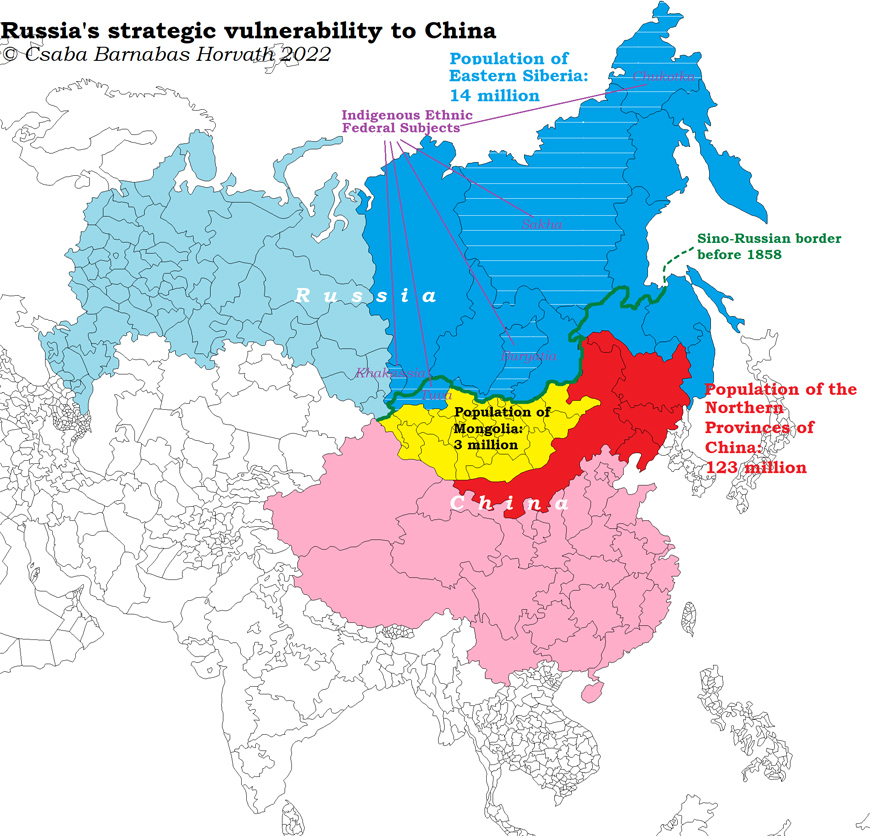
Sometimes pictures are better than words Originally Posted by harrybarracuda


-
14-11-2022, 11:34 AM #10264Heading down to Dino's
- Join Date
- Jun 2009
- Last Online
- @
- Posts
- 35,425
BAKHMUT: 2330 UTC 13 NOC/ RU's piecemeal assaults on Bakhmut have resulted in high casualties and limited gains. The terrain in the vicinity of the urban area greatly favors UKR defenders. UKR artillery, firing from covered positions, continues to break up RU attacks.
-
14-11-2022, 01:11 PM #10265Thailand Expat

- Join Date
- Mar 2006
- Last Online
- 01-04-2026 @ 01:05 AM
- Location
- Germany/Satthahip
- Posts
- 7,279
Sabong is a Troll! Originally Posted by pickel
Nobody can be that stupid.
-
14-11-2022, 01:42 PM #10266Thailand Expat
- Join Date
- Mar 2006
- Last Online
- 01-04-2026 @ 01:05 AM
- Location
- Germany/Satthahip
- Posts
- 7,279
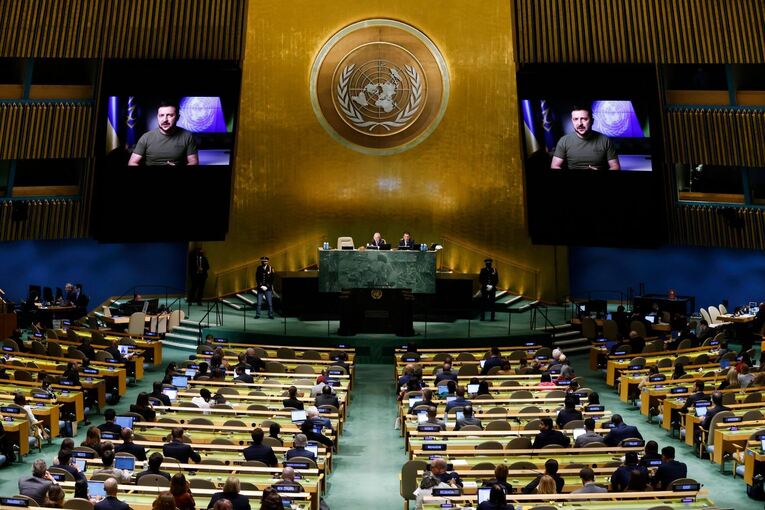
Just open your eyes my little "I always get it wrong imbecile". Originally Posted by sabang


Last edited by HermantheGerman; 14-11-2022 at 01:47 PM.
-
14-11-2022, 01:44 PM #10267Thailand Expat
- Join Date
- Mar 2006
- Last Online
- 01-04-2026 @ 01:05 AM
- Location
- Germany/Satthahip
- Posts
- 7,279
By the way....where is Putler?
-
14-11-2022, 01:52 PM #10268Thailand Expat
- Join Date
- Feb 2006
- Last Online
- @
- Posts
- 40,667
Jeffrey Sachs: “Dangerous” U.S. Policy & “West’s False Narrative” Stoking Tensions with Russia, China
JEFFREY SACHS: The main point, Amy, is that we are not using diplomacy; we are using weaponry. This sale now announced to Taiwan that you’ve been discussing this morning is just another case in point. This does not make Taiwan safer. This does not make the world safer. It certainly doesn’t make the United States safer.
This goes back a long way. I think it’s useful to start 30 years ago. The Soviet Union ended, and some American leaders got it into their head that there was now what they called the unipolar world, that the U.S. was the sole superpower, and we could run the show. The results have been disastrous. We have had now three decades of militarization of American foreign policy. A new database that Tufts is maintaining has just shown that there have been more than 100 military interventions by the United States since 1991. It’s really unbelievable.
And I have seen, in my own experience over the last 30 years working extensively in Russia, in Central Europe, in China and in other parts of the world, how the U.S. approach is a military-first, and often a military-only, approach. We arm who we want. We call for NATO enlargement, no matter what other countries say may be harmful to their security interests. We brush aside anyone else’s security interests. And when they complain, we ship more armaments to our allies in that region. We go to war when we want, where we want, whether it was Afghanistan or Iraq or the covert war against Assad in Syria, which is even today not properly understood by the American people, or the war in Libya. And we say, “We’re peace-loving. What’s wrong with Russia and China? They are so warlike. They’re out to undermine the world.” And we end up in terrible confrontations.
The war in Ukraine — just to finish the introductory view — could have been avoided and should have been avoided through diplomacy. What President Putin of Russia was saying for years was “Do not expand NATO into the Black Sea, not to Ukraine, much less to Georgia,” which if people look on the map, straight across to the eastern edge of the Black Sea. Russia said, “This will surround us. This will jeopardize our security. Let us have diplomacy.” The United States rejected all diplomacy. I tried to contact the White House at the end of 2021 — in fact, I did contact the White House and said there will be war unless the U.S. enters diplomatic talks with President Putin over this question of NATO enlargement. I was told the U.S. will never do that. That is off the table. And it was off the table. Now we have a war that’s extraordinarily dangerous.
And we are taking exactly the same tactics in East Asia that led to the war in Ukraine. We’re organizing alliances, building up weaponry, trash-talking China, having Speaker Pelosi fly to Taiwan, when the Chinese government said, “Please, lower the temperature, lower the tensions.” We say, “No, we do what we want,” and now send more arms. This is a recipe for yet another war. And to my mind, it’s terrifying.
We are at the 60th anniversary of the Cuban missile crisis, which I’ve studied all my life and I’ve written about, have written a book about the aftermath. We are driving to the precipice, and we are filled with our enthusiasm as we do so. And it’s just unaccountably dangerous and wrongheaded, the whole approach of U.S. foreign policy. And it’s bipartisan.
JUAN GONZÁLEZ: Jeffrey Sachs, I wanted to ask you — one of the things that you mentioned in a recent article that was published in Consortium News was this insistence of the United States, dragging Europe along, as well, in maintaining hegemony throughout the world at a time when the economic power of the West is declining. You mention, for instance, that the BRICS nations — Brazil, Russia, India, China and South Africa — represent more than 40% of the world population and have a greater GDP than the G7 nations, yet their interests and their concerns are pretty much dismissed or, in the case, obviously, of Russia and China, portrayed to the American people as the aggressors, as the authoritarians, as the ones that are creating turmoil in the world.
JEFFREY SACHS: Your point is —
JUAN GONZÁLEZ: I’m wondering if you could expand on that.
JEFFREY SACHS: Yeah, absolutely, and directing us to that is extremely important. The disproportionate power of the Western world, and especially the Anglo-Saxon world, which started with the British Empire, and now the United States, is about 250 years old, so a short period in world history. It happened, for a lot of very interesting reasons, that the Industrial Revolution came to England first. The steam engine was invented there. That’s probably the single most important invention of modern history. Britain became militarily dominant in the 19th century, like the United States was in the second half of the 20th century. Britain ran the show. Britain had the empire on which the sun never set. And the West, meaning the United States and Western Europe, now meaning the U.S. and the European Union, the U.K., Canada, Japan — in other words, the G7, the European Union together — is a small part of the world population, perhaps now roughly 10%, a little bit more, maybe 12.5% if you add in Japan to Western Europe and the U.S. But the mindset is “We run the world.” And that was the way it was for 200 years in this Industrial Age.
But times have changed. And really, since the 1950s, the rest of the world, when it gained independence from European imperialism, started to educate its populations, started to adopt and adapt and innovate technologies. And lo and behold, a small sliver of the world really didn’t run the world or didn’t have a monopoly on wisdom or knowledge or science or technology. And this is wonderful. The knowledge and possibility of decent lives is spreading throughout the whole world.
But in the United States, there is a resentment to this, a deep resentment. I think there’s also a tremendous historical ignorance, because I think a lot of U.S. leaders have no clue as to modern history. But they resent China’s rise. That is an affront to the United States. How dare China rise! This is our world! This is our century! And so, starting around 2014, I saw, step by step — I watched it with intense detail, because it’s my daily activity — how the United States recast China not as a country that was recovering from a century and a half of great difficulty, but rather as an enemy. And we consciously, as a matter of American foreign policy, started to say, “We need to contain China. China’s rise is no longer in our interest,” as if the United States is to determine whether China is prosperous or not. The Chinese are not naive; in fact, they’re extraordinarily sophisticated. They watched all of this exactly the same way that I did. I know the authors of the U.S. texts. They are my colleagues, at Harvard or other places. I was shocked when this kind of containment idea started to be applied.
But the basic point is, the West has led the world for a brief period, 250 years, but feel, “That’s our right. This is a Western world. We are the G7. We get to determine who writes the rules of the game.” Indeed, Obama, you know, a good guy on the spectrum of what we have in foreign policy, said, “Let’s write the rules of trade for Asia, but not have China write any of those rules. The U.S. will write the rules.” This is an incredibly naive and dangerous and outmoded way to understand the world. We in the United States are 4.2% of the world’s population. We do not run the world. We are not world leader. We are a country of 4.2% of the people in a big, diverse world, and we should learn to get along, play in the sandbox peacefully, not demand that we have all the toys in the sandbox. And we’re not over that thinking yet. And unfortunately, it’s both political parties. It’s what motivates Speaker Pelosi to go to Taiwan in the middle of all of this, as if she really had to go to stir up the tensions. But it’s the mindset that the U.S. is in charge.
JUAN GONZÁLEZ: I wanted to go back a little bit to — back into the 1990s. You recall, I’m sure, the enormous financial collapse that occurred in Mexico in the 1990s, where the Clinton administration authorized $50 billion in a bailout to Mexico, which was really to Wall Street investors. At the time, you were advising the post-Soviet Russian government, which also had a financial — had deep financial problems at the time but was unable to get any significant Western assistance, even from the International Monetary Fund. And you were critical of that at the time. I’m wondering if you could talk about the differences how the U.S. responded to the Mexico crisis versus the Russian financial crisis, and what the roots of that may have been in what the current situation is in Russia today.
JEFFREY SACHS: Absolutely. And I had a controlled experiment, because I was economic adviser both to Poland and to the Soviet Union in the last year of President Gorbachev and to President Yeltsin in the first two years of Russian independence, 1992, ’93. My job was finance, to actually help Russia find a way to address, as you described it, a massive financial crisis. And my basic recommendation in Poland, and then in Soviet Union and in Russia, was: To avoid a societal crisis and a geopolitical crisis, the rich Western world should help to tamp down this extraordinary financial crisis that was taking place with the breakdown of the former Soviet Union.
Well, interestingly, in the case of Poland, I made a series of very specific recommendations, and they were all accepted by the U.S. government — creating a stabilization fund, canceling part of Poland’s debts, allowing many financial maneuvers to get Poland out of the difficulty. And, you know, I patted myself on the back. “Oh, look at this!” I make a recommendation, and one of them, for a billion dollars, stabilization fund, was accepted within eight hours by the White House. So, I thought, “Pretty good.”
Then came the analogous appeal on behalf of, first, Gorbachev, in the final days, and then President Yeltsin. Everything I recommended, which was on the same basis of economic dynamics, was rejected flat out by the White House. I didn’t understand it, I have to tell you, at the time. I said, “But it worked in Poland.” And they’d stare at me blankly. In fact, an acting secretary of state in 1992 said, “Professor Sachs, it doesn’t even matter whether I agree with you or not. It’s not going to happen.”
And it took me, actually, quite a while to understand the underlying geopolitics. Those were exactly the days of Cheney and Wolfowitz and Rumsfeld and what became the Project for the New American Century, meaning for the continuation of American hegemony. I didn’t see it at the moment, because I was thinking as an economist, how to help overcome a financial crisis. But the unipolar politics was taking shape, and it was devastating. Of course, it left Russia in a massive financial crisis that led to a lot of instability that had its own implications for years to come.
But even more than that, what these people were planning, early on, despite explicit promises to Gorbachev and Yeltsin, was the expansion of NATO. And Clinton started the expansion of NATO with the three countries of Central Europe — Poland, Hungary and Czech Republic — and then George W. Bush Jr. added seven countries — Bulgaria, Romania, Slovakia, Slovenia and the three Baltic states — but right up against Russia. And then, in 2008, the coup de grâce, which was the U.S. insistence, over the private opposition of the European leaders — and European leaders talked to me privately about it at the time. But in 2008, Bush said NATO will expand to Ukraine and to Georgia. And again, if you take out a map and look at the Black Sea, the explicit goal was to surround Russia in the Black Sea. By the way, it’s an old playbook. It’s the same playbook as Palmerston in 1853 to 1856 in the first Crimean War: surround Russia in the Black Sea, cut off its ability to have a military presence and to project any kind of influence into the eastern Mediterranean. Brzezinski himself said in 1997 that Ukraine would be the geographic pivot for Eurasia.
So, what these neocons were doing in the early 1990s was building the U.S. unipolar world. And they were already contemplating lots of wars in order to take out the former Soviet-allied countries — wars to overthrow Saddam, wars to overthrow Assad, wars to overthrow Gaddafi. Those were all rolled out in the next 20 years. They’ve been a complete disaster, debacle for those countries, horrible for the United States, trillions of dollars wasted. But it was a plan. And that neoconservative plan is in its heyday right now on two fronts: in the Ukraine front and on the Taiwan Strait front. And it’s extraordinarily dangerous, what these people are doing to American foreign policy, which hardly is, you know, a policy of democracy. It’s a policy of a small group that has the idea that a unipolar world and U.S. hegemony is the way that we need to go.
AMY GOODMAN: Jeffrey Sachs, we don’t have much time, but since this was such a big issue — Naomi Klein took you on big time with The Shock Doctrine, talking about you recommending shock therapy. Can you draw a line between what happened as the Russian economy unraveled to the conditions leading up to the Ukraine invasion? I mean, how did the economic catastrophe that followed the collapse of the Soviet Union lead to the rise of the oligarchic class and, indeed, the presidency of Vladimir Putin?
JEFFREY SACHS: Yeah, I’ve tried to explain to Naomi, whom I admire a great deal, for years that what I was recommending was financial help to — whether it was Poland or to the Soviet Union or to Russia. I was absolutely aghast at the cheating and the corruption and the giveaways. And I said so very explicitly at the time and resigned over it, both because I was useless in trying to get Western help and also because I did not like at all what was going on.
And I would say that the failure of an orderly approach, which was achieved in Poland but failed in the former Soviet Union because there was no Western constructive engagement, definitely played a role in the instability in the 1990s, definitely played a role in the rise of the oligarch class. In fact, I was absolutely explaining to the U.S. and to the IMF and the World Bank in 1994, '95, what was going on. They didn't care, because they thought, “Well, that’s OK. That’s for Yeltsin, perhaps,” all of that cheating in the shares-for-loans process. Having said all of that, it was a —
AMY GOODMAN: We have less than a minute.
JEFFREY SACHS: OK. Having said all of that, I think what is important to say is that there is no linear determinism, even from events like that, which were destabilizing and very unhappy and unnecessary, to what is happening now, because when President Putin came in, he was not anti-European, he was not anti-American. What he saw, though, was the incredible arrogance of the United States, the expansion of NATO, the wars in Iraq, the covert war in Syria, the war in Libya, against the U.N. resolution. So, we created so much of what we’re facing right now through our own ineptitude and arrogance. There was no linear determination. It was step-by-step U.S. arrogance that has helped to bring us to where we are today.
AMY GOODMAN: Jeffrey Sachs, economist and director of the Center for Sustainable Development at Columbia University, president of the U.N. Sustainable Development Solutions Network, has served as adviser to three U.N. secretaries-general. I want to thank you so much for being with us, joining us from Austria, where he’s attending a conference.
Coming up, we will look at — we will talk to a reporter who’s documented how, over the last year, the U.S. has approved just 123 Afghan humanitarian parole applications. Compare that to 68,000 approved applications from Ukrainians in recent months. Stay with us.
Jeffrey Sachs: “Dangerous” U.S. Policy & “West’s False Narrative” Stoking Tensions with Russia, China | Democracy Now!
-
14-11-2022, 02:49 PM #10269Thailand Expat
- Join Date
- Sep 2009
- Last Online
- @
- Posts
- 108,187
Typical of the bonehead to respond with pages more of nonsensical bullshit that fit his desperate search for propaganda.
Bonehead still doesn't understand that the reason NATO is expanding is that countries don't want to be invaded by the Russian war criminal.
Bonehead is as thick as shit.The next post may be brought to you by my little bitch Spamdreth
-
14-11-2022, 03:42 PM #10270Heading down to Dino's
- Join Date
- Jun 2009
- Last Online
- @
- Posts
- 35,425
Jeffrey Sachs: Xi Propagandist?
He is, and he is just rolling out his clown car of bozos again. Jeffery Sachs is a fucking wack job... Originally Posted by harrybarracuda
Sachs has repeated COVID-19 disinformation by China by stating publicly that COVID-19 came out of "US lab biotechnology". While Sachs has leanings toward the possibility of a virus leak from a "U.S.-backed laboratory research program", he has stated "A natural spillover is also possible, of course. Both hypotheses are viable at this stage".[50]
In August 2022 Sachs appeared on the podcast of anti-vaccine conspiracy theorist Robert F. Kennedy Jr. where he accused officials like Anthony Fauci of "not being honest” about the origins of COVID.[51] He received criticism for comparing vaccine mandates to the Holocaust on the podcast.[52]
Sachs was the chair of The Lancet 's COVID-19 Commission.[53][54] In September 2022 a panel assembled by The Lancet published a wide-ranging report on the pandemic, including commentary on the virus origin overseen by Sachs. This suggested that the virus may have originated from an American laboratory, a notion long supported by Sachs. Reacting to this, virologist Angela Rasmussen commented that this may have been "one of The Lancet's most shameful moments regarding its role as a steward and leader in communicating crucial findings about science and medicine".[55] Virologist David Robertson said the suggestion of US laboratory involvement was "wild speculation" and that "it's really disappointing to see such a potentially influential report contributing to further misinformation on such an important topic".[55]
It is always a special moment in the lives of public intellectuals when mighty men on the world stage start parroting the edifice of thoughts which that intellectual helped shape over recent decades.During a January 2021 interview, despite the interviewer's repeated prompting, Sachs evaded questions about China's repression of Uyghur people and resorted to whataboutism by alluding to "huge human rights abuses committed by the U.S."[67] Subsequently, 19 advocacy and rights groups jointly wrote a letter to Columbia University questioning Sachs' comments.[67][68] The letter's signatories wrote that Sachs took the same stance as China's Ministry of Foreign Affairs, and that he invoked the history of U.S. human rights violations as a way to avoid discussions of China's mistreatment of Uyghurs. The rights groups went on to say that Sachs "betrayed his institution's mission" by trivializing the perspective of those who were oppressed by the Chinese government.
Such is the case right now with Jeffrey Sachs, the director of Columbia University’s Center for Sustainable Development.
When Xi channels Sachs
In his books and articles, Jeff Sachs has done much to frame and popularize the language and thinking to push a sustainable development agenda on the world stage. That is an achievement in which he can rightfully take considerable pride.
But that should not mean turning oneself effectively into a China — or rather: Xi Jinping — propagandist.
Sadly, based on a very explicit recent opinion article, titled “Why the US Should Pursue Cooperation with China,” one cannot arrive at any other conclusion. After all, time and again Jeff Sachs takes Xi’s pronouncements at face value.
Doing PR for China’s President for life
For evidence of his PR campaign for China’s President for life, consider this statement: “China’s goal is neither to prove that autocracy outperforms democracy…” An eyeroll conducted in utter disbelief is the most benign of reactions this conjures up.
But Sachs is just getting started. Soon after, he quotes Mr. Xi directly with his call on the global community “to abandon ideological prejudice and jointly follow a path of peaceful coexistence, mutual benefit and win-win cooperation.”
Viewed in purely rhetorical terms, that is a certainly a statement to be welcomed. But any public intellectual worth his salt would also explore the veracity of such a noble pronouncement by the speaker.
Xi’s hollow rhetoric
Given that Mr. Sachs has longstanding competence and experience in international debt issues, the dubious nature of Mr. Xi’s pronouncement must have been obvious to him.
Jeff Sachs goes on quoting President Xi right thereafter, this time with Xi’s call to “close the divide between developed and developing countries and jointly bring about growth and prosperity for all.”
Once again, as such that would obviously be a good thing. However, the extremely one-handed way in which China applies this presidential pie-in-the-sky rhetoric in the real world cannot possibly have escaped Mr. Sachs.
And yet, he stays completely mum on testing the veracity of this Xi pronouncement on this point as well.
Wanted: Global realism, not subservience
One does not need to be a hardliner on China, just a global realist, to see that there is a vast gap between Xi’s rhetoric and reality.
Moreover, this is a gap that definitely warrants further explanations from the Chinese side. But on the issue of holding the Beijing govern¬ment accountable for actually delivering on its words, Mr. Sachs remains mum yet again.
Now, in the broader framework of global politics, no reasonable person can dispute Mr. Sachs’s statement that we “need shared global stewardship by all parts of the world.”
Blocking Biden
But to present all those Xi Jinping pronouncements as an argument to question the wisdom of Joe Biden taking a tough line on China misses the mark of an even remotely balanced analysis.
What’s worse, for all his devotion to “Xi Speak,” Mr. Sachs does not even attempt to explore the motives of the Biden administration’s reasoning. He essentially dismisses it with the same strictness the world expects out of the mouths of the spokespeople at China’s Ministry of Foreign Affairs.
China committed to openness and inclusiveness?
Instead, Sachs offers this true blooper and we quote: “Xi stated that the path to global cooperation requires remaining ‘committed to openness and inclusiveness,’ as well as ‘to international law and international rules’ and ‘to consultation and cooperation.’
Inserting that claim into an oped without any mention of Hong Kong, Xinjiang or Taiwan, to name but a few, is stunning.
Indeed, Sachs’s stance toward Xi is reminiscent of the duplicitous support that former German Chancellor Gerhard Schröder steadfastly offers his bosom buddy Vladimir Putin on the North Stream 2 pipeline.
From Yeltsin to Xi
Taking Xi at face value brings to mind the earlier, enthusiastic support of Boris Yeltsin in the 1990s by a young American economics professor who served at the time as an economic advisor in Moscow.
That man was none other than Jeff Sachs. Enthusiasm, whether then or now, should never result in abandoning one’s critical faculties. That remains true even if Xi Jinping himself is paying lip service to Jeff Sachs’s storylines.
Love China, then deal with racism at home?
The ultimate conceit, however, comes at the very end of Sachs’s Xi hagiography when he writes these words: “With reduced global tensions, Biden could direct the administration’s efforts toward overcoming the inequality, racism and distrust that put Trump in power in 2016 and still dangerously divide American society.”
At first flush, that reads like a plausible suggestion — until one understands that Mr. Sachs is not only falling for, but actively agitating(!) for a classic Communist propaganda ploy.
False equivalency
His “argument” sets up a false equivalency. The suggestion Sachs makes at least implicitly is that overcoming inequality and racism in the United States — both urgent priorities for any Democratic President — should be regarded as to be undertaken only upon reducing global tensions, and thus as a time-sequenced policy activity.
That is ludicrous. In fact, it smacks of alluring Soviet suggestions in the 1960s to leave them a free hand in Cuba, so that the United States could fully focus on dealing with its domestic racial tensions at the time.
https://www.theglobalist.com/jeffrey...es-propaganda/
-
14-11-2022, 05:09 PM #10271Thailand Expat
- Join Date
- Aug 2011
- Last Online
- @
- Location
- Fuente del Berro
- Posts
- 27,925
DW TV reports Sergei Lavrov Russian exterior minister has had head a heart attack at G20 in Indonesia.
Perhaps he was shocked by a free press?
-
14-11-2022, 05:31 PM #10272Thailand Expat

- Join Date
- Dec 2009
- Last Online
- @
- Location
- Chiang Mai
- Posts
- 57,171
Russia's Lavrov dismisses AP report that he was taken to hospital at G20
NUSA DUA, Indonesia (Reuters) - Russian Foreign Minister Sergei Lavrov on Monday dismissed an Associated Press report that he had been taken to hospital with a heart condition, scolding Western journalists for what he cast as false reporting.
Associated Press, citing Indonesian officials, said that Lavrov had been taken to hospital after arriving on the island of Bali for a Group of 20 summit. AP said Lavrov, 72, had been treated for a heart condition.
"This, of course, is the height of fakery," Foreign Ministry spokeswoman Maria Zakharova said.
Zakharova posted a video of Lavrov, President Vladimir Putin's foreign minister since 2004, sitting outdoors on a patio, dressed in shorts and a T-shirt and reading documents.
Asked about the report, Lavrov said Western journalists had been writing falsely for a decade that Putin, 70, was ill.
"This is a kind of game that is not new in politics," Lavrov said with an ironic smile. "Western journalists need to be more truthful - they need to write the truth."
Lavrov said Western media routinely took a partial view of events and ignored Russia's point of view.
Bali Governor I Wayan Koster told Reuters that Lavrov had breifly visited Sanglah Hospital in Bali for a "check-up" but that the minister was in good health.
"He was in good health and after the check-up he immediately left," the governor said.
Russia's Lavrov dismisses AP report that he was taken to hospital at G20
-
14-11-2022, 06:34 PM #10273Thailand Expat
- Join Date
- Aug 2011
- Last Online
- @
- Location
- Fuente del Berro
- Posts
- 27,925
MUST BE REALLY HARD TO BOOK A CHECK UP IN MOSCOW AS NUMBER 2 IN THE REGIME IF YOU HAVE TO QUEUE WITH THE SWITCHERS DOWN KUTA CLAP CLINIC. Originally Posted by misskit

-
14-11-2022, 06:54 PM #10274Days Work Done!

- Join Date
- Oct 2007
- Last Online
- Today @ 04:02 AM
- Location
- Roiet
- Posts
- 36,064
Bottom line is Lavrov and all Russians in the party in Bali know damn well they will face a major diplomatic ass kicking if the show up in the meetings. Expect some from China as well. Putin nowhere in sight and likely not to be seen on vid conference either.
Russia (Putin) has well and truely cooked their own goose with the ill thought out invasion of the Ukraine and things are going to go from bad to worse before this is over.
In a few years they won't have to worry about attending the G20 club meeting. "Whenever you find yourself on the side of the majority, it is time to pause and reflect,"
-
14-11-2022, 08:54 PM #10275Thailand Expat
- Join Date
- Sep 2009
- Last Online
- @
- Posts
- 108,187
Originally Posted by misskit
Great news, would be hilarious if he popped his clogs at a G20, especially with the coward not there.
No-one would shed a tear expect perhaps the people with their hands in his pockets.


 Reply With Quote
Thread Information
Users Browsing this Thread
There are currently 3 users browsing this thread. (0 members and 3 guests)
