

Originally Posted by OhOh


Results 8,076 to 8,100 of 15707
Thread: Ukraine war mega thread
-
26-08-2022, 01:10 AM #8076Thailand Expat



- Join Date
- Jan 2010
- Last Online
- @
- Posts
- 32,868
-
26-08-2022, 01:54 AM #8077Thailand Expat
- Join Date
- Jan 2010
- Last Online
- @
- Posts
- 32,868
Oh ang on this one is good too
have you tried to get a flight to Donbas lately
https://www.theguardian.com/politics/2022/aug/25/keir-starmer-planning-ukraine-trip-kyiv-zelenskiy-labour
Keir Starmer is planning a trip to Ukraine in the late autumn as he moves to cement his relations with the Kyiv government as it continues its fight against Russia.
The Labour leader approached the government of Volodymyr Zelenskiy this summer about the possibility of a visit as opposition leader, with the Labour party writing a letter seen by the Guardian. It affirms Starmer’s support for Ukraine in its struggle against Russia and proposes he travels to Kyiv and holds talks with Zelenskiy.
-
26-08-2022, 06:01 AM #8078Days Work Done!

- Join Date
- Oct 2007
- Last Online
- Today @ 06:41 AM
- Location
- Roiet
- Posts
- 36,058
Really? And here I was led to believe Russia invaded the Ukraine in 2014 and again in 2022. Originally Posted by sabang
-
26-08-2022, 06:15 AM #8079Thailand Expat

- Join Date
- Feb 2006
- Last Online
- @
- Posts
- 40,667
Former Soviet Union norts. If we ignore that intellectual sleight of hand, I suppose you can add Georgia to that list too.
-
26-08-2022, 06:41 AM #8080Days Work Done!
- Join Date
- Oct 2007
- Last Online
- Today @ 06:41 AM
- Location
- Roiet
- Posts
- 36,058
That would depend on the meaning of "beyond". I took it as meaning "after" which we all know was the case in Syria.
-
26-08-2022, 06:48 AM #8081Thailand Expat
- Join Date
- Feb 2006
- Last Online
- @
- Posts
- 40,667
It Seems Ukraine Is Struggling To Form Tank Brigades
The Ukrainian army’s tank brigades are spread thin. That could help to explain why the army’s highly anticipated counteroffensive in southern Ukraine hasn’t yet picked up much momentum.
It seems likely manpower, rather than hardware, is the main reason the Ukrainians haven’t stood up more armored units.
It’s not totally clear exactly how many tank brigades the army has. Maybe six. Maybe five. Maybe fewer. The Ukrainian army has a habit of keeping undermanned—practically non-existent—units on paper and occasionally touting them in the media.
So observers should look for hard evidence of a brigade in combat before concluding that brigade is real. By that standard the 1st, 3rd, 4th and 17th Tank Brigades definitely exist.
The 5th and 14th Tank Brigades, by contrast ... might be mostly fictional.
Tank brigades are the hard core of any mechanized army. Artillery shapes the battlefield. Infantry hold terrain. But tanks—with their speed, mobility, firepower and protection—close with and destroy the enemy, and allow an army to seize ground.
A Ukrainian tank brigade might have three or four battalions with, between them, a hundred or so tanks and several thousand troops.
The 1st Tank Brigade, arguably Ukraine’s best armored formation with its upgraded T-64 tanks, defended Chernihiv, east of Kyiv, early in Russia’s wider war on Ukraine that began in late February. It was a costly battle for the storied brigade.
When the Russian army retreated from the Kyiv suburbs in late March and the fighting shifted east to the Donbas region, the 1st Tank Brigade pulled back from the front for an extended period of rest and refit. Three months later the brigade reappeared in southern Ukraine near Zaporizhzhia.
The 3rd Tank Brigade, a reserve unit with T-72s, fought in Donbas. Today it’s holding the line around Kharkiv, Ukraine’s most vulnerable major city, just 25 miles from the Russian border. The reserve 4th Tank Brigade with its T-64s also fought in Donbas—and apparently still is out east.
The T-64-equipped 17th Tank Brigade might be the most important right now. It’s helping to hold a bridgehead across the Inhulets River 30 miles northeast of Russian-occupied Kherson in southern Ukraine.
Liberating Kherson with its strategic port and pre-war population of 300,000 might be Kyiv’s top priority. Holding it might be Moscow’s top priority. The Russian 49th Combined Arms Army oversees a growing force—currently as many as 30 battalions—that’s digging in around Kherson and might even attempt a countercounteroffensive.
Whether the Ukrainians march south from the Inhulets or the Russians march north toward the river, the 17th Tank Brigade could bear the brunt of the fighting.
That’s four tank brigades that we can confirm. The ones we can’t confirm are the 5th and 14th. The 5th Tank Brigade, ostensibly a reserve unit with T-72s, was part of the garrison defending Odesa, Ukraine’s main Black Sea port, from a possible Russian amphibious attack.
That attack never came. And as the Ukrainians have acquired more and more anti-ship missiles, the chance of the Russians ever attacking Odesa from the sea seems to have declined nearly to zero. It would make sense, then, for the 5th Tank Brigade to quit Odesa and join the fight around the Inhulets and Kherson.
Indeed, some analysts place the brigade around Krivyi Rih, safely inside Ukrainian lines north of the southern front. But there’s so little hard evidence of the 5th Tank Brigade marching or fighting that it’s possible the brigade is either seriously under-equipped and under-manned ... or exists mostly on paper.
You could say the same of the reserve 14th Tank Brigade with its T-64s—another unit that may have disappeared from the Ukrainian order of battle.
It seems trained manpower, rather than a shortage of battle-ready tanks, is the major factor in Ukraine’s apparent struggle to field a larger armored force. The Ukrainian army had around 900 tanks—T-64s, mostly—in its arsenal on day one of the war. More than enough for four, five or even six tank brigades plus tank battalions in infantry brigades.
In five months of hard fighting the Ukrainians have lost around 230 tanks that analysts can confirm. But they’ve captured 280 Russian tanks and also have acquired around 300 fresh tanks from foreign allies.
Of course, it’s likely many tanks have sustained damage and await repair. Even so, Ukraine in theory has more tanks now than it did before the war.
But a tank without a trained crew is just a lump of metal and rubber. Thousands, perhaps tens of thousands, of Ukraine’s best soldiers have been killed or wounded since Russia attacked in late February. Their skills and experience aren’t easy to replace.
https://www.forbes.com/sites/davidax...h=6ab1c52c669a
-
26-08-2022, 06:57 AM #8082Days Work Done!
- Join Date
- Oct 2007
- Last Online
- Today @ 06:41 AM
- Location
- Roiet
- Posts
- 36,058
It's a war so yes troops die and equipment is destroyed. Replace the word "Ukraine" with "Russia" in the above and it would also be the case.
-
26-08-2022, 07:40 AM #8083Thailand Expat
- Join Date
- Feb 2006
- Last Online
- @
- Posts
- 40,667
What about them 'ghost battalions'. Bit dodgy this bunch.
 I don't typically bother much with war porn, but Forbes is a pretty sober source.
-
26-08-2022, 07:52 AM #8084Heading down to Dino's

- Join Date
- Jun 2009
- Last Online
- @
- Posts
- 35,408
Without question. Russian forces are completely depleted at this point, and the evidence is plain to see in that they are not advancing anymore for the most part. What is going on now that is so important to notate is that Ukraine continues to degrade Russian forces through relentless use of HIMARS destroying command and control as well as ammo dumps, even taking the war into Crimea. Every day this war goes on, Russia's army gets weaker and weaker. I should also add that now, Ukraine is also using HARM anti-radiation missiles to destroy Russian air defenses. Originally Posted by Norton
Rommel used them to great effect in WW2 and completely fooled the Brits. They saved his skin, basically. Originally Posted by sabang
-
26-08-2022, 10:01 AM #8085Thailand Expat
- Join Date
- Feb 2006
- Last Online
- @
- Posts
- 40,667
Six months into Ukraine’s collapse, the world has changed forever
The inevitable transfer of power away from the west is leading to a surge in state-sponsored terrorism, but this will do little to reverse the trend
Six months after the start of the Special Military Operation (SMO) by Russia in Ukraine, the geopolitical tectonic plates of the 21st century have been dislocated at astonishing speed and depth – with immense historical repercussions already at hand.
To paraphrase T.S. Eliot, this is the way the (new) world begins, not with a whimper but a bang.
The cold-blooded assassination of Darya Dugina – terrorism at the gates of Moscow – may have fatefully coincided with the six-month intersection point, but will do nothing to change the dynamics of the current, work-in-progress, historical shift.
Russia’s Federal Security Service (FSB) appeared to have cracked the case in a little over 24 hours, designating the perpetrator as a neo-Nazi Azov operative instrumentalized by the Security Service of Ukraine (SBU) – itself a mere tool of the CIA/MI6 combo that de facto rules Kiev.
The Azov operative is just a patsy. The FSB will never reveal in public the intel it has amassed on those that issued the orders, and how they will be dealt with.
One Ilya Ponomaryov, an anti-Kremlin minor character granted Ukrainian citizenship, boasted he was in contact with the outfit that prepared the hit on the Dugin family. No one took him seriously.
What is manifestly serious, however, is how oligarchy-connected organized crime factions in Russia would have a motive to eliminate Alexander Dugin, the Christian Orthodox nationalist philosopher who, according to them, may have influenced the Kremlin’s pivot to Asia (he didn’t).
These organized crime factions blamed Dugin for a concerted Kremlin offensive against the disproportional power of Jewish oligarchs in Russia. So these actors would have both the motive and the local know-how to mount such a coup.
If that’s the case, it potentially spells out a Mossad-linked operation – especially given the serious schism in Moscow’s recent relations with Tel Aviv. What’s certain is that the FSB will keep their cards very close to their chest – and retribution will be swift, precise and invisible.
The straw that broke the camel’s back
Instead of delivering a serious blow to Russia’s psyche that could impact the dynamics of its operations in Ukraine, the assassination of Darya Dugina only exposed the perpetrators as tawdry killers who have exhausted their options.
An IED cannot kill a philosopher – or his daughter. In an essential essay, Dugin himself explained how the real war – Russia against the US-led collective west – is a war of ideas. An existential war.
Dugin correctly defines the US as a “thalassocracy,” heir to “Britannia rules the waves.” Yet now the geopolitical tectonic plates are spelling out a new order: The Return of the Heartland.
Russian President Vladimir Putin himself first spelled it out at the Munich Security Conference in 2007. China’s Xi Jinping put it into action by launching the New Silk Roads in 2013. The Empire struck back with Maidan in 2014. Russia counter-attacked by coming to the aid of Syria in 2015.
The Empire doubled down on Ukraine, with NATO weaponizing it non-stop for eight years. At the end of 2021, Moscow invited Washington for a serious dialogue on “indivisibility of security” in Europe. That was dismissed with a non-response response.
Moscow took no time to assess that a dangerous US-led trifecta was instead in the works: an imminent Kiev blitzkrieg against Donbass; Ukraine flirting with acquiring nuclear weapons; and the work of US bioweapon labs. That was the straw that broke the camel’s back.
A consistent analysis of Putin’s public interventions these past few months reveals that the Kremlin – as well as Security Council Yoda Nikolai Patrushev – fully realize how the politico/media talking heads and shock troops of the collective west are directed by the rulers of Finance Capitalism.
As a direct consequence, they also realize how western public opinion is absolutely clueless, Plato cave-style, totally captive to the ruling financial class, who cannot tolerate any alternative narrative.
So Putin, Patrushev, and their peers will never presume that a senile teleprompter reader in the White House or a cokehead comedian in Kiev “rule” anything.
As the US rules global pop culture, it is fitting to borrow from what Walter White/Heisenberg, an average American channeling his inner bad, states in Breaking Bad: “I’m in the Empire business.” And the Empire business is to exercise raw power, maintained with ruthlessness, by all means necessary.
Russia broke that spell. But Moscow’s strategy is way more sophisticated than leveling Kiev with hypersonic weapons, something that could have been done at any moment, starting six months ago.
Instead, what Moscow is doing is talking to virtually the entire Global South, bilaterally or to groups of actors, explaining how the world-system is changing right before our eyes, with the key actors of the future configured as the Belt and Road Initiative (BRI), Shanghai Cooperation Organization (SCO), Eurasian Economic Union (EAEU), BRICS+, the Greater Eurasia Partnership.
And what we see is vast swathes of the Global South – or 85 percent of the world’s population – slowly but surely becoming ready to engage in expelling the finance capitalists from their national horizons, and ultimately taking them down: a long, tortuous battle that will imply multiple setbacks.
The facts on the ground
On the ground in soon-to-be rump Ukraine, Khinzal hypersonic weapons launched from Tu-22M3 bombers or Mig-31 interceptors will continue to be employed.
Piles of HIMARS will continue to be captured. TOS 1A Heavy Flamethrowers will keep sending invitations to the gates of hell. Crimean Air Defense will continue to intercept all sorts of small drones with IEDs attached. Terrorism by local SBU cells will eventually be smashed.
Using essentially a phenomenal artillery barrage – cheap and mass-produced – Russia will annex Donbass, very valuable in terms of land, natural resources and industrial power. And then on to Nikolaev, Odessa, and Kharkov.
Geoeconomically, Russia can afford to sell its oil with fat discounts to any Global South customer, not to mention strategic partners China and India. Cost of extraction reaches a maximum of $15 per barrel, with a national budget based on $40-45 for a barrel of Urals, whose market value today is almost double that.
A new Russian benchmark is imminent, as well as oil in rubles following the wildly successful gas for rubles scheme.
The assassination of Darya Dugina provoked endless speculation about the Kremlin and the Ministry of Defense finally breaking their discipline. That’s not going to happen. Russian advances along the enormous 1,800-mile battle front are relentless, highly systematic, and deeply invested in a Greater Strategic Picture.
A key vector is whether Russia stands a chance of winning the information war with the west. That will never happen inside NATO’s realm – even as success after success is unfolding across the Global South.
As Glenn Diesen has masterfully demonstrated in his latest book, Russophobia, the collective west is viscerally impervious to admitting any social, cultural, historical merits by Russia.
They have already catapulted themselves into the irrationality stratosphere: the grinding down and de facto demilitarization of the imperial proxy army in Ukraine is driving the Empire’s handlers and its vassals literally nuts.
But the Global South should never lose sight of the ‘Empire business.’ That industry excels in producing chaos and plunder, always supported by extortion, bribery of local elites, and assassinations on the cheap. Every trick in the Divide and Rule book should be expected at any moment. Never underestimate a bitter, wounded, deeply humiliated, declining Empire.
Fasten your seat belts for more of this tense dynamic for the remainder of the decade.
But before that, all along the watchtower, get ready for the arrival of General Winter, whose riders are fast approaching. When the winds begin to howl, Europe will be freezing in the dead of dark nights, lit up occasionally by its finance capitalists puffing on fat cigars.
The straw that broke the camel’s back
Instead of delivering a serious blow to Russia’s psyche that could impact the dynamics of its operations in Ukraine, the assassination of Darya Dugina only exposed the perpetrators as tawdry killers who have exhausted their options.
An IED cannot kill a philosopher – or his daughter. In an essential essay, Dugin himself explained how the real war – Russia against the US-led collective west – is a war of ideas. An existential war.
Dugin correctly defines the US as a “thalassocracy,” heir to “Britannia rules the waves.” Yet now the geopolitical tectonic plates are spelling out a new order: The Return of the Heartland.
Russian President Vladimir Putin himself first spelled it out at the Munich Security Conference in 2007. China’s Xi Jinping put it into action by launching the New Silk Roads in 2013. The Empire struck back with Maidan in 2014. Russia counter-attacked by coming to the aid of Syria in 2015.
The Empire doubled down on Ukraine, with NATO weaponizing it non-stop for eight years. At the end of 2021, Moscow invited Washington for a serious dialogue on “indivisibility of security” in Europe. That was dismissed with a non-response response.
Moscow took no time to assess that a dangerous US-led trifecta was instead in the works: an imminent Kiev blitzkrieg against Donbass; Ukraine flirting with acquiring nuclear weapons; and the work of US bioweapon labs. That was the straw that broke the camel’s back.
A consistent analysis of Putin’s public interventions these past few months reveals that the Kremlin – as well as Security Council Yoda Nikolai Patrushev – fully realize how the politico/media talking heads and shock troops of the collective west are directed by the rulers of Finance Capitalism.
As a direct consequence, they also realize how western public opinion is absolutely clueless, Plato cave-style, totally captive to the ruling financial class, who cannot tolerate any alternative narrative.
So Putin, Patrushev, and their peers will never presume that a senile teleprompter reader in the White House or a cokehead comedian in Kiev “rule” anything.
As the US rules global pop culture, it is fitting to borrow from what Walter White/Heisenberg, an average American channeling his inner bad, states in Breaking Bad: “I’m in the Empire business.” And the Empire business is to exercise raw power, maintained with ruthlessness, by all means necessary.
Russia broke that spell. But Moscow’s strategy is way more sophisticated than leveling Kiev with hypersonic weapons, something that could have been done at any moment, starting six months ago.
Instead, what Moscow is doing is talking to virtually the entire Global South, bilaterally or to groups of actors, explaining how the world-system is changing right before our eyes, with the key actors of the future configured as the Belt and Road Initiative (BRI), Shanghai Cooperation Organization (SCO), Eurasian Economic Union (EAEU), BRICS+, the Greater Eurasia Partnership.
And what we see is vast swathes of the Global South – or 85 percent of the world’s population – slowly but surely becoming ready to engage in expelling the finance capitalists from their national horizons, and ultimately taking them down: a long, tortuous battle that will imply multiple setbacks.
The facts on the ground
On the ground in soon-to-be rump Ukraine, Khinzal hypersonic weapons launched from Tu-22M3 bombers or Mig-31 interceptors will continue to be employed.
Piles of HIMARS will continue to be captured. TOS 1A Heavy Flamethrowers will keep sending invitations to the gates of hell. Crimean Air Defense will continue to intercept all sorts of small drones with IEDs attached. Terrorism by local SBU cells will eventually be smashed.
Using essentially a phenomenal artillery barrage – cheap and mass-produced – Russia will annex Donbass, very valuable in terms of land, natural resources and industrial power. And then on to Nikolaev, Odessa, and Kharkov.
Geoeconomically, Russia can afford to sell its oil with fat discounts to any Global South customer, not to mention strategic partners China and India. Cost of extraction reaches a maximum of $15 per barrel, with a national budget based on $40-45 for a barrel of Urals, whose market value today is almost double that.
A new Russian benchmark is imminent, as well as oil in rubles following the wildly successful gas for rubles scheme.
The assassination of Darya Dugina provoked endless speculation about the Kremlin and the Ministry of Defense finally breaking their discipline. That’s not going to happen. Russian advances along the enormous 1,800-mile battle front are relentless, highly systematic, and deeply invested in a Greater Strategic Picture.
A key vector is whether Russia stands a chance of winning the information war with the west. That will never happen inside NATO’s realm – even as success after success is unfolding across the Global South.
As Glenn Diesen has masterfully demonstrated in his latest book, Russophobia, the collective west is viscerally impervious to admitting any social, cultural, historical merits by Russia.
They have already catapulted themselves into the irrationality stratosphere: the grinding down and de facto demilitarization of the imperial proxy army in Ukraine is driving the Empire’s handlers and its vassals literally nuts.
But the Global South should never lose sight of the ‘Empire business.’ That industry excels in producing chaos and plunder, always supported by extortion, bribery of local elites, and assassinations on the cheap. Every trick in the Divide and Rule book should be expected at any moment. Never underestimate a bitter, wounded, deeply humiliated, declining Empire.
Fasten your seat belts for more of this tense dynamic for the remainder of the decade.
But before that, all along the watchtower, get ready for the arrival of General Winter, whose riders are fast approaching. When the winds begin to howl, Europe will be freezing in the dead of dark nights, lit up occasionally by its finance capitalists puffing on fat cigars.
https://thecradle.co/Article/Columns/14747
Pepe Escobar, in case you were wondering.Last edited by sabang; 26-08-2022 at 10:06 AM.
-
26-08-2022, 11:00 AM #8086Thailand Expat
- Join Date
- Feb 2006
- Last Online
- @
- Posts
- 40,667
Meanwhile-
Europe Quietly Abandoning Ukraine, as for the First Time, No New Military Pledges Have Been Made
The US has announced a new package, but can it bear alone the burden of aiding Kiev?
According to Germany’s Kiel Institute for the World Economy, the six largest European countries gave Kiev no new military pledges last month, this being the first time such a thing has happened since the beginning of the conflict in February. Besides Spain, France, Germany and Italy, not even the UK and Poland have made any new military commitments to Ukraine, which is quite surprising considering they had been such staunch supporters. In any case, European military support had been decreasing since April. It would seem Europe is quietly and silently “abandoning” Kiev.
FULL- Europe Quietly Abandoning Ukraine, as for the First Time, No New Military Pledges Have Been Made - Global ResearchGlobal Research - Centre for Research on Globalization
-
26-08-2022, 11:29 AM #8087Thailand Expat

- Join Date
- Mar 2007
- Last Online
- 21-10-2023 @ 08:08 AM
- Location
- Way, Way South of the border now - thank God!
- Posts
- 33,190
There's always a bright side. Originally Posted by misskit
Yet more bullshit . . . why do you place so much credence in absolute bullshit, backspit . . . err sabang. You have become a complete embarrassment - what a fucking loon you are. The first part in white is what has been delivered, the yellow in what has been and is part of new pledges: Originally Posted by sabang
Militarische Unterstutzungsleistungen fur die Ukraine | BundesregierungMilitärische Unterstützungsleistungen für die Ukraine
Deutschland unterstützt die Ukraine mit Ausrüstungs- und Waffenlieferungen – aus Beständen der Bundeswehr und durch Lieferungen der Industrie, die aus Mitteln der Ertüchtigungshilfe der Bundesregierung finanziert werden. Eine Übersicht.
Gelieferte militärische Unterstützungsleistungen:
(Änderungen im Vergleich zur Vorwoche in fett)
- 54 M113 gepanzerte Truppentransporter mit Bewaffnung (Systeme aus Dänemark, Umrüstung durch Deutschland finanziert)* (zuvor 44)
- 53.000 Schuss Flakpanzermunition (zuvor 49.000)
- 20 Laserzielbeleuchter*
- 15 Flakpanzer GEPARD*
- 403.000 Rationen Einpersonenpackungen (EPa)
- 3.000 Patronen „Panzerfaust 3“ zuzüglich 900 Griffstücke
- 14.900 Panzerabwehrminen
- 500 Fliegerabwehrraketen STINGER
- 2.700 Fliegerfäuste STRELA
- 10 Panzerhaubitzen 2.000 inklusive Anpassung, Ausbildung und Ersatzteile (gemeinsames Projekt mit den Niederlanden)
- 21,8 Millionen Schuss Handwaffenmunition
- 50 Bunkerfäuste
- 100 Maschinengewehre MG3 mit 500 Ersatzrohren und Verschlüssen
- 100.000 Handgranaten
- 5.300 Sprengladungen
- 100.000 Meter Sprengschnur und 100.000 Sprengkapseln
- 350.000 Zünder
- 10.500 Schuss Artilleriemunition 155mm
- 10 Antidrohnenkanonen
- 14 Drohnenabwehrsensoren und -jammer
- 100 Auto-Injektoren
- 28.000 Gefechtshelme
- 15 Paletten Bekleidung
- 280 Kraftfahrzeuge (Lkw, Kleinbusse, Geländewagen)
- 100 Zelte
- 12 Stromerzeuger
- 6 Paletten Material für Kampfmittelbeseitigung
- 125 Doppelfernrohre
- 1.200 Krankenhausbetten
- 18 Paletten Sanitätsmaterial, 60 OP-Leuchten
- Schutzbekleidung, OP-Masken
- 10.000 Schlafsäcke
- 600 Schießbrillen
- 1 Radiofrequenzsystem
- 3.000 Feldfernsprecher mit 5.000 Rollen Feldkabel und Trageausstattung
- 1 Feldlazarett (gemeinsames Projekt mit Estland)
- 353 Nachtsichtbrillen
- 4 elektronische Drohnenabwehrgeräte
- 165 Ferngläser
- Sanitätsmaterial (unter anderem Rucksäcke, Verbandspäckchen)
- 38 Laserentfernungsmesser
- Kraftstoff Diesel und Benzin (laufende Lieferung)*
- 10 Tonnen AdBlue*
- 500 Stück Wundauflagen zur Blutstillung
- MiG-29 Ersatzteile*
- 30 sondergeschützte Fahrzeuge*
- 80 Pick-up*
- 7.944 Panzerabwehrhandwaffen RGW 90 Matador*
- 3 Mehrfachraketenwerfer MARS mit Munition
- 6 Lkw Fahrzeugdekontaminationspunkt HEP 70 inklusive Material zur Dekontaminierung
- 10 Fahrzeuge HMMWV (8x Bodenradarträger, 2x Jammer/Drohnenträger)*
- 3 Bergepanzer 2*
- 7 Störsender*
- 8 elektronische Drohnenabwehrgeräte*
- 4 mobile, ferngesteuerte und geschützte Minenräumgeräte*
- 8 mobile Bodenradare und Wärmebildgeräte*
- 1 Hochfrequenzgerät inkl. Ausstattung*
- 2 Kühlschränke für Sanitätsmaterial
Militärische Unterstützungsleistungen in Vorbereitung/Durchführung:
(Aus Sicherheitserwägungen sieht die Bundesregierung bis zur erfolgten Übergabe von weiteren Details insbesondere zu Modalitäten und Zeitpunkten der Lieferungen ab.)
- Ersatzteile schweres Maschinengewehr M2
- 167.000 Schuss Handwaffenmunition
- 12 Schwerlastsattelzüge M1070 Oshkosh*
- 12 Frequenzscanner/Frequenzjammer*
- Feldlazarett (Rolle 2)*
- 20 Raketenwerfer 70mm auf Pick-up trucks mit 2.000 Raketen*
- 1.592 Schuss Artilleriemunition 155 mm*
- 255 Schuss Vulcano Artilleriemunition 155 mm*
- 60.200 Schuss Munition 40mm*
- 6 Gabelstapler*
- 40 Bandbreitenerweiterungen elektronische Drohnenabwehrgeräte*
- 12 Bergepanzer 2*
- 30 MG3 für Bergepanzer 2
- 4.000 Schuss Flakpanzerübungsmunition
- 10 (+10 als Option) Autonome Überwasserdrohnen*
- 14 Sattelzugmaschinen und 14 Sattelauflieger*
- 2 Zugmaschinen und 4 Auflieger*
- 43 Aufklärungsdrohnen*
- 10 geschützte Kfz*
- 1 Fahrzeugdekontaminationspunkt
- Luftverteidigungssystem IRIS-T SLM*
- Artillerieortungsradar COBRA*
- 100.000 Erste-Hilfe Kits*
- 5.032 Panzerabwehrhandwaffen*
- 200 LKW Nutzfahrzeuge*
- 24 Drohnenabwehrsysteme*
- 16 Brückenlegepanzer BIBER*
- 3.000 Schuss Artilleriemunition 155 mm
- 63 Kühlschränke für Sanitätsmaterial
- 15 Flakpanzer GEPARD inklusive circa 6.000 Schuss Flakpanzermunition*
Der Gesamtwert der im Zeitraum vom 1. Januar 2022 bis zum 8. August 2022 von der Bundesregierung erteilten Einzelgenehmigungen für die Ausfuhr von Rüstungsgütern beträgt 686.440.038 Euro. Dieser Genehmigungswert beinhaltet die oben in der Liste aufgeführten Güter, soweit ihre Ausfuhr genehmigungspflichtig nach Außenwirtschaftsrecht ist. Das ist nicht bei allen oben genannten Gütern der Fall. Um die Abwicklung bestimmter Lieferungen zu beschleunigen, hat die Bundesregierung zudem Verfahrenserleichterungen zum Beispiel für Schutzgüter geschaffen. Auch diese Lieferungen sind im Genehmigungswert nicht enthalten. Die Wertangaben für gebrauchtes Material aus Bundeswehrbeständen beruhen zudem auf Zeitwerten, die bedeutend unterhalb der jeweiligen Neu- oder Wiederbeschaffungswerte liegen können. Im Genehmigungswert enthalten sind die Güter unabhängig davon, wie ihre Beschaffung und Lieferung finanziert wurden. Aus Sicherheitserwägungen sieht die Bundesregierung bis zur erfolgten Übergabe auch hier von der Nennung weiterer Details ab.
* Es handelt sich um eine aus Mitteln der Ertüchtigungsinitiative finanzierte Lieferungen der Industrie. Mit den Lieferungen sind teilweise Instandsetzungsmaßnahmen verbunden oder die Produktion dauert noch an; zudem erfolgen teilweise noch Ausbildungsleistungen.
Mittwoch, 24. August 2022
Green states that there are more deliveries which can't be named due to security reasons . . . so, why don't you just fuck off with your lies.
-
26-08-2022, 11:31 AM #8088Thailand Expat
- Join Date
- Mar 2007
- Last Online
- 21-10-2023 @ 08:08 AM
- Location
- Way, Way South of the border now - thank God!
- Posts
- 33,190
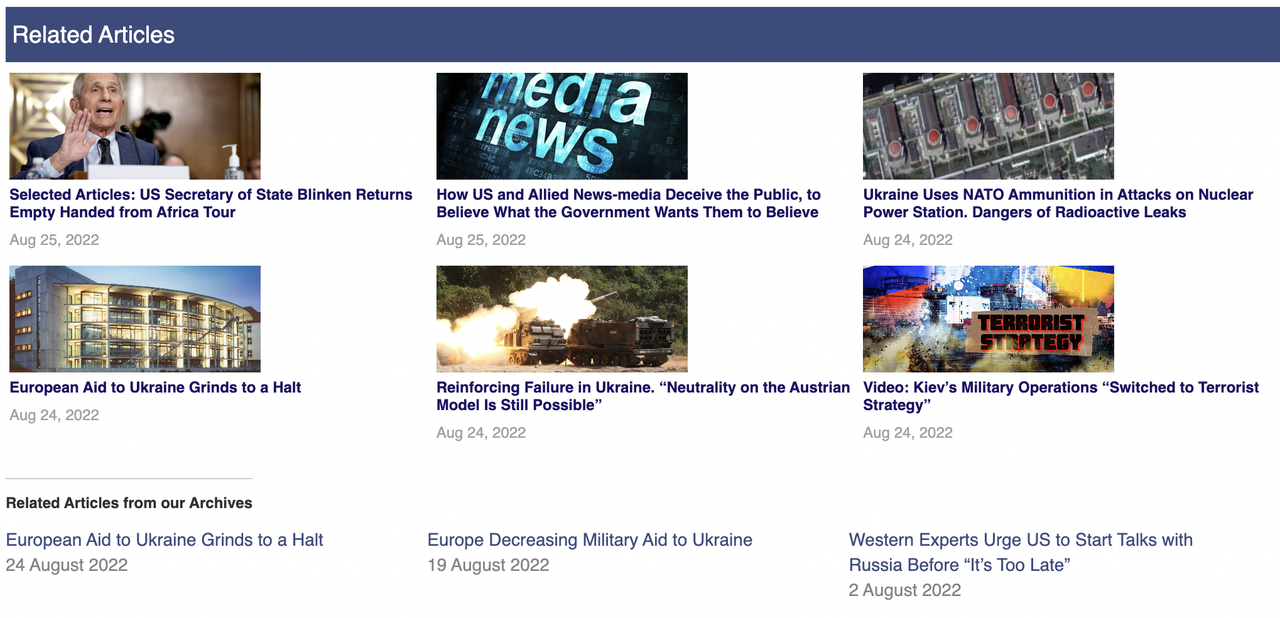
While we're at it, have a look at your quoted source . . . do you see a pattern . . . buffoon.
-
26-08-2022, 11:46 AM #8089Thailand Expat
- Join Date
- Feb 2006
- Last Online
- @
- Posts
- 40,667
Childish idiot. FYI, the source of the information is the Kiel Institute- highly credible, and another supporting Link provided just to give you something else to sob about. BooHoo.Yet more bullshit .
The Kiel Institute for the World Economy (Institut für Weltwirtschaft, or IfW) is an independent, non-profit economic research institute and think tank based in Kiel, Germany. In 2017, it was ranked as one of the top 50 most influential think tanks in the world and was also ranked in the top 15 in the world for economic policy specifically. German business newspaper, Handelsblatt, referred to the Institute as “Germany’s most influential economic think tank”, while Die Welt, stated that “The best economists in the world are in Kiel”.
European Aid to Ukraine Grinds to a Halt - Global ResearchGlobal Research - Centre for Research on Globalization
-
26-08-2022, 11:46 AM #8090Heading down to Dino's
- Join Date
- Jun 2009
- Last Online
- @
- Posts
- 35,408
Originally Posted by sabang
Its complete garbage, riddled with falsehoods. Just more Three Stooges horseshit. Originally Posted by sabang
-
26-08-2022, 11:57 AM #8091Thailand Expat

- Join Date
- Jul 2010
- Last Online
- 24-07-2024 @ 09:54 PM
- Location
- Where troubles melt like lemon drops
- Posts
- 26,242
^
-
26-08-2022, 12:02 PM #8092Thailand Expat

- Join Date
- Dec 2009
- Last Online
- @
- Location
- Chiang Mai
- Posts
- 57,145
^^^ One would think you would link to the Kiel Institute, which has some credibility instead of Global Research, which has none. The problem being Global Research draws wrong conclusions from the information they have. They are just another disinformation site.
Get a better grip on what’s happening here.Ukraine Support Tracker | Kiel InstituteLast edited by misskit; 26-08-2022 at 12:20 PM.
-
26-08-2022, 12:13 PM #8093Heading down to Dino's
- Join Date
- Jun 2009
- Last Online
- @
- Posts
- 35,408
He is at it in the other thread as well, posting up more utter rubbish propaganda. He needs his own thread in the doghouse to dump some of the horseshit he floods these threads with. Originally Posted by misskit
-
26-08-2022, 12:41 PM #8094Thailand Expat
- Join Date
- Feb 2006
- Last Online
- @
- Posts
- 40,667
It Is a fact that the highly respected Kiel Institute found that Europe's six largest economies made no further pledges of military aid to Ukraine last month, for the first time since the escalation of this war. Feel free to check it out for yourself from original source, MK provided a link. Just because you might like that fact does not make it propaganda.
Last edited by sabang; 26-08-2022 at 12:50 PM.
-
26-08-2022, 12:47 PM #8095Thailand Expat
- Join Date
- Dec 2009
- Last Online
- @
- Location
- Chiang Mai
- Posts
- 57,145
“Europe quietly abandons Ukraine” is not a fact. They are still sending military aid.
-
26-08-2022, 12:59 PM #8096Heading down to Dino's
- Join Date
- Jun 2009
- Last Online
- @
- Posts
- 35,408
It's propaganda. Originally Posted by sabang
The truth. Originally Posted by misskit
-
26-08-2022, 01:01 PM #8097Thailand Expat
- Join Date
- Feb 2006
- Last Online
- @
- Posts
- 40,667
^^ Correct. As the article clearly states, they are indeed delivering military aid already pledged, but have pledged no more in the previous month. Going around in circles here.
-
26-08-2022, 01:06 PM #8098Heading down to Dino's
- Join Date
- Jun 2009
- Last Online
- @
- Posts
- 35,408
Which isn't even worth mentioning, especially in light of the fact that the US just announced the largest aid package to date, at $3.1 billion. So it was just your typical horseshit. Originally Posted by sabang

-
26-08-2022, 02:17 PM #8099Thailand Expat
- Join Date
- Mar 2007
- Last Online
- 21-10-2023 @ 08:08 AM
- Location
- Way, Way South of the border now - thank God!
- Posts
- 33,190
Self-identification is a good thing, keep it up. Originally Posted by sabang
Which isn't the case as per my post with government figures . . . as it is a government website. Originally Posted by sabang
The only thing going around in circles is your bullshit
-
27-08-2022, 05:52 AM #8100Thailand Expat
- Join Date
- Feb 2006
- Last Online
- @
- Posts
- 40,667
No Matter Who Wins Ukraine, America Has Already Lost
There are multiple tough strategic realities for the United States to absorb.
Regardless of who wins the Ukrainian war, the United States will be the strategic loser. Russia will build closer relations with China and other countries on the Eurasian continent, including India, Iran, Saudi Arabia, and the Gulf states. It will turn irrevocably away from European democracies and Washington. Just as President Richard Nixon and Henry Kissinger played the “China card” to isolate the Soviet Union during the Cold War, presidents Vladimir Putin and Xi Jinping will play their cards in a bid to contain U.S. global leadership.
Knowing that it can no longer keep Europe as its top energy customer, Moscow has logically moved to grow its fossil fuels sales with Asia, notably China and India. Since the Ukraine invasion, Russia has become China’s top oil provider, replacing Saudi Arabia. It is true that in the short to medium term, transfer capacity will limit how much more fossil fuels Russia can sell to China. Russia currently has just one overland oil route to China, the ESPO pipeline. The only gas pipeline currently in operation is Power of Siberia. Pipeline sales of both oil and gas are supplemented by seaborne routes to mainland China. In the years ahead, China and Russia will doubtlessly make substantial investments to expand oil and gas transmission between the two countries, better enabling Russia to be the primary supplier of fossil fuels to China. The Chinese will likely be able to reduce their dependence on fossil fuel shipments from the Middle East which must pass through vulnerable naval choke points such as the Malacca Straits.
Closer energy relations between China and Russia will help to draw them closer as strategic allies with “no limits” on the Eurasian continent. By having a committed Russian energy supplier in its backyard, China will inevitably obtain more strategic flexibility for dealing with the United States and its Indo-Pacific regional allies, all to the detriment of Western democracies.
Russia has also greatly increased its energy business with India since the Ukraine invasion. According to the Centre for Research on Energy and Clean Air, “India has been the main buyer of the cargoes out of the Atlantic that Europe doesn’t want anymore.” Before invading Ukraine, India bought almost no oil from Russia. Now it is importing over 760,000 barrels a day. Increases in Russian fossil fuel sales to India will be detrimental to efforts by the United States, Australia, and Japan to continue to draw Delhi into a closer orbit with democratic countries in the Indo-Pacific region.
In fact, India—the world’s largest democracy—has taken a neutral stance on Russia’s invasion of Ukraine. At the United Nations, India abstained from votes that condemned the Russian invasion of Ukraine. It has refused to blame Russia for the attack. Besides a new and growing energy supply relationship, Russia has also been the long-time, primary supplier of weapons for the Indian armed forces. Importantly, Delhi remains appreciative, as well, of Russia’s longtime support on Kashmir. The Indian response to the Russo-Ukrainian War underscores the reality that India will likely not fully integrate into a Western Pacific alliance such as the Quad. If China is smart enough to avoid more border fights with India, momentum for India to become more involved with the Quad could well decline.
In more bad news for the West, India was not alone in abstaining from the UN General Assembly resolution that censured Russia for invading Ukraine. Thirty-four other countries declined to take the West’s side. Two-thirds of the global population live in countries that have refrained from denouncing Russia. Even neighboring Mexico refused to condemn Russia or join economic sanctions.
These are tough strategic realities for the United States to absorb. After the Russian invasion, the Western democracies swiftly coalesced, passing a broad array of sanctions against Moscow, including deadlines for ending fossil fuel purchases from Russia. The West’s energy sanctions have to an extent backfired, causing inflationary and supply disruptions so severe that Brussels now is struggling to cope with the economic consequences. The EU has even quietly announced steps to ease Russian energy sanctions to help stabilize energy markets. While the West complains that Russia weaponized its oil and gas exports, the reality is that it was Brussels and Washington that first raised the energy sword when they announced their intent to cut back Russian fossil fuel purchases immediately after the Ukraine invasion.
One positive byproduct of the Russo-Ukrainian War has been the rejuvenation of NATO, which has rallied to support Ukraine. The alliance will become even stronger when Finland and Sweden join. On the negative side, the United States is carrying more than its pro rata share of the burden to support Ukraine compared to other alliance partners except for Baltic states and Poland. Through May 20, 2022, the United States supplied or committed $54 billion in military aid to Kyiv. The United Kingdom was a distant second at $2.50 billion, followed by Poland at $1.62 billion and Germany at $1.49 billion. As of May 20, the United States had committed more than three times as much aid to Kyiv as all other European Union countries combined. The United States is the largest supplier of military aid notwithstanding that Russia’s invasion is far more of an immediate threat for European allies than for the United States, which is 5,700 miles away from the war, across the Atlantic Ocean. Ukraine shows again how dangerously dependent Western Europe is on American leadership and its military. That will not change until the U.S. foreign policy establishment can shake off the conviction, firmly cemented over seven decades, that only the United States can lead NATO, providing the military backbone for the alliance.
The United States must adapt, particularly as an even more jarring, ugly reality is the fact that NATO’s Article V defense commitments are limited by treaty to the Atlantic region. Were Pearl Harbor, Hawaii, or Guam attacked by China, North Korea or Russia, NATO’s collective defense commitments would not apply. Nonetheless, even though there is no chance that the NATO treaty will ever be amended to help the United States in the Pacific, Washington should not and cannot abandon NATO. Instead, the U.S. foreign policy establishment must work harder to enable European allies to pick up more, even if not the lion’s share, of the burden on their side of the Eurasian continent. If the United States continues to keep its head buried in the historical assumptions that prompted the creation of NATO in 1949, things are going to get steadily worse for over-stretched United States military resources and capabilities. The United States is no longer the world’s sole dominant power. More burden sharing in the U.S. alliance system will have to happen sooner or later to deal with the reality of an increasingly multipolar world.
Ramon Marks is a retired, New York international lawyer.
https://nationalinterest.org/feature...dy-lost-204288

 Reply With Quote
Thread Information
Users Browsing this Thread
There are currently 1 users browsing this thread. (0 members and 1 guests)
