

Did y'all hear about Romney's campaign is going to hold twenty four separate “We Did Build This” events in swing states across the country.
"You Didn't Build That" -- B. Hussien Obama
Results 476 to 500 of 1556
Thread: Mitt Romney
-
26-07-2012, 02:35 PM #476Thailand Expat



- Join Date
- May 2006
- Last Online
- 13-09-2019 @ 04:18 PM
- Location
- Samui
- Posts
- 44,704
-
26-07-2012, 05:13 PM #477Thailand Expat

- Join Date
- Jan 2006
- Last Online
- @
- Posts
- 15,051
 Originally Posted by Humbert

yeah, he probably will.
and as far as the president 'needing' a teleprompter...it's surprising how soon some forget a beating they took.
the president debated the entire republican caucus, and schooled them. it wasn't even close. and btw, there wasn't a teleprompter in sight.
-
26-07-2012, 06:43 PM #478Guest Member

- Join Date
- Sep 2008
- Last Online
- @
- Location
- left of center
- Posts
- 29,888
Dim Mitt lies or is just stupid/out of touch because the person who purchased those weapons in Colorado did nothing against the law to purchase those weapons.
"Well, this person shouldn't have had any kind of weapons and bombs and other devices and it was illegal for him to have many of those things already. But he had them”, Romney said.
the video is in the link: http://firstread.msnbc.msn.com/_news/2012/07/25/12953031-romney-on-nbc-changing-gun-laws-wont-make-all-bad-things-go-away?lite&__utma=14933801.1980419544.1343128934.13 43267175.1343269296.7&__utmb=14933801.1.10.1343269 296&__utmc=14933801&__utmx=-&__utmz=14933801.1343128934.1.1.utmcsr=(direct)|ut mccn=(direct)|utmcmd=(none)&__utmv=14933801.|8=Ear ned%20By=msnbc%7Ccover=1^12=Landing%20Content=Mixe d=1^13=Landing%20Hostname=www.nbcnews.com=1^30=Vis it%20Type%20to%20Content=Earned%20to%20Mixed=1&__u tmk=83587478
And now a man who knows how to start the debate about gun control,……..
Dim Mitt doesn’t have a chance. But I do hope Dim (and his CPACs) spends a lot of money on advertising in Florida.
Where the returns? Keep your friends close and your enemies closer.
-
26-07-2012, 08:39 PM #479Thailand Expat
- Join Date
- Sep 2009
- Last Online
- @
- Posts
- 108,148
One of the best bits of writing from an American that I've read for years. Get a coffee and light up a ciggie, it's worth the read.
I think Carlin pretty much nailed it:The Joke’s on You
Steve Almond
from The Baffler No. 20
To read more great writing from our past issues, click here.
138 Print
Among the hacks who staff our factories of conventional wisdom, evidence abounds that we are living in a golden age of political comedy. The New York Times nominates Jon Stewart, beloved host of Comedy Central’s Daily Show, as the “most trusted man in America.” His protégé, Stephen Colbert, enjoys the sort of slavish media coverage reserved for philanthropic rock stars. Bill Maher does double duty as HBO’s resident provocateur and a regular on the cable news circuit. The Onion, once a satirical broadsheet published by starving college students, is now a mini-empire with its own news channel. Stewart and Colbert, in particular, have assumed the role of secular saints whose nightly shtick restores sanity to a world gone mad.
But their sanctification is not evidence of a world gone mad so much as an audience gone to lard morally, ignorant of the comic impulse’s more radical virtues. Over the past decade, political humor has proliferated not as a daring form of social commentary, but a reliable profit source. Our high-tech jesters serve as smirking adjuncts to the dysfunctional institutions of modern media and politics, from which all their routines derive. Their net effect is almost entirely therapeutic: they congratulate viewers for their fine habits of thought and feeling while remaining careful never to question the corrupt precepts of the status quo too vigorously.
Our lazy embrace of Stewart and Colbert is a testament to our own impoverished comic standards. We have come to accept coy mockery as genuine subversion and snarky mimesis as originality. It would be more accurate to describe our golden age of political comedy as the peak output of a lucrative corporate plantation whose chief export is a cheap and powerful opiate for progressive angst and rage.
Fans will find this assessment offensive. Stewart and Colbert, they will argue, are comedians, offering late-night entertainment in the vein of David Letterman or Jay Leno, but with a topical twist. To expect them to do anything more than make us laugh is unfair. Besides, Stewart and Colbert do play a vital civic role—they’re a dependable news source for their mostly young viewers, and de facto watchdogs against media hype and political hypocrisy.
Michiko Kakutani of the New York Times offered a summation of the majority opinion in a 2008 profile of Stewart that doubled as his highbrow coronation. “Mr. Stewart describes his job as ‘throwing spitballs’ from the back of the room,” she wrote. “Still, he and his writers have energetically tackled the big issues of the day . . . in ways that straight news programs cannot: speaking truth to power in blunt, sometimes profane language, while using satire and playful looniness to ensure that their political analysis never becomes solemn or pretentious.”
Putting aside the obvious objection that poking fun at the powerful isn’t the same as bluntly confronting them, it’s important to give Stewart and Colbert their due. They are both superlative comedians with brilliant writing staffs. They represent a quantum improvement over the aphoristic pabulum of the thirties satirist Will Rogers or the musical schmaltz of Beltway balladeer Mark Russell. Stewart and Colbert have, on occasion, aimed their barbs squarely at the seats of power.
The most famous example is Colbert’s turn as the featured speaker at the 2006 White House Correspondents’ Association Dinner. Paying tribute to President George W. Bush, seated just a few feet away, Colbert vowed, “I stand by this man. I stand by this man because he stands for things. Not only for things, he stands on things. Things like aircraft carriers and rubble and recently flooded city squares. And that sends a strong message, that no matter what happens to America, she will always rebound—with the most powerfully staged photo ops in the world.” He went on to praise, in punishing detail, the media who had served as cheerleaders for the president’s factually spurious rush to war in Iraq, and his embrace of domestic surveillance and torture. The crowd, composed of A-list cheerleaders, sat in stunned silence.

Stewart has generated a few similar moments of frisson, most notably when he eviscerated Jim Cramer, the frothing former hedge fund manager who hosts the CNBC show Mad Money, and Betsy McCaughey, an unctuous lobbyist paid by insurance companies to flog the myth of government-run “death panels” during the debate over health care reform. Stewart also played a vital role in shaming Senate Republicans into supporting a bill to provide medical care for 9/11 first responders.
What’s notable about these episodes, though, is how uncharacteristic they are. What Stewart and Colbert do most nights is convert civic villainy into disposable laughs. They prefer Horatian satire to Juvenalian, and thus treat the ills of modern media and politics as matters of folly, not concerted evil. Rather than targeting the obscene cruelties borne of greed and fostered by apathy, they harp on a rogues’ gallery of hypocrites familiar to anyone with a TiVo or a functioning memory. Wit, exaggeration, and gentle mockery trump ridicule and invective. The goal is to mollify people, not incite them.
In Kakutani’s adoring New York Times profile, Stewart spoke of his comedic mission as though it were an upscale antidepressant: “It’s a wonderful feeling to have this toxin in your body in the morning, that little cup of sadness, and feel by 7 or 7:30 that night, you’ve released it in sweat equity and can move on to the next day.” What’s missing from this formulation is the idea that comedy might, you know, change something other than your mood.
Back in October of 2004, Stewart made a now-famous appearance on the CNN debate show Crossfire, hosted by the liberal pundit Paul Begala and his conservative counterpart Tucker Carlson. Stewart framed his visit as an act of honor. He had been mocking the contrived combat of Crossfire on his program and wanted to face his targets. The segment quickly devolved into a lecture. “Stop, stop, stop, stop hurting America,” he told Carlson. “See, the thing is, we need your help. Right now, you’re helping the politicians and the corporations. And we’re left out there to mow our lawns.” The exchange went viral. Stewart was hailed as a hero: here, at last, was a man brave enough to condemn the tyranny of a middling cable shoutfest.
But who, exactly, did Stewart mean by “we”? He’s not just some poor schnook who works the assembly line at a factory then goes home to mow his lawn. He’s a media celebrity who works for Viacom, one of the largest entertainment corporations in the world. Stewart can score easy points by playing the humble populist. But he’s as comfortable on the corporate plantation as any of the buffoons he delights in humiliating.
The queasy irony here is that Stewart and Colbert are parasites of the dysfunction they mock. Without blowhards such as Carlson and shameless politicians, Stewart would be out of a job that pays him a reported $14 million per annum. Without the bigoted bluster of Bill O’Reilly and Rush Limbaugh, The Colbert Report would not exist. They aren’t just invested in the status quo, but dependent on it.
Consider, in this context, Stewart’s coverage of the Occupy Wall Street movement. His initial segment highlighted the hypocrisy of those who portrayed the protestors in Zuccotti Park as lawless and menacing while praising Tea Party rallies as quintessentially patriotic. But Stewart was careful to include a caveat: “I mean, look, if this thing turns into throwing trash cans into Starbucks windows, nobody’s gonna be down with that,” he said, alluding to vandalism by activists during a 1999 World Trade Organization summit. Stewart then leaned toward the camera and said, in his best guilty-liberal stage whisper, “We all love Starbucks.” The audience laughed approvingly. Protests for economic justice are worthy of our praise, just so long as they don’t take aim at our luxuries. The show later sent two correspondents down to Zuccotti Park. One highlighted the various “weirdos” on display. The other played up the alleged class divisions within those occupying the park. Both segments trivialized the movement by playing to right-wing stereotypes of protestors as self-indulgent neo-hippies.
Stewart sees himself as a common-sense critic, above the vulgar fray of partisan politics. But in unguarded moments—comparing Steve Jobs to Thomas Edison, say, or crowing over the assassination of Osama bin Laden— he betrays an allegiance to good old American militarism and the free market. In his first show after the attacks of September 11, he delivered a soliloquy that channeled the histrionic patriotism of the moment. “The view from my apartment was the World Trade Center,” he said shakily, “and now it’s gone, and they attacked it. This symbol of American ingenuity, and strength, and labor, and imagination, and commerce, and it is gone. But you know what the view is now? The Statue of Liberty. The view from the South of Manhattan is now the Statue of Liberty. You can’t beat that.”
It does not take a particularly supple intellect to discern the subtext here. The twin towers may have symbolized “ingenuity” and “imagination” to Americans such as Stewart and his brother, Larry, the chief operating officer of the New York Stock Exchange’s parent company. But to most people in the world, the WTC embodied the global reach of U.S.-backed corporate cartels. It’s not the sort of monument that would showcase a pledge to shelter the world’s “huddled masses.” In fact, it’s pretty much the opposite of that. To imply a kinship between the towers and the Statue of Liberty—our nation’s most potent symbol of immigrant striving—is to promote a reality crafted by Fox News CEO Roger Ailes. Stewart added this disclaimer: “Tonight’s show is not obviously a regular show. We looked through the vault and we found some clips that we thought might make you smile, which is really what’s necessary, I think, uh, right about now.”
You got that? In times of national crisis, the proper role of the comedian is not to challenge the prevailing jingoistic hysteria, but to induce smiles.
The Daily Show and The Colbert Report are not just parodies of news shows. They also include interview segments. And it is here that Stewart, at least occasionally, sheds his greasepaint and red rubber nose. With the help of his research department, he is even capable of exposing lightweight frauds such as Jim Cramer.
More often, though, his interviews are cozy affairs, promotional vehicles for whatever commodity his guest happens to be pimping. He’s not interested in visitors who might interrogate the hegemonic dogmas of corporate capitalism. On the contrary, his green room is often stocked with Fox News regulars. Neocon apologist Bill Kristol has appeared on the show a record eleven times since 2003. Mike Huckabee has visited seven times, Newt Gingrich, Chris Wallace, and Ed Gillespie five times, and so on and so forth on down the dismal demagogic food chain: Lou Dobbs, Ron Paul, Michael Steele, Juan Williams, Ralph Reed, Dick Armey. Stewart, who is nothing if not courteous, allows each of these con men to speak his piece. He pokes fun at the more obvious lines of bullshit. The audience chortles. Now for a message from our sponsors.
When Stewart hosts a figure of genuine political power, the discussion usually winds up anodyne. A 2010 visit with former Secretary of State Condoleezza Rice was especially painful to witness. Stewart, a prominent critic of the Bush administration’s war in Iraq, seemed starstruck. “What does the burden feel like,” he asked Rice, “on a day to day basis, agree or disagree with the policy?” It was a textbook illustration of the golden parachute of politics. Having left office, Rice’s sins were, if not forgotten, then at least deferred for promotional purposes. His guest had a new memoir to sell, after all. “I’m telling you, you gotta pick up [Rice’s book] about a patriotic American who is, if I may, doing the best that . . .” Stewart paused awkwardly, as if suddenly recognizing what a shill he’d become. “We’ll have the other conversation a different time.”
When Rice returned a year later to promote a book about her years in the Bush White House, what emerged was Stewart’s obeisance to figures of authority. “I hate to harp on this,” he said at one point, attempting to redirect Rice back to her use of bogus intelligence. He asked her no explicit questions about, for instance, a report by the House Committee on Government Reform citing twenty-nine false or misleading public statements she had made about Iraq’s weapons of mass destruction and links to Al Qaeda. While Stewart played the milquetoast, Rice commandeered the conversation, suggesting that without the Iraq war the Arab Spring would never have happened and (by the way) Iraq and Iran would be locked in a nuclear arms race. Once a charming propagandist, always a charming propagandist!
In a sense, Rice owed Stewart an even larger debt. His criticism of the Iraq war—a series of reports under the banner Mess O’Potamia—might have done more to diffuse the antiwar movement than the phone surveillance clauses embedded in the Patriot Act. Why take to the streets when Stewart and Colbert are on the case? It’s a lot easier, and more fun, to experience the war as a passive form of entertainment than as a source of moral distress requiring citizen activism.
Colbert’s interviews are even more trivializing. While he occasionally welcomes figures from outside the corporate zoo, his brash persona demands that he interrupt and confound them. If they try to match wits with him, they get schooled. If they play it straight, they get steamrolled. The underlying dynamic of Colbert’s show, after all, is that he never loses an argument. The only acceptable forms of outrage reside in his smug denial of any narrative that questions American supremacy.
In this sense, Colbert the pundit can been seen as a postmodern incarnation of the country’s first comic archetype, the “Yankee” (a designation that was then a national, rather than regional, term). As described by Constance Rourke in her 1931 survey, American Humor: A Study of the National Character, the Yankee is a gangly figure, sly and uneducated, who specializes in tall tales and practical jokes. Unlike Stewart, whose humor clearly arises from the Jewish tradition of outsider social commentary, Colbert plays the consummate insider, a cartoon patriot suitable for export. But Colbert’s mock punditry reinforces a dismissive view of actual corporate demagogues. Bill “Papa Bear” O’Reilly and his ilk come off as laughable curmudgeons, best mocked rather than rebutted, even as they steer our common discourse away from sensible policy and toward toxic forms of grievance.
And Colbert’s own flag-fellating routine often bends toward unintended sincerity. His visit to Iraq in June 2009 amounted to a weeklong infomercial for the U.S. military. It kicked off with a segment in which black ops abduct Colbert from his makeup room and transport him to a TV stage set in Baghdad, which turns out to be one of Saddam Hussein’s former palaces. Colbert is a brilliant improvisational comedian, adept at puncturing the vanities of his persona in the same way Bob Hope once did. (Colbert even brandished a golf club for his opening monologue in Baghdad, an homage to Hope, a frequent USO entertainer.) Still, there’s something unsettling about seeing America’s recent legacy of extraordinary rendition mined for laughs.
Colbert’s first guest, General Ray Odierno, commander of the multinational forces in Iraq, was treated to questions such as, “What’s happening here that’s not being reported that you think people back home should know about?” The hulking general then gave the host a buzz cut, as a crowd of several hundred uniformed soldiers roared.
Colbert himself acknowledged his reverence for the troops in interviews leading up to his visit. (“Sometimes my character and I agree.”) So it wasn’t exactly shocking that the shows themselves were full of reflexive sanctification of the military. Soldiers, by Colbert’s reckoning, aren’t moral actors who choose to brandish weapons, but paragons of manly virtue whose sole function is to carry out their orders—in this case “bringing democracy” to a hellish Arab backwater. This is an utterly authoritarian mindset.
Stewart, at least, has displayed the temerity to question American military might on occasion. A few months before Colbert’s Iraq adventure, in the midst of a heated debate over torture with yet another neocon guest, Cliff May, Stewart dared to opine that President Harry S. Truman was a war criminal for ordering the bombing of Hiroshima and Nagasaki during World War II. His statement was shocking in its candor: “I think if you dropped an atom bomb fifteen miles offshore and you said, ‘The next one’s coming and hitting you,’ then I would think it’s okay. To drop one on a city, and kill a hundred thousand people. Yeah. I think that’s criminal.”
Two days later, Stewart issued an on-air apology: “The atomic bomb—a very complicated decision in the context of a horrific war, and I walk [my statement] back because it was in my estimation a stupid thing to say. Which, by the way, as it was coming out of your mouth, you ever do that, where you’re saying something and as it’s coming out you’re like, ‘What the fuck?’ And it just sat in there for a couple of days, just sitting going, ‘No, no, he wasn’t, and you should really say that out loud on the show.’ So I am, right now, and, man, ew. Sorry.”
This mea culpa was not spurred by a media uproar or a corporate directive (as far as we know) or any apparent reexamination of Truman’s decision, which (for the record) led to the deaths of an estimated 250,000 Japanese, most of them civilians. It was, more revealingly, the result of Stewart’s inbred aversion to conflict, to making any statement that might depart too dramatically from the cultural consensus and land him at the center of a controversy.
An even more dramatic example came during his 2010 interview with Rachel Maddow, during which Stewart trotted out one of his favorite canards, that “both sides have their way of shutting down debate.”
Maddow asked, “What’s the lefty way of shutting down debate?”
“You’ve said Bush is a war criminal,” Stewart replied. “Now that may be technically true. In my world, a war criminal is Pol Pot or the Nuremberg trials. . . . But I think that’s such an incendiary charge that when you put it into conversation as, well, technically he is, that may be right, but it feels like a conversation stopper, not a conversation starter.” This is the Stewart credo distilled: civility at any cost, even in the face of moral atrocity.
By contrast, consider the late Bill Hicks, a stand-up comedian of the same approximate vintage as Stewart and Colbert. “You never see my attitude in the press,” Hicks once observed. “For instance, gays in the military. . . . Gays who want to be in the military. Here’s how I feel about it, alright? Anyone dumb enough to want to be in the military should be allowed in. End of fucking story. That should be the only requirement. I don’t care how many pushups you can do. Put on a helmet, go wait in that foxhole, we’ll tell you when we need you to kill somebody. . . . I watched these fucking congressional hearings and all these military guys and the pundits, ‘Seriously, aww, the esprit de corps will be affected, and we are such a moral’—excuse me! Aren’t y’all fucking hired killers? Shut up! You are thugs and when we need you to go blow the fuck out of a nation of little brown people, we’ll let you know. . . . I don’t want any gay people hanging around me while I’m killing kids!”
Fellow comics considered Hicks a genius, and he did well in clubs. But he never broke into national television, because he violated the cardinal rule of televised comedy—one passed down from Johnny Carson through the ages—which is to flatter and reassure the viewer. David Letterman invited Hicks to perform on his show but cut his routine just before the broadcast. Several years after Hick’s death, an apologetic Letterman ran a clip of the spot Hicks had recorded. It was obvious why Letterman—or the network higher-ups—had axed it. The routine openly mocked everyone from pro-lifers to homosexuals.
To hear Hicks rant about the evils of late-model capitalism (“By the way, if anyone here is in advertising or marketing, kill yourself”), or militant Christians, or consumerism, is to encounter the wonder of a voice free of what Marshall McLuhan called the “corporate mask.” Hicks understood that comedy’s highest calling is to confront the moral complacency of your audience—and the sponsors.
This willingness to traffic in radical ideas is what makes comic work endure, from Aristophanes’s indictments of Athenian war profiteers to Jonathan Swift’s “modest proposal” that Irish parents sell their children as food to rich gourmands, from Lenny Bruce’s anguished, anarchic riffs to George Carlin’s rants. “There’s a reason education sucks, and it’s the same reason that it will never, ever, ever, be fixed,” Carlin once said, though not on The Daily Show. “The owners of this country don’t want that. I’m talking about the real owners now. The real owners, the big wealthy business interests that control things and make all the important decisions. Forget the politicians. The politicians are put there to give you the idea that you have freedom of choice. You don’t.”
In a 1906 address at Carnegie Hall entitled “Taxes and Morals,” Mark Twain lambasted plutocrats who advertised their piety while lying about their incomes. “I know all those people,” Twain noted. “I have friendly, social, and criminal relations with the whole lot of them.” He said that word—criminal—knowing that many of these folks were seated in the gallery before him. Twain had this to say about the patriotism of his day: “The Patriot did not know just how or when or where he got his opinions, neither did he care, so long as he was with what seemed the majority—which was the main thing, the safe thing, the comfortable thing.” It’s this quality of avoiding danger, of seeking the safety of consensus, that characterizes the aesthetic of Stewart and Colbert. They’re adept at savaging the safe targets—vacuous talking heads and craven senators. But you will never hear them referring to our soldiers as “uniformed assassins,” as Twain did in describing an American attack on a tribal group in the Philippines.
It’s worth noting that Twain’s scathing indictment of the military initially was redacted from his autobiography by an editor concerned that such comments would tarnish the author’s reputation. And it’s equally worth pondering the constraints that define Stewart and Colbert’s acceptable zone of satire. After all, their shows air on Comedy Central, which is owned by Viacom, the fifth largest media conglomerate in the world.
Apart from bleeped out profanity, there appears to be no censorship, ideological or otherwise, enforced by the suits at Viacom. So long as Stewart and Colbert keep earning ratings (and ad dollars), they can do what they like. This is how the modern comedy plantation functions. It’s essentially self-policing. You find yourself out of a job only when your candor costs the bean counters more than it makes them.
Bill Maher learned this in 2001, when, as the host of ABC’s Politically Incorrect, he offered a rebuttal to President Bush’s assertion that the 9/11 hijackers were cowards. “We have been the cowards,” Maher observed. “Lobbing cruise missiles from two thousand miles away. That’s cowardly. Staying in the airplane when it hits the building. Say what you want about it. Not cowardly.”
What followed was a textbook case of economic censorship. The right-wing media launched into the expected paroxysms, and the mainstream media fanned the fury. Maher insisted he was making a linguistic argument, not endorsing the terrorists. But it was too late. FedEx and Sears Roebuck pulled their ads, and ABC cancelled Politically Incorrect in early 2002. Soon after, the Los Angeles Press Club awarded Maher an award for “championing free speech,” and he took his act to HBO, where he didn’t have to worry about offending sponsors.
For Viacom chief Sumner Redstone, airing shows with offensive content isn’t a problem. Redstone grew up in the entertainment business. After earning a law degree and acquainting himself with the intricacies of tax law, he joined his father’s movie theater chain. Redstone’s crucial insight was to recognize that, while new means of distribution might evolve, content was the vital commodity. He built his father’s business accordingly, eventually acquiring Viacom in a hostile takeover. The corporation now owns 170 media networks and thousands of programs, including Jersey Shore, which celebrates binge drinking, brawling, and the vigorous pursuit of venereal disease and melanoma.
In the corporate mindset, the specifics of “content” are irrelevant. Either you generate the necessary margin, or you cease to exist. “Content is king,” as Redstone is famously fond of pointing out. And profit is God.
If there’s one program on Comedy Central that affirms this maxim, it’s not The Daily Show or The Colbert Report, but the cartoon satire South Park. Over the course of sixteen seasons, the show’s creators, Trey Parker and Matt Stone, have pursued taboo topics with abandon. An episode entitled “Trapped in the Closet” not only played off rumors that Tom Cruise is gay but also condemned Scientology as “a big fat global scam” and exposed its various loony secrets. Other South Park episodes have used epithets and profanity as a way of confronting our collective neuroses about race, religion, and sexual orientation. The only publicized instances of Comedy Central censoring South Park have been in response to episodes in which Parker and Stone used images of the Prophet Muhammad that provoked threats of violence.
South Park indulges in a good deal of bathroom humor—perhaps inevitably, given that its protagonists are ten-year-olds. But the show is far more radical than its polished stablemates for the simple reason that it is willing to confront its viewers. Parker and Stone savage both the defensive bigotry of conservatives and the self-righteous entitlement of the left. They accomplish this not by riffing on the corruption of our media and political cultures, but by creating original dramas that expose the lazy assumptions and shallow gratifications of the viewing audience.
Surveying the defects of American governance more than eight decades ago, H. L. Mencken issued the following decree: “The only way that democracy can be made bearable is by developing and cherishing a class of men sufficiently honest and disinterested to challenge the prevailing quacks. No such class has ever appeared in strength in the United States. Thus the business of harassing the quacks devolves upon the newspapers. When they fail in their duty, which is usually, we are at the quacks’ mercy.”
To their millions of fans, Jon Stewart and Stephen Colbert represent the vanguard of just such a class. And hope for their leadership was never more keenly felt than in the weeks leading up to their vaunted Rally to Restore Sanity and/or Fear. The gathering, a hastily conceived send-up of Glenn Beck’s Restoring Honor Rally, took place three days before the 2010 midterm elections, with a stated purpose of calling for civility.
But the event itself accomplished nothing beyond revealing the bathos of Stewart and Colbert. It boiled down to a goofy variety show, capped by one of Stewart’s mawkish soliloquies. His central point was that Americans are a decent people, capable of making “reasonable compromises.” By way of proof he showed a video of cars merging in the Holland Tunnel. “These millions of cars must somehow find a way to squeeze one by one into a mile-long, thirty-foot-wide tunnel carved underneath a mighty river,” Stewart said. “And they do it. Concession by concession. ‘You go. Then I’ll go. You go, then I’ll go. . . . Oh my God, is that an NRA sticker on your car, is that an Obama sticker on your car? Well, that’s okay. You go and then I’ll go.’ Sure, at some point there will be a selfish jerk who zips up the shoulder and cuts in at the last minute. But that individual is rare and he is scorned, and not hired as an analyst.”
It’s hard to know where to begin with a metaphor this misguided. But it might be instructive to contemplate the rise of right-wing radio, an industry borne of commuter rage, which now dominates not just the Republican Party, but our national discourse. Stewart would have us believe that selfish jerks never get hired as analysts. But as his sidekick Colbert clearly demonstrates, that’s exactly who gets hired at the networks—folks who can excite our primal states of negative feeling: wrath, envy, fear. In Stewart’s daffy formulation, pundits and politicians are the ones who prey on an otherwise noble citizenry. But it’s us citizens who watch those pundits and elect those politicians. We’ve chosen to degrade our discourse. Stewart and Colbert make their nut by catering to those citizens who choose to laugh at the results rather than work to change them.
Having convinced more than 200,000 such folks to get off their butts and crowd the National Mall—not to mention the two and a half million who watched the proceedings on television or online—Stewart’s call to action amounted to: “If you want to know why I’m here and what I want from you, I can only assure you this: you have already given it to me. Your presence was what I wanted.” Such is the apotheosis of the Stewart-Colbert doctrine: the civic “rally” as televised corporate spectacle, with special merit badges awarded for attendance.
Bill Maher was one of the few prominent voices to call his comrades out. “If you’re going to have a rally where hundreds of thousands of people show up, you might as well go ahead and make it about something,” he said. He went on to point out the towering naïveté of their nonpartisan approach, with its bogus attempt to equate the insanity of left and right: “Martin Luther King spoke on that mall in the capital and he didn’t say, ‘Remember folks, those Southern sheriffs with the fire hoses and the German shepherds, they have a point too!’ No. He said, ‘I have a dream. They have a nightmare!’ . . . Liberals like the ones on that field must stand up and be counted and not pretend that we’re as mean or greedy or shortsighted or just plain batshit as they are, and if that’s too polarizing for you and you still want to reach across the aisle and hold hands and sing with someone on the right, try church.”
Maher’s dissent, all but lost amid the orgy of liberal self-congratulation, echoed Mencken’s exhortation: one must challenge the quacks to get rid of them. The reason our discourse has grown vicious, and has drifted away from matters of actual policy and their moral consequence, isn’t because of some misunderstanding between cultural factions. It is the desired result of a sustained campaign waged by corporations, lobbyists, politicians, and demagogues who have placed private gain over the common good.
In a sense, these quacks have no more reliable allies than Stewart and Colbert. For the ultimate ethos of their television programs is this: the customer is always right. We need not give in to sorrow, or feel disgust, or take action, because our brave clown princes have the tonic for what ails the national spirit. Their clever brand of pseudo-subversion guarantees a jolt of righteous mirth to the viewer, a feeling that evaporates the moment their shows end. At which point we return to our given role as citizens: consuming whatever the quacks serve up next.
" “There’s a reason education sucks, and it’s the same reason that it will never, ever, ever, be fixed,” Carlin once said... “The owners of this country don’t want that. I’m talking about the real owners now. The real owners, the big wealthy business interests that control things and make all the important decisions. Forget the politicians. The politicians are put there to give you the idea that you have freedom of choice. You don’t.”"The next post may be brought to you by my little bitch Spamdreth
-
26-07-2012, 10:08 PM #480En route



- Join Date
- Jan 2006
- Last Online
- 12-05-2025 @ 09:06 PM
- Location
- Reality.
- Posts
- 32,988
As a non U.S.A.nian who doesn't really understand the politics of the various comedians (some swing left, some right apparently. it seems in the U.S.A. even comedy is political.)That was a good read, and a couple of very poignant points.
So in other words, nothing's changed, they've come full circle. For a while there it was impolite to talk about wealth though.In a 1906 address at Carnegie Hall entitled “Taxes and Morals,” Mark Twain lambasted plutocrats who advertised their piety while lying about their incomes. “I know all those people,” Twain noted. “I have friendly, social, and criminal relations with the whole lot of them.” He said that word—criminal—knowing that many of these folks were seated in the gallery before him. Twain had this to say about the patriotism of his day: “The Patriot did not know just how or when or where he got his opinions, neither did he care, so long as he was with what seemed the majority—which was the main thing, the safe thing, the comfortable thing.”
But what I really took from that is that the American public is so stupid they're starting to take their comedy seriously.
or the comedians are such jerks they bring their politics to their acts.“If we stop testing right now we’d have very few cases, if any.” Donald J Trump.
-
27-07-2012, 05:48 AM #481Thailand Expat
- Join Date
- May 2006
- Last Online
- 13-09-2019 @ 04:18 PM
- Location
- Samui
- Posts
- 44,704
Romney: 'Looking Forward to the Bust of Winston Churchill Being in the Oval Office Again'
Heh...that socialist in the U.K. might not let it go after Mitt pissed him off, eh?
"At an event in London, Republican presidential candidate Mitt Romney said, "I'm looking forward to the bust of Winston Churchill being in the Oval Office again."Mitt Romney at London fundraiser: "I'm looking forward to the bust of Winston Churchill being in the Oval Office again." #watersedge?President Obama famously sent Churchill's bust back to Britain soon after coming into office. As the Telegraph reported then:
— Kasie Hunt (@kasie) July 26, 2012A bust of the former prime minister once voted the greatest Briton in history, which was loaned to George W Bush from the Government's art collection after the September 11 attacks, has now been formally handed back.
The bronze by Sir Jacob Epstein, worth hundreds of thousands of pounds if it were ever sold on the open market, enjoyed pride of place in the Oval Office during President Bush's tenure.
But when British officials offered to let Mr Obama to hang onto the bust for a further four years, the White House said: "Thanks, but no thanks."
Romney: 'Looking Forward to the Bust of Winston Churchill Being in the Oval Office Again' | The Weekly Standard
"Thanks but no thanks"? Ya know, there's not a single redeeming thing about B. Hussien or his crew...
A Deplorable Bitter Clinger
-
27-07-2012, 06:34 AM #482Guest Member
- Join Date
- Sep 2008
- Last Online
- @
- Location
- left of center
- Posts
- 29,888
Thank goodness Dim Mitt will never ever see the inside of the White House. He’s an embarrassment to the US. No way to start a visit by insulting a country you’re visiting.
From the telegraph: Olympics: Mitt Romney seeks to play down London 2012 comments - Telegraph ,…..
"Do they come together and celebrate the Olympic moment? That's something which we only find out once the Games actually begin," he (Romney) said.
"It's hard to know just how well it will turn out. There are a few things that were disconcerting.
"The stories about the private security firm not having enough people, the supposed strike of the immigration and Customs officials - that obviously is not something which is encouraging."
The remarks were greeted with anger, with many British supporters of the Games taking to Twitter to accuse Mr. Romney of being graceless and rude.
And Mr. Cameron’s response,…
He (Mr. Cameron) pointed out that the 2012 Olympics were taking place in a busy city rather than “the middle of nowhere” – a remark was widely seen as a reference to the 2002 Winter Games in Salt Lake City, Utah, which Mr. Romney was in charge of organising.
Oh but wait. Maybe Dim Mitt can show the Brits how it’s done,……
Dim Mitt seems to be stuck on himself: http://abcnews.go.com/blogs/politics...omneys-face/,…..
Like the uniforms in 2012 and in 2002, when Mitt Romney ran the Salt Lake Olympics much of its official memorabilia was manufactured overseas, including a 9/11 commemorative pin and another fashioned in the shape of Romney’s head.
Salt Lake 2002 Olympics paraphernalia obtained by ABC bears “Made in China” and “Made in Bangladesh” stamps.

As head of the Salt Lake Olympics Mitt Romney became the first Olympic executive to approve a series of commemorative pins in his likeness. (They're in the news right now because they were made in China, but their mere existence is its own indictment of Romney's judgment.): Mitt Romney Issued Comically Bizarre Cartoon-Mitt-Romney Olympic Pins
Where the returns?Last edited by S Landreth; 27-07-2012 at 07:33 AM.
-
27-07-2012, 09:52 AM #483Days Work Done!
- Join Date
- Oct 2007
- Last Online
- Today @ 02:59 AM
- Location
- Roiet
- Posts
- 36,056
A letter to Mitt:
Dear MR,
^Scratch that. Could be interpreted as a slur against your good name. Not my intent.
Dear Mitt,
The key to victory lies solely on a single historically proven factor. Out spend your opponent!! The recent Supreme Court ruling citing "freedom of speech" allows individuals and organizations to contribute unlimited funds to your campaign. Get out there and appeal to each and all to build up a war chest bigger than your opponents. Use it wisely. Barrage the electorate with a media blitz directed solely at criticizing your opponent.
Under no circumstances offend your base. Keep them happy by proclaiming your support whilst remaining vague on exactly what you will do if you win.
Promise you will bring a "better" America to all if you're elected. Never mind explaining specific programs you intend to make it better. No need to confuse the electorate or give the opponent the opportunity to attack specifics.
The biggest spender plus assurances America will be better off if you're elected is enough to sway the vote in your favor. Let's make sure our next President is the best money can buy.
Wishing you success,
Cynical in Thailand"Whenever you find yourself on the side of the majority, it is time to pause and reflect,"
-
27-07-2012, 10:33 AM #484Thailand Expat
- Join Date
- Feb 2008
- Last Online
- 19-12-2015 @ 05:51 PM
- Location
- Paese dei Balocchi
- Posts
- 7,833
Mr. Bean for President!
Telegraph: "Mitt Romney is perhaps the only politician who could start a trip that was supposed to be a charm offensive by being utterly devoid of charm and mildly offensive."
Commentary: if Mitt Romney doesn’t like us, we shouldn’t care - Telegraph
-
27-07-2012, 10:40 AM #485Thailand Expat
- Join Date
- Feb 2006
- Last Online
- @
- Posts
- 40,667
Romney also described Russia as the USA's 'number one geopolitical foe'. Considering Russia supplies most of Europe's domestic energy requirements, maybe it's time for Europe to kiss goodbye to or at least downgrade Nato. It's only used now to try to drag Europe into pointless wars in the Middle east anyway.
-
27-07-2012, 11:13 AM #486Thailand Expat
- Join Date
- Feb 2008
- Last Online
- 19-12-2015 @ 05:51 PM
- Location
- Paese dei Balocchi
- Posts
- 7,833
NATO is an idea long past its usefulness, but of course Mittens wants to expand it so as to further intimidate Russia, which despite being a US "foe" has been allowing US military overflights to Afghanistan for years. Bizarre.
This is quite an amusing thing to say right before running off to Europe:
Mitt Romney questions London's enthusiasm for Olympics | Olympics News | The Week UK
As if questioning the enthusiasm of the British public wasn’t enough, Romney appeared to go on to denounce the whole of Europe, telling NBC: “We’re at a point here where we have two different roads we can go down. One leads to Europe. The other leads to the kind of dynamism and prosperity which has always characterised America.”
---
Finally, the one thing I think everyone recognizes. The man is simply unlikable:
The Man Without Qualities by Paul Constant - Seattle Features - The Stranger, Seattle's Only Newspaper
I’ve been in the same room with Mitt Romney twice—in Des Moines and Bellevue. I’ve been in rooms full of people who voted for Romney in the Iowa and Washington State caucuses. I’ve shared disgusting hotel bathrooms covered in litter and puddles of questionable fluids with men wearing baseball hats and pins bearing Romney’s name and Romney T-shirts awkwardly pulled over their very expensive Oxford-cloth button-down shirts. I’ve stood in line with people at cold ungodly hours of the morning as we all waited to be allowed into Romney rallies. And I have never, once, met a Mitt Romney fan.
I have looked far and wide, halfway across this country and back, and I have not found a human being who is genuinely fond of Romney and believes that, based on the strength of his character, he would make a great president. I’m not talking about an anti-Obama Republican; there are plenty of people who will vote for Romney because he’s not Barack Obama. But I have not talked with one person who will vote for Mitt Romney because he’s Mitt Romney. And I’ve tried. E-mails and phone calls to prospective Romney fans went unanswered. Google searches were fruitless…
... Romney can’t run on the issues, because he can’t admit what his issues really are. And he can’t run on his record as a politician. His Senate campaign crashed and burned to a loss of 17 percent in the biggest election year for Republican wins on record. Except for the health- care reform he championed—Romneycare was supposed to be the centerpiece of his presidential campaign, before his party veered to the right and ran it down dead—Romney’s record as governor of Massachusetts is terrible. He cut funds to public education. Massachusetts fell to 47th in the nation for job creation. Hell, even Romneycare relied on funds from the federal government to really work.
So what does Romney have left? He’s “a businessman.” He can’t even say he’ll govern as a “CEO president,” because George W. Bush used that line already, and Romney can’t afford to remind people that the last “CEO president” we had presided helplessly over the destruction of a major American city, drove the economy at top speed into a brick wall, and then made his friends try to pin the accident on the nearest black guy.“You can lead a horticulture but you can’t make her think.” Dorothy Parker
-
27-07-2012, 11:33 AM #487Pronce. PH said so AGAIN!

- Join Date
- Jul 2009
- Last Online
- @
- Location
- Behind a slipping mask of sanity in Phuket.
- Posts
- 9,081
This is supposed to be Romney pushing his theme that Obama is inept at foreign policy! Originally Posted by robuzo
What's he going to say in Israel?
"Some of my best friends own gas stations"
"Some of my best after-death baptisms were Jews"
-
27-07-2012, 11:40 AM #488Thailand Expat
- Join Date
- May 2006
- Last Online
- 13-09-2019 @ 04:18 PM
- Location
- Samui
- Posts
- 44,704
Mitt Romney hammered Barack Obama today with his latest ad: “It Worked”
Once again, Mitt used Barack Obama’s own ridiculous statement against him in the ad
It Worked - YouTube
A few nights ago at a fundraiser, President Obama proudly proclaimed that his economic plan had "worked." Tell that to the millions of Americans now on food stamps. Tell that to the millions of Americans struggling to make ends meet. No Mr. President, it did not work.
Everything he touches...
-
27-07-2012, 11:50 AM #489Thailand Expat
- Join Date
- Sep 2009
- Last Online
- @
- Posts
- 108,148
I fear for the likes of Boon Mee that they are so desperate to get a - let's face it - pretty powerless President like Obama out of the Whitehouse and replace him with a cardboard cut out for big business, who will only do his best to continue and exarcebate the financial rape of the American public committed by his Republican predecessor.
-
27-07-2012, 01:08 PM #490Thailand Expat
- Join Date
- Jan 2006
- Last Online
- @
- Posts
- 15,051
well, it's been a brutal start for willard's foreign fundraising trip.
first he questioned whether england was prepared to host the olympics. with good reason, the brits took umbrage.
PM Cameron:
London mayor Johnson:“We are holding an Olympic Games in one of the busiest, most active, bustling cities anywhere in the world,” Cameron noted. “Of course it’s easier if you hold an Olympic Games in the middle of nowhere.”
There’s a guy called Mitt Romney who wants to know whether we are ready!” London Mayor Boris Johnson bellowed to a crowd in Hyde Park. “Are we ready? Yes we are!” It wasn’t supposed to go like this.
ouch.
but i suppose this UK takedown is better than being compared to nixon in the US for continuing to stonewall on releasing his tax returns.
but hold on.....it gets worse.
willard stepped in it again by boasting about meeting with the head of the MI6.
here's the problem:“I can only say that I appreciated the insights and perspectives of the leaders of the government here and opposition here as well as the head of MI6 as we discussed Syria and the hope for a more peaceful future for that country,” Romney told reporters at a press conference Thursday
Britain’s Foreign and Commonwealth Office told CBS News that “Sir John Sawers meets many people, but we don’t give a running commentary on any of these private meetings.”
As The Guardian pointed out, MI6 was not officially acknowledged until 1994. “For our American readership, this isn’t like bragging you just met David Petraeus. The British take on the national secret intelligence service comes with an extra-heavy dollop of the whole secret thing,” the Guardian’s Tom McCarthy wrote.
in short:
not ready for prime time.
he embarrassed himself....but more importantly he embarrassed america.
-
27-07-2012, 01:26 PM #491Thailand Expat
- Join Date
- Feb 2008
- Last Online
- 19-12-2015 @ 05:51 PM
- Location
- Paese dei Balocchi
- Posts
- 7,833
Certainly among the most numerous. Don't think that goes down too well in the Promised Land, to be honest. Originally Posted by quimbian corholla
-
27-07-2012, 01:29 PM #492Thailand Expat
- Join Date
- Feb 2008
- Last Online
- 19-12-2015 @ 05:51 PM
- Location
- Paese dei Balocchi
- Posts
- 7,833
Oh, I don't know. I suspect he generated a fair bit of sympathy. Originally Posted by raycarey
-
27-07-2012, 02:20 PM #493Pronce. PH said so AGAIN!
- Join Date
- Jul 2009
- Last Online
- @
- Location
- Behind a slipping mask of sanity in Phuket.
- Posts
- 9,081
I wonder how Mitt feels that Johnson (a Conservative) is ridiculing him in front of a crowd of ~60,000 knowing that the GOP gleefully gloated when the USA lost the chance to host another Olympics. Originally Posted by raycarey
The Tea Party went so ballistic and cheered the loss so loudly that the USOC didn't even bother bidding for 2020. They pretty much knew the exact same thing was going to happen no matter what city they put forward.
-
27-07-2012, 06:01 PM #494Thailand Expat
- Join Date
- Feb 2008
- Last Online
- 19-12-2015 @ 05:51 PM
- Location
- Paese dei Balocchi
- Posts
- 7,833
^Cameron also had some choice words. I had not expected Mittens' trip to the UK to turn out to be comedy gold.
Watch him slip up and say something unwise in re the Holocaust in Poland.
-
27-07-2012, 06:08 PM #495Guest Member
- Join Date
- Sep 2008
- Last Online
- @
- Location
- left of center
- Posts
- 29,888
Dim Mitt the twit takes a tour,.........
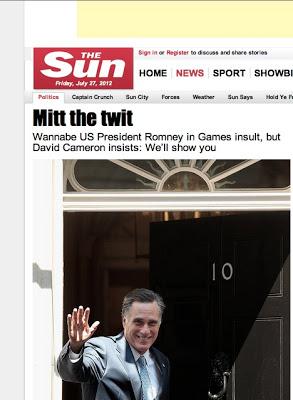
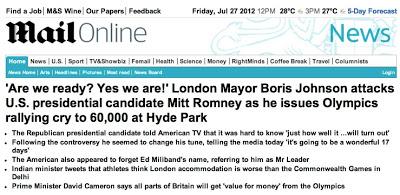


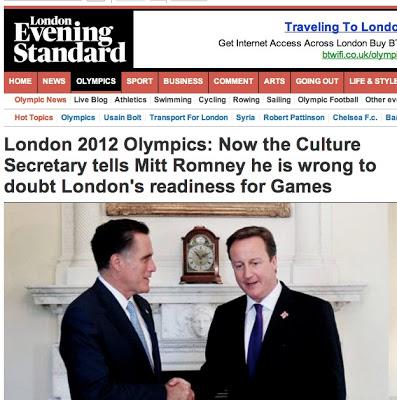


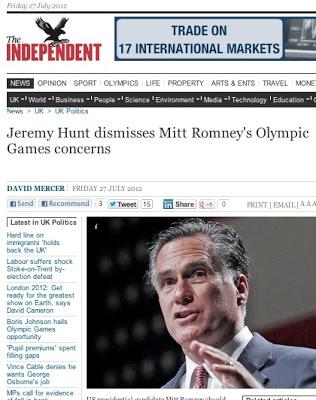


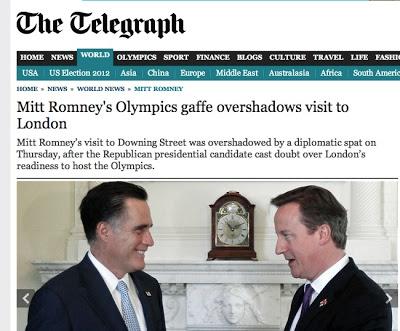


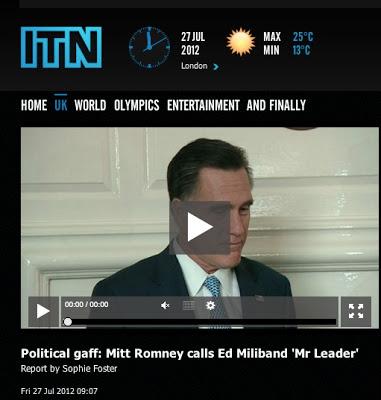
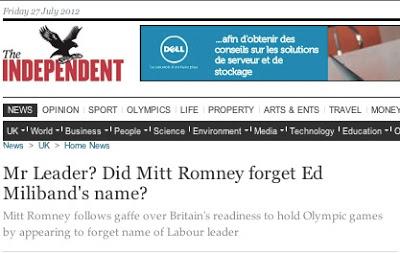
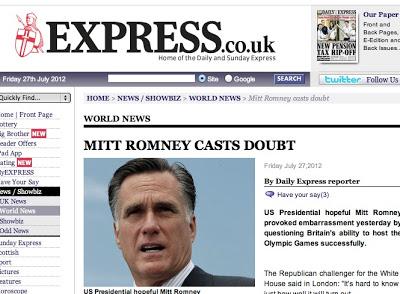
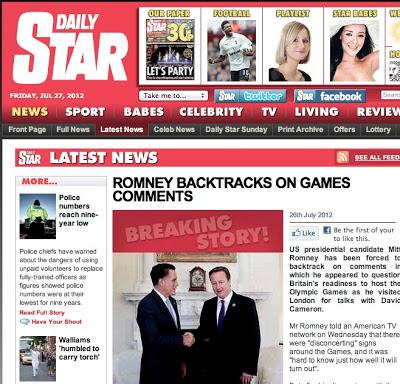

wonder what the hell Dim Mitt is gonna say when he gets to Poland (tell polish jokes?) or Israel (God forbid)
where the returns
-
27-07-2012, 06:12 PM #496Thailand Expat
- Join Date
- Feb 2008
- Last Online
- 19-12-2015 @ 05:51 PM
- Location
- Paese dei Balocchi
- Posts
- 7,833
He addressed Miliband as "Leader? Really?
-
27-07-2012, 08:11 PM #497Pronce. PH said so AGAIN!
- Join Date
- Jul 2009
- Last Online
- @
- Location
- Behind a slipping mask of sanity in Phuket.
- Posts
- 9,081
Lulz, his 'burnish my foreign policy credentials' tour doesn't seem to be going very well.
Apparently he's not even going to go and watch his ballet horse compete! Poor Rafalca, whatever will it do..
-
27-07-2012, 08:42 PM #498Thailand Expat
- Join Date
- Feb 2006
- Last Online
- @
- Posts
- 40,667
I think Mitt was trying to sound, y'know "important". He succeeded in sounding the exact opposite.
-
27-07-2012, 08:48 PM #499Thailand Expat

- Join Date
- Dec 2009
- Last Online
- @
- Location
- Chiang Mai
- Posts
- 57,135
^ ^Aww..
Romney got a tax write off of $77,000 for Rafalca, the dancing horse.
Daily Kos: Romney Took $77,000 Tax Deduction For His Dancing Horse
WTF?
-
27-07-2012, 08:56 PM #500Whopping Member

- Join Date
- Nov 2005
- Last Online
- 28-09-2024 @ 08:52 AM
- Location
- In the comfy chair
- Posts
- 5,549
Nice to see him making a tit of himself abroad as well as at home. Shows a real broad appeal.

 Reply With Quote
Thread Information
Users Browsing this Thread
There are currently 1 users browsing this thread. (0 members and 1 guests)
