

It was not what he wanted to do. The start of the war seems like a lifetime ago, as Russia has wreaked so much havoc on this democratic nation. He has been misinformed from the start right till today. It started off as a lightning strike of Russia's best forces. They had initial success, but were completely left abandoned and got wiped out.Originally Posted by Switch

What was left is nothing to brag about. So they are retreating and trying to settle for what they can get.
Results 4,976 to 5,000 of 15707
Thread: Ukraine war mega thread
-
31-03-2022, 06:34 PM #4976Heading down to Dino's



- Join Date
- Jun 2009
- Last Online
- @
- Posts
- 35,425
-
31-03-2022, 06:38 PM #4977Thailand Expat

- Join Date
- Feb 2006
- Last Online
- @
- Posts
- 40,667
The untold secrets of America's biolabs in Ukraine
Ever since the Russians raised their concerns about the existence of secret U.S. biolabs in Ukraine, intense discussions have been circulating around the globe. The world is expecting a serious answer and detailed explanation from Washington, which responded with a simple accusation of these concerns as "disinformation."
While U.S. embassies around the world parrot such rhetoric, they were met with a slap in the face in Hanoi. Obviously, people who went through the Vietnam War won't forget Agent Orange and many replied angrily to the U.S. embassy's post: "Millions of Vietnamese people who have been and are still tasting the dioxin toxicity that the U.S. had spread in Vietnam," "I'm sorry that I misunderstood. The Agent Orange is not a chemical weapon but cosmetics!"
Given the history and consequences of U.S. bio-experiments, it is imperative to scrutinize what is really happening to U.S. biolabs in Ukraine and elsewhere.
Who calls the shots in the U.S. biolabs in Ukraine?
The U.S. claims that these labs are owned and run by the Ukrainian government, and it only participates in project cooperation. But according to the research from U.S. National Academies of Sciences, Engineering, and Medicine (NASEM), the U.S. Department of Defense (DoD) has so far invested over $200 million into a Biological Threat Reduction Program (BTRP) to collaborate with Ukraine on these labs. A U.S.-Ukraine agreement signed in 2005 also clearly stipulates that DoD representatives have the right to participate in related activities at facilities in Ukraine and the Ukrainian side shall store all dangerous pathogens at these labs, share relevant data with the U.S., transfer to the U.S. pathogen strains, and withhold from public disclosure of information designated by the U.S. as "sensitive."
What is hidden in the biolabs?
The U.S. claims that the facilities in Ukraine would help prevent biological security risks and improve public health. However, the Russian defense ministry recently disclosed information showing the scope of U.S. biological military activities in Ukraine. With Ukraine as the center, the U.S. has set up a secret biological research network spanning Europe and Asia. For instance, the UP-4 project studies the possibility of the spread of avian viruses through migrating birds. The R-781 project considers bats as carriers of pathogens that can be transmitted to humans. The UP-8 project studies the Congo-Crimean hemorrhagic fever and hantavirus. It is argued that the UP-8 project is conducted because the pathogens studied have natural foci both in Ukraine and Russia, and their use can be disguised as natural outbreaks of diseases.
Why does the U.S. stand against the world?
The White House claimed on March 10 that the U.S. is in full compliance with its obligations under the Chemical Weapons Convention (CWC) and the Biological Weapons Convention (BWC) and does not develop or possess such weapons anywhere. However, over the past two decades or so, the U.S. has been standing alone in opposing the establishment of a BWC verification mechanism, asserting the unverifiability of the biological field and that verification may pose threats to its national interests and business secrets. In the meantime, the U.S. is the sole possessor state party of chemical weapons and has twice missed the deadline for its destruction.
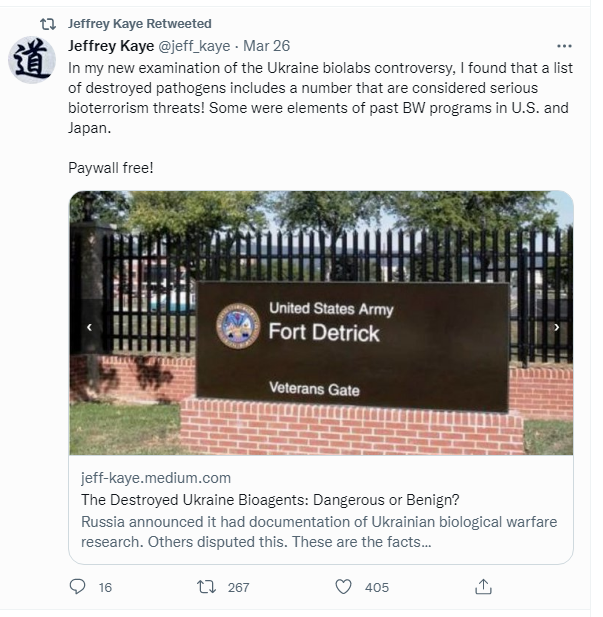
A screenshot of Jeffrey Kaye's tweet
Where has the U.S. biological footprint reached?
U.S. biolabs in Ukraine are just a tip of the iceberg of its long record of chemical and biological experiments worldwide. American researcher Jeffrey Kaye, author of "Cover-up at Guantanamo", revealed recently the U.S. Army's gross deal with Unit 731, a notorious Japanese biological warfare unit that conducted bestial live bacteria experiments on innocent Chinese during the WWII.
By pardoning Unit 731's war criminals, including its head Shiro Ishii who was later assigned to lecturing at Fort Detrick, the U.S. in return obtained data and technologies pertaining to the use of biological and chemical weapons, many of which were also sent to Fort Detrick, center of the U.S. biological warfare research.
According to Jeffrey Kaye, the Central Intelligence Agency (CIA), which worked closely with Fort Detrick on developing such weapons, proved in declassified files that the U.S. applied bio-weapons inspired by Unit 731 during the Korean War, in which countless mice and insects carrying contagious bacteria, including plague and cholera, were dropped to the northern part of the peninsula.
Even now, it remains a mystery what the U.S. has done in its 336 biolabs around the globe. In 2010, Washington apologized for syphilis experiments in Guatemala; for several times, wild protests against a U.S. biolab broke out in Busan, South Korea; last year, the Non-Aligned Movement, speaking on behalf of 123 state parties, urged the U.S. to change its course and called for the resumption of negotiations for a verification protocol of BWC as early as possible. If the calls of the international community are merely treated by politicians in Washington as "disinformation," nobody will ever know what would be unleashed from the Pandora's Box of the U.S. biolabs.
The U.S. is the only country in the world that has used all three major kinds of weapons of mass destruction: nuclear, biological and chemical weapons. Now, it owes the world a fair and verifiable explanation on its biolabs in Ukraine and beyond.
The untold secrets of America's biolabs in Ukraine - CGTN
I think the US owes the world some explanation on this. It won't just go away....
-
31-03-2022, 06:41 PM #4978Heading down to Dino's
- Join Date
- Jun 2009
- Last Online
- @
- Posts
- 35,425
More tin foiled idiocy from a blinkered, humiliated moron.
Russia would never invade and all the west was lying.

-
31-03-2022, 07:24 PM #4979Thailand Expat

- Join Date
- Dec 2009
- Last Online
- @
- Location
- Chiang Mai
- Posts
- 57,183
^He digs deep for that rubbish he posts.
China, Russia slam 'illegal' international sanctions targeting Putin over Ukraine
Russia and China further cemented their alliance on Wednesday, hitting out "illegal" international sanctions on Russia in response to its invasion of Ukraine.
"The ministers had a thorough exchange of views on the situation around Ukraine," the Russian foreign ministry said in a statement following talks between Russian foreign minister Sergei Lavrov and his Chinese counterpart Wang Yi in the eastern province of Anhui on Wednesday.
"The head of the Russian foreign ministry informed his Chinese counterpart about the progress of the special military operation ... and the dynamics of the negotiation process with the Kyiv regime," the statement said.
"The sides noted the counterproductive nature of the illegal unilateral sanctions imposed on Russia by the United States and its satellites."
Wang and Lavrov, who were shown masked and bumping elbows on state TV in deference to CCP leader Xi Jinping's zero-COVID policy, had agreed to continue to speak out on the issue "with a united voice," it said.
Both China and Russia also referenced their vision of a "multipolar" world order, implying a challenge to U.S. diplomatic and military power.
China has refused to describe the war as an invasion, nor to condemn Russia's military action in Ukraine, blaming eastward expansion by NATO for stoking security tensions with Russia and calling for the issue to be resolved through negotiation.
The two foreign ministers also discussed strengthening coordination on foreign policy matters, and widening bilateral cooperation.
'No limits'
Wang Yi was quoted as saying by state-backed Phoenix TV that Sino-Russian ties had "withstood the test of international turbulence," amid an increased willingness to develop the relationship on both sides.
"Our striving for peace has no limits, our upholding of security has no limits, our opposition towards hegemony has no limits," Wang said.
Chinese foreign ministry spokesman Wang Wenbin meanwhile reiterated the ruling Chinese Communist Party (CCP) line that Beijing sees this alliance as having unlimited potential.
"There is no limit to China-Russia cooperation, no limit to our efforts to achieve peace, safeguard security and oppose hegemony," Wang told a regular news briefing in Beijing.
"China-Russia relations are non-aligned, non-confrontational and not targeted at any third party," the spokesman said.
On Ukraine, Wang Wenbin said China would "play a constructive role and provide assistance to normalize the situation in Ukraine," adding, "any action that could add fuel to the fire or exacerbate controversies must be prevented."
Lavrov, who is in the country ostensibly for talks about the future of Afghanistan, said the international community is "living through a very serious stage in the history of international relations."
"We, together with you, and with our sympathizers will move towards a multipolar, just, democratic world order," he said in a video clip released by the Russian foreign ministry ahead of a meeting with Chinese Foreign Minister Wang Yi.
Beijing-based independent commentator Zha Jianguo said the meeting shows that the alliance between Beijing and Moscow is rock-solid.
"China's basic attitude towards the war in Ukraine will not change, which is to say that it will side with Russia while remaining neutral, and focus on its own interests," Zha said.
"I think both sides were probably telling each other the truth, sharing views and attitudes, and gaining further understanding of each other's positions," he said of the meeting.
Low Russian morale
Zha said the war had almost certainly not gone according to Russian president Vladimir Putin's original plan.
"The sticking point right now is likely to be coming from Russia," he said. "Personally, I'm not very optimistic about [these] negotiations."
Independent political commentator Wu Qiang said it was hard to see how long Putin could keep the war going, however.
"If they try to keep the areas they had de facto control of before the war, Donbass and the Crimean peninsula, then this could lead to a protracted defensive war," Wu said.
"But the state of the Russian army right now suggests that would be pretty hard for the Kremlin to do."
Wu said low morale and a hostile international community could affect the stability of Putin's hold on power.
A senior international news editor surnamed Gao said the friendly relationship between Beijing and Moscow had definitely been reaffirmed on this visit by Lavrov.
"They have once more jointly condemned the so-called eastward expansion of NATO, and aid supplies will still be sent to Russia," Gao said. "It's just a little more subtle now, but the friendly ties are definitely being reaffirmed."
"China won't give the U.S. anything, substantially or superficially."
China, Russia slam 'illegal' international sanctions targeting Putin over Ukraine — Radio Free Asia
-
31-03-2022, 07:33 PM #4980Thailand Expat
- Join Date
- Dec 2009
- Last Online
- @
- Location
- Chiang Mai
- Posts
- 57,183
^^What makes no sense to me why any government would pursue biological weapons. We have seen in the last couple of years how fast a new virus can spread around the world even with the best efforts to stop it.
It makes more sense that governments would be trying to figure out how to stop disease spread than start it!
-
31-03-2022, 07:58 PM #4981Thailand Expat
- Join Date
- Feb 2006
- Last Online
- @
- Posts
- 40,667
You really don't have to dig deep kitty.
-
31-03-2022, 07:59 PM #4982Thailand Expat
- Join Date
- Feb 2006
- Last Online
- @
- Posts
- 40,667
Agree totally.It makes more sense that governments would be trying to figure out how to stop disease spread than start it!
-
31-03-2022, 09:24 PM #4983En route

- Join Date
- Jan 2006
- Last Online
- 12-05-2025 @ 09:06 PM
- Location
- Reality.
- Posts
- 32,988
A very good read. If History teaches us anything.....
'This war is far from over': History says Russia isn't really interested in peace.
'This war is far from over': History says Russia isn't really interested in peace
To some, the promise of a settled peace is also reminiscent of the two wars Russia waged in the autonomous, majority-Islamic republic of Chechnya, which sought independence after the dissolution of the Soviet Union in 1991. Fearing that other semi-independent regions would seek to cleave from Russia, President Boris Yeltsin sent the Russian army into what would become its first post-Soviet conflict.
Much like Putin in Ukraine, Yeltsin expected an easy conquest. Again like Putin, he would be proven wrong. The already savage war culminated with an especially savage 1996 battle in the Chechen capital, Grozny. Russia’s inexperienced soldiers, led by corrupt officers, found themselves ambushed by thousands of Chechen fighters who had long been preparing for a definitive battle.
“We had to make them understand that we will never give our country away,” a Chechen commander said at the time, sounding very much like the defenders of Ukraine who say they refuse to accept less than complete independence.
Three weeks after the defeat at Grozny, Russia signed a peace agreement that looked like victory for Chechnya. A brutal conflict was over. A badly wounded superpower withdrew. A much smaller nation yearning for freedom saw that freedom finally within grasp.
“It’s the end of the war,” Russia’s security chief declared.
But only for a little while.
Just five years after that ostensible peace was signed, a second Chechen war began, one that saw a Russian military determined not to make the same mistakes. Just months later, Grozny was flattened. The war would ebb and flow after that but would never descend into the chaos of the Yeltsin years; Russia declared final victory over Chechnya in 2009, just 13 years after promising Chechnya peace.
“The Russian government lies as a matter of policy and principle,” says Russia expert Michael Weiss, who like others sees the Kremlin as a fundamentally untrustworthy negotiator. U.S. officials share that view.
-
31-03-2022, 11:57 PM #4984Thailand Expat
- Join Date
- Oct 2019
- Last Online
- @
- Posts
- 12,608
These same imperial propagandists predicted at the time that Chechnya was going to have an insurgency problem for the next 30 years. Originally Posted by Cujo
Chechnya has since been a success. Chechens put their Russian identity above all else. And they've become an integeral part of the Russian military and were pivotal in pacifying and patrolling Syrian cities.
-
01-04-2022, 12:05 AM #4985Thailand Expat
- Join Date
- Oct 2019
- Last Online
- @
- Posts
- 12,608
What morons call comparative analysis and context when hypocritical agitprop exposed.. Originally Posted by DrWilly
-
01-04-2022, 02:34 AM #4986Thailand Expat
- Join Date
- Oct 2019
- Last Online
- @
- Posts
- 12,608
Some high ranking Azov militants tried to get lifted out of Mariupol in helicopters. They were shot down. Warning. Graphic content
The first video from the crash site of a downed helicopter in the sky over Mariupol. Telegram: Contact @intelslava
-
01-04-2022, 05:33 AM #4987Thailand Expat
- Join Date
- Oct 2019
- Last Online
- @
- Posts
- 12,608
Since the war began, the percentage of Russians who say the country is moving in the right direction soared from 52% to 69%
https://twitter.com/SamRamani2/statu...--1_GhzEg&s=19
-
01-04-2022, 05:35 AM #4988Thailand Expat
- Join Date
- Feb 2006
- Last Online
- @
- Posts
- 40,667
Mariupol is nearly deNazified. Saw some awful war porn on Quora this morning. Still happy about joining Azov tough guy?
-
01-04-2022, 05:42 AM #4989Heading down to Dino's
- Join Date
- Jun 2009
- Last Online
- @
- Posts
- 35,425
So the Russians pulled out then? Originally Posted by sabang
-
01-04-2022, 06:51 AM #4990Thailand Expat
- Join Date
- Feb 2006
- Last Online
- @
- Posts
- 40,667
PCR was, of course, Assistant Secretary for the US Treasury under the Reagan administration. Now Reaganite's can't be all bad- they despise both trumptards and old joes dog n' pony show!
 So I feel it to be my patriotic duty to share this with y'all-
The Sanctions Have Backfired
March 31, 2022 | Categories: Articles & Columns | Tags: | Print This Article
The Sanctions Have Backfired
Paul Craig Roberts
The idiot Biden Regime’s sanctions have turned out to be a great gift to Russia while driving up inflation in the US and its empire, forcing Washington to remove some of the sanctions. DDOS-GUARD
The sanctions have created a great opportunity for import substitution in Russia. Russian investment in the Russian economy prevents foreign ownership from taking the profits out of the country. Instead the profits are reinvested and enrich Russians instead of Westerners.
The sanctions also save Russia from globalism and save her sovereignty with it, while breaking up the Bretton Woods agreement that gave the US a financial and currency monopoly. The main effect of the US sanctions is dedollarization, that is, the end of the dollar’s role as world currency. This means the end of the free ride the US has had from foreigners financing the US trade deficit. Americans will soon be experiencing life no longer subsidized by the rest of the world.
Russia is now set for rapid economic growth like China once Putin gets rid of his incompetent central bank director. The current central bank director is 100 times more damaging to Russia than sanctions.
The American Empire is not the real problem Russia faces. Its real problem are the pro-western globalists in its own upper circles. These Russians are the real danger to Russia. Everyone of them is a de facto American agent. Washington is hoping they will assassinate or overthrow Putin, or in the least continue to restrain his effectiveness.
https://www.paulcraigroberts.org/202...ave-backfired/
-
01-04-2022, 07:03 AM #4991Thailand Expat
- Join Date
- Oct 2019
- Last Online
- @
- Posts
- 12,608

-
01-04-2022, 07:16 AM #4992Thailand Expat
- Join Date
- Aug 2017
- Last Online
- 11-02-2026 @ 06:00 AM
- Location
- Sanur
- Posts
- 8,969
^^^The American Empire is not the real problem Russia faces. Its real problem are the pro-western globalists in its own upper circles. These Russians are the real danger to Russia. Everyone of them is a de facto American agent. Washington is hoping they will assassinate or overthrow Putin, or in the least continue to restrain his effectiveness.
A statement on the one hand saying that the US is not a danger, but pro US influences inside Russia are the biggest danger?
Contradictory opinion in only one paragraph. In the same way that Ukraine has bio labs with US funding, your prior statement claims that these actually exist, but countered by US opinion that such research is for defence against bio/chemical attacks!
Your links seem on the surface to support your assertions, but once again, demonstrate that anyone reading between the lines can easily see the contradictions. (Except you, of course).
-
01-04-2022, 07:21 AM #4993Thailand Expat
- Join Date
- Feb 2006
- Last Online
- @
- Posts
- 40,667
It's not the first time I've heard that actually, about the Russian central bank being too 'westernised'. Anyway, PCR is a bit of an out there dude- but he is worth listening to. If only for a refreshing change from the propaganda blitzkrieg we currently endure.
-
01-04-2022, 07:35 AM #4994Thailand Expat

- Join Date
- Sep 2009
- Last Online
- @
- Posts
- 108,193
And the 2022 "Stating the fucking obvious" award goes to.... Originally Posted by AntRobertson
-
01-04-2022, 07:36 AM #4995Thailand Expat
- Join Date
- Sep 2009
- Last Online
- @
- Posts
- 108,193
And now he's a senile conspiracy theorist who is only taken seriously by fucking morons. Originally Posted by sabang
-
01-04-2022, 07:38 AM #4996Thailand Expat
- Join Date
- Sep 2009
- Last Online
- @
- Posts
- 108,193
Oh Vlad bless him

I bet someone puts that on Wikipedia.Russia Demands Wikipedia Take Down Information About Ukraine War

-
01-04-2022, 09:23 AM #4997En route
- Join Date
- Jan 2006
- Last Online
- 12-05-2025 @ 09:06 PM
- Location
- Reality.
- Posts
- 32,988
Blows my mind the amount of Russian propaganda being parroted here, from nazis to biolabs, I even read a post somehow equating biolabs with the U.S use of agent orange in the vietnam war. FFS.
Morons, I see morons everywhere.
-
01-04-2022, 09:39 AM #4998Heading down to Dino's
- Join Date
- Jun 2009
- Last Online
- @
- Posts
- 35,425
Just three. Skiddy, sabang and OhDoh often referred too as the Three Stooges. Originally Posted by Cujo
-
01-04-2022, 09:52 AM #4999Thailand Expat

- Join Date
- Jan 2016
- Last Online
- @
- Location
- Palace Far from Worries
- Posts
- 14,962
Backspin, instead of sourcing your information from a non-related entity, just simply go directly to the source. Originally Posted by Backspin
So, here is the image from Backspin's post which he linked.
Below is what it should be from the original source ... Indicators – Levada-Center ...
A closer look at what backspin posted ...
1/ The title has been changed
2/ There is a combination of English and Russian on the same image (which doesn't happen)
3/ The question has been changed
4/ The table has been hacked, even the rows don't align.
5/ The table has had a new row added to the bottom called 'Poll Method'
6/ For some weird reason numbers have been replaced with the spelling of the number. e.g. '11' has been replaced with the word eleven ... WTF?
7/ General comment is that the sample size is 100 people and there is no reference as to where (as in just Moscow) the population was sampled.
Apart from that, it's flawless
Someone is sitting in the shade today because someone planted a tree a long time ago ...
-
01-04-2022, 09:59 AM #5000Heading down to Dino's
- Join Date
- Jun 2009
- Last Online
- @
- Posts
- 35,425
So as expected from Skiddy. More horseshit.

 Reply With Quote
Thread Information
Users Browsing this Thread
There are currently 3 users browsing this thread. (0 members and 3 guests)
