

Results 3,251 to 3,275 of 15707
Thread: Ukraine war mega thread
-
05-03-2022, 08:44 AM #3251Thailand Expat


- Join Date
- Oct 2019
- Last Online
- @
- Posts
- 12,608
-
05-03-2022, 11:12 AM #3252hangin' around

- Join Date
- Oct 2006
- Last Online
- @
- Location
- Home
- Posts
- 41,146
Well, those weapons that the dastardly, scheming US 'pumped into' Ukraine will hopefly be put to good use.
And as for 'mutually beneficial cooperation' with Putin, well in another context a 'rofl' emoji would be appropriate.
-
05-03-2022, 11:24 AM #3253Thailand Expat


- Join Date
- Aug 2017
- Last Online
- 11-02-2026 @ 06:00 AM
- Location
- Sanur
- Posts
- 8,969
The British Military Training and advisory teams have been deployed in the Middle East and Africa. Training and advisory teams have been deployed in NATO and non-aligned European countries. These teams are usually in support of FCO requests, or more often in support of perfectly legal British Arms Sales. Their presence has always been with the request and blessing of the host country.
Can Putins Russia say the same about Putins war in Ukraine?
If they are afraid of NATO as you suggest, the common sense approach is to talk to each other and negotiate. That is civilised and sensible behaviour for any country.
Putin, like Backspin, understands this behaviour, but being warmongers, they support the invasion of sovereign countries instead of the more statesman like diplomacy. Putins War is a disgrace and he is now considered to be a global pariah and a bully.
If NATO was the warlike faction that Backspin thinks they are, why haven’t they kicked Putin’s arse all the way back to Moscow? They are perfectly capable of that, but as Backspin has been reminded, NATO are a DEFENSIVE alliance of democratic states and they observe the rules.
Putin tried to re-write the rules in his favour, and despite his protestations to the contrary, the war is not on target. He will not be able to insert a puppet in a country that clearly does not want Russian rule by any means, least of all by Putin’s proxy.
ETA the nazi bullshit is just another Putin propaganda red herring.
-
05-03-2022, 11:28 AM #3254Thailand Expat
- Join Date
- Oct 2019
- Last Online
- @
- Posts
- 12,608
^ It is nice to see Nato's literal billions of dollars go up in smoke. Nato even still has the websites up for these places. https://www.nato.int/structur/nmlo/l...ing-centre.pdf
Ukraine Plans To Speed Construction Of Berdyansk Base Amid Tensions With RussiaToo late.
Nato ribbon cutting.
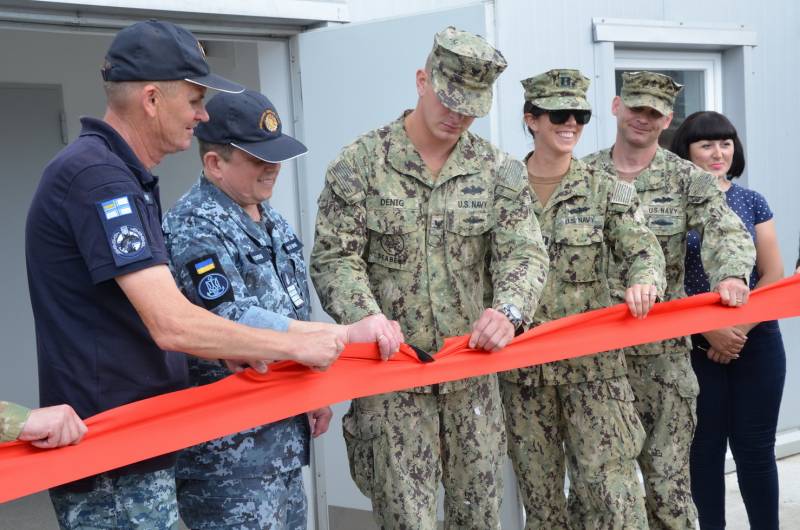
Then Ochakov base completely destroyed

-
05-03-2022, 11:37 AM #3255Thailand Expat
- Join Date
- Oct 2019
- Last Online
- @
- Posts
- 12,608
That's hilarious. Russia was begging for negotiations. And Nato said fuck off every time. If you go into a negotiation and offer nothing, you aren't negotiating. Originally Posted by Switch

U.S., NATO offer no concessions in response to Russian demands on Ukraine | CBC News
NATO rejects Russian demands for security guarantees in latest round of talks - ABC News
-
05-03-2022, 11:48 AM #3256Thailand Expat

- Join Date
- Jul 2010
- Last Online
- 24-07-2024 @ 09:54 PM
- Location
- Where troubles melt like lemon drops
- Posts
- 26,242

Some are suggesting the map represents the final Russia proposed Outcome. The pink area for the remnants of the Ukraine "army", plus western introduced terrorists.
Conveniently adjacent NATO countries, for them to deal with the fascists and terrorists.

The green area Ukraine government, if one survives area, as a neutral country.
The blue area, an area more closely Russian aligned, a la Belarus.
Achievable, this guy had an answer?
A tray full of GOLD is not worth a moment in time.
-
05-03-2022, 11:49 AM #3257Thailand Expat
- Join Date
- Aug 2017
- Last Online
- 11-02-2026 @ 06:00 AM
- Location
- Sanur
- Posts
- 8,969
When you make preposterous demands, why are you surprised that they are rejected? Your opinion is as reliable as a burst sofa. Originally Posted by Backspin
Russia begging for negotiations? Don’t make people laugh so much. This is serious.
-
05-03-2022, 11:56 AM #3258Thailand Expat

- Join Date
- Jun 2010
- Last Online
- 03-08-2023 @ 01:50 PM
- Location
- My couch
- Posts
- 5,027
The Number one reason for the war , is IMO the discovery of vast natural gas fields of the territorial waters of Ukraine. Originally Posted by Backspin
Ukraine contracted with Shell to develop those field, Not only did Ukraine threaten Russia's monopoly but it charged Russia huge fees for the Russian pipeline going through it's territory. Russia checked the Ukrainian development of these fields my annexing Crimea who's territorial waters contain a large percentage of those field. Shel pulled out of the development of those fields.
Crimea is a very arid area and got a lot of it's water from a canal that diverted some water from Dnieper river.
Ukraine blocked the canal , and made overtures to NATO, an overt indication that it had aspirations toward taking back
Crimea ,
No way would Putin allowed Ukraine to become the front door into Russia for NATO or for Ukraine to retake Crimea and threaten Russia's dominance on the energy sector of that region.
I cant believe that the US was not aware of any of those dynamics, but bet that Russia was too week to respond.
Putin called their bluff.
So now it's a question of who is going to blink first
With Germany's block of Nor stream 2 pipeline that Russia was developing to counter the high fees that Ukraine was charging for the southern pipeline , Russia is feeling a revenue crunch, but at the same time energy bills are skyrocketing in Europe, I was just talking to a friend in Greece and he said his electric bill for the last 2 months was over 500 euros, and that was pre invasion bills and with him being very frugal in his electric use.
So it's a game of chess, with element of a game of chicken, with the Ukrainian people and to a lesser extend the European people caught in the middle .
I hope the Ukrainians would come to their senses, and negotiate a deal with the Russians where everyone's concerns are addressed.The sooner you fall behind, the more time you have to catch up.
-
05-03-2022, 12:24 PM #3259Thailand Expat

- Join Date
- Mar 2007
- Last Online
- 21-10-2023 @ 08:08 AM
- Location
- Way, Way South of the border now - thank God!
- Posts
- 33,190
Uh-huh . . . how dare they. Originally Posted by Buckaroo Banzai
Again, how dare they . . . Originally Posted by Buckaroo Banzai
The fees were negotiated and Russia passed on the costs. Originally Posted by Buckaroo Banzai
And that's Ukraine's fault . . . again. Originally Posted by Buckaroo Banzai
Yes, how dare they get invaded by the second largest military superpower on earth. Originally Posted by Buckaroo Banzai
-
05-03-2022, 12:51 PM #3260Thailand Expat

- Join Date
- Aug 2011
- Last Online
- @
- Location
- Fuente del Berro
- Posts
- 27,925
Interesting points, Energy /Money is always moot. Originally Posted by Buckaroo Banzai
Do you think your friends bill was a normal home/appartment in Attica, Athens or the Islands or is he running a resort Hotel in the bitterly cold Northern Mountains . I doubt I spend 22.4 euros /800 269Euros a year ? with Air Con (only used in few hot months here in the very North April-July in 2 rooms 2 Tvs and rooms full of wife's hair dryers and other gadgets, to be honest with few needs, no rent I hardly look at Prices in LOS except a weekly couple fine wines which is always over priced.
While I have a ceramic hob , microwave , 2 ovens used for bread pizza and roasts my Wife prefers BBQ/burn in outside kitchen!
Reason I ask was considering renting a unit in Crete this autumn
To the core issue EU is learning that security of energy supply may trump the price.Last edited by david44; 05-03-2022 at 01:01 PM.
Originally Posted by harrybarracuda
-
05-03-2022, 02:18 PM #3261Thailand Expat
- Join Date
- Jul 2010
- Last Online
- 24-07-2024 @ 09:54 PM
- Location
- Where troubles melt like lemon drops
- Posts
- 26,242
My financial site, Trading Economics, the same site for years, confirms you figures 2020 was a disaster allegedly. Originally Posted by Switch
The NaGastan plan precisely. The EU is caving in to their own demise. Sad. Originally Posted by sabang
NaGastan of course is already in the shit zone, economically.
-
05-03-2022, 02:31 PM #3262Thailand Expat
- Join Date
- Jun 2010
- Last Online
- 03-08-2023 @ 01:50 PM
- Location
- My couch
- Posts
- 5,027
I make no value judgments, I simply state the realities of the situation. Originally Posted by panama hat
-
05-03-2022, 02:38 PM #3263Thailand Expat

- Join Date
- Nov 2006
- Last Online
- @
- Posts
- 41,581
Russian forces attacking journalists / targeting civilians:
Sky News team's harrowing account of their violent ambush in Ukraine this week | World News | Sky News
-
05-03-2022, 02:43 PM #3264I'm In Jail - Don't Hate Me


- Join Date
- Nov 2021
- Last Online
- Today @ 07:59 PM
- Location
- Thailand
- Posts
- 3,411
Guarantee our special forces will be incountry, not fighting but giving ground support and intel. I read somewhere there is actually a portal with live intel which some sections of the Ukrainian military can look at in real time and request whatever they want to know.
-
05-03-2022, 02:55 PM #3265Thailand Expat
- Join Date
- Jun 2010
- Last Online
- 03-08-2023 @ 01:50 PM
- Location
- My couch
- Posts
- 5,027
Yea we are spoiled with electric here in Khon Kaen also. Originally Posted by david44
Ask me again in a few months, I have rented a place in Salamis ,and we are going there April 3rd, I would have a better handle on the situation while there.
Not to go off topic on this Thread I will send you a PM with a couple of links.
-
05-03-2022, 05:33 PM #3266Thailand Expat
- Join Date
- Aug 2017
- Last Online
- 11-02-2026 @ 06:00 AM
- Location
- Sanur
- Posts
- 8,969
You, just like Backspin and OHOh are entitled to your opinion. Like you, they are obliged to answer to real world criticism, instead of using Google fu to find more propaganda. Originally Posted by Buckaroo Banzai
At least your response seem to be based on what you believe as a reasonable observer.
-
05-03-2022, 08:11 PM #3267Thailand Expat

- Join Date
- Dec 2009
- Last Online
- @
- Location
- Chiang Mai
- Posts
- 57,185
Is the Russian Air Force Actually Incapable of Complex Air Operations?
Justin Bronk
4 March 2022
7 Minute Read
More than a week into the Russian invasion of Ukraine, the Russian Air Force has yet to commence large-scale operations. Inactivity in the first few days could be ascribed to various factors, but the continued absence of major air operations now raises serious capability questions.
One of the greatest surprises from the initial phase of the Russian invasion of Ukraine has been the inability of the Russian Aerospace Forces (VKS) fighter and fighter-bomber fleets to establish air superiority, or to deploy significant combat power in support of the under-performing Russian ground forces. On the first day of the invasion, an anticipated series of large-scale Russian air operations in the aftermath of initial cruise- and ballistic-missile strikes did not materialise. An initial analysis of the possible reasons for this identified potential Russian difficulties with deconfliction between ground-based surface-to-air missile (SAM) batteries, a lack of precision-guided munitions and limited numbers of pilots with the requisite expertise to conduct precise strikes in support of initial ground operations due to low average VKS flying hours. These factors all remain relevant, but are no longer sufficient in themselves to explain the anaemic VKS activity as the ground invasion continues into its second week. Russian fast jets have conducted only limited sorties in Ukrainian airspace, in singles or pairs, always at low altitudes and mostly at night to minimise losses from Ukrainian man-portable air defence systems (MANPADS) and ground fire.
MORE Is the Russian Air Force Actually Incapable of Complex Air Operations? | Royal United Services Institute
-
05-03-2022, 08:28 PM #3268I'm In Jail - Don't Hate Me
- Join Date
- Nov 2021
- Last Online
- Today @ 07:59 PM
- Location
- Thailand
- Posts
- 3,411
^He is using what is expendable in my view. He will need his high tech aircraft and the heavily trained pilots IF there was a bigger war with NATO in the future.
I have always thought that the real question is, how much does this war expose him in the future. I guess not much because he will always have his nukes. Either way, I think he is not using his airforce because it is probably not necessary for this scenario.
Just my take
-
05-03-2022, 08:45 PM #3269Thailand Expat
- Join Date
- Dec 2009
- Last Online
- @
- Location
- Chiang Mai
- Posts
- 57,185
'He was deceived by his own propaganda': Putin's former speechwriter speaks to WION
Russian President Vladimir Putin's former speechwriter Abbas Gallyamov spoke to WION as he attempted to decode him.
Gallyamov deemed Putin as a "rational" man. "He was always struck me as being absolutely rational. You could never think that he could ever be able to act so emotionally," Abbas said.
Speaking directly from Tel Aviv about the Ukraine invasion, Gallyamov said that in this case, Putin does have a "plan B".
"In this case, he was deceived..he was deceived by his own propaganda. He was trying to prove to Russians that Ukraine is weak and the Russian army is most powerful in the world."
Gallyamov believes that Putin did not so much convince Russians, as he convinced himself. "As he crossed the border, he started the action actually hoping that it would be something like it was in 2014 when he took over Crimea from Ukraine."
The situation now is different, Gallyamov said. "There is a legitimate president elected by the people."
"Putin, however, was unable to understand that. And now, he needs to improvise and is therefore pulling out the nuclear weapon threat," believes Gallyamov.
The former speechwriter further said that this is about his image as he has always presented himself as a "strong man."
Putin had declared "special military operations" against Ukraine on February 24 as Russian forces began pounding Kyiv with missiles and attacked Ukrainian cities.
The war has now entered its tenth day with heavy bombing campaign underway by Russian forces. Amid the fighting Western nations have announced waves of sanctions against Putin's regime although NATO has said it won't be sending its troops and planes to Ukraine.
Watch: 'He was deceived by his own propaganda': Putin's former speechwriter speaks to WION, World News | wionews.com
-
05-03-2022, 09:10 PM #3270Thailand Expat
- Join Date
- Oct 2019
- Last Online
- @
- Posts
- 12,608
"We are grateful to the volunteers who come to our military registration and enlistment offices, but their help is not needed and, I am sure, it will not be" - Putin
-
05-03-2022, 09:17 PM #3271Thailand Expat
- Join Date
- Oct 2019
- Last Online
- @
- Posts
- 12,608
Why do ppl keep deluding themselves ? Russia didn't need to even use its air force. It has cruise missiles with 4500 km range. Originally Posted by misskit
The Russian air force single handedly ended the civil war in Syria and is still stationed there right now , running patrols daily. Yet these delusions in the media come up.
The US is just butthurt that some of its trained terrorists with expensive stinger missiles have nothing to shoot at
-
05-03-2022, 09:24 PM #3272Thailand Expat

- Join Date
- Nov 2005
- Last Online
- @
- Posts
- 17,370
...Mark Hachman (Twitter) If you were wondering about whether the Russians really influence our social media, compare the list of top Facebook posts from a few weeks ago to this week, when Russia couldn't access its foreign cash reserves. Rather telling.
-
05-03-2022, 09:32 PM #3273Thailand Expat
- Join Date
- Dec 2009
- Last Online
- @
- Location
- Chiang Mai
- Posts
- 57,185
How the US can beat Russia in Ukraine without firing a shot
Despite a brave showing by the Ukrainian army and people, Russian victory seems inevitable — but what then?
Watching the Ukrainian conflict unfold on television has been indescribably painful. For those U.S. military veterans whose experience of war lacks perhaps the moral clarity of the Ukrainian cause, the feeling of helplessness is particularly acute. Despite a brave showing by the Ukrainian army and people, Russian victory seems inevitable — but what then?
“We will be fighting,” Oksana Markarova, the Ukrainian ambassador to the United States announced last week. “Not only our brave and motivated military but all Ukrainians … We don’t expect others to fight with us, but we expect all the support we can get.”
Ambassador Markarova’s promise — echoed repeatedly in the press by her compatriots — offers hope that a post-invasion Ukrainian resistance will turn the tide on Putin, and convince Russia that Ukraine is untenable. For readers of a certain era, that thought will conjure up images from the “Guns of Navarone” — with David Niven and Gregory Peck creating havoc with a hapless Wehrmacht in the mountains of Yugoslavia. (A slightly younger generation might think of “Red Dawn.”) The reality, of course, is that getting a respectable resistance movement up and running requires deliberate planning, and — despite some blithe commentary in the media suggesting otherwise — is by no means a straightforward task for any government to pull off successfully. In the early parts of the Cold War, efforts by the CIA and MI6 to back resistance in countries behind the Iron Curtain, such as Ukraine, the Baltics and Albania, all ended in disaster. More recently, a U.S.-led effort to raise a local force to fight ISIS in Syria also failed.
If the United States is serious about supporting a resistance movement in Ukraine, the decision to do so needs to be made now and a deliberate plan put in place before the Russian Federation has engulfed the entire country.
Fertile ground for Ukrainian resistance
Ukrainian national resolve appears unshaken, which augurs well for a nascent resistance movement. And as anyone who has worked with the Ukrainian military will tell you, the last eight years of war with Russia, and increasingly close relations with the West, have led to a strong feeling of nationhood among the Ukrainian people. In a December poll of Ukrainians taken by a Kyiv think tank, 45% of respondents said they would resist a Russian invasion, weapons in hand. Even allowing for false bravado, that is a strong indicator of national resolve.
Evidence of this has been seen in the fight put up by the Ukrainian army from the outset of the invasion — the counter-attacks to take lost ground and the determined last stand made by a number of units and individuals. If Kyiv falls, the Ukrainian government will likely set up in Lviv, the largest city in western Ukraine, the birthplace of Ukrainian nationalism where 60% of the population say that they plan to resist a Russian occupation.
Popular support, however, while necessary for any resistance movement is by itself not enough. The U.S. government must now ensure that other conditions are in place.
What are the legal implications of supporting resistance in Ukraine?
The first step must be to ensure that the domestic legal requirements for supporting a resistance movement are in place. If the Russians capture the whole country, then the question becomes one of sponsoring resistance against a sovereign nation, which is illegal in the absence of a Presidential Finding to permit covert action.
No finding will be needed if the United States recognizes a government in exile as the legitimate government of Ukraine. There’s a good chance that this question is already being discussed, or at least it should be. In 2016, while serving as a special operations task force commander in the counter-ISIS fight, our plans to raise an active resistance in Mosul were, at the last minute, stymied by a legal requirement that forbade us from using proxy forces for lethal action.
A clear policy: How far are we prepared to go?
The United States needs to establish clear campaign objectives for the resistance, with the resources required and an assessment of the risks involved. The goal will be to sustain a viable resistance and cause pain for the Russians — ultimately forcing them to withdraw without risking armed conflict with Russia. But what will that entail?
Lethal aid has previously been thought of as the Rubicon for any country supporting an insurgency, but it’s not that simple anymore. Some of the most effective assistance that the United States can give a resistance movement in Ukraine will probably be in the cyber domain and on the electromagnetic spectrum — actions to selectively jam or deceive Russian command and control systems. Such actions, even if confined to those units in Ukraine, heighten the risk of escalation. This isn’t a topic that the United States can just back into. It needs to be discussed now.
A grinding war of attrition will not benefit the Ukrainian people. The longer the resistance continues, the more savage reprisals are likely to be; Russia has a track record of using brutal methods to suppress such activity, as witnessed in Chechnya. Washington will want to insist that members of the resistance are treated by the Russians as combatants with all protections that accrue under this heading. Convincing the Russian government that it is in its interests to do so will be the trick — it may seem that they have little more to lose at this point. As with everything that involves Putin, some creative diplomacy will be required in crafting a message that things will most certainly get worse for him if he mistreats captured members of the resistance or commits atrocities against the Ukrainian people. The story of Slobodan Milosevic, the former President of Serbia who died in his cell at The Hague while undergoing a trial for war crimes, provides a relevant cautionary tale.
Setting up safe havens
Every successful resistance requires a safe haven, a secure area where a resistance force can resupply, train, treat its casualties, and plan future operations. The need for such a location is as much psychological as physical since a safe haven helps guard against the debilitating sense of isolation and vulnerability to exposure that must inevitably undermine the morale of any movement fighting an occupation force.
It is difficult, if not possible to seal a country’s borders hermetically. Historically, no counterinsurgency campaign has been completely successful in doing so — not the French in Algeria, the Americans in Vietnam, the British in Northern Ireland nor again the U.S. military in Afghanistan and Iraq.
Ukraine, Europe’s second-largest country, has thousands of miles of border, much of which abuts against NATO territory. The Russians will not be able to stop the flow of aid to a resistance group across these borders, but safe-havens come at a cost for those countries that provide them, wittingly or otherwise. Occupying armies tend not to respect international boundaries when it becomes apparent that insurgent forces are using them for protection — cross-border air and artillery strikes and raids are the common methods used in such circumstances to destroy safe havens and to deter countries from hosting them. In some cases, safe havens incur a full-scale invasion — as was the case with Israel’s invasion of Lebanon in 1982 or South Africa’s incursions into Angola and Botswana in the 1970s and 1980s.
In the four NATO countries bordering Ukraine — Poland, Slovakia, Hungary, and Romania — this concern will already be weighing in a decision whether to support a Ukrainian resistance. Indeed, the ramifications of Russian retribution go beyond the individual countries involved — since any violation of their borders will trigger NATO’s Article V, thus challenging the principle of collective self-defense that lies at the heart of the organization’s founding treaty. Washington needs to move now to ensure that the countries concerned are on board, with a focus on Poland since that country’s position, length of border, and current U.S. military footprint make it the best option. Because of the potential downside involved for those countries, this will involve a concerted diplomatic effort.
The need for a safe haven is heightened by the transparency of the modern battlefield. Escaping the reach of occupying forces is harder now thanks to drones, satellites, and thermal imagery. But technology, of course, works both ways. U.S. assistance will need to involve direct support to enable resistance units to defeat Russian drones and other methods of surveillance.
Supply sensors and shooters
Careful planning has to go into supplying the resistance with what it most critically needs. Logistics lines that are set up from point of manufacture or warehouse to distribution in-country or at a safe haven, are bound to be vulnerable. Redundancy is therefore all-important — as is prioritizing what gets passed along these lines.
Since resistance fighters are likely to be outnumbered in every engagement, they will need more than small arms or anti-tank weapons to give them the ability to engage the Russians outside the range of the latter’s weapons. Man-portable anti-tank and anti-aircraft missiles have been making the news, but U.S. assistance should also include plentiful drones such as the Bayraktar TB-2, which is capable of penetrating Russian air defense systems and loitering munitions, which can search out and destroy with precision targets several miles from the operator. Even simple kamikaze drones such as the Switchblade, which has a range of roughly 6 miles and is relatively inexpensive, would be the ideal weapon to provide en masse to the Ukrainian resistance.
The Javelin anti-tank guided missile, already supplied to the Ukrainians, is the only such weapon capable of defeating the Russian T-90 tank’s reactive armor, but it requires a particular model of warhead to do so. It’s unknown if the Ukrainians are already in possession of this particular model, but if not, it should now become a priority to get it to them.
The same goes for the latest model of the famed Stinger anti-aircraft launcher, which advertises the ability to shoot down fast-flying fixed-wing aircraft. And lastly, a hand-held counter-drone capability will be worth more than its weight in gold.
Western military observers will have noticed the tendency among Russian mechanized infantry to remain “buttoned up” in their vehicles after contact with the enemy, effectively ceding the initiative and leaving themselves vulnerable to mass casualties from a single anti-tank projectile. This is partly a function of the way that the Russian battalion tactical groups are organized with just a few soldiers per vehicle, and partly a result of poor training. In a few weeks will come the springtime thaw, or rasputitsa – a term that means “time without roads” in that part of the world. The same intractable mud that stopped the Wehrmacht will now slow Russian operations and logistics efforts – making the armored vehicles upon which they are so dependent even more vulnerable.
Stand up a cyber resistance
U.S. assistance should include cyber and electromagnetic operations targeting Russian forces in Ukraine. This carries with it the risk of escalation, but in the current situation the United States can make a clear distinction between cyber-attacks launched against the Russian homeland, and those directed against Russian military forces violating Ukrainian sovereignty, with the latter declared fair game. This last point could be made as an explicit red line to Putin to avoid turning a tactical cyber campaign into mutually assured paralysis.
Alternatively, because cyber and electromagnetic spectrum operations are notoriously hard to attribute and because their intermittent use in support of resistance operations could be below the threshold of Russian detection, the United States might choose not to claim ownership.
Electronic and cyber-attacks could be used to target the command and control nodes of those Russian units on Ukrainian soil. Such attacks would involve more than intermittently shutting these systems down. They would instead create ambiguity — a perception that Russian forces are not where they are supposed to be, and Ukrainian forces are everywhere.
The United States should also target Russian logistics via cyberattacks against rail networks in Ukraine and leading into Ukraine. A number of the Ukrainian rail lines are electrified and therefore vulnerable to cyber interference with control stations and power sources.
Get into Ivan’s head
Insurgencies tend to be particularly nasty wars that bring out the worst in people. U.S. efforts should focus on delivering this fact to the Russian people — while undermining the morale of Russian soldiers in Ukraine. The occupation force is likely to be comprised — as most of the Russian Army is — of conscripts who lack the training, maturity, and discipline required to fight a successful counterinsurgency. They are less likely than regular soldiers to take the trouble to do those little but burdensome tasks that help keep you alive in such an environment.
They are more likely to succumb to grief and anger following the loss of comrades. And they are more likely to overreact to provocation, with results that undermine their cause. These are fertile conditions for a coherent information campaign, which could be launched by the Ukrainian resistance with U.S. technical assistance.
Build Ukrainian resistance networks
The resistance must have roots in the heartland. Cross-border raids will have limited effect, so the resistance needs to strike instead where Russian forces are most vulnerable: logistics supply lines and command and control nodes. For these targets it is much easier to use resistance fighters already in the area — people living ostensibly normal lives but with access to weapons and communications — than to try to infiltrate a force from outside. The best approach may be to combine the two, which requires planning and preparation to put in place. The U.S. will likely be working now to identify and contact these networks, and if not, it probably should.
The U.S. military will need to set up a fusion cell with Ukrainians to process information collected, shared, and disseminated in support of the resistance. One proviso: U.S. military personnel involved will need to overcome their squeamishness about commercial platforms. In 2016, most traffic between my counter-ISIS task force and resistance groups in Mosul took place on WhatsApp and Skype. We shouldn’t expect the Ukrainian resistance to act differently.
Rescue the leaders
Russia’s leaders are already alleged to have drawn up capture or kill lists of those who might be involved in any resistance to prevent it from developing. Indeed, they would be foolish not to do so. The immediate aftermath of Russia capturing the country will see a round-up of these Ukrainians with an effect on the nascent resistance that is impossible to estimate now.
The United States should work with the Ukrainian government to get many of these leaders out of the country now, and into one of the safe havens being established to support the resistance.
Provide continuous training
Creating resistance fighters from scratch is a labor and time-intensive enterprise with results that are more often than not disappointing. Ideally, resistance fighters are already familiar with the tools of the trade, and just need to be fed and equipped, as was the case, for instance, with Mujahedin fighting the Russians in Afghanistan. One can expect for there to be in Ukraine a pool of such men and women with the training and motivation to continue to resist: former soldiers of the Ukrainian Army in addition to the hundreds of thousands of Ukrainian civilians with military experience. U.S. training efforts will focus therefore on specialized skills — such as the employment of drones and anti-tank and anti-aircraft weapon systems or the manufacture of improvised explosive devices. U.S. trainers must also plan to collect and propagate by training specific tactics and techniques that have proved to be particularly effective against the Russians. These efforts will require semi-permanent camps, far enough from the border to avoid surveillance or attack. Such camps excite international interest and trigger political sensitivities, all of which Washington must be prepared for.
Where we go from here
Invading a country is one thing, occupying it is quite another, and barring escalation, time is on the side of the Ukrainian resistance. The Russians will move quickly to detain or kill resistance leaders, whose identities we must assume they know. These initial successes may disrupt initial plans for the resistance, but won’t be fatal. Other leaders will take the place of those who were arrested, or killed, and the organization will adapt and gain momentum.
Time may be on the side of the Ukrainians, but that does not mean that the insurrection will end quickly. The fall of the Taliban in 2002 at the hands of the Northern Alliance was an anomaly that may have left policymakers with a false impression. Resistance movements take time to build momentum and achieve their goals, usually years. Supporting an insurgency throughout will take political will and strategic patience — resources that are perhaps most likely to run out first.
How NATO can beat Russia in Ukraine without firing a shot
(Posted to make socal go change his pants.)
-
05-03-2022, 09:34 PM #3274Thailand Expat
- Join Date
- Oct 2019
- Last Online
- @
- Posts
- 12,608
It's incorrect. The war happened for the same reason any US president would go to war if the Chinese were building naval bases on Vancouver island. While the US navys only warm water port was at Point Roberts. Originally Posted by Buckaroo Banzai
The civilian population always thinks wars are about resources. They aren't. Why did Chinese oil companies get the majority of the oil in Iraq ? Because the US didn't want it. Resource extraction is not a get rich quick scheme anymore. It's the opposite. It's capital intensive and fraught with risk.
-
05-03-2022, 09:35 PM #3275Thailand Expat
- Join Date
- Oct 2019
- Last Online
- @
- Posts
- 12,608
Myth Originally Posted by tomcat
EU Official: ‘We Cannot Block’ Russia’s Central Bank Reserves, They Moved Them Out ‘In The Last Year’ - [your]NEWS

 Reply With Quote
Thread Information
Users Browsing this Thread
There are currently 3 users browsing this thread. (0 members and 3 guests)
