

The Azolla event
The Azolla event occurred in the middle Eocene period, around 49 million years ago, when blooms of the freshwater fern Azolla are thought to have happened in the Arctic Ocean. As they sank to the stagnant sea floor, they were incorporated into the sediment; the resulting draw down of carbon dioxide has been speculated to have helped transform the planet from a "greenhouse Earth" state, hot enough for turtles and palm trees to prosper at the poles, to the icehouse Earth it has been since.
Conditions encouraging the event
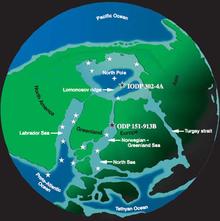
The continental configuration during the Early Eocene resulted in an isolated Arctic basin.
During the early Eocene, the continental configuration was such that the Arctic sea was almost entirely cut off from the wider oceans. This meant that mixing — provided today by deep water currents such as the Gulf Stream — did not occur, leading to a stratified water column resembling today's Black Sea.[6] High temperatures and winds led to high evaporation, increasing the density of the ocean, and — through an increase in rainfall — high discharge from rivers which fed the basin. This low-density freshwater formed a nepheloid layer, floating on the surface of the dense sea. Even a few centimetres of fresh water would be enough to allow the colonization of Azolla; further, this river water would be rich in minerals such as phosphorus, which it would accumulate from mud and rocks it interacted with as it crossed the continents. To further aid the growth of the plant, concentrations of carbon (in the form of carbon dioxide) and accessible nitrogen in the atmosphere are known to have been high at this time.
Blooms alone are not enough to have any geological impact; to permanently draw down CO2 and cause climate change, the carbon must be sequestered, by the plants being buried and eventually fossilised. The anoxic bottom of the Arctic basin, a result of the stratified water column, permitted just this: the anoxic environment inhibits the activity of decomposing organisms and allows the plants to sit unrotted until they are buried by sediment and incorporated into the fossil record.
Global effects
With 800,000 years of Azolla bloom episodes and a 4,000,000 km² basin to cover, even by very conservative estimates more than enough carbon could be sequestered by plant burial to account for the observed 80% drop in CO2 by this one phenomenon alone. This drop initiated a global temperature decline which continued for millions of years[citation needed]; the Arctic cooled from an average sea-surface temperature of 13 °C to today's −9 °C, and the rest of the globe underwent a similar change. For perhaps the first time in its history, the planet had ice caps at both of its poles. A geologically rapid decrease in temperature between 49 and 47 million years ago, around the Azolla event, is evident: dropstones — which are taken as evidence for the presence of glaciers — are common in Arctic sediments thereafter. This is set against a backdrop of gradual, long-term cooling: It is not until 15 million years ago that evidence for widespread polar freezing is common.
Alternative explanations
While a verdant Arctic Ocean is a viable working model, sceptical scientists point out that it would be possible for Azolla colonies in deltas or freshwater lagoons to be swept into the Arctic Ocean by strong currents, removing the necessity for a freshwater layer. Economic considerations
Much of the current interest in oil exploration in the Arctic regions, made possible by global warming, is directed towards the Azolla deposits. The burial of large amounts of organic material provides the source rock for oil, so given the right thermal history, the preserved Azolla blooms might have been converted to oil or gas. This means that much money is available for the study of this event[citation needed] — a centre has been set up in the Netherlands devoted to Azolla.
Azolla event - Wikipedia, the free encyclopedia
http://www.soest.hawaii.edu/GG/FACUL...et_al_2008.pdf
Possibly a simplification of a poorly understood phenomena, but does demonstrate a possible method for the reduction of carbon dioxide in the atmosphere. The Black Sea and a major amount of nitrate could offer the same conditions.
Results 1 to 4 of 4
Thread: THe Azolla Event
-
07-01-2011, 09:39 PM #1Not a Mod.


- Join Date
- Mar 2006
- Last Online
- @
- Location
- Lagrangian Point
- Posts
- 11,365
THe Azolla Event
-
08-01-2011, 07:45 PM #2Out there...



- Join Date
- Jul 2009
- Last Online
- @
- Location
- BKK
- Posts
- 40,029
Interesting stuff, thanks.
-
09-01-2011, 05:26 PM #3Member

- Join Date
- Jun 2010
- Last Online
- 12-01-2011 @ 11:58 AM
- Posts
- 795
Aren't the oil companies going to the Arctic areas going to release even more CO2 once they tap the Azolla underground there. The idea doesn't show a solution any more than it shows a threat in my view.
If I remember right, as it is they say as the northern regions get warmer they releasing gases stored in permafrost at a higher rate adding to the greeenhouse effect.
-
10-01-2011, 08:37 PM #4Not a Mod.
- Join Date
- Mar 2006
- Last Online
- @
- Location
- Lagrangian Point
- Posts
- 11,365
^The carbon from the Azolla event has been buried and cooked long ago. It's a source of hydrocarbons that have migrated into more recent rocks.
I posted the study as it appears to be a "geologicaly" swift method of removing large amounts of CO2 from the atmosphere.


 Reply With Quote
Thread Information
Users Browsing this Thread
There are currently 1 users browsing this thread. (0 members and 1 guests)
