

That seems like the smart thing to do really.
If you don't pay off the car and get broke then they come and take the car, it is a secured loan.
So you pay it off with the card, then you own the car and the Credit Card is an unsecured loan so they are just fucked if you can't pay.
I have always thought it was strange of people to hock their house for the money to pay off credit cards,,
Results 51 to 75 of 269
Thread: US dollar decline, or collapse?
-
20-03-2009, 06:39 PM #51RIP


- Join Date
- Dec 2006
- Last Online
- 08-07-2010 @ 08:33 PM
- Location
- Phetchabun city
- Posts
- 15,471
-
21-03-2009, 05:37 AM #52ding ding ding

- Join Date
- Jul 2006
- Last Online
- @
- Posts
- 12,604
Use mastercard to pay your visa bill, was how somebody put it. Originally Posted by Mid
-
21-03-2009, 06:46 AM #53I don't know


- Join Date
- Dec 2005
- Last Online
- @
- Location
- on pacific ocean, south america
- Posts
- 21,406
Got this: Worth a skim. Mostly the top 1/3:
Link at the top.
Fed planning 15-Fold Increase in US monetary base
http://www.marketskeptics.com/2009/0...ase-in-us.html
by Eric deCarbonnel
The fed is planning moves that would more than double its balance-sheet assets by September to $4.5 trillion from $1.9 trillion. Whether expressing approval or concern over the fed’s move, most commentators fail to understand the real magnitude of the projected expansion of the US monetary base because they don’t take into account the amount of dollars circulating abroad.
At least 70 percent of all US currency is held outside the country, and this means the US monetary base is considerably smaller than the fed’s overall balance sheet. Take, for example, the true US domestic money supply at the beginning of September 2008, before the fed started its quantitative easing. From the Federal Reserve’s website, we know that currency in circulation was 833 Billion. This translates as 583 Billion dollars circulating abroad (70 percent), and 250 Billion dollars circulating domestically (30 percent). Since the bank reserve balances held with Federal Reserve Banks were 12 billion, that gives us a 262 Billion domestic monetary base as of September 2008. Now compare that to the projected US domestic monetary base for September 2009 which is 3,818 billion (4,500 billion – 583 billion (dollars circulating abroad) – 99 billion (other fed liabilities not part of the money supply)). The fed’s planned balance sheet expansion results in a 15-fold increase in the base money supply.
262 Billion = US monetary base as of September 2008 (minus dollars held abroad)
3,818 Billion = projected US monetary base in September 2009 (minus dollars held abroad)
3,818 Billion / 262 Billion = 15-Fold Increase in US monetary base
This is a staggering devaluation of the US currency! That means for every dollar that existed in America in September 2008, the fed is going to created fourteen more of them! Below is a rough sketch of what this Increase in US monetary base would look like:

This 15-Fold Increase will be impossible to reverse
Next September, when the fed realizes it has gone too far and tries to reverse its balance sheet expansion, it will be unable to do so. The realities which will hinder the fed’s control of the money supply are:
1) The toxic assets filling its balance sheet
Expanding the money supply is easy. All the fed has to do is print dollars and then use them to buy assets. There is no effective limit to how much the fed can print and spend.
Shrinking the money is much trickier. To shrink the base money supply, the fed sell assets and takes the dollars it receives for them out of circulation. The amount the fed can shrink the money supply is therefore effectively limited by the market value of assets on its balance sheets. Since the fed is in the process of loading up on toxic securities trying to restore health to the financial sector, it is now sitting billions of unrealized losses. These unrealized losses means the fed has little ammunition available to bring the money supply under control.
Once September rolls around, If the fed wants to reverse the expansion of its balance sheet and shrink the monetary base back down from 3,818 billion to 262 billion, then it will need to sell 3,556 billion worth of assets. However, the market value of its assets will only be worth a fraction of that.
2) Political constrains on fed's actions
Even if the fed does try to shrink the money, it is likely to run into political constrains on its actions:
A) Selling toxic assets at a loss could become a crippling source of major embarrassment for the fed, undermining its authority. For example, last year when the fed took 29 billion toxic assets to help JPMorgan’s takeover of Bear Stearns, it assured Americans that by holding those securities till maturity, the cost to taxpayers would be minimal. If the fed sells those toxic Bearn Stearns assets at a catastrophic loss, it would cause fury and outrage from voters and lawmakers.
B) Selling assets at below book value will quickly cause the fed’s equity to turn negative. The federal reserves would then need to be recapitalized by new debt from the treasury, which would increase the national debt.
3) The benefits from of its balance sheet expansion which would be lost if the fed starts selling assets
The fed is accumulating toxic mortgage backed securities, long term treasuries, and other assets to unfreeze the credit markets and spur economic growth. Turning around and selling those assets would result in the collapse of the credit markets and the financial system, which the fed has been desperately trying to prevent.
Upwards pressure on interest rates
On top of all the issues above, the fed’s woes are going to be compounded by upwards pressure on the yields of treasuries and other US debt. This upwards pressure will likely force the fed to monetize far more treasuries than the planned $300 billion purchases it has already announced, and will greatly complicate any efforts by the fed to control the money supply.
Below are the nine factors which will cause yields to move higher:
1) Massive supply of treasuries in the pipeline
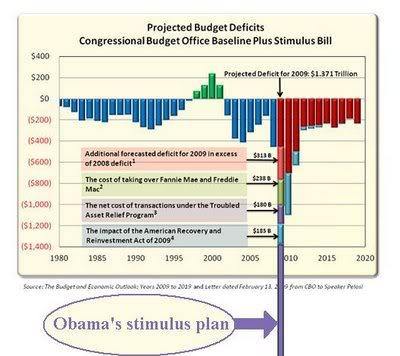
The biggest force of upward pressure on treasury yield is without a doubt the trillions of debt the treasury is going to sell to finance the US’s enourmous 2009 budget deficit. There is nowhere near enough buyers to this supply. The graph below demonstrates the challenge facing the treasury in trying to fund this year’s deficit.
2) As a reserve asset, treasury bonds will face enormous selling pressure in 2009
There is the mistaken belief that the treasuries’ role as a safe haven is bullish for treasury bonds. It is not. This logic ignores the reality that reserve assets, such as treasuries, are accumulate in good times and sold in bad times:
Federal and state agencies will be selling treasury reserves. For example, the Deposit Insurance Fund (a.k.a. FDIC) will be selling treasuries to pay back depositors of failed banks, and the Unemployment Trust Fund will be selling treasuries to make payments to the unemployed.
State and local governments will be selling treasury reserves. As an example, states have already begun drawing down reserves as their budget troubles worsen. The bulk of those reserve remain, and they will be sold over the course of this year.
Banks and insurers will be selling off their treasury loan-loss reserves. Financial institutions have been building their treasury loan-loss reserve for the last year in anticipation of growing defaults. In 2009, this process will reverse as loans go bad and insurers make good on claims.
Foreign central banks will be selling off their treasury foreign reserves. Saudi Arabia, for example, is projecting a 2009 Budget Deficit, which it intends to finance by selling off its US holdings. Russia, meanwhile, has already sold over 20% of its $598.1 billion reserves, and India's central bank has been forced to sell off its US holdings to curb its currency's decline, and its total reserves have decreased by $62.2 billion. Japan, which is now running record current account deficits, can also be expected to sell treasuries.
Even China could become a seller of treasuries as it mobilizes its dollar reserves. The Chinese government has sent clear signals that it is shifting from passive to active management of its reserve and is exploring more efficient ways to use its reserves to boost its domestic economy.
3) Retirement inflows into treasuries are over
The steady accumulation of treasuries by government retirement funds has helped absorb the supply of treasury bonds over three decades. This accumulation of government debt to secure the retirement of baby boomers helped drive down treasury yields and fund US deficit spending. As of September 2008, the four biggest of these funds held 3.3 trillion treasuries:
2150 billion (Federal old-age and survivors insurance trust fund)
615 billion (Federal employees retirement fund)
318 billion (federal hospital insurance trust fund)
217 billion (federal disability insurance trust fund) (for more on these four funds, see where social security tax amounts deposited)
3300 billion total
Today, the accumulation of treasuries by government retirement funds is now over. Baby boomers are beginning to retire, increasing outflows, and unemployment is rising, cutting inflows. More importantly, the 3.3 trillion already accumulated in these funds provides an enormous political incentive to prevent treasury prices from collapsing. Faced with a run on treasuries, politicians, rather than explaining to baby boomers that their retirement savings are gone, will instruct the fed to monetize treasury bonds. This alone will prevent the fed from reversing its current balance sheet expansion.
4) Deleveraging in credit-default swap market will drive up risk premiums
If you have been following the credit crisis in any detail, you might have heard that the 53 trillion credit-default swap market threatening the solvency of the financial system. What you might not have heard is the other dire threat posed by the CDS market: drastically higher risk premiums on all forms of debt.
These higher risk premiums are the result of reversing the process by which credit-default swaps were leveraged up and packaged into investment vehicles. Some examples of these horrors are:
Synthetic CDOs
As opposed to regular CDOs (which contain actual bonds), synthetic CDOs provide income to investors by selling credit-default swaps on hundreds bonds from companies and governments.
To juice returns, these synthetic CDOs disproportionally insured the riskiest AAA rated debt, such as Lehman’s bonds. Synthetic CDOs are estimated to have sold insurance on between $1.25 trillion to $6 trillion worth of bonds.
constant-proportion debt obligations
CPDOs are specialized funds which work exactly like synthetic CDOs but with one major difference: they used leverage to boost returns. These CPDO funds typically borrowed about $15 for every dollar invested with them. They also contain safety triggers that force the liquidation of their investments if losses reach a predetermined level, and most CPDO funds have begun to hit these triggers. For example, Three CPDO funds launched in 2006 by Dutch bank ABN Amro Holding NV have already been forced to liquidate as credit insurance costs spiked and their credit ratings were downgraded.
credit derivative product companies
CDPPs are another group of specialized funds which work exactly like synthetic CDOs and CPDO funds, except for one key difference: they used an insane amount of leverage, as much as $80 for every dollar invested. CDPP funds together with subprime CDOs squared are finalists for the title of “most idiotic financial instrument ever created”.
Since these leveraged investment vehicles sold an enormous amount of insurance, the premiums for CDS insurance dropped sharply, making corporate debt seem safer and lowering interest rates. In effect, the process of building up the 53 trillion CDS market created an era of artificially low risk premiums on all forms of debt. Unfortunately, the pendulum is now swinging in the other direction, and the pain has just begun.
As investors attempt to get out of synthetic CDOs and CPDO/CDPP funds try to deleverage, they push up the cost of default insurance. In turn, that raises the risk premium on all forms of debt since most investors use the cost of default insurance as a guide when deciding at what interest rate they will buy bonds. Many banks are also tying corporate loan rates to credit-default swaps, raising borrowing costs and exposing companies to an overleveraged derivative market which is largely responsible for crippling the financial system.
The graph below shows how the cost of insuring the debt of EU nations is being driven up.

The rising cost of insuring debt is impacting treasuries too. The cost to hedge against losses on $10 million of Treasuries is now about $100,000 annually for 10 years, up from $1,000 in the first half of 2007. These rising insurance costs have helped push up treasury yields in the last few months. Worse still, the rising costs of insuring against government defaults will undermine faith in dollar. After all, the CDS market is telling us that 10-year treasury note has become 100 times more risky in the last two years.
5) Unwinding the Gold carry trade
The massive expansion in the US money supply will undoubtedly drive gold prices several times higher and force the unwinding of the gold carry trade. To see the threat which unwinding the gold carry trade poses, it is necessary to understand how US and UK financial institutions got themselves stuck in enormous short position in gold from which they have no hope of ever escaping. For that purpose, I have outlined below the five steps Wall Street seems to repeat endlessly on its path to ruin.
Step 1: Wall Street embraces a false paradigm
“Housing prices never fall”
-----
“gold is a relic” or “gold is in permanent downtrend”
Step 2: Wall Street makes billions embracing this false paradigm…
US/UK Financial institutions made billion in fees from making mortgage loans and securitizing them.
-----
US/UK Financial institutions made billions via gold carry trade. Here is an ultra quick explanation how it works from zealllc.com
So, if you can find a cheap enough cost of capital, a safe enough destination, and you have the credit to borrow large amounts of money, you too could make enormous profits in carry trades. The notorious gold carry trade is based on the exact same idea. Elite money-center bullion banks were given sweetheart opportunities to borrow central bank physical gold at 1%, sell it in the open market, and immediately invest the proceeds in higher yielding “safe” investments and reap vast profits.
As Moneyweek further explains:
It seemed like a no-brainer. The central banks got to squeeze a yield from their gold. The borrowers got to sell the gold on, and use the proceeds to fund more exciting investments like 10-year US Treasuries yielding 4% per year or so. Yes, these 'carry trade' returns were tiny. But the cost of borrowing gold was tinier still.
Step 3: …and creates a catastrophic mess in the process
Enormous housing bubble
Subprime CDOs squared
Off balance sheet SIVs
Etc…
-----
Commercial banks and speculators are left inescapably short gold. This ridiculous short position is best captured by John Hathaway in his 1999 article, The Golden Pyramid.
The recipe for a shortage has been carefully followed. A few finishing touches may be required before a market epiphany. There is no known reconciliation between paper and physical positions, and none will be attempted until after the squeeze. The weakness of credit analysis and supervisory oversight, as well as the many ambiguities in the linkage between paper gold and physical can flourish only if there is supreme confidence in gold's permanent downtrend. The trust and confidence essential to balance the gold derivatives pyramid depends on three critical errors: that mine reserves = physical gold; that gold receivables = gold on hand; and that financial markets will enjoy smooth sailing indefinitely. Trust is nothing more than a state of mind. When this levitation is finally exposed and its illusions shattered, it is ludicrous to think the imbalances can be corrected by a small rise in the price and within a comfortable time frame. Expect the resolution to be swift, furious, and uncomfortable for those caught short.
Step 4: Something then goes horribly wrong
Subprime borrowers start defaulting
Housing prices plummet
-----
Gold prices shoot up after the 1999 Washington Agreement on Gold (EU central banks agreed to limits on gold sales/leasing).
This gold bear trap is best described by Reginald H. Howe in his report about central banks at the abyss.
The first Washington Agreement on Gold, announced in September 1999 at the close of the annual meetings of the International Monetary Fund and World Bank in Washington, D.C., placed limits for the next five years on the official gold sales of the signatories as well as on their gold lending and use of futures and options. Put together at the instigation of major Euro Area central banks in response to the decline in gold prices caused by the series of U.K. gold auctions announced in May of the same year, WAG I caused gold prices to shoot sharply higher.
Within days, as gold shorts rushed to cover, the price jumped from around $265 to almost $330/oz. and gold lease rates spiked to over 9%. The rally caught the major bullion banks completely wrong-footed, resulting in the panic later described by Edward A.J. George, then Governor of the Bank of England (Complaint, 55):
We looked into the abyss if the gold price rose further. A further rise would have taken down one or several trading houses, which might have taken down all the rest in their wake. Therefore at any price, at any cost, the central banks had to quell the gold price, manage it. It was very difficult to get the gold price under control but we have now succeeded. The U.S. Fed was very active in getting the gold price down. So was the U.K.
Despite managing to “get the gold price under control”, US/UK bullion banks (JPMorgan, HSBC, etc…) have been stuck on the short side of gold ever since.
Step 5: The US fed and UK do everything in its power to “safe the financial system”
Royal Bank of Scotland bailout
Bear Stearns bailout
Freddie/Fannie bailout
AIG bailout
US/UK Quantitative easing
Etc…
-----
Leasing out all US/UK gold to bullion banks
Gold swaps with foreign central banks (then leasing out the gold)
Convincing allies to sell gold
Writing naked call options on gold
Britain’s 1999 gold sales
Pre-emptive gold sales
Allowing JPMorgan’s and HSBC’s manipulation of COMEX futures
Etc…
Make no mistake, gold prices have suppressed, but calling this process a “conspiracy” would be inaccurate. Gold suppression by the US and UK is better characterized as a desperate cover-up. Furthermore, while a side affect of the gold carry trade and gold suppression was to drive down interest rates, that was never the .
A desire to hold interest rates would not have been enough to push the fed or bank of England to manipulate the price of gold. It was only the threat of the total collapse of US/UK financial system which prompted the suppression of gold. The unwinding of the gold carry trade would have (and will) drag the some of the biggest US/UK banks under (JPMorgan, HSBC, etc…) and that was what had to be prevented at any cost.
Stay away from any form of paper gold: GLD (HSBC is custodian), gold pools and unallocated gold accounts, gold futures, etc… Paper gold investments are guaranteed to default before this crisis ends.
Besides leaving the financial system inescapably short gold, the gold carry trade also drove down yields on treasuries and other US debt, as commercial banks invested the proceeds from the sale of borrowed central bank gold and other naked short positions. Unwinding the gold carry trade involves the purchase of physical gold, but also the sale of the investments linked to the gold short positions. As the fed begins 15-fold expansion of the monetary base (which logically should eventually send gold prices up at least ten times where they are now), the unwinding and fallout of the gold carry trade seems imminent.
6) The return of the 580 billion dollars circulating abroad
Over the last thirty years, the steady outflow of 580 billion dollars has helped drive down interest rates. For example, If 10 billion dollars leaked out of the US and began circulating abroad, the fed would print 10 billion and buy treasuries in order to replenish the domestic money supply. So the 580 billion dollars held abroad resulted in the purchase of roughly 580 billion treasury bonds by the fed, thereby increasing demand for US debt.
While the accumulation of oversea dollars has been beneficial in the past, today the large pools of dollars circulating outside the US pose a threat. With many dollar alternatives becoming available, US oversea currency looks increasingly likely to start flowing back home. The main currencies with the potential to displace dollars are:
A) Chinese yuan is becoming an international currency
B) Gulf states are launching their own currency called the Khaleeji and possibly be backed by gold.
C) Euro with its partial gold backing
D) Gold
Furthermore, now that the fed has begun creating money at an accelerating rate, the extensive foreign holdings of US currency might exacerbate the effects of inflation fears. As foreign dollar holders’ confidence in the dollar is eroded, they will trade their dollars for alternate stores of value (yuan, euro, gold, etc…), potentially sending a flood of currency back to the US. If the Fed failed to reduce the supply of currency to counteract dollars being unloaded from abroad, the inflationary consequences would be made worse as the mass reversal of currency flows from foreigners to the US becomes overwhelming.
7) Interest rate derivates nightmare
This threat posed by interest rate derivates is perhaps the greatest out of all the ones outlined so far. It is also the one hardest to understand. First thing to note about interest rate swap is the size of the market, as explained by the Wikipedia:
The Bank for International Settlements reports that interest rate swaps are the largest component of the global OTC derivative market. The notional amount outstanding as of December 2006 in OTC interest rate swaps was $229.8 trillion, up $60.7 trillion (35.9%) from December 2005. These contracts account for 55.4% of the entire $415 trillion OTC derivative market. As of Dec 2007 the number rose to 309,6 trillion according to the same source.
The growth in interest rate swaps creates demand for bonds because many of these interest derivatives require the purchase of bonds as a hedge. Rob Kirby on 321gold.com explains this in his article, the real ponzi scheme - "unreal interest rates".
Interest Rate Swaps create demand for bonds because bond trades are implicitly embedded in these transactions. Without end user demand for the product - trading for "trading sake" creates ARTIFICIAL demand for bonds. This manipulates rates lower than they otherwise would be.

Interest rate swaps were originally developed to [1] allow parties to exchange streams of interest payments for another party's stream of cash flows; [2] manage fixed or floating assets and liabilities and [3] to speculate - replicating unfunded bond exposures to profit from changes in interest rates. Growth in the first two of these activities are dependent on their being increased end-user-demand for these products - graph 1 above indicated that this is not the case:
In the case of J.P. Morgan in particular [forgetting about the lesser obscenities at Citi and B of A]; their interest rate swap book is so big that there are not enough U.S. Government bonds being issued or in existence for them to adequately hedge their positions.
This means that the obscene, explosive growth in interest rate derivatives was all about overwhelming the long end of the interest rate complex to ensure that every and any U.S. Government bond ever issued had a buyer on attractive terms for the issuer. Concurrent with the neutering of usury, the price of gold was also "capped" largely through Fed appointed banks "shorting gold futures" as well as brokering gold leases [sales in drag] sourcing vaulted Sovereign Central Bank gold bullion. The gold price had to be rigged concurrently because historically, according to observations outlined in Gibson's Paradox - lowering interest rates leads to a higher gold price. Gold price strength is historically synonymous with U.S. Dollar weakness which leads to higher financing costs or the possibility of capital flight.
Same as with the gold carry trade, while the explosive growth in interest rate derivatives did reduce interest rates by creating demand for bonds, I am not sure about the conspiracy element. From everything I have seen and read during the credit crisis, the wizards of Wall Street (ie: the creators of the subprime CDO squared, and other horrors) and the federal reserve seem more like children playing with dynamite rather than masterminds capable of pulling off vast conspiracies.
The greater threat posed by interest rate swap
Besides creating artificial demand for bonds, interest rate swap market pose an even greater systematic risk than the credit default swap market because of its enormous size and the fact that each interest rate swap contract offers the potential for unlimited losses. The graph below should help show this danger.

In a currency collapse (which is where we are headed with Bernanke’s 15-fold increase in the money supply), interest rates follow inflation to astronomical heights. Loans for 24 hour periods and interest rates in the five or six digits are common in hyperinflation, and, should they occur here in the States, anyone “short the swap” (the floating-rate payers) will be crushed into oblivion. At least with credit default swaps, there is a limit to how much investors can lose.
8) The liquidation of the 8 Trillion dollar holdings of overleveraged European banks
European banks increased their dollar assets sharply in the last decade which help drive down US interest rates and absorbed a large portions of America's growing debt. Their combined long dollar positions grew to more than $800 billion by mid-2007. This $800 billion was then leveraged into $8 trillion in US assets. The low capital ratios of these dollar positions were acceptable to regulators because European banks are allowed to apply a lot more leverage as long as they are buying exclusively AAA rated securities.
Unfortunately, as we have learned over the past 18 months, AAA is not always AAA. While much of the AAA rated securities bought by European banks were treasuries and agencies, some of these AAA rated securities were senior securitized loans that are still marked close to par on the balance sheet of European banks despite the fact they trade around 70 cents on the dollar in the markets. The enormous unrealized losses of their US holdings are only one of the problems facing European banks.
The other is the loss of their dollar funding. The enormous leverage employed by European banks to purchase toxic AAA rated US assets was funded in great part by loans from US money market funds. After Lehman's default led to massive withdrawals from money market funds, European banks lost access to dollar financing to billions in dollar funding.
If European banks are forced to sell their 8 trillion US assets, it will crash the credit markets, and they will have to recognize enormous losses. Since the fed is desperate to prevent the collapse of the US financial system, it lent those European banks 600 billion dollars so that they wouldn't be forced to sell. Meanwhile, European banks accepted this 600 billion because they don't want to recognize losses on their toxic US securities.
What is going to happen next with these overleveraged European banks?
Well, if history is any guide, the outlook isn’t good for the US financial system:
“When the American economy fell into depression, US banks recalled their loans, causing the German banking system to collapse”
The same thing will happen in 2009, except the roles will be reversed. It will be European banks that will recall their loans and sell off dollar assets, causing the US banking system to collapse.
What could convince European banks sell off their US assets at firesale prices?
The answer is simple: fear of a dollar collapse. With the fed increasing the monetary base 15-fold, the strategy of waiting for impaired assets to recover becomes meaningless: if European banks fear the dollar might lose nine tenths of its value in the next year, then waiting for assets trading 70 cents on the dollar to recover is a senseless venture.
9) Inflation expectations
The US’s experience during the Great Depression has left America dominated by Keynesian thinking and prone to deflation fears. As a result, inflation expectations are about nonexistent right now despite the current financial crisis. However, the fed’s latest plan to expand the monetary base 15-fold should give pause to the most hardened deflationist. Indeed someone must be worried, because the fed’s Wednesday announcement has caused a dramatic collapse of the dollar:

The sheer size the fed’s monetary expansion and the dollar’s fall will soon increase both inflation and inflation expectations. This in turn will put upwards pressure on treasury yields.
Conclusion
Since the thirty years, long-term interests rates have steadily fallen in US, as demonstrated by the chart below

Logically speaking, the chart above makes no sense. The US fundamental underlying the US economy have grown steadily worse over the last thirty years. For example, in 2006, the US’s current account deficit nearly hit 9 percent of gdp, and economists usually consider 4% to be unsustainable. There are also the US’s chronic budget deficits and the massive projected social security shortfalls. Even more incomprehensible, over the last six months the yield on long-term treasuries has fallen in the face of a disintegrating economy and a massive expansion of the supply of treasuries. This is NOT how the world works: as the financial health of borrowers decrease, their interest rates are supposed to go up. The only rational explanation is that some combination of forces has been unnaturally driving rates lower. These forces, (outlined above) which have driven interest rates down in the last three decades, have today become threats and issues which need to be resolved before the current crisis can end:
The US budget deficit
The crisis in entitlement spending
The trade deficit and large holdings of treasury reserves
The credit-default swap market
The gold carry trade
The 580 billion dollar circulating overseas
The 8 trillion dollar assets accumulated by European banks
The interest rate swaps market
The Keynesian thinking dominating US economic and fiscal policy
-
21-03-2009, 12:19 PM #54I don't know
- Join Date
- Dec 2005
- Last Online
- @
- Location
- on pacific ocean, south america
- Posts
- 21,406
Devaluing the dollar, inflation, dumping Treasuries, refusing to buy more = downward US Dollar:
Link & Entire: Euro Pacific Capital
The Mother of All Bells
March 20, 2009
There is an old adage on Wall Street that no one rings a bell at major market tops or bottoms. That may be true in normal times, but as many have noticed, we are now completely through the looking glass. In this parallel reality, Ben Bernanke has just rung the loudest bell ever heard in the foreign exchange and government debt markets. Investors who ignore the clanging do so at their own peril.
The bell’s reverberations will be felt by everyday Americans, whose lives are about to change in ways few can imagine. While nearly every facet of America’s economy has been devastated over the past six months, our national currency has thus far skipped through the carnage with nary a scratch. Ironically, the U.S dollar has been the beneficiary of the global economic crises which the United States set in motion. As a result, our economy has thus far been spared the full force of the storm.
This week the Federal Reserve finally made clear what should have been obvious for some time – the only weapon that the Fed is willing to use to fight the economic downturn is a continuing torrent of pure, undiluted, inflation. The announcement should be seen as a game changer that redirects the fury of the financial storm directly onto our shores.
In its statement, the Fed announced its intention to purchase an additional $1 trillion worth of U.S. treasury and agency debt. The purchases, of course, will be made with money created out of thin air through the Fed’s printing presses. Few can doubt that they will persist with these operations until the economy returns to its former health. Whether or not this can ever be accomplished with a printing press alone has never been seriously considered. Bernanke himself admits that we are in uncharted waters, with no map or compass, just simply a hope that more dollars are the answer.
Rather than solving our problems, more inflation will only add to the crisis. Falling asset prices, the credit crunch, declining consumer spending, bankruptcies, foreclosures, and layoffs are all part of the necessary rebalancing of our economy. These wrenching movements, however painful, are the market’s attempts to resolve the serious problems at the root of our bubble economy. Attempts to literally paper-over these problems will lead to disaster.
Now that the Fed has recklessly shown its hand, the mad dash to get out of Treasuries and dollars should not be far off. The more the Fed prints to buy bonds the less the dollar is worth. Holders of our debt (read China and Japan) understand this dynamic. We must expect that they will not only refuse to buy new bonds, but they will look to unload those bonds they already own.
-
25-03-2009, 02:00 PM #55I don't know
- Join Date
- Dec 2005
- Last Online
- @
- Location
- on pacific ocean, south america
- Posts
- 21,406
Here is Jim Rogers on why the recent dollar rally is happening, and he states he think the USD will down.
-
28-03-2009, 10:05 PM #56I don't know
- Join Date
- Dec 2005
- Last Online
- @
- Location
- on pacific ocean, south america
- Posts
- 21,406
A discussion about the dollar and China's options. March 25, 2009:
-
30-03-2009, 02:48 PM #57Thailand Expat
- Join Date
- Jul 2007
- Last Online
- 20-10-2012 @ 04:24 PM
- Posts
- 7,959
After the Vietnam war USA was essentially broke and under Nixon they totally abandoned all ties with the gold standard, demanding to trade only in $USs.
France was the only country to resist the US ultimatum and demanded US pay its debts to France in gold. The French resistance against the $US monopoly failed because USA refused to accept it.
USA writes all its debt in $USs and all its trade is in $USs. As the biggest debtor nation on earth and the biggest consumer nation on earth USA now has something of a monopoly on the worlds trading currency.
In recent years the Euro has encroached on the $US to take over a quarter of the world trade in that currency. The $US still controls about two thirds of all world trade.
Any country could trade in any currency they like, including gold. Just they wouldn't be doing business with the USA. France found that out in the '70s.
When the debt ridden $US tanks, a lot of countries will take a big loss, -- especially China and Japan. It makes a lot of sense for China to propose a new world currency now while the $US exchange rate is still strong.
-
30-03-2009, 03:26 PM #58Excommunicated

- Join Date
- Apr 2006
- Last Online
- Today @ 03:42 PM
- Posts
- 25,579
all those americans with their 401ks - they have lost half their personal wealth and still have the wife

-
30-03-2009, 04:27 PM #59Thailand Expat
- Join Date
- Jul 2007
- Last Online
- 20-10-2012 @ 04:24 PM
- Posts
- 7,959
At least the wives can keep the smile on their face, --- they still have a financial asset working for them even after they divorce 'em. Originally Posted by baldrick

-
31-03-2009, 01:06 PM #60I don't know
- Join Date
- Dec 2005
- Last Online
- @
- Location
- on pacific ocean, south america
- Posts
- 21,406
Countries and using dollar for trade and shifting out of US dollar for trade:
Argentina and Brazil
http://www.presstv.ir/detail.aspx?id...onid=351020706
Russia, China, Belarus,
http://www.bloomberg.com/apps/news?p...d=aYaPzpEgF_BA
South Korea, Japan and China (this one I wasn't aware of)
http://www.bloomberg.com/apps/news?p...d=awJV0HGibVmw
China, Argentina
http://www.marketwatch.com/news/stor...-1D24927C4433}
Southeast Asia, China, Japan, Korea
http://news.alibaba.com/article/deta...operation.html
-
31-03-2009, 01:16 PM #61Thailand Expat

- Join Date
- Jan 2006
- Last Online
- @
- Posts
- 15,051
i think most would agree that the dollar is in trouble....but the pertinent question is when will the bottom fall out? right now, i'm in 6 different currencies (actually five plus commodities), but i'm extremely overweight $US at nearly 60%.
it seems to me that if/when we retest the lows in world stock markets, there will be additional rushes to safety (ie the dollar).
after that, massive stimulus plans and inflation in the US would seem to be the biggest worry for the dollar. market timing is a gift few have, but finding the sweet spot between these two would be ideal.Last edited by raycarey; 31-03-2009 at 01:30 PM.
-
31-03-2009, 02:28 PM #62I don't know
- Join Date
- Dec 2005
- Last Online
- @
- Location
- on pacific ocean, south america
- Posts
- 21,406
That is a high ratio, but you can switch currencies with the click of a mouse, correct? Originally Posted by raycarey
The recent strength of the US dollar is happening now.it seems to me that if/when we retest the lows in world stock markets, there will be additional rushes to safety (ie the dollar).
Here is a current take. But when? We have to track it, and watch.
-
31-03-2009, 04:14 PM #63Thailand Expat
- Join Date
- Jul 2007
- Last Online
- 20-10-2012 @ 04:24 PM
- Posts
- 7,959
Downside of the oversupply of the $US and its eventual decline is going to be inflation with higher costs and reduced standard of living for US citizens.
Upside is going to be a more competitive export position which will lead to more jobs and less government debt.
Its an adjustment that HAS TO HAPPEN sooner or later for not just the USAs economy to function properly, but for the whole worlds economy to function properly.
Same, same British Pound.
Wealth is also going into the Japanese Yen, which is pushing up its value and hurting the Japanese economy.
All the more reason why we need a truly international currency based on production of real goods and services to move ahead with a stable world economy. The experiment with the $US as a free floating currency of world trade has ended in failure. The time for a more sensible alternative is approaching.
The real danger is that the world will take the loss when the $US drops in trading value and continue to limp along with it or worse, move to the Euro as the preferred trading currency. Staying with the old failed financial exchange system or moving to the Euro would only start the artificial boom and bust cycle all over again.
-
02-04-2009, 10:17 AM #64Excommunicated
- Join Date
- Apr 2006
- Last Online
- Today @ 03:42 PM
- Posts
- 25,579
interesting article from atimes
Asia Times Online :: Asian news and current affairsTHE BEAR'S LAIR
Beyond the dollar
By Martin Hutchinson
People's Bank of China governor Zhou Xiaochuan said last week that the Special Drawing Rights (SDR) of the International Monetary Fund (IMF) should replace the dollar as the world's main currency. The political reasons for his proposal are clear, its merits rather less so. Could the world economy work better with a global central bank, whether in the form of the IMF or some other body, and with a global currency as its main reserve unit?
There is certainly a good argument for the world ditching the dollar. It's estimated that the US budget deficit for the current fiscal year that runs through September will be 12% of gross domestic product (GDP). Broad money supply, whether measured
by M2 or the St Louis Fed's MZM, has risen at annual rate of 17% in the six months through March 16, before the start this week of the Fed's potentially hyper-inflationary purchase of US$300 billion of Treasury bonds over the next six months.
There is thus no reason to believe that the dollar represents a sound store of value, the principal function of a reserve currency. While liquidity in US dollar debt instruments is enormous and ever increasing as their supply skyrockets, there must be a danger of disruptions in the Treasury bond market similar to that caused by the "failed auction" last week in the UK gilts market, potentially causing price discontinuities and liquidity outages. In criticizing US economic management, therefore, Zhou is on solid ground, reflecting many of the criticisms this column has made of US monetary policy since 1995 and fiscal policy since 2002.
Other major world currencies don't look any more solid than the dollar. The pound is equally affected by the financial services disaster, and the UK has a budget deficit that is as large as the United States in terms of GDP, has been much worse managed over the last several years, and has an economy with very little raison d'etre outside the shrunken financial services sector. The yen has been strong recently, but that strength has caused a collapse in Japanese exports, down in February by almost half from the previous year. Domestically, the Japanese economy had been quite well run until September 2008, but Prime Minister Taro Aso represents a reversion to the worst tendencies of the 1990s, with four wasteful public spending "stimulus" plans announced, a budget deficit as large as that of the United States, and a government debt three times larger.
Only the euro represents a haven of stability, particularly if the German and French reluctance to indulge in excessive public spending spreads to the remainder of the currency's members. While the Mediterranean group of countries have structural weaknesses, their membership in the euro will force discipline on them, and so the chances are that the euro bloc will hold together. If it does, the euro will provide a satisfactory store of value, since the European Central Bank's policy has been far less inflationary than that of the United States and its members' budget deficits are much smaller. The danger is that of the unit's relative novelty; in a deep and prolonged recession, it is possible that Italian, Greek and Irish profligacy will overwhelm German and French good management, either debauching the unit or splitting it apart.
Zhou no doubt regards China's monetary management as a model of solidity. That is nonsense. For one thing, in spite of its $2 trillion in reserves and massive balance of payments surpluses, China has still not allowed its ordinary residents to invest abroad on a free basis. Doubtless that policy results from a desire to maintain the apparatus of a police state rather than from balance of payments paranoia. Still, it is highly immoral, blocking one of the most fundamental and important economic freedoms and protections against arbitrary government. No currency that is subject to an exchange control regime has any claim to be included in the international monetary system, the essence of which is the free movement of capital.
There are also, incidentally, remaining questions about the Chinese banking system. The $911 billion of bad loans in the system estimated by Ernst & Young in the boom year of 2006 will certainly not have diminished and may well have increased further in the current downturn, which appears to be more severe than the Chinese authorities are admitting.
Nevertheless, whether or not his own currency is in a fit state to travel, with $2 trillion of international reserves Zhou has a perfectly reasonable desire that the value of those reserves should not disappear in an orgy of inflationary monetary policy and "Yes, We Can" deficit spending. US authorities may object to this desire, since a withdrawal of any significant portion of China's reserves would irretrievably doom the Treasury bond market, but their right to object is vitiated by their responsibility for the spendthrift policies that led to the dollar's vulnerability.
As the proprietor of a non-convertible currency, Zhou doubtless has only a limited grasp of the purpose of a reserve currency. This is threefold. First, it must provide immediate liquidity for the world's pools of international reserves. Second, it should provide a store of value, preventing those reserves from being artificially devalued. Third, it should as far as possible be "politician-proof", gaining its value through some automatic mechanism that is not dependant on the whims of central bankers and politicians. As the current unpleasantness has demonstrated, central bankers and politicians are only too likely to panic in crises and engage in value-destroying currency debasement.
The gold standard, in place with a few interludes for more than 200 years from its establishment by Isaac Newton as Master of the Mint in London in 1717 until its final collapse in 1931, fulfilled all three purposes admirably. Since gold could be melted down and re-minted in the form of any of the world's currencies, it was admirably liquid. It provided a superb store of value, although that value fluctuated by as much as 20% to 25% with periods of new gold discoveries (California and Victoria for a decade from 1849-51, South Africa and the Klondike in the 1890s) when prices rose, and periods of economic expansion faster than the rate of gold discovery (1870-93) when prices declined. Most important, it was automatic and independent of political and central banker control. Under it, bubbles were throttled fairly early by shortages of specie and downturns were ended by natural means rather than by dissolute floods of money creation.
In an ideal world, we would satisfy Zhou's requirements by a simple return to the gold standard at a parity, of perhaps $1,000 per ounce, that was high enough not to be excessively deflationary. There would doubtless be a few years of disruption, as there were in 1815-19 when Britain was forced into deflation to return to the gold standard at its pre-1797 parity. However, in the long term, the world's monetary system would settle down on the basis of the major currencies being linked to gold. Central banks and politicians would be deprived of much though not all of their power over money creation. Damaging bubbles such as those of 1995-2007 would be cut short by a drain of gold from the banking system, forcing higher interest rates before prices of stocks, housing and commodities got too far out of line.
In the world we live in, that option is not politically available. In any case, with global population growth running at around 1% annually, it is doubtful whether gold can be discovered fast enough to prevent an excessively deflationary price regime under a gold standard. Contrary to the absurdly overblown view of Federal Reserve chairman Ben Bernanke, deflation of 1% to 2% per annum is harmless, even beneficial, but in extreme cases such as that of 1930-33, when US prices fell 25% in terms of gold dollars, it stifles productive investment because holding cash becomes highly profitable in real terms.
Gold mine production in 2008 of 2,407 tonnes, higher than in recent years because of high gold prices, was only 1.4% of the gold stock of 170,000 tons. If velocity were constant, that would not be sufficient to accommodate 1% population growth and desired global economic growth of 3% without an unpleasant average annual deflation of 2.6%. (In the 19th century, gold mine output was higher in terms of the existing gold stock while population increase averaged only about 0.5% annually. The faster population growth and relatively slower gold stock increase after 1900 made the 1920s' gold standard unpleasantly deflationary.) Thus a global return to the gold standard is at present impossible, though it would certainly be feasible and possibly attractive for an individual country.
Zhou's proposal for increasing SDR issuance passes none of the above tests for a reserve currency. Before 1971, the SDR was linked nominally to gold, but it is currently a basket made up of 63 US cents, 41 euro cents and smaller amounts of yen and sterling. The total of SDR quotas is currently SDR 21.4 billion; a proposal has been outstanding since 1997 (effectively blocked by the United States), which would increase that total to SDR 64.2 billion (about US$100 billion.) Smaller than the money supply of Malaysia, that is a laughably inadequate amount of money to provide adequate liquidity for the world's reserves.
Zhou would propose - with the breathless endorsement of senior IMF officials - that new SDRs be created to raise the SDR money supply to an adequate value comparable to the broad US money supply of $9.6 trillion. Needless to say, this would be extraordinarily inflationary.
Spurred by the grossly over-expansionary US monetary policy, and later by similar follies elsewhere, international reserves more than quadrupled in the decade from 1998, rising at an average annual rate of over 16%. Since September, most monetary authorities have pursued even laxer monetary policies, so an epidemic of high global inflation is inevitable once the recession bottoms out. A large expansion of SDRs would greatly worsen that problem, preventing the SDRs themselves or any other currency from representing an adequate store of value, for international reserves or any other purpose.
However, the most serious reason why the SDR should not be used as a reserve currency is its control by the unaccountable bureaucrats of the IMF. Far from being immune to political control, SDRs would be managed by international bureaucrats subject to no outside control by electorates or the market. Such bureaucrats would be at least as prone to damaging panic as domestic monetary authorities. Even more dangerous, they would be free to manage the world's money by whatever cockamamie left-wing economic theories they chose, and to siphon off resources from the world's money supply to every corrupt Third World Marxist regime they wanted to support.
Allowing the SDR to become the world's reserve currency, even on a non-exclusive basis, would place global monetary policy entirely on a non-market basis, without individual countries having any recourse but to purge their international reserves of SDR assets and refuse to accept SDRs in payment - which would defeat the point of the exercise. It is a proposal worthy of the impoverished and genocidal China of Mao Zedong, not the hopeful market-oriented China of today.
If China is really worried about the value of its reserves and wishes to provide a long-term benefit to the world economy and its own citizens' wealth, it has an alternative to the SDR, which would weaken rather than strengthen the trans-national bureaucrat class. The IMF, typically enough, forbids its members from linking their currencies to gold. Governor Zhou should break that prohibition and put the yuan on the gold standard. With $2 trillion in reserves and a structural balance of payments surplus, China can well afford it.
and this article - too long to post in its entirety - is a very good take on the US financial system
The Quiet Coup - The Atlantic (May 2009)Last edited by baldrick; 02-04-2009 at 11:45 AM.
-
04-04-2009, 02:43 PM #65I don't know
- Join Date
- Dec 2005
- Last Online
- @
- Location
- on pacific ocean, south america
- Posts
- 21,406
Long article, but worth a browse. It's about the Fed increasing the money supply:
Link at the topc.There Will Be (Hyper)Inflation - Thorsten Polleit - Mises Institute
Mises Daily by Thorsten Polleit | Posted on 4/2/2009 12:00:00 AM
Thorsten Polleit is Honorary Professor at the Frankfurt School of Finance & Management.
Increasing "Excess Reserves"
The demise of fiat-money regimes around the world has become unmistakable. They can only be kept alive by central banks creating ever greater amounts of base money and governments underwriting commercial banks' liabilities.
The US Federal Reserve, for instance, increased the stock of the monetary base — which includes banks' demand deposits held with the Fed, plus coins and notes in circulation — from $870.9 billion in August 2008 to $1735.3 billion in January 2009.

Banks' "excess reserves" — banks' base-money holdings minus required reserves — rose from $1.9 billion to $798.2 billion. These excess reserves allow the banking sector, which operates under fractional reserves, to increase the credit and money supply manifold.
The monetary base expands when the central bank takes over the troubled assets of commercial banks in order to extend new credit to those banks. This process is gaining momentum: on March 18, 2009, the Federal Open Market Committee (FOMC) announced that it will increase base money by purchasing another $1,150 billion of securities. It is also considering increasing base money by extending credit to private households and small businesses.
Causing Inflation
What the Fed does is produce inflation — and this is a truth that stands in sharp contrast to what mainstream economists say, namely that the rise in base money will just increase the liquidity in the interbank market and will not affect the money holdings in the hands of consumers, firms, and the government, which — they admit — could then inflate consumer prices.
In contrast, Austrian economists stress that inflation is a result of a rise in the stock of money. This viewpoint rests on sound economics, firmly rooted in the notion that, first and foremost, value is a subjective concept. Money is a good, like any other, and it is therefore subject to the law of diminishing marginal utility.
A rise in the money stock necessarily reduces the marginal utility of a money unit — and therefore its value — from the viewpoint of the individual; likewise, the marginal utility of a money unit — and therefore its value — would increase if the money stock declines.
Changes in the value individuals assign to a money unit are reflected in prices for vendible items. For instance, if the money stock in the hands of an individual rises, he may wish to increase his holdings of other goods. As he exchanges money against vendible items, the prices of the latter are bid up.
In that sense, the change in the money stock is what must be called inflation, while changes in the prices for goods and services are just symptoms of the underlying cause, which is the change in the stock of money.
What the rise in base money has done so far is prevent prices of banks' security holdings to decline to free-market levels. In other words, the money injection helps to keep asset prices at artificially elevated levels, thereby preventing prices in financial markets, credit markets in particular, from adjusting.
The Path Toward Ever-Higher Inflation
The government controlled fiat-money regime is highly inflationary, as it allows for an increase in the stock of money mostly through bank credit in excess of real savings (circulation credit). The rising money stock pushes up prices — be it consumer or asset prices (such as stocks, housing, etc.).

Expanding the money stock through circulation credit sets into motion an illusionary boom, leading to malinvestment. However, the latter does not come to the surface as long as the credit and money supply keeps growing.
If money supply growth slows down all of a sudden, however, investor expectations are disappointed, and investment projects, which were — in a world of ever more money and rising prices — considered economically viable, become unprofitable.
The slowing down of money growth reveals that the production structure does not comply with actual demand, thereby unmasking the squandering of scarce resources. And so the artificial boom, induced by new money injections, turns into bust.
A policy of holding up the artificial boom would require ever-greater increases in money. Ludwig von Mises saw that this would lead to disaster:
There is no means of avoiding the final collapse of a boom brought about by credit expansion. The alternative is only whether the crisis should come sooner as the result of a voluntary abandonment of further credit expansion, or later as a final and total catastrophe of the currency system involved.[1]
Schemes for Producing Inflation
In an attempt to keep credit and money supply from slowing down and the economies from going into recession, monetary policies around the world are about to push short-term interest rates towards zero and expand the stock of base money, and thereby banks' excess reserves, drastically.
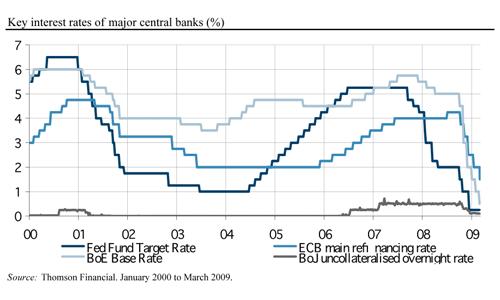
Commercial banks can be expected to put their excess reserves to use, because base-money balances do not yield any interest: banks need to generate income to be in a position to pay interest on their liabilities (demand, time and savings deposits, and debentures).
Extending loans is one option. However, in an economic environment of financially overstretched borrowers, banks might be hesitant to increase their loan exposure vis-à-vis households and firms. In fact, it might be increasingly difficult for banks to do so given that equity capital has become increasingly scarce and costly.
So commercial banks may wish to monetize government debt, as the latter does not require putting equity capital to use. The government then spends the additionally created money stock on politically expedient projects (unemployment benefits, infrastructure, defense, etc.), and the money stock in the hands of households and firms rises.
If, however, commercial banks decide to refrain from additional lending, and even call in loans falling due, the government may decide — as another drastic, but logically consequential step of interventionism — to nationalize the banking industry (or at least a great part of it). By doing so, it can make the banks increase the credit and money supply.
Alternatively, the central bank could print additional money, distributing it to households and firms as a transfer payment.[2] Under a fiat-money regime, this can be done at any time and without limit, as Federal Reserve Chairman Ben S. Bernanke made unmistakably clear in a notorious speech in 2002:
[T]he U.S. government has a technology, called a printing press (or, today, its electronic equivalent), that allows it to produce as many U.S. dollars as it wishes at essentially no cost. By increasing the number of U.S. dollars in circulation, or even by credibly threatening to do so, the U.S. government can also reduce the value of a dollar in terms of goods and services, which is equivalent to raising the prices in dollars of those goods and services. We conclude that, under a paper-money system, a determined government can always generate higher spending and hence positive inflation.[3]
The Way Toward Hyperinflation
Government-controlled fiat money is fraudulent money. It is money that is created out of thin air, in violation of property rights: fiat-money production doesn't require any of the wealth-producing activities characteristic of the free market. It is and will always be, by construction, fraudulent money.
What is more, fiat money created through bank credit expansion necessarily causes boom-and-bust cycles, inducing governments to push back free-market forces to prop up the economy and keep the fiat-money regime afloat; in fact, fiat money will increasingly undermine the free-market order.
Mises was well aware of the final consequences of a monetary regime that rests on ever-greater increases in the money stock produced by banks' expanding circulation credit. It would, at some point, lead to bankruptcies on the grandest scale, resulting in a contraction of the credit and money supply (deflation).
Or it would end in hyperinflation:
But if once public opinion is convinced that the increase in the quantity of money will continue and never come to an end, and that consequently the prices of all commodities and services will not cease to rise, everybody becomes eager to buy as much as possible and to restrict his cash holding to a minimum size. For under these circumstances the regular costs incurred by holding cash are increased by the losses caused by the progressive fall in purchasing power. The advantages of holding cash must be paid for by sacrifices which are deemed unreasonably burdensome. This phenomenon was, in the great European inflations of the 'twenties, called flight into real goods (Flucht in die Sachwerte) or crack-up boom (Katastrophenhausse).[4]
Mises knew very well what he was referring to. He had lived through the period of great inflation that started in Europe in 1914 with World War I. This finally led to hyperinflation and a complete destruction of Germany's Reichsmark in 1923. On a technical level, Germany's hyperinflation was the result of the German Reichsbank monetizing the growing government debt, issued for financing social benefits, subsidies, and reparation payments.
In Age of Inflation (1979), reviewing Germany's hyperinflation from a political-economic viewpoint, Hans F. Sennholz asked, "Who would inflict on a great nation such evil which had ominous economic, social, and political ramifications not only for Germany but for the whole world?"[5] His sobering answer was that
[e]very mark was printed by Germans and issued by a central bank that was governed by Germans under a government that was purely German. It was German political parties, such as the Socialists, the Catholic Centre Party, and the Democrats, forming various coalition governments that were solely responsible for the policies they conducted. Of course, admission of responsibility for any calamity cannot be expected from any political party.[6]
That said, the German hyperinflation was the result of a policy that considered the financing of government debt by an accelerating increase in the money stock as the politically least unfavorable method. It seems that the state of opinion hasn't actually changed much. Today, there is great public support when it comes to expanding the base-money stock for financing ailing banks, insurance companies and, most important, rising government debt.
"The doctrines and theories that led to the German monetary destruction have since then caused destruction in many other countries. In fact, they may be at work right now all over the western world."[7]
Austrian economics would rightly maintain that current fiat-money polices have become increasingly inflationary — and they should have little doubt that the forces and instruments that can pave the way towards hyperinflation are already in place and gaining strength by the day .
The solution to a destruction of the currency is the return to sound money — free-market money — as outlined by Mises and further developed by Murray N. Rothbard. It would presumably, at least in the initial stage, result in gold-backed money under 100% reserves. The edging up of the gold price seems to support the view that people consider gold as the ultimate means of payment — a status that will become increasingly obvious once people fear that the exchange value of fiat money will be eroded substantially.

-
05-04-2009, 04:24 AM #66Member
- Join Date
- Jan 2009
- Last Online
- 26-04-2013 @ 07:08 AM
- Posts
- 587
Total fiat collapse. That includes USD as well as all the rest. Good luck to anyone holding that shit.
-
05-04-2009, 10:36 AM #67Thailand Expat
- Join Date
- Jan 2006
- Last Online
- @
- Posts
- 15,051
passengers, when do you think the bottom will fall out of the US dollar?
and are you totally in precious metals and other commodities?
-
05-04-2009, 10:41 AM #68Thailand Expat

- Join Date
- Jun 2005
- Last Online
- 08-09-2014 @ 10:43 AM
- Location
- Simian Islands
- Posts
- 34,807
I very much doubt Harry is in anything apart from a cheap SLAGDOG. Originally Posted by raycarey
-
05-04-2009, 11:11 AM #69Member

- Join Date
- Apr 2009
- Last Online
- 30-06-2009 @ 01:00 PM
- Location
- Mid Wife Isis
- Posts
- 212
Hope and so called"laws " do not determine currency equivalences In addition to economic data war ,natural disaster and government intervention determine long term rates Also we are looking at a basket of world currencies While at any stage theUS $ will be up or down in relation to others This is inevitable since 1971 break from fixed rates Originally Posted by Butterfly
-
05-04-2009, 02:27 PM #70Member
- Join Date
- Jan 2009
- Last Online
- 26-04-2013 @ 07:08 AM
- Posts
- 587
Just diversified assets now. Total change from 6-months ago. You have to keep ahead of the curve. Originally Posted by raycarey
USD collapse is too political to be able to pinpoint a particular timeframe or tipping point for that timeframe. It is inevitable however.
-
06-04-2009, 07:35 PM #71I don't know
- Join Date
- Dec 2005
- Last Online
- @
- Location
- on pacific ocean, south america
- Posts
- 21,406
A general article on the Greenback from Time Magazine.
Link & Entire: Is the Dollar Doomed? - TIMEIs the Dollar Doomed?
By Michael Schuman Monday, Apr. 06, 2009
....The dollar is a universal medium of exchange, because it is liquid, readily available and backed by the largest economy in the world. There has been little reason for global commerce to function any other way.
Until now.
....There is also the possibility that the dollar, after its recent show of strength, will again weaken in value against other major currencies, eroding its attractiveness as a reserve currency. Confidence in the health of the U.S. economy, and therefore the U.S. dollar, could plunge due to continued large U.S. current-account deficits, an unstable banking sector and a recession-busting, expansionist monetary policy. The budget deficit, which the Congressional Budget Office estimates will reach $1.8 trillion this fiscal year, or 13% of GDP, is reaching heights not seen since World War II.
The dollar has also been supported recently by the deleveraging taking place within the American financial system. Desperate for cash, U.S. financial institutions have been liquidating foreign assets and repatriating the funds, pushing up the value of the dollar. As that process plays out, a key support of the dollar's value could be removed. Currency markets are clearly jittery. In late March, U.S. Treasury Secretary Timothy Geithner sent the dollar tumbling when he said he was "actually quite open" to China's proposal for a greater role for SDRs. The dollar lost 1.3% against the euro within 10 minutes of Geithner's unexpected comment. (The greenback recovered a short time later, after Geithner said he expected the dollar to remain the top global currency.) "The chance of a very abrupt fall in the dollar is quite possible," says Harvard University economist Jeffrey Frankel.
-
16-04-2009, 10:53 AM #72RIP
- Join Date
- Dec 2006
- Last Online
- 08-07-2010 @ 08:33 PM
- Location
- Phetchabun city
- Posts
- 15,471
Couple days ago I got at BKK bank ATM 34.98=$1 US and I see today it is better so might go get another $1000 worth.
Had to buy wifey a new desk top PC. so she can wear it out on Govt work for the school.
That HP laptop we bought her a few years back is still kicking so we did good on that buy.
-
21-05-2009, 07:56 AM #73I don't know
- Join Date
- Dec 2005
- Last Online
- @
- Location
- on pacific ocean, south america
- Posts
- 21,406
Russia has shifted its foreign currency reserves enough so that now its main holdings are in Euros.

Link & Entire: Russia Dumps the U.S. Dollar for Euro as Reserve Currency :: The Market Oracle :: Financial Markets Analysis & Forecasting Free WebsiteRussia Dumps the U.S. Dollar for Euro as Reserve Currency
Currencies / Global Financial System May 19, 2009
The US dollar is not Russia’s basic reserve currency anymore. The euro-based share of reserve assets of Russia’s Central Bank increased to the level of 47.5 percent as of January 1, 2009 and exceeded the investments in dollar assets, which made up 41.5 percent, The Vedomosti newspaper wrote.
The dollar has thus lost the status of the basic reserve currency for the Russian Central Bank, the annual report, which the bank provided to the State Duma, said.
In accordance with the report, about 47.5 percent of the currency assets of the Russian Central Bank were based on the euro, whereas the dollar-based assets made up 41.5 percent as of the beginning of the current year. The situation was totally different at the beginning of the previous year: 47 percent of investments were made in US dollars, while the euro investments were evaluated at 42 percent.
-
21-05-2009, 11:33 AM #74Thailand Expat

- Join Date
- Feb 2008
- Last Online
- 19-12-2015 @ 05:51 PM
- Location
- Paese dei Balocchi
- Posts
- 7,833
Interesting comments here Beat the Press Archive | The American Prospect from Dean Baker about why China keeps buying US T-bills, and from Krugman about the liquidity trap here China and the liquidity trap - Paul Krugman Blog - NYTimes.com
-
21-05-2009, 11:49 AM #75I'm in Jail


- Join Date
- Mar 2006
- Last Online
- 12-06-2021 @ 11:13 PM
- Posts
- 39,826
Actually it makes more sense, closer to home Originally Posted by Milkman
having Russians becoming the new center of USD exchange like in the late 90s was absolutely ridiculous, probably contributed to the overvaluation of the USD. Maybe that crash was long overdue, hence return to the mean.

 Reply With Quote
Thread Information
Users Browsing this Thread
There are currently 1 users browsing this thread. (0 members and 1 guests)
