

It's right there in front of you and you didn't even see it you muppet.
As they work to survive, CBN News was given a rare view that few outsiders witness: a secret meeting of new Iranian believers in a neighboring country, not far from the border.
Results 126 to 150 of 197
Thread: Iran
-
08-09-2014, 03:53 PM #126Thailand Expat


- Join Date
- Sep 2009
- Last Online
- @
- Posts
- 108,238
-
08-09-2014, 05:00 PM #127I'm in Jail


- Join Date
- Jan 2013
- Last Online
- 19-06-2023 @ 09:10 PM
- Location
- Chiang Mai
- Posts
- 5,731

-
08-09-2014, 06:09 PM #128Thailand Expat
- Join Date
- Feb 2006
- Last Online
- @
- Posts
- 40,667
^^ Where do you live- Tehran or Isfahan?
Anyway, I get my info from travellers reports- sounds a great place to check out.
-
08-09-2014, 06:25 PM #129Thailand Expat
- Join Date
- Jun 2014
- Last Online
- @
- Posts
- 18,010
First thing I think of when considering Christianity - progress....development Originally Posted by quimbian corholla


-
28-09-2014, 01:44 AM #130Thailand Expat


- Join Date
- Dec 2012
- Last Online
- 28-10-2019 @ 03:54 AM
- Location
- England
- Posts
- 10,936

Hoe is Iran these days, just noticed diplomatic relations maybe restored
-
28-09-2014, 01:47 PM #131Thailand Expat
- Join Date
- Sep 2009
- Last Online
- @
- Posts
- 108,238
Old Chinese proverb: "The enemy of my enemy is my friend".
-
28-09-2014, 08:18 PM #132Thailand Expat
- Join Date
- Feb 2006
- Last Online
- @
- Posts
- 40,667
Old Chinese lie.
-
25-10-2014, 05:55 PM #133Member
- Join Date
- Oct 2014
- Last Online
- 10-11-2014 @ 05:32 AM
- Posts
- 4
This photo taken in Iran because ...
Hi fellas , i'm Iranian accidentally find here , this picture is obviously taken in Iran, because of car plate number behind the girl's head , here is some pictures from Iranian cars plate number for you , ask me if you had any questioned about Iran, thanks. Originally Posted by pseudolus

-
25-10-2014, 06:33 PM #134RIP

- Join Date
- Jan 2012
- Last Online
- @
- Posts
- 18,054
Salam Effendi - nice input. How are things in Iran then?
-
25-10-2014, 08:15 PM #135Thailand Expat
- Join Date
- Sep 2009
- Last Online
- @
- Posts
- 108,238
Shit, we established that pages ago. Originally Posted by pseudolus
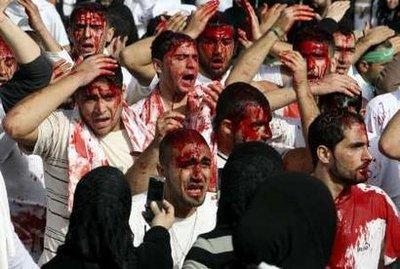
Especially next week. It's Muharram!

-
26-10-2014, 02:47 AM #136Thailand Expat
- Join Date
- Dec 2012
- Last Online
- 28-10-2019 @ 03:54 AM
- Location
- England
- Posts
- 10,936
Just the right calibre of soldier that is needed for boots on the ground.
To conquer ISIS
-
26-10-2014, 08:43 AM #137RIP
- Join Date
- Jan 2012
- Last Online
- @
- Posts
- 18,054
Harryshill takes umbridge at people do that to themselves. Funny though - that photo is more reminiscent of the scenes seen after his mancrush Obomba has been bombing for peace all around the world. Originally Posted by harrybarracuda

-
30-10-2014, 10:10 AM #138Thailand Expat
- Join Date
- Oct 2014
- Last Online
- 10-08-2020 @ 01:40 PM
- Posts
- 2,000
pseu, in thread # 17 you refer to "the holy axis of evil" (UK,EU, US).
I can't understand why Russia nor China would not be on an 'evil list'. I guess North Korea should receive an honourable mention.
It's not a fair fight on any playground. The 'big bullys' usually hold the power if they're united. If the sheriffs are holding the gun or the potential of a serious 'big gun' (stealth deterrent) - they obviously don't want too many others to possess that deadly serious weapon nor the ability to possess. Agreed ?
That aside I don't believe it is any countries intention to annihilate Iran.
In fact many nations are 're-establishing' diplomatic relations in earnest...much more so just in the recent few years. This comes after the severing diplomatic ties following the 1979 'revolution' which deposed Britain's hand-picked 'Shah' Reva Pahlavi.
The major question that is on the plate - should Iran be allowed to build up its nuclear program (possibly with the potential to create WMDs) ?
I don't have all the answers nor do I reside in that neighborhood.
What are your thoughts on furthering Iran's nuclear ambitions ?
-
30-10-2014, 03:03 PM #139RIP
- Join Date
- Jan 2012
- Last Online
- @
- Posts
- 18,054
Oh really? Originally Posted by PeeCoffee
Now why do you believe and perpetuate the myth that the US is the worlds Sheriff. If they are, they are following the Thai Police model of being the Sheriff. Originally Posted by PeeCoffee
No - that is the imaginary question being raised by the israel lobby and the war mongers. This is purposely designed to get twats like harry's panties in a bunch. Should Iran be allowed nuclear fuel for power? Who has the right to tell a country they can not when the countries who are doing the telling all have nuclear power and tacitly back renegade war crime capital of the world Israel's Nuke arsenal. Originally Posted by PeeCoffee
-
06-11-2014, 04:31 AM #140Thailand Expat
- Join Date
- Dec 2012
- Last Online
- 28-10-2019 @ 03:54 AM
- Location
- England
- Posts
- 10,936
What about Us poor Brits, our electrictical coal burning power stations have been sold to France, they are being shut down by EON.
Britain now has wind farms to sustain its energy, to satisfy EU renewable energy dictated by Brussels.
This winter the U.K. will suffer power shortages, thank the E.U. for that thick cable running from France to the U.K. which will provide electricity from France to the U.K.
France will also supply Green Germany with Electricity from its Nuclear Power Stations.
Nuclear Power, who cares where it comes from, as long as I don't have to buy a garden generator to power My Christmas lights.
Like folks in Baghdad, Pakistan, South Africa and a Pikey caravan site.
-
06-11-2014, 07:36 AM #141Days Work Done!
- Join Date
- Oct 2007
- Last Online
- Today @ 07:34 PM
- Location
- Roiet
- Posts
- 36,076
I watched Bourdain in Iran on Parts Unknown couple days ago. Worth a look for all regardless of your view on Iran.
This from an interview on his visit.
"Fareed speaks with author and chef Anthony Bourdain about his visit to Iran. Watch the full interview on GPS this Sunday at 10 a.m. and 1 p.m. ET on CNN, or watch Bourdain in Iran on Parts Unknown at 9 p.m. ET.
So you did the thing most American negotiators haven’t yet done, which is actually go to Iran.
Yes, and an incredible experience. What we saw inside Iran was extraordinary, heartbreaking, confusing, inspiring and very, very different than the Iran I expected from looking at it from afar, from a geopolitical sense or what we read on the news – what we know from that long and very contentious relationship we’ve had as nations.
What do you think was the most surprising thing to you?
To walk down the street as an American and have total strangers constantly saying, where are you from? America, have you tried our food? Thank you for coming. Just outgoing, friendly, welcoming to strangers, to a degree that we really experience very, very few places – and I’m talking Western Europe and allied nations.
We’d been told to expect that. But you get thrown by it when you face it everywhere. Our producer – it was his birthday and we all went out with our local crew to a very crowded restaurant. Traditional Persian music and Iranian families eating. And someone found out that my producer, it was his birthday. The entire restaurant sang “Happy Birthday” to him and presented him with a cake. It was a very different Iran than I had been led to expect or could have imagined."
Bourdain: Iran different from what I could have imagined ? Global Public Square - CNN.com Blogs
-
09-11-2014, 03:32 AM #142Member
- Join Date
- Oct 2014
- Last Online
- 10-11-2014 @ 05:32 AM
- Posts
- 4
First of all why do you so hate of Iran and its people my friend ? Originally Posted by harrybarracuda
Can I ask you what did they do to you ?
Obviously this picture is not from Iran ! it's in Iraq because this kind of act is forbidden in Iran ! yes forbidden !
you can't judge a country and it's people only from anonymous pictures from media !
You can come to Iran and see our hospitality by yourself and see what is medias show you from Iran are completely wrong ! these are just American propaganda against Iran and it's people man !
seeing , believing !
-
09-11-2014, 03:38 AM #143Member
- Join Date
- Oct 2014
- Last Online
- 10-11-2014 @ 05:32 AM
- Posts
- 4
Hi my friend Originally Posted by pseudolus
thanks , everything fine here, I invite you and others to come to my country,
it would be your best experience in your life, believe me, ask other travelers who came to Iran, seeing believing !
and at the end, the phrase "Effendi" use for calling people (men) in Turkey not Iran

cheers.
-
09-11-2014, 03:27 PM #144Thailand Expat
- Join Date
- Sep 2009
- Last Online
- @
- Posts
- 108,238
You seriously think he went anywhere and met anyone without the express permission of the Guardian Council and Savak (or rather VEVAK) breathing down his (and their) necks 24/7? Originally Posted by Norton
-
09-11-2014, 03:31 PM #145Thailand Expat
- Join Date
- Sep 2009
- Last Online
- @
- Posts
- 108,238
And I'm guessing VEVAK is your employer then. Originally Posted by blackgaia
-
09-11-2014, 03:32 PM #146Thailand Expat
- Join Date
- Sep 2009
- Last Online
- @
- Posts
- 108,238
Take no notice of Pseudolus, his expansive knowledge of the Middle East comes from watching Carry On Up the Khyber. Originally Posted by blackgaia
-
09-11-2014, 05:34 PM #147Member
- Join Date
- Oct 2014
- Last Online
- 10-11-2014 @ 05:32 AM
- Posts
- 4
I have not another words for you, go back ! your Republican American master calling you !!! Originally Posted by harrybarracuda

-
09-11-2014, 08:43 PM #148Thailand Expat
- Join Date
- Sep 2009
- Last Online
- @
- Posts
- 108,238
Fuck that you idiot, I stand alongside my bloodythirsty Sunni brothers! Originally Posted by blackgaia

-
09-11-2014, 09:20 PM #149Thailand Expat

- Join Date
- Mar 2007
- Last Online
- 23-05-2020 @ 05:51 PM
- Posts
- 12,223
Iran gaining popularity as tourist destination
TEHRAN, Iran - Since Iran’s revolution in 1979, only the most intrepid Western tourists have been travelling there. But that is changing.
Led by an English-speaking guide, a group of tourists from Germany, Switzerland and Australia admire the large, stained-glass windows of the lavish Golestan Palace. The walled complex, with 17 different buildings, museums and enough gold and cut crystal to compete with St. Petersburg’s Winter Palace, is the legacy of the Qajar family, who built it, and ruled from the palace in the late 18th century. It’s one of those, ‘don’t leave Tehran, ‘til you’ve visited…’ locations.
For the first time in decades, Iran is steadily in the travel pages of British newspapers. The Financial Times, The Daily Telegraph, and others have branded it the next, “new” destination for adventure travelers; new, but old. Iran used to be a popular place to vacation. Some 70,000 Americans travelled there in 1977. But, the tourists, and multi-national hotels like the Intercontinental, Sheraton and others, pulled out in 1979, at the start of the revolution.
Iran is finally starting to see a tourism turnaround. Since President Hassan Rouhani took over a year ago, with more liberal views and an interim nuclear agreement, tourism has risen rapidly. Iran’s tourism ministry has cited a 240 percent increase in European visitors, alone. That figure may seem high, but sources from other parts of the tourism industry agree.
Arshan used to work one or two days a week as a tour guide in Tehran. Now, he tells Rudaw, “There’s a completely different change in tourism. I work seven days a week, sometimes double and triple days, with airport transfers. “
The people using those airport transfers are also filling up hotels.
Amir Mousapour manages the front office at the Espinas Hotel, the only privately-owned, post-revolution five-star hotel.
“After Rouhani took office, we don’t advertise. When he came to power, there was a feeling Iran would be open for business to tourists and there has been a big change.”
Mousapour says the Espinas went from a 45-50 percent occupancy rate to 80 percent full. And it’s not just about business picking up; Mousapour explains the kind of tourists coming marks a big change, too.
“Previously guests were only from Asia and not the EU. But now, it’s a lot of EU, US, British and Australian guests, tourists and government ministers.”
The government has pledged to ease strict visa requirements for visitors, and it is encouraging hotel development with attractive loans. The Espinas will open a second Tehran property, with a helipad and an air taxi, next year.
But there are no plans to ease the ban on alcohol, or the dress code for women, the “hijab.” Local and tourist women must be covered in public in long flowing robes or a “manteu” – a light jacket – over their normal clothes.
Tourists may only visit government-approved sites, with mandatory guides for Americans, British and Canadians. The government still has a patchy human rights record, but Cynthia McVey and her husband have wanted to travel to Iran for 10 years. It finally felt like the right time to do so.
“When Rouhani came in, things seemed to ease up a little bit and we thought we’d go for it,” McVey says.
The 57-year old from Wales says the biggest surprise was the visibility of Iranian women.
“Yes, they wear the veil, you are covered up, but women are everywhere; they’re on the streets, they’re in big jobs. There are more women in higher education than men; it definitely seems they’re there and ready to step forward. The trouble is when it comes to the law; they don't have a lot of rights. They're walking a knife edge all the time, you feel.”
American Frances Broaddus-Crutchfield first visited Iran three years ago. She returned in October, on the inaugural journey of the Blue Eagle Danube Express, the first Western train to complete the trip. She says things were different this time.
“The younger people have changed, the jeans are getting tighter, the sleeves are pushed up a little more, the manteau (is more shapely, some even had belts on and the headscarf is pushed back, even showing a little hair. I did get the chance to talk to a local, who volunteered that he was very happy with his new president and the potential for relationships with other countries. That really surprised me. I would never have asked about it.”
That wasn’t the only change Broaddus-Crutchfield noticed.
“It’s more crowded… there were people milling around everywhere. I’m sure there were more tourists, particularly in train stations and at the airport.”
One of the biggest signs Western tourism is picking up? Welcome the food tourists.
Fatemeh Fereidooni established her travel agency two years ago, and is the first to lead culinary tours. She says much of the demand is from Australians, like one woman who requested a three-day tour of Tehran’s tea shops, bakeries and coffee houses.
Fereidooni explains that Iran has an inherently rich food culture, with eight different kinds of bread in Tehran alone, 10 different kinds of dried plums, a city with 15 different sweets -- and the list goes on, she says.
Everyone connected to Iran’s tourism industry shares a collective excitement about its potential, but there’s also an awareness, that the hospitality sector must grow alongside visitor numbers.
David McGuinness owns London-based tour operator Travel the Unknown. He’s seen interest in Iran rise 350-400 percent over the last year, and says the hardest part now is identifying local tour guides who can provide specialist tours.
For example, Tehran’s urban art scene is vibrant. The government pays big name, and lesser-known artists to beautify buildings. All of the artwork is different, from tile mosaics, to abstracts, portraits of members of parliament and simple, bright flower cut-outs. In any Western city, there would be a tour of such a vibrant street art scene. Not in Tehran. McGuinness says that’s part of the problem.
“We’d love to expand our offerings to include a gentle walking tour taking in local villages, or a tour of Tehran’s murals, but these things are so new there. We’re working on finding people who can do these tours well.”
And, at the Espinas, Mr. Mousapour, who was educated in Europe, says Tehran needs more infrastructure and education to welcome guests.
“We need accommodation, transfers from the airport, restaurants and education for hospitality in our universities. We need our young people to learn how to present service in hotels. We don’t have enough English speakers.”
He acknowledges that hospitality is a cornerstone of Iranian culture: “but service doesn’t come naturally to us.”
http://rudaw.net/english/people-places/09112014
-
09-11-2014, 09:49 PM #150Lord of Swine

- Join Date
- Feb 2012
- Last Online
- @
- Location
- Nahkon Sawon
- Posts
- 13,012
Originally Posted by blackgaia
No doubt Iran, like many other countries has interesting and pleasing aspects to it's culture and traditions. But there is no getting away from the fact that it is a police state where freedom of thought and expression is punishable by death or tortuous imprisonment.

 Reply With Quote
Thread Information
Users Browsing this Thread
There are currently 1 users browsing this thread. (0 members and 1 guests)
