

Dwight Twilley Dead: 'I'm on Fire' Singer-Songwriter Was 72
Singer-songwriter Dwight Twilley, known for such power pop hits as “I’m on Fire” and “Girls,” has died. He was 72.
His wife Jan confirmed a statement from Tulsa’s Church Studio, where Twilley recorded several songs including “I’m on Fire,” which read, “He peacefully departed this world, surrounded by the love of his life, Jan, and close friends. The loss is immeasurable, and our words can’t capture the depth of our grief. Dwight’s musical prowess touched countless lives, leaving an indelible mark on the hearts of many. We are profoundly thankful for the enduring musical legacy he has bestowed upon us all.”
Twilley was born on June 6, 1951, in Tulsa, Okla., where he met and formed the music group Oister with Phil Seymour in the late 1960s, recruiting part-time member, Bill Pitcock IV, on lead guitar.
During an appearance on “American Bandstand,” the group was set to perform what would’ve been their follow-up single “Shark (in the Dark),” but Shelter Records rejected the single to avoid the Dwight Twilley Band being perceived as a cash-in novelty act following the success of Steven Spielberg’s “Jaws.”
Amid a lawsuit between Russell and Cordell, the band’s completed album went unreleased for nearly 18 months due to Shelter Record’s move from MCA Records to ABC Records for distribution; their “B Album” was left unreleased altogether.
The Dwight Twilley Band endured distribution problems multiple times, including for their follow-up single “You Were So Warm” and their debut album “Sincerely” (1976), which featured “I’m on Fire.” Around that time, Twilley and Seymour befriended Tom Petty and contributed backing vocals on several tracks, with Petty returning the favor for the band’s sophomore album “Twilley Don’t Mind” in 1977. Seymour exited the band the following year and pursed a brief solo career until his death in 1993.
As a solo artist, Twilley released his eponymous album in 1979, followed by his 1982 album “Scuba Divers.” In 1984, the musician dropped the album “Jungle,” featuring his second national hit “Girls” that also reached no. 16 on the Billboard Hot 100. “The Great Lost Twilley” album, released in 1993, consisted of Twilley and Seymour’s unreleased songs.
In 1996, two newly recorded songs appeared on the 21-song best-of collection “XXI.” Twilley released both another rarities collection in 1999, “Between the Cracks, Vol. 1,” along with his first new album in 13 years, “Tulsa.” In 2001, Twilley released “The Luck,” an album he had completed in 1994, and his ninth studio album “47 Moons” dropped in 2005.
His critically acclaimed song “Looking for the Magic” (1997) has been featured in such films and TV series as “Diary of a Teenage Girl,” “Backcountry,” “House of Cards” and “Mindhunter.”
Results 6,201 to 6,225 of 6950
Thread: The RIP Famous Person Thread
-
25-10-2023, 11:12 AM #6201Guest Member



- Join Date
- Sep 2008
- Last Online
- @
- Location
- left of center
- Posts
- 30,087
Keep your friends close and your enemies closer.
-
26-10-2023, 04:25 PM #6202Thailand Expat
- Join Date
- Sep 2009
- Last Online
- @
- Posts
- 108,270
Oh hang, he's alright.
No, he's dead.
No, he's alright...
-
26-10-2023, 04:28 PM #6203Guest Member
- Join Date
- Sep 2008
- Last Online
- @
- Location
- left of center
- Posts
- 30,087
pity......
-
27-10-2023, 04:43 PM #6204Thailand Expat


- Join Date
- Jun 2011
- Last Online
- Today @ 03:19 PM
- Posts
- 1,670
Tony Husband obituary
Cartoonist whose long-running series The Yobs in Private Eye presented his view of the quirks of everyday existence
Tony Husband, who has died aged 73, was the cartoonist behind one of Britain’s longest running comic strips, The Yobs, a new episode appearing every fortnight for 38 years since 1985, on the seemingly uninspiring subject of bovver boys with IQs as low as their brows.
“I was beaten up by a bunch of skinheads,” Husband told The Observer in 2001, “so maybe this was my way of getting back at them.” He had submitted a cartoon to Private Eye of two skinheads spray-painting graffiti on a wall, one of them asking “How do you spell NF?”
The magazine’s editor Ian Hislop then suggested that they use “the yob figures that you do a lot” in a three-panel strip called The Yobs. It went on to be named strip cartoon of the year in 1987 by the Cartoonists’ Club of Great Britain, who had already chosen Husband as best gag cartoonist in 1985 and 1986, and would reward him many more times.
Husband had previously been warned against sending cartoons to Private Eye, a friend telling him it was a closed shop for Oxbridge types. He sent in 10 cartoons anyway, but received a package back from them with no note; he did not bother to check how many cartoons were returned. “A week later a friend rang to congratulate me on having two cartoons in Private Eye. Puzzled, I dashed to Stockport to get a copy … and there they were.”
A former hippy, Husband was tall, slim and surprisingly deadpan for someone whose business was laughter. “I’ve actually got a very private sense of humour,” he once told the Manchester Evening News. “People’s blunders make me laugh. And I like daft things. And I suppose I do incline towards the sick side of life. I don’t take anything that seriously.” He made fun of everyday existence and its quirks, which led to him winning the Cartoon Art Trust’s Pont award in 2005, the citation reading: “Whether it is football hooligans on the rampage or a quiet sherry for four in the front lounge, Tony Husband’s cartoons sum up the British character of today.”
In later life Husband’s father, Ron, suffered from Alzheimer’s, his gradual loss of memory and move into a care home inspiring Husband to draw a few illustrations of an imagined conversation between the two. Stephen Fry tweeted the pages to his social media followers and a publisher mailed Husband asking if he could turn the pages into a book. Take Care, Son: The Story of My Dad and His Dementia was published in 2014 and Husband became an active campaigner for dementia. He tackled other challenging subjects in From a Dark Place (2016), about his son Paul’s heroin addiction, and in his illustrations for Libby Moore’s After… The Impact of Child Abuse (2019).
The eldest son of Ron, a managing executive of Great Universal Stores, and Vera (nee Fletcher), Tony was born in Blackpool, Lancashire, but raised in the countryside, in the village of Gee Cross near Hyde, Greater Manchester. He attended the local Holy Trinity primary school and discovered a talent for art at Greenfield Street secondary school in Hyde. His father enjoyed drawing cartoons and painting watercolours, and Tony began cartooning at the age of 16, at first copying his father’s work but also influenced by his reading of Punch and Private Eye and cartoonists such as Mike Williams. He developed a free, uninhibited style of drawing that allowed him to sketch upwards of 60 cartoons a week.
He joined a Manchester advertising agency as an office junior, and it was in the in-house magazine of one of their clients, Burlington World, that he had his first cartoons published in 1968. He continued to draw cartoons at night while working as a window dresser for Burton’s menswear shops and then as a designer for a Manchester jeweller, contributing to local underground papers – Grass Eye and Mole Express – before selling two cartoons to Weekend and the Daily Mirror in one week in 1971; he went on to draw for national daily newspapers, weekly magazines and glossy monthlies.
He took voluntary redundancy from the jeweller’s in 1984 and became a full-time cartoonist, later that year publishing his first book, Use Your Head, which imagined macabre uses for a severed head – as a door stop, a child’s potty, a Christmas tree decoration, and other grisly suggestions. He was named joke cartoonist of the year for the first time that year.
Over a drink in a Manchester pub, Husband, a fellow cartoonist, Patrick Gallagher, and a writer, Mark Rodgers, dreamed up Oink!, an irreverent, alternative children’s comic. They approached IPC, the country’s biggest comics publisher, who agreed to publish it from April 1986, alongside long-running and unchanging Buster and Whizzer & Chips, for which Husband wrote occasional scripts. Edited by Uncle Pigg, the paper was filled with pig-puns and gags about smells that won over the 10- to 13-year-old audience, selling 155,000 copies fortnightly by its fifth issue before falling back to 90,000. Husband’s character, Horace “Ugly Face” Watkins, was a star from the beginning and Paul made guest appearances in photo stories.
It folded after four years, but out of the ashes came a TV series, Round the Bend! (1989-91), a blend of cartoons, live action and puppets starring Doc Croc and his staff of rats who run a variety show from their sewer. The show was nominated for an award by the Royal Television Society.
The trio of Husband, Gallagher and Rodgers were brought in by the BBC to launch Hangar 17, described as the first “the-weekend-starts-here” Friday night show for kids since Crackerjack. The wacky variety show’s mix of music and comedy ran for three seasons (1992-94). Husband also wrote an episode for the Chuckle Brothers’ comedy series ChuckleVision (1994).
He wrote and illustrated dozens of books and designed costumes, scenery and slides for Save the Human, a children’s show that was staged at the Manchester Opera House in 1990. The show, about animals taking over the world after mankind has made a mess of it, was co-written with David Wood. Husband also toured with the Yorkshire poet Ian McMillan, performing A Cartoon History of Here, a mix of readings and improvised poetry, which the artist illustrated on a flipchart, or on acetate where venues had projectors.
Ever busy, he contributed strips and cartoons to publications including the Oldie, the Times, the Spectator, Golf International, the Nursing Standard and Practical Caravan. He illustrated greetings cards, was cartoonist in residence at the Lowry Centre in Manchester, official cartoonist for the Groucho Club in London, and drummer for the Idler magazine’s ukulele band.
Husband lived in Hyde, not far from where he grew up, and enjoyed walking in the countryside, dreaming up jokes. He was on his way to a Private Eye leaving party in London, on a Thames barge , when he suffered a heart attack on Westminster Bridge. After his father’s death, Paul posted online the last cartoon Husband drew: on the train to London, thinking that he would be late, he sent a picture of himself waving goodbye to a boat departing from Westminster Pier.
His wife, Carole (nee Garner), whom he married in 1976, acted as his book-keeper and personal assistant. She and Paul survive him as do his brothers, James, Keith and Ronald.
Tony (William Anthony) Husband, cartoonist and author, born 28 August 1950; died 18 October 2023Ronald.
Tony Husband obituary | Newspapers & magazines | The Guardian
-
29-10-2023, 09:00 PM #6205Thailand Expat
- Join Date
- Sep 2009
- Last Online
- @
- Posts
- 108,270
-
29-10-2023, 10:32 PM #6206Guest Member
- Join Date
- Sep 2008
- Last Online
- @
- Location
- left of center
- Posts
- 30,087
Matthew Perry Dead at 54 After Apparent Drowning: Report
Matthew Perry has reportedly died. He was 54.
The actor, who was best known for playing Chandler Bing on Friends, was found dead at a Los Angeles-area home on Saturday, TMZ reported, citing law enforcement sources. Law enforcement sources also confirmed Perry's death to the Los Angeles Times.
The outlet reported that Perry was found in a jacuzzi at the home, and no drugs were found at the scene.
A spokesperson for the Los Angeles Police Department told PEOPLE that officers responded to a call at Perry's address regarding the death of a male in his 50s, but would not confirm the deceased's identity.
TMZ was also told that there was no foul play involved, and their sources said first-responders were called to the residence for cardiac arrest.
Representatives for Perry did not immediately respond to PEOPLE's request for comment.
Born in Williamstown, Massachusetts, on Aug. 19, 1969, Perry was raised on Ottawa, Canada, where he attended elementary school with Canadian Prime Minister Justin Trudeau.
His mother, Suzanne Morrison, was a journalist and press secretary to Prime Minister Pierre Trudeau, Justin’s father.
Perry’s stepfather is Dateline‘s Keith Morrison. His father, John Bennett Perry, was an actor and model — the younger Perry even guest-starred in an episode of his dad’s cop show, 240-Robert, in 1979.
Perry moved to Los Angeles as a teenager. After landing a few TV guest spots, he recurred as Chazz Russell on Boys Will Be Boys from 1987 to 1988. Roles on Growing Pains and Sydney followed, but his big break came in 1994 with NBC’s iconic sitcom Friends.
Perry played sarcastic commitment-phobe Chandler Bing for 10 seasons, landing an Emmy nomination in 2002. Friends was the hottest show of the 90s, with Perry and costars Jennifer Aniston, Courteney Cox, Lisa Kudrow, Matt LeBlanc and David Schwimmer ultimately earning a whopping $1 million per episode.
“I was 24 when I got on the show,” he said in the 2004 book Friends … ‘Til the End. “I’ll be 34 when it’s over, and those are really important years in somebody’s life. So to do it all in public … was difficult. At first you have the wave of ‘I’m famous, and this is exactly what I’ve wanted my whole life.’ But then you go through the whole recluse stage where you think, ‘I wish everybody would stop staring at me.’ And then you eventually, hopefully, get through all that. You find things in your life that are grounding, like your family and good friends.”
Despite his success, Perry struggled with addiction behind the scenes, seeking treatment in 1997 and 2001. He told Britain’s BBC Radio 2 in 2016 that he didn’t remember filming seasons 3 through 6 of Friends.
In a 2013 PEOPLE cover story, the actor admitted to abusing alcohol and Vicodin, which a doctor had prescribed him after a 1997 Jet Ski accident.
“I had a big problem with alcohol and pills and I couldn’t stop,” he said. “Eventually things got so bad that I couldn’t hide it, and then everybody knew.”
Then, “something clicked,” and he founded Perry House, a men’s sober living facility, in his old Malibu beach home.
“The interesting reason that I can be so helpful to people now is that I screwed up so often,” he said. “It’s nice for people to see that somebody who once struggled in their life is not struggling any more.”
Back in 2015, he was awarded for his advocacy by the treatment center Phoenix House, telling The Hollywood Reporter, “You can’t have a drug problem for 30 years and then expect to have it be solved in 28 days.”
When Friends ended in 2004, Perry struggled to find another small-screen hit: his next starring vehicle, Aaron Sorkin’s Studio 60 on the Sunset Strip aired on NBC for just 22 episodes from 2006-07.
He co-created Mr. Sunshine in 2011, but ABC cancelled the comedy after nine episodes. His NBC comedy Go On ran for one season in 2013. Next, he starred alongside Thomas Lennon on CBS’s The Odd Couple reboot for three seasons from 2015-17.
Perry also worked on a play The End of Longing, in London beginning in 2016.
His movie credits include Fools Rush In, The Whole Nine Yards, Serving Sara and 17 Again.
-
30-10-2023, 12:43 AM #6207Thailand Expat

- Join Date
- May 2010
- Last Online
- 03-04-2026 @ 10:25 PM
- Location
- Chalong, Phuket
- Posts
- 5,272

-
30-10-2023, 05:31 AM #6208Thailand Expat


- Join Date
- Apr 2010
- Last Online
- Today @ 07:57 PM
- Location
- Down South
- Posts
- 10,037
-
30-10-2023, 06:41 AM #6209Goodbye
- Join Date
- Sep 2019
- Last Online
- @
- Location
- Canada
- Posts
- 4,107
^

RIP Chandler.. he was such a talent. So sad, so young. I thought this was an interesting and sad look into the life of Matthew.
"While Matthew Perry’s cause of death remains unconfirmed, many fans of the Friends star can’t help but wonder if his sudden passing had anything to do with his past health struggles—including his battles with addiction to alcohol and Vicodin.
Perry’s battle with drug addiction started after he had a skiing accident on the set of the film When Fools Rush In in 1997. The doctor prescribed Vicodin for his pain, but as a highly addictive substance, Perry’s use escalated to taking up to 55 pills a day. Along with his opioid addiction, he suffered from alcoholism.
In his 2022 memoir Friends, Lovers, and the Big Terrible Thing, he explained how to tell which substance he was using based on his appearance on Friends: “When I’m carrying weight, it’s alcohol; when I’m skinny, it’s pills. When I have a goatee, it’s lots of pills.”
Five years before his passing, Perry was also open about the fact that he already had his fair share of brushes with death. He revealed in his memoir that he almost died after suffering a gastrointestinal perforation when his colon burst from opioid overuse. “The doctors told my family that I had a two percent chance to live,” he told People in 2022. “I was put on a thing called an ECMO machine, which does all the breathing for your heart and your lungs. And that’s called a Hail Mary. No one survives that.”
“There were five people put on an ECMO machine that night and the other four died and I survived,” he added. “So the big question is why? Why was I the one? There has to be some kind of reason.”
During the height of the COVID-19 pandemic lockdowns, Perry had another near death experience while staying at a rehab center in Switzerland when he had to get surgery. During his procedure, he was given a shot of propofol. After 11 hours, he woke up in a different hospital and was told that the propofol had stopped his heart for five minutes. The long CPR process broke eight of his ribs."
How Did Matthew Perry Die? Cause of Death Info After Apparent Drowning – StyleCaster
-
30-10-2023, 06:46 AM #6210Goodbye
- Join Date
- Sep 2019
- Last Online
- @
- Location
- Canada
- Posts
- 4,107

Justin Trudeau
@JustinTrudeau
Matthew Perry’s passing is shocking and saddening. I’ll never forget the schoolyard games we used to play, and I know people around the world are never going to forget the joy he brought them. Thanks for all the laughs, Matthew. You were loved – and you will be missed.
-
30-10-2023, 08:42 PM #6211Thailand Expat

- Join Date
- Jan 2014
- Last Online
- @
- Location
- PI
- Posts
- 7,257
RIP Matthew Perry, aka Chandler Bing. I initially thought it was a hoax when a news feed about him popped up on my YouTube. Turned out it was true.
We'll always have Friends... RIP...
-
31-10-2023, 01:31 AM #6212Guest Member
- Join Date
- Sep 2008
- Last Online
- @
- Location
- left of center
- Posts
- 30,087
-
03-11-2023, 10:53 AM #6213Thailand Expat
- Join Date
- Sep 2009
- Last Online
- @
- Posts
- 108,270
Astronaut Thomas K. Mattingly, who helped save Apollo 13, dies aged 87
Thomas K. "TK" Mattingly passed away on October 31, the space agency said in a statement Thursday.
His most dramatic role came when he was assigned as command module pilot for the Apollo 13 flight but was grounded 72 hours prior to launch due to exposure to rubella, NASA Administrator Bill Nelson said.
After an explosion crippled the spacecraft on its way to the Moon, Mattingly, who did not in fact get sick, went to Mission Control and devised procedures to conserve power so the vehicle could successfully re-enter the atmosphere, ensuring astronauts James Lovell, Jack Swigert, and Fred Haise survived.
The mission was dramatised in the 1995 film "Apollo 13" in which Mattingly was played by Gary Sinise.
Mattingly began his career as a US Navy pilot before being selected to the astronaut class of 1966.
He later took on the role of command module pilot on the Apollo 16 mission and was the spacecraft commander in two Space Shuttle missions.
"TK's contributions have allowed for advancements in our learning beyond that of space," said Nelson.
https://www.france24.com/en/americas/20231103-astronaut-thomas-k-mattingly-who-helped-save-apollo-13-dies-aged-87The next post may be brought to you by my little bitch Spamdreth
-
03-11-2023, 11:04 AM #6214Guest Member
- Join Date
- Sep 2008
- Last Online
- @
- Location
- left of center
- Posts
- 30,087
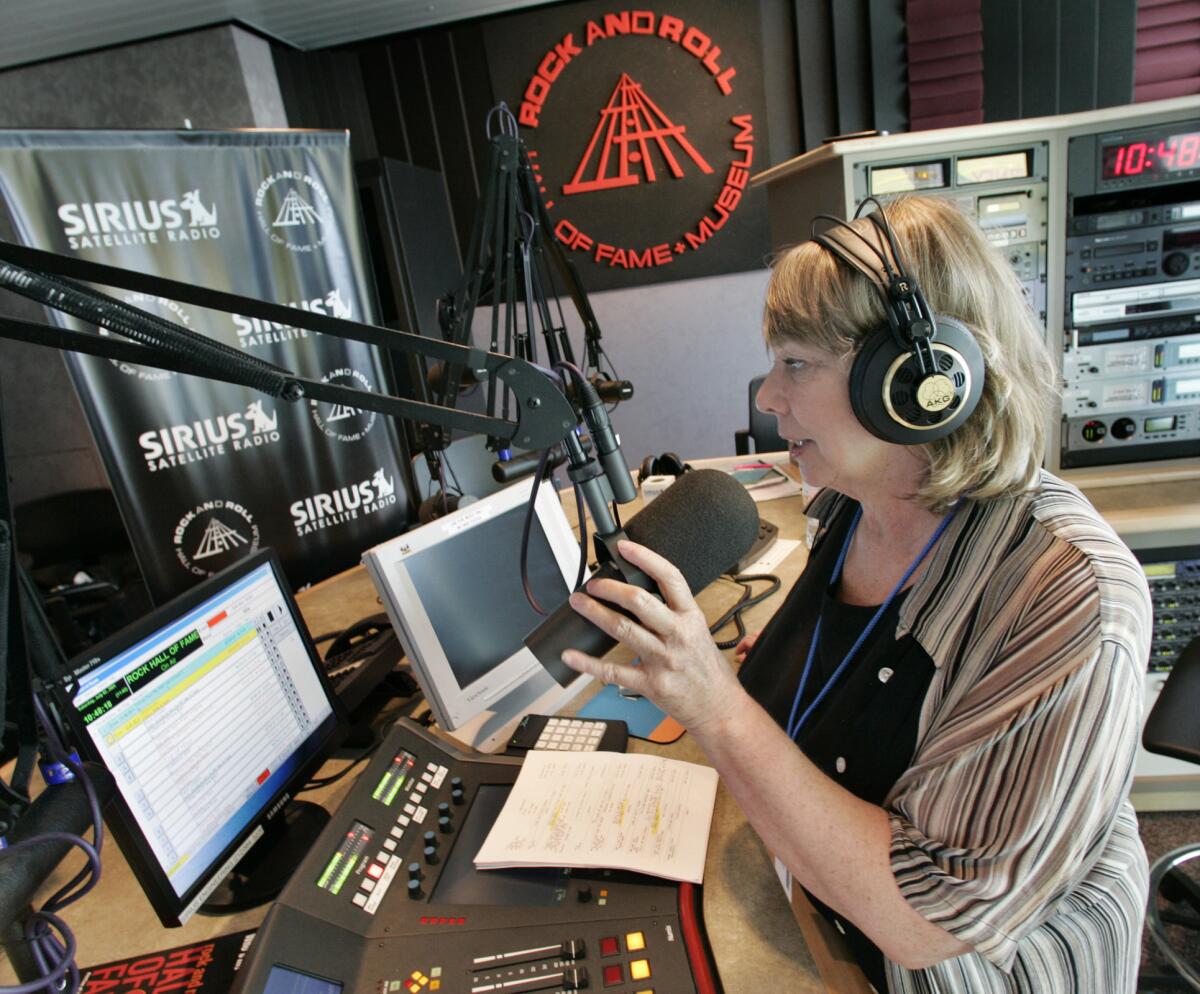
Dusty Street, a DJ familiar to Southern Californians as one of the seminal personalities in the early days of KROQ, and one of the pioneering female voices in rock radio, period, died Saturday at age 77 in Eugene, Oregon.
With her sultry voice and deep knowledge of the music she played, Street was not just an essential personality in L.A. rock radio history. She began her career in San Francisco, DJ-ing at freeform KMPX beginning in 1967 before moving on to KSAN in 1969, where she held court for a decade. She moved on to KROQ in 1979, as the new wave movement was cresting and making that station feel like a clubhouse for a new generation. Her other stints in L.A. radio included stops at KWST and KLOS. Street eventually moved to Las Vegas and then Cleveland, from which she did her SiriusXM show on the Deep Tracks channel over the last two decades. She settled back in Oregon in 2022 as she battled health problems.
Street was heavily featured in this year’s MGM+ documentary “San Francisco Sounds: A Place In Time.” She was also inducted into the Bay Area Radio Hall of Fame this year.
Many former colleagues took to social media to memorialize Street. Freddy Snakeskin, a fellow KROQ alumnus, called her “one of my life’s all-time favorite people” in a post. “Shattered,” wrote Tami Heide, one of the women who later followed in her wake at the station, saying “thank you for all you did for KROQ, and women radio hosts.”
Geno Michellini broke the news on Facebook. “I have been in Eugene the last two days at Dusty Street’s bedside,” he wrote late Saturday night. “The numerous afflictions that she has been so indomitably fighting these last years finally caught up to her. I am writing with a broken heart to say that Dusty left us tonight. She died peacefully, quietly and surrounded by love in a beautifully serene location overlooking the most beautiful lake you could ever want. As befitting the queen that she was. Tonight I lost one of the best friends I ever had and the world lost a radio and music legend as befitting her starring role in the ‘San Francisco Sounds’ documentary movie that just came out recently. She was all that and so much more. There will never be another Dusty Street. The queen is gone, but she’ll never be forgotten.”
Fellow KROQ DJ Richard Blade wrote, “Time is a cruel mistress. … It was Dusty who trained me to run the board at KROQ, and trying to emulate her expertise was a tough job. She brought so much of her love of music — particularly Dark Wave like Siouxsie, Bauhaus, and so many others, to the airwaves. In today’s barren terrestrial radio market, there is no one like her. I’ll so miss her voice, her laugh, her caring for animals, our trips to Hawaii together, and our visits when I’d do a gig in Cleveland – where she did her show on SiriusXM and made her home for the past decade. Your talents will not be forgotten. Fly low and avoid the radar, Dusty.”
Heide quoted a favorite line of Street’s, which she had said in an interview she once said to her ex-husband: “A good segue is better than sex.”
Although it sounds like the perfect radio nom de plume, Dusty Street was, in fact, her birth name. The Palo Alto native said that when she graduated high school in 1964, she received a draft notice, her name having been mistaken for a man’s.
Street discussed her history at length in an oral history written by Elizabeth Ohanesian as a university thesis. The DJ said she had been working in television at San Francisco State when a friend said a local “underground” radio station needed engineers. Soon enough, when one of the DJs didn’t show up, she filled out his shift. “They got all pissed because back in those days, you could say could say ‘damn’ but you couldn’t say ‘god damn’ together. We were playing ‘God Damn the Pusherman’ from Steppenwolf. So, because, you got to realize that when we started on FM radio, the only thing that was on FM radio was cooking shows, God and foreign language. Nobody had FM in their cars. There were no FM radios in cars, can you imagine that? The only way you could get FM was you had to have one of those tuners on a high- fidelity system. … We would send out these little diagrams of how you would attach a coat hanger or a piece to the back of your stereo. … It had all been very regulated AM radio.”
Years later, she got an interview with KROQ the day that Frazier Smith got fired, and landed the job. “I got a telephone call from FrazierSmith after I had been on the air for a little while and he said, ‘You know, I wanted to hate you, but you’re not bad.'” After doing weekends and then mornings, she landed a 6-10 p.m. slot. Her tenure lasted from 1979-89, with a couple of blips early on, when she briefly defected to KLOS and K-West before program director Rick Carroll brought her back in 1991.
She described early KROQ as being like “that movie ‘Airheads.’ … It was really crummy. It had this horrible green carpet that went everywhere through it and the green carpet was because the owner ofthe radio station had carpeted his house in this green carpet and had a trade out with Carpeteria and they had some leftover carpet and used it for the radio station. So, we had to do a Carpeteria spot every half-hour and we did Carpeteria spots as long as I was there, until Infinity took over. It was pretty funny.
“The people were great; the pay was terrible,” she continued, saying she remembers take-home pay being about $800 a month after taxes. “But once again, you do it for the love. Radio for me has always been about the music. I never thought about being a ‘star’ or a great disc jockey or any of the rest of it.”
Her tastes sometimes proved surprising, for someone who had come up in the SF counterculture. “I was the queen of goth,” she told Ohanesian. “As a matter of fact, I got a gold record from Beggars Banquet record label for the entire record label rather than just a single record, which is what most people get the album for. They gave me a gold record for the entire company. I was the home of goth for a long time. If you were going to hear Bauhaus or Love and Rockets or any of that stuff — Sex Gang Children, Alien Sex Fiend — all that stuff. I love that stuff. I’m a complete gothy.”
Street did not hear much on contemporary broadcast rock radio that impressed her. She said, “What I fmd really horrible about these radio stations like Jack, they’re just segues for the sake of segueing. There’s no rhyme or reason to them. They’re put together by a computer and it’s, as far as I’m concerned, one train crash after another. It’s like, we’re going to take every genre of music and throw it together because that’s what freeform radio was. It is the weirdest mutation of what was an artform that I have ever heard.”
The testimonials continue to come in. Wrote DJ April Whitney, “To a truly amazing woman who has been my friend for the last forty-some years and I already miss her like crazy. She took me in to her heart when she had every excuse not to back in the ‘80s and we’ve been tight ever since. I love you to pieces, Street. She could have just as easily chewed me up and spit me out but instead we grew to respect each other and became life long friends. How lucky am I that life brought our roads to cross. How cool that we’ve been friends all these years. You touched my life in some unimaginable ways — thank you Street. I know that we will see each other again my friend. Until then, avoid the radar and enjoy those beautiful wings.”
Music journalist Annie Zaleski befriended Street during the latter’s years in Cleveland. “When I was writing my book on Duran Duran’s ‘Rio,’ I knew I wanted to talk to DJs and radio folks who were there as the band was coming up and breaking in America, to get a sense of how they were perceived. The world-famous KROQ of course was high on my list — and, as it so happened, I was friends with Dusty Street, who of course had played the very first Duran Duran singles in 1981 on her legendary ‘The Import Show.’ She happily chatted to me about what made them special — naturally, she picked up on the beautiful parts of Simon Le Bon’s vocals — and I was thrilled to have her voice in my book.”
Continued Zaleski, “Anyone who heard Dusty’s voice even once remembered it: a smoky, jovial instrument that was welcoming and sparkled with wit and mischief. Her name was no radio pseudonym — and her radio persona was no persona. It was who she was: a passionate, open-minded music fan who wanted to share her new discoveries and old favorites with listeners. She was determined to do this even as radio playlists became narrower — her Sirius Deep Tracks playlists especially had plenty of Dusty sprinkled in. … Dusty also had amazing ears. Yes, she was one of the first DJs in America to play Duran Duran — but she also broke bands like Depeche Mode and AC/DC, and loved Billy Idol. … Dusty was the opposite of a gatekeeper: She certainly had no problem telling you when she didn’t like something — but she also encouraged you to give things a chance.”
In Street’s interview with Ohanesian, she cited her insistence on having a hand in picking the songs that were played on her shift as a reason for her exit from KROQ, saying that number gradually went down from five personal picks per hour to just one during her tenure… and then, in the years that followed, just one per shift. “I wasn’t a complete freak,” she said. “I gotta give people what they want to hear. You want to hear Duran Duran, Depeche Mode and U2, I’m going to play that… But I’m going to interject it with some of the other stuff I want you to hear like the Bronski Beat or Flesh for Lulu or whatever else it is that I happen to pull out of my hat. … It has a name in the business, it’s called the ‘thread of the familiar.’ … (But) you know how you hear the same records over and over and over again ad nauseum? To me that’s the ‘threat of the familiar.’ But, you know, those days are long gone and they will never return.”
She continued, “I don’t know of any disc jockey that’s becoming as famous as we were at KROQ on the air today,” she said. “You have your Howard Stem, of course, and you have your Rick Dees and Ryan Seacrest, but, trust me, if Ryan Seacrest weren’t on ‘American Idol’ nobody would know who he was outside of Los Angeles. It absolutely is not the personality. It is the music, but then you have to take it another step further and the reason why it was the music that was popular is because we were picking the music.”
-
10-11-2023, 04:01 PM #6215Guest Member
- Join Date
- Sep 2008
- Last Online
- @
- Location
- left of center
- Posts
- 30,087
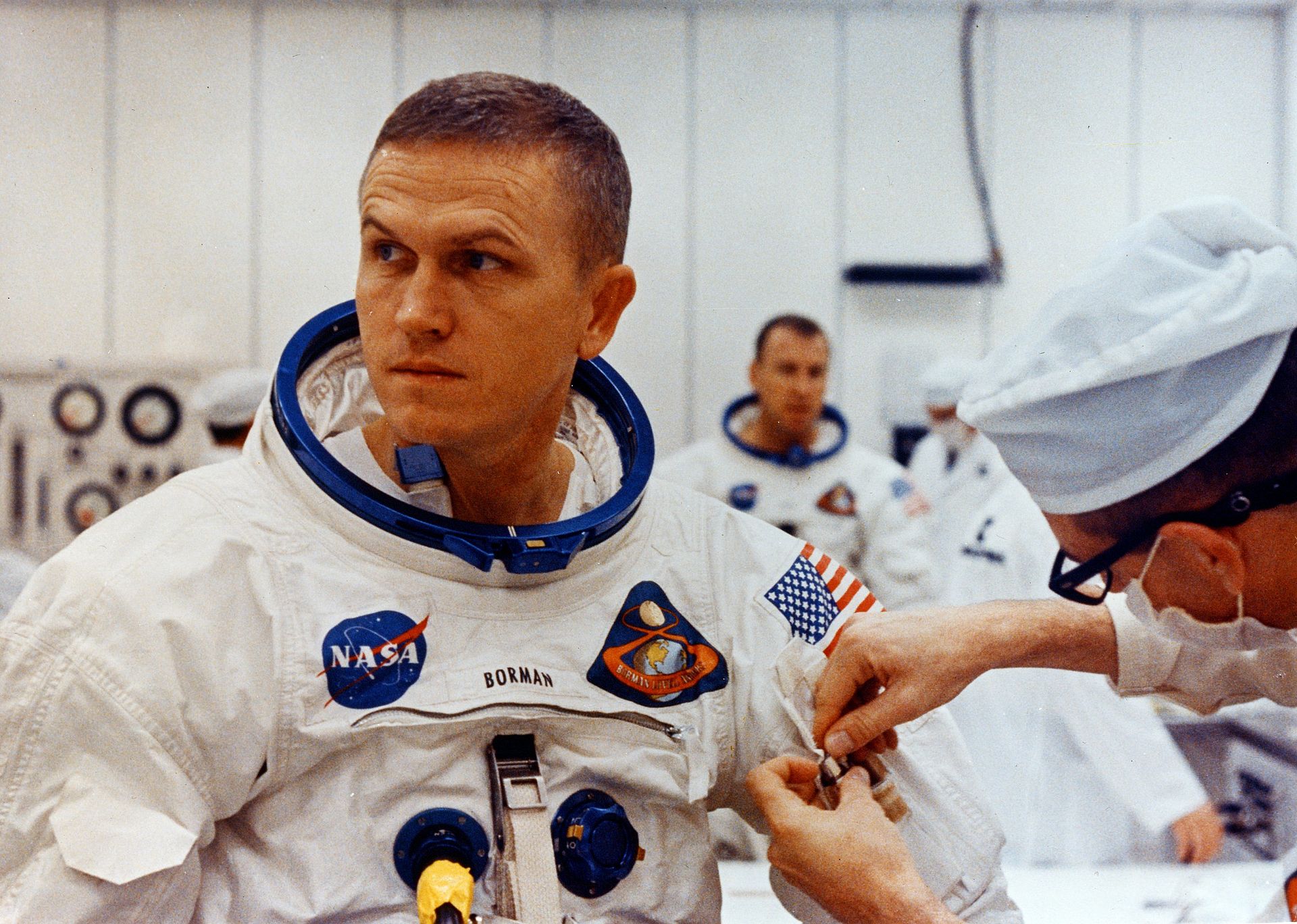
Astronaut Frank Borman, who commanded Apollo 8’s historic Christmas 1968 flight that circled the moon 10 times and paved the way for the lunar landing the next year, has died. He was 95.
Borman died Tuesday in Billings, Montana, according to NASA.
Borman also led troubled Eastern Airlines in the 1970s and early ‘80s after leaving the astronaut corps.
But he was best known for his NASA duties. He and his crew, James Lovell and William Anders, were the first Apollo mission to fly to the moon — and to see Earth as a distant sphere in space.
“Today we remember one of NASA’s best. Astronaut Frank Borman was a true American hero,” NASA Administrator Bill Nelson said in a statement Thursday. “His lifelong love for aviation and exploration was only surpassed by his love for his wife Susan.”
Launched from Florida’s Cape Canaveral on Dec. 21, 1968, the Apollo 8 trio spent three days traveling to the moon, and slipped into lunar orbit on Christmas Eve. After they circled 10 times on Dec. 24-25, they headed home on Dec. 27.
On Christmas Eve, the astronauts read from the Book of Genesis in a live telecast from the orbiter: “In the beginning, God created the heaven and the earth. And the earth was without form, and void; and darkness was upon the face of the deep.”
Borman ended the broadcast with, “And from the crew of Apollo 8, we close with good night, good luck, a Merry Christmas, and God bless all of you — all of you on the good Earth.”
Lovell and Borman had previously flown together during the two-week Gemini 7 mission, which launched on Dec. 4, 1965 — and, at only 120 feet apart, completed the first space orbital rendezvous with Gemini 6.
“Gemini was a tough go,” Borman told The Associated Press in 1998. “It was smaller than the front seat of a Volkswagen bug. It made Apollo seem like a super-duper, plush touring bus.”
In his book, “Countdown: An Autobiography,” Borman said Apollo 8 was originally supposed to orbit Earth. The success of Apollo 7’s mission in October 1968 to show system reliability on long duration flights made NASA decide it was time to take a shot at flying to the moon.
But Borman said there was another reason NASA changed the plan: the agency wanted to beat the Russians. Borman said he thought one orbit would suffice.
“My main concern in this whole flight was to get there ahead of the Russians and get home. That was a significant achievement in my eyes,” Borman explained at a Chicago appearance in 2017.
It was on the crew’s fourth orbit that Anders snapped the iconic “Earthrise” photo showing a blue and white Earth rising above the gray lunar landscape.
Borman wrote about how the Earth looked from afar: “We were the first humans to see the world in its majestic totality, an intensely emotional experience for each of us. We said nothing to each other, but I was sure our thoughts were identical — of our families on that spinning globe. And maybe we shared another thought I had, This must be what God sees.”
After NASA, Borman’s aviation career ventured into business in 1970 when he joined Eastern Airlines — at that time the nation’s fourth-largest airline. He eventually became Eastern’s president and CEO and in 1976 also became its chairman of the board.
Borman’s tenure at Eastern saw fuel prices increase sharply and the government deregulate the airline industry. The airline became increasingly unprofitable, debt-ridden and torn by labor tensions. He resigned in 1986 and moved to Las Cruces, New Mexico.
In his autobiography, Borman wrote that his fascination with flying began in his teens when he and his father would assemble model airplanes. At age 15, Borman took flying lessons, using money he had saved working as a bag boy and pumping gas after school. He took his first solo flight after eight hours of dual instruction. He continued flying into his 90s.
Borman was born in Gary, Indiana, but was raised in Tucson, Arizona. He attended the U.S. Military Academy at West Point, where he earned a bachelor of science degree in 1950. That same year, Borman married his high school sweetheart, Susan Bugbee. She died in 2021.
Borman worked as a U.S. Air Force fighter pilot, operational pilot and instructor at West Point after graduation. In 1956, Borman moved his family to Pasadena, California, where he earned a master of science degree in aeronautical engineering from California Institute of Technology. In 1962, he was one of nine test pilots chosen by NASA for the astronaut program.
He received the Congressional Space Medal of Honor from President Jimmy Carter.
In 1998, Borman started a cattle ranch in Bighorn, Montana, with his son, Fred. In addition to Fred, he survived by another son, Edwin, and their families.
NASA Administrator Honors Life of Apollo Astronaut Frank Borman - NASA
Last edited by S Landreth; 10-11-2023 at 04:10 PM.
-
14-11-2023, 09:18 AM #6216Thailand Expat
- Join Date
- Sep 2009
- Last Online
- @
- Posts
- 108,270
Might change the betting odds.
Maryanne Trump Barry, former President Donald Trump’s oldest sister, died on Monday at 86 years old.
A former federal judge, Barry, was found in her Upper East Side apartment in New York Monday morning. According to ABC News, “There were no signs of trauma or foul play. Emergency crews responded to a call of a person in cardiac arrest.”
Barry was the third of Donald Trump’s four siblings to die, leaving him and his younger sister, Elizabeth Trump Grau, as the only surviving siblings.
-
14-11-2023, 09:24 AM #6217Guest Member
- Join Date
- Sep 2008
- Last Online
- @
- Location
- left of center
- Posts
- 30,087
Conny Van Dyke Dead: Motown Singer Was 78
Conny Van Dyke, Motown Singer and ‘W.W. and the Dixie Dancekings’ Star, Dies at 78
Conny Van Dyke, a singer-songwriter signed to Motown Records who starred in such films as “W.W. and the Dixie Dancekings” and “Framed,” has died. She was 78.
Van Dyke died on Nov. 11 at her home in Los Angeles due to complications of vascular dementia, her son Bronson Page told Variety.
The Detroit native was a longtime colon cancer and stroke survivor. She got her start in the entertainment industry when she was just 15 and a student in high school, making the film “Among the Thorns” with Tom Laughlin, Bill Wellman Jr. and Stephanie Powers. During that time, Van Dyke also worked as a songwriter for Wheelsville Records in Detroit.
In 1961, Van Dyke signed with Motown Records, making her one of the first white recording artists on the label. Her first two singles, “Oh, Freddy,” written by Smokey Robinson, and “It Hurt Me Too,” previously written and recorded by Marvin Gaye, were released in 1963.
In 1969, Van Dyke starred as Betsy, Jeremy Slate’s love interest, in the outlaw biker film “Hell’s Angels ’69.” Also starring in the film were Tom Stern, Steve Sandor, Sonny Barger and the Oakland Hells Angels motorcycle club as themselves. Van Dyke described filming the movie as “a terrifying, and yet, exhilarating experience.”
After starring in “Hell’s Angels ’69,” Van Dyke released two country albums, “Conny Van Dyke” and “Conny Van Dyke Sings for You.” In 1975, she also went on to star in “W.W. and the Dixie Dancekings” alongside Burt Reynolds and Art Carney and “Framed” as singer Susan Barrett with Joe Don Baker. Van Dyke made a slew of television appearances on “Adam-12,” “Barbary Coast” and “Nakia” with game show appearances on “The Hollywood Squares,” “Match Game,” “Tattletale” and “The Gong Show,” among others.
Van Dyke retired from acting in the late 1970s to take care of her son, but returned in 2008 with a guest role on “Cold Case” and, later, “CSI,” before suffering a stroke that left her partially paralyzed and from which she never fully recovered.
Van Dyke is survived by her son, Page.
-
17-11-2023, 11:34 PM #6218hangin' around
- Join Date
- Oct 2006
- Last Online
- @
- Location
- Home
- Posts
- 41,228
AS Byatt
Died aged 87.
'Possession' was her most lauded novel, winning the Booker Prize in 1990.
I've only just found out that she was Margaret Drabble's sister.
What talent in that family.
RIP.
-
18-11-2023, 05:39 AM #6219Thailand Expat
- Join Date
- Jun 2011
- Last Online
- Today @ 03:19 PM
- Posts
- 1,670
George Brown, Kool and the Gang drummer and co-founder, dies aged 74
George “Funky” Brown, known for playing an instrumental part in Kool and the Gang, has died at the age of 74.
Brown died in Los Angeles of lung cancer, according to a statement released from a representative. “When asked to describe his music, Brown always replied, ‘The sound of happiness,’” it read.
He was one of the co-founders of the band as well as the drummer and a songwriter, co-writing some of their biggest hits including Celebration, Ladies’ Night and Jungle Boogie. He described himself as a “self-taught” musician.
Kool and the Gang was started in 1964 in New Jersey. “None of us were silver spoon babies,” Brown said. “All Jersey City was in the city, meaning, you know, the minority and the hardships. And that lent itself to writing and playing a certain way – being untrained, but knowing or teaching ourselves how to play.”
The band released their self-titled debut album in 1969. After two more live albums, it was 1973’s Wild and Peaceful that pushed them to the forefront, with hits including Hollywood Swinging. Further success was found in 1979 with Ladies’ Night, an album that became their first platinum success.
The band won two Grammy awards and had 31 gold and platinum albums.
In Brown’s memoir Too Hot: Kool & the Gang & Me, released earlier this year, he wrote about struggles with depression and prescription drugs. This past summer also saw the band release a new album called People Just Wanna Have Fun, written by Brown and bassist Robert “Kool” Bell. In August he decided to officially retire.
Samples from Kool and the Gang songs have been used by artists including Jay-Z, Beastie Boys, Madonna and Janet Jackson. Brown said he was “totally honored” by how often his music had been reused.
His family have asked, in lieu of flowers, that donations be made to the Lung Society of America.
In an interview earlier this year, Brown said: “When you do music that’s happy music, that’s what it does. It brings people to the clubs to have a good time. And that’s what we do. We say our prayer before we leave, and we say, let’s go make some people happy.”
-
18-11-2023, 06:14 AM #6220Thailand Expat

- Join Date
- Dec 2009
- Last Online
- @
- Location
- Chiang Mai
- Posts
- 57,226
Doesn’t anyone make fun music like this nowadays?
-
18-11-2023, 08:59 AM #6221Thailand Expat
- Join Date
- Sep 2009
- Last Online
- @
- Posts
- 108,270
Terrible, terrible song.
Played by crap wedding bands everywhere.
-
18-11-2023, 09:35 AM #6222Guest Member
- Join Date
- Sep 2008
- Last Online
- @
- Location
- left of center
- Posts
- 30,087
Pity the one of the founders passed away Originally Posted by misskit

-
18-11-2023, 10:05 AM #6223hangin' around
- Join Date
- Oct 2006
- Last Online
- @
- Location
- Home
- Posts
- 41,228
That's why their music is being discussed on this thread, numpty.
Post 6219.
-
18-11-2023, 10:37 AM #6224Guest Member
- Join Date
- Sep 2008
- Last Online
- @
- Location
- left of center
- Posts
- 30,087
^didn't see it
Robert Butler, the Emmy-winning, go-to pilot director who helmed the first episodes of such acclaimed shows as Batman, Star Trek, Hill Street Blues and Moonlighting, died Nov. 3 in Los Angeles, his family announced. He was 95.
Butler also co-created the Pierce Brosnan-starring Remington Steele (and helmed its pilot, of course), directed the first episode of Hogan’s Heroes in 1965, and called the first shots and set the tone for, Glenn Gordon Caron’s Moonlighting, Lois and Clark: The New Adventures of Superman, Sisters and The Division.
In 1973, he directed the William Holden-starring The Blue Knight — the first four-hour television miniseries — at NBC and then got the CBS series adaptation of the Joseph Wambaugh novel that starred George Kennedy off on the right foot.
Butler also helmed two episodes of The Twilight Zone (the fifth-season installments “Caesar and Me,” starring his old friend, Jackie Cooper, and “The Encounter”) and worked on The Dick Van Dyke Show, The Untouchables, Dr. Kildare, The Fugitive, Walt Disney’s Wonderful World of Color, Gunsmoke, Hawaii Five-O, Kung Fu, I Spy, Columbo, The Waltons and Ironside.
He received the DGA’s inaugural Lifetime Achievement Award in Television Direction in 2015, being honored alongside James Burrows, the king of the sitcom pilot. Fourteen years earlier, he was presented with the Robert B. Aldrich Achievement Award in recognition of his decades of service to the guild.
Butler was pals with screenwriter Lorenzo Semple Jr., who developed Batman for ABC, as their wives had known each other since they were kids. So Semple was delighted when producer William Dozier hired his friend to bring the Caped Crusader from the comic books to life in late 1965.
“Dozier knew me when he was a CBS boss [and] I was a very efficient associate director,” Butler said in the 2016 book Batman: A Celebration of the Classic TV Series, written by Bob Garcia and Joe Desris. “He knew me as a guy who knew production and would get the job done right.”
Butler took 21 days to film the highly touted pilot episode of Batman (split into two half-hour installments that aired on Jan. 12 and 13, 1966), which featured Frank Gorshin as The Riddler. He employed hand-held cameras and “Dutch angle” shots that showed the villains in “slanted” environments (they were crooked, after all).
Butler then helmed another pair of two-parters in the Adam West-starring series’ first season, ones that featured The Penguin (Burgess Meredith) and Mister Freeze (George Sanders).
Butler had directed two episodes of Gene Roddenberry’s The Lieutenant military drama in 1963-64, and the writer-producer asked him to tackle “The Cage,” the original pilot episode for Star Trek, in 1966. It starred Jeffrey Hunter as the ship’s captain alongside Leonard Nimoy as Mr. Spock.
“I read the script and said, ‘This is just a palette of science fiction,’ ” he recalled in a 2004 interview for the Archive of American Television. “I remember talking to my wife about it and saying, ‘This is too nuts, I don’t know whether to do this.’ She said, ‘Ah, why don’t you do it?’ So I did.
“NBC saw the show and said, ‘We like it, we want it, we don’t understand it, do it again.'” So another pilot was ordered, and William Shatner was in for Hunter. “The Cage” wasn’t broadcast in its entirety until 1986, though some of Butler’s footage was used in the first-season two-parter “The Menagerie.”
For the pilot of Hill Street Blues, the landmark Steven Bochco-Michael Kozoll cop show that aired on NBC from 1981-87, Butler said he wanted it to look “messy.”
“In my mind, the show came from the congestion of the material, the congestion of the characters,” Butler said in a 2011 story about the cop drama that was published on the DGA website. “I remember the camera operator cleaning up shots, in the classic Hollywood style that I had begun to hate, and I had to brainwash him to let it be a mess.
“The trick was to make it look seemingly real, live, raunchy, congested. We jammed the streets with derelict cars and graffiti. We suggested Eastern-city crunch very well.”
Michael Zinberg, then NBC’s vp development at the time, said the pilot “was the single most compelling screening I’ve ever seen. It killed the room. As good a script as it was, it wasn’t until Bob Butler put his hands on it that it became Hill Street Blues. He was an adventurous thinker and took everything that had been done before and launched it into a whole new level. Hire any other director, and you don’t get that show.”
Butler won an Emmy for directing the pilot episode after receiving two trophies for the Blue Knight miniseries. He was nominated seven times in all, including twice for the pilot for ABC’s Moonlighting, the 1985-89 comedy-drama that starred Cybill Shepherd and Bruce Willis as private detectives.
In the Batman book, he said working on the first episodes had a distinct advantage.
“On pilots, everyone is hungry. Everyone is paying attention,” he said. “There is less goofing around. They want to sell it. They want to get it on the air. [Everyone has the attitude of,] ‘How can I help? What can I do?'”
Robert Stanton Butler was born on Nov. 16, 1927, in a hospital in Hollywood. His father was an insurance adjuster and his mother a schoolteacher. He grew up on the Westside and attended University High School. He played the trombone, and as a teenager, he was a musician in the band on Hoagy Carmichael’s live NBC Radio variety show.
After graduating with a degree in English from UCLA, Butler landed a job as an usher at CBS in Hollywood and quickly rose through the ranks to receptionist, production clerk, stage manager and then assistant director on such live anthology shows as Climax! and Playhouse 90.
Butler got his first shot at directing on a 1959 episode of the TV comedy Hennesey, which starred Cooper as a Navy doctor, then went on to such shows as The Many Loves of Dobie Gillis, The DuPont Show With June Allyson and Have Gun — Will Travel.
After Cooper turned down an offer to direct the Hill Street Blues pilot, MTM Enterprises president Grant Tinker went after Butler.
Butler came up with the concept for the Brosnan show: A woman (Stephanie Zimbalist) wants to run a detective agency but has to invent a fictitious male superior, named Remington Steele, to get nervous clients comfortable enough so they’ll sign on.
Butler originally had Steele as nothing more than innuendo, but writer Michael Gleason thought the character should come to life, and that’s how it would be when the series bowed on NBC in 1982.
Butler also helmed a few features, including The Computer Wore Tennis Shoes (1969), The Barefoot Executive (1971) — both at Disney — and Turbulence (1997).
“Few directors have changed the face of television as much as Bob did — his impact on the medium is truly immeasurable, and this loss to our guild is deeply felt,” DGA president Lesli Linka Glatter said in a statement.
“At ease in any genre, Bob’s pilots established the look and feel of several seminal series including Hogan’s Heroes, Batman and Star Trek. His groundbreaking work on Hill Street Blues brought to life the grit and reality of an urban precinct by coupling his unique visual style with evocative performances he coaxed from an incomparable cast, forever changing the trajectory and style of episodic procedurals.”
Survivors include his wife, Adri; children Robert Jr. and Cornelia; and grandsons Rainer and Liam. Gifts in his honor may be made to the Directors Guild Foundation, for whom he was a trustee for more than 35 years. He joined the DGA in 1959.
-
18-11-2023, 10:47 AM #6225hangin' around
- Join Date
- Oct 2006
- Last Online
- @
- Location
- Home
- Posts
- 41,228
So you knew a founder member of Kool & The Gang had recently died, saw the video of 'Celebration' on the 'RIP Famous Dead Person' thread and thought people were just spontaneously discussing their music? Originally Posted by S Landreth


 Reply With Quote
Thread Information
Users Browsing this Thread
There are currently 1 users browsing this thread. (0 members and 1 guests)
