

ASEAN unlikely to reach agreement on Human rights issue
PUTRAJAYA, July 18 (Bernama) -- The Asean Foreign Ministers Meeting in Singapore next week is unlikely to reach an agreement on the inclusion of the human rights clause in the Asean Charter, Malaysian Foreign Minister Rais Yatim said Friday.
"The meeting from July 20 to 24 will concentrate on human rights under the Asean Charter, the definition of human rights, its scope and so on. The concept of human rights itself is wide and there are a few important questions that need to be answered.
"What I would like to stress is the need to include the eastern values in the clause. For example, respecting an elder and religious values are important to us in Asia. We can't take the Universal Human Rights Declaration as a whole and apply it here," he told a news conference at Wisma Putra (Foreign Ministry) here.
Other important Asian tenets must also be included in the Asean Human Rights charter, he said, adding: "I don't think an agreement on the matter would be reached at this meeting."
He said the human rights issue needed further delibration by the 10 member states of the grouping before it could be accepted under the Charter.
On another issue, Rais, who has just returned from Britain, said he had requested the British authorities to continue to waive visa requirements for Malaysians, taking into account the close ties between the two nations.
"Although the British government had given several countries, including Malaysia, six months to improve our immigration laws and enforcement, we feel that we should not have any visa requirement. We have close business ties, we have some 12,000 Malaysian students studying there," he said.
Britain imposed the six-month period after it was found that some 1,500 Malaysian passport holders had abused visas given to them over the past several years.
"I also stressed the importance for the British immigration authorities to inform the Malaysian High Commission in London once such visa fraud cases are detected. This would enable us to check on the matter and take appropriate preventive action," Rais added.
He said that during the trip, he also met officials of the Commonwealth Secretariat where the minister had emphasised the need for the Commonwealth to extend technical programmes to countries in Asia.
He said that presently Commonwealth programmes were concentrated in Africa, India and other continents but not in the east or in Asia.
"I will bring this matter up at the Commonwealth Ministerial Action Group meeting in September. They should also extend whatever programmes to Asia," he added. (BERNAMA)
enews.mcot.net
unlikely to reach an agreement on the inclusion of the human rights clause in the Asean Charter
thus nothing more than a good junket for the pollies and a waste of time and money for the ordinary folks.
.
Results 1 to 25 of 30
-
19-07-2008, 02:28 PM #1Thailand Expat



- Join Date
- Aug 2007
- Last Online
- @
- Posts
- 1,405
ASEAN unlikely to reach agreement on Human rights issue
-
22-07-2008, 04:34 PM #2Thailand Expat
- Join Date
- Aug 2007
- Last Online
- @
- Posts
- 1,405

Myanmar opposes investigative powers for human rights body
JIM GOMEZ, Associated Press Writer
July 22, 2008
SINGAPORE (AP) - Myanmar's junta has indicated it will oppose any effort to give a Southeast Asian human rights body the power to monitor or investigate rights violations in the region, diplomats said Tuesday.
A high-level panel of the Association of Southeast Asian Nations started work Monday to set up the rights body. The panel will lay down the body's future makeup, role and powers, which will be presented to a summit of ASEAN leaders in December.
But in a closed-door session with the panel Monday, Myanmar Foreign Minister Nyan Win said the human rights body should uphold ASEAN's bedrock policy of noninterference in each other's affairs, a diplomat present at the meeting told The Associated Press.
The diplomat spoke on condition of anonymity because she was not authorized to speak to the media.
Another diplomat who attended a separate meeting between all 10 ASEAN ministers and the panel also said Nyan Win made clear his opposition to the rights body having any monitoring authority.
Myanmar's military government, which has been strongly criticized by Western governments and even fellow ASEAN members for its dismal human rights record, has used the bloc's policy to parry any attempt by outsiders to intervene on behalf of human rights victims in the military-ruled nation.
It has already been decided that the rights body will not have the power to impose sanctions or seek prosecution of violators. But Myanmar's objections, if honored, will make the body even less effective.
A majority of other ASEAN foreign ministers, led by Indonesia, the Philippines and Thailand, separately told the panel that the human rights body should at least be empowered to monitor violations and offer advice to prevent such problems, said the first diplomat.
Myanmar officials were not immediately available for comment but in the past they have said the human rights body should only serve as a ''consultative mechanism'' and that it should not ''shame and blame'' any ASEAN nation.
The rights body is being set up as part of ASEAN's proposed new charter, which seeks to make the organization rule-based.
ASEAN Secretary-General Surin Pitsuwan said the charter will serve as a guide to the panel drafting the terms of reference for the rights body.
''They're going to follow the charter very, very closely - its principle of promoting, upholding and protecting human rights,'' Surin said.
The international community has condemned Myanmar's junta for its refusal to restore democracy and release pro-democracy leader and Nobel laureate Aung San Suu Kyi and other political detainees. ASEAN has also been criticized for not doing enough to pressure Myanmar's military leaders.
ASEAN foreign ministers, disappointed with the Myanmar junta's foot-dragging on democracy, expressed ''deep disappointment'' in a statement Sunday at the junta's May decision to extend Suu Kyi's detention.
ASEAN's members are Brunei, Cambodia, Indonesia, Laos, Malaysia, Myanmar, the Philippines, Singapore, Thailand and Vietnam.
newspress.com
-
22-07-2008, 06:33 PM #3RIP

- Join Date
- Dec 2006
- Last Online
- 08-07-2010 @ 08:33 PM
- Location
- Phetchabun city
- Posts
- 15,471
How in the hell can they reach an agreement when no one knows what Human Rights are or what it means.
-
22-07-2008, 06:59 PM #4Days Work Done!

- Join Date
- Oct 2007
- Last Online
- Today @ 02:41 PM
- Location
- Roiet
- Posts
- 36,050
My initial response when I first read this was bollocks. The more I thought about it, the more I believe he has a point. There are aspects of "human rights" as practiced in the west which IMO will never work in many Asian countries. Originally Posted by Mid
Burma is a country whose human rights only include the rights of those in power and anything they have to say regarding human rights is bullocks. Other countries such as Singapore, Malaysia and Thailand may well be better served with a slightly different spin on what constitute "human rights".
I may start a post in Issues on the subject to get comment from the board."Whenever you find yourself on the side of the majority, it is time to pause and reflect,"
-
22-07-2008, 07:53 PM #5Thailand Expat
- Join Date
- Aug 2007
- Last Online
- @
- Posts
- 1,405
hi Norton , here's a link to the UNIVERSAL DECLARATION OF HUMAN RIGHTS
wondering which clause / clauses you may think don't apply to Asia ?
-
22-07-2008, 08:46 PM #6Thailand Expat

- Join Date
- Mar 2007
- Last Online
- 21-10-2023 @ 08:08 AM
- Location
- Way, Way South of the border now - thank God!
- Posts
- 33,190
But, since the Declaration is not legally binding technically, there are no signatories to the Declaration. Instead, the Declaration was ratified through a proclamation by the General Assembly on December 10, 1948 with a count of 48 votes to none with 8 abstentions. Originally Posted by Mid

(from the UN Charter of Human Rights)
-
10-12-2008, 03:17 PM #7Thailand Expat
- Join Date
- Aug 2007
- Last Online
- @
- Posts
- 1,405
ASEAN human rights body: Will it have an impact on Myanmar's junta?
Wednesday, December 10, 2008 3:09 PM
Djoko Susilo , Jakarta
Almost a year ago, at a meeting of parliamentarians of the Association of Southeast Asian Nations, I urged the ASEAN states to freeze Myanmar's membership from the 10-member grouping since there had been no serious political will to implement democracy and protect human rights, such as by releasing its jailed political opponents -- especially Daw Aung San Suu Kyi from her house detention.
Last year's incidents in Myanmar proved that such a call is indeed still valid and it will still be valid until the domestic situation in that country moves toward democracy.
The violent crackdown and the junta's brutality against the peaceful demonstrations of the Buddhist monks -- who were supported by the Myanmarese people -- were well documented and widely known throughout the international community, yet the junta recently tried to fool the world by announcing a so-called general election.
Regrettably some ASEAN leaders have expressed their readiness to cooperate with the junta and welcomed the last false referendum and the planned election as "real" progress. It is a shameful act and betrays the people of Burma/Myanmar. They don't really care about the sufferings of the people who have been oppressed by the military junta for almost two decades.
Indeed, we cannot just sit back and wait until the situation improves. Action must be taken because there has been no serious will from the military junta to work for a peaceful solution to Myanmar's problems.
With this appeal, the international community needs to work together and have a untied stand to put more pressure on Myanmar. The Indonesian government, in this case, supports the efforts of democratization and reconciliation. In his meeting with UN special envoy Ibrahim Gambari, President Susilo Bambang Yudhoyono said it was necessary to push for Myanmar's reconciliation process from many aspects.
However, the Indonesian government believes that those aspects that must be advocated in Myanmar are not only related to democracy and human rights, but also to security and stability as potential threats to Myanmar's disintegration. This is the way to handle Myanmar's psychological issues, especially with the sense of insecurity and inconvenience of the ruling government in the context of the new Myanmar.
The Indonesian government also strongly supports Gambari's mission to solve Myanmar's problems within UN's framework and Indonesia will ensure that the issue remains on the UN Security Council's agenda.
In addition, Indonesia urges the Chinese and Indian governments to do more to convince Myanmar to improve its dismal human rights record. We believe it is important to enlist the help of these two nations to convince the junta to fulfill its promise to embrace democracy.
Within the ASEAN context, especially in its relations between the Myanmar issue and the signing of the ASEAN Charter in Singapore last year or its finalization later this year (probably) in Thailand, many have expressed concerns as to whether the charter will work as expected, especially after the recent troubles in that member country. The Indonesian parliament, for example, has expressed its concern over several of the ASEAN Charter's articles -- a legally binding treaty that regulates relations among the 10 members of ASEAN.
Recent reports of senior officials meeting in Denpasar, Bali, in preparation for the upcoming ASEAN summit produced discouraging news. The members of the high-level panel have yet to agree on the official name of the human rights body. Some reports suggest that many countries in ASEAN are more interested in the "promotion" rather than the "protection" of human rights.
Sihasak Phuangketkeow, a senior Thai diplomat who chaired the meeting said that human rights promotion and protection would be an evolutionary process given the differences of the ASEAN members, in terms of their diversities, stages of development and political awareness.
Thus, member countries do not expect too much on the protection of human rights from within ASEAN, let alone its ability to maintain peace and security in the region. Myanmar will be the biggest offender, and the crimes committed by the junta will go unpunished.
Indonesia acknowledges that ASEANS's diplomatic efforts to prod Myanmar to rapidly democratize have failed. ASEAN has recognized that its constructive engagement has not produced any tangible results. But sanctions and pressures by western countries have also failed.
Within the ASEAN Parliamentary, the Myanmar tragedy is a catastrophe for the region. The Parliamentarians urge their governments to take strong actions and recognize the seriousness of the human security problems caused by the Myanmar regime. We must be as one to end the misery and sufferings of the Myanmar people.
The writer is member of the Indonesian House of Representatives and Chairman of the ASEAN Inter-Parliamentary on Myanmar Caucus.
thejakartapost.com
wasn't sure whether this went here or here : https://teakdoor.com/thailand-and-asi...an-rights.html (Activists and member states discuss ASEAN rights body)
so it ended up here .
-
10-12-2008, 03:47 PM #8សុខសប្បាយ

- Join Date
- Oct 2007
- Last Online
- 11-12-2009 @ 11:23 PM
- Location
- 75 clicks above the Do Lung bridge
- Posts
- 6,659
Interesting that Malaysia just reduced the period of stay for Visa on arrival because of the exact same concerns. Originally Posted by Mid
-
25-12-2008, 01:49 PM #9Thailand Expat
- Join Date
- Aug 2007
- Last Online
- @
- Posts
- 1,405
UN condemns human rights violations in Myanmar
25 Dec 2008
UNITED NATIONS: The UN General Assembly has strongly condemning widespread human rights violations in Myanmar and called on the government to halt politically motivated arrests and free all detainees and political prisoners including Aung San Suu Kyi.
The sharply worded resolution, sponsored by the United States, Australia, South Korea, Israel and many European countries, was approved on Wednesday by a vote of 80-25 with 45 abstentions.
Myanmar accused the assembly of "blatant interference" in its home-grown political process and said it will not be bound by the resolution.
General Assembly resolutions are not legally binding but carry weight because they reflect the views of the 192-member world body.
timesofindia.indiatimes.com
-
21-01-2012, 05:00 PM #10Thailand Expat
- Join Date
- Aug 2007
- Last Online
- @
- Posts
- 1,405
Human rights document to be judged by universal standards
Friday, 20 January 2012
The long-awaited Human Rights Declaration by the Association of Southeast Asian Nations is expected to be finalized in the coming months, but human rights groups say the process has been surrounded in secrecy, raising concerns. The process also calls for the setting up of a human rights body.

The drafting process under the Asean Intergovernmental Commission on Human Rights is now in full swing and is expected to gather momentum, but challenges abound when trying to reconcile the desires of the 10-member regional body, many of whose governments are recognized as not free, and which limit the scope of human rights.
Writing in the Bangkok Post on Friday, Vitit Muntarbhorn, a professor of law at Chulalongkorn University, outlined some of the challenges.
First is the long-cherished Asean principle of national sovereignty and "non-interference in the internal affairs of a state," which has been citied as reason for Asean not to become involved in controversial issues in the past.
“From an international perspective, however, sovereignty itself comes with the responsibility to protect human rights. Moreover, international human rights advocacy is a part of international law and jurisdiction, and cannot be considered to be interference in the affairs of a sovereign state. This is easily illustrated by the fact that all Asean countries were and are against apartheid, and have never considered their advocacy on this front to be interfering in the internal affairs of another state,” Vitit wrote.
“Second, there may be a question as to whether to refer to various particularities, such as by means of the term ‘Asean values,’” in the draft text.
He said the term itself has a negative connotation because the term implies that there should be deference to "authority," dictating that the government's action should prevail over the rights of individuals and that economic rights should prevail over political rights.
“A better term is to underline ‘values in Asean’ which support universal human rights standards,” said Vitit. “A positive list of these values includes our commitment to peace, non-violence from the home to the state level, and a caring community that cherishes human dignity and the rights and freedoms of individuals to help strengthen international human rights law rather than to compromise it.”
Third, he said the draft declaration should aim for “a balance between responsibilities on the part of individuals and responsibilities on the part of the state and other non-state actors.”
“Internationally, every person is already under a duty towards his or her family, community and state, and he/she must exercise his or her rights with due regard to the rights of others. For instance, freedom of expression cannot be used to defame others,” he said.
“However, the duties and limitations to be imposed on individual rights must also be based on fair and transparent criteria: there must be a limitation on the limitations.
“Internationally, therefore, if there are to be such limitations to constrain the exercise of human rights, they must be in accordance with the law and not be based on arbitrary action; necessary in view of the risks; proportionate to the circumstances; and in the pursuit of democratic aims.”
Vitit emphasized that the universal principle of human rights is based on non-discrimination.
“They are not only the rights of our nationals but of all persons on our territory, including stateless persons, refugees, displaced persons, migrant workers, minorities and indigenous peoples, bearing in mind gender sensibility,” he said.
Human rights are also premised on basic minimum standards of humane treatment for all: protection from violence, access to justice and access to basic services and assistance, including free and compulsory education, birth registration and emergency healthcare.
“On another front, it is now internationally accepted that every nation has a responsibility to protect its population from serious violations, such as genocide, war crimes and crimes against humanity, failing which the international community can offer a helping hand and take other actions under the UN charter,” he said.
The Asean Human Rights Declaration will be judged, said Vitit, on whether it unambiguously meets universal human rights standards.
bnionline.net
-
21-01-2012, 05:02 PM #11Member

- Join Date
- May 2006
- Last Online
- 07-02-2019 @ 08:58 PM
- Posts
- 827
What they mean is they want to remove any obstacle that gets in the way of ASEAN State Governments and Industries from fucking their people over.
-
17-02-2012, 07:54 PM #12Thailand Expat
- Join Date
- Aug 2007
- Last Online
- @
- Posts
- 1,405
Asean waters down human rights draft: leaked document
Friday, 17 February 2012
(Mizzima) – A leaked draft of the Asean Human Rights Declaration obtained by Mizzima has lifted the veil of secrecy surrounding the centerpiece of the human rights agenda of the Association of Southeast Asian States (Asean).

A working draft, written in January at the time of the first meeting of Asean Intergovernmental Commission on Human Rights on the Asean Human Rights Declaration held in Siem Reap, Cambodia, includes detailed comments by officials from Laos, Malaysia, Vietnam, Thailand, Indonesia, the Philippines and Singapore.
The draft revealed a number of the Asean-member states – most notably Laos – are seeking to water down the declaration by proposing wording that would limit its scope and application, while officials from Thailand, Indonesia and the Philippines, providing comment as a block of nations, proposed more progressive wording.
Laos has arguably taken the most hardl-line stance, placing conditions on a number of sections in the draft declaration.
Commenting on the duties and responsibilities of the Asean member States, Laos said the “realization of universal human rights” must be in the context of “regional and national particularities” such as political, economic, social, cultural, historical and religious backgrounds.
Laos’ position is contrary to the more expansive wording drafted by the Asean Secretariat that “…it is the duty of member states, regardless of their political, economic and cultural systems, to promote and protect all human rights and fundamental freedoms.”
Laos is also proposing the inclusion of a “national security” and “public morality” trigger to override claims to universal human rights and freedoms, perhaps fearful of an erosion of national security and moral principles.
“The exclusive insistence on rights can result in conflict, division, and endless dispute and can lead to lawlessness and chaos,” Laos said.
While the secretariat’s original wording acknowledges rights shall be exercised with “due regard” to national security and contains no mention of “public morality,” Laos’ rewording would extend the reach of limitations, potentially enabling a member state to claim exemption from the Declaration where national security, public morality and other issues enacted in national laws permit.
“The exercise of human rights and fundamental freedoms shall be subject only to such limitations as are determined by law solely for the purpose... to meet the just requirements of national security, public order, public health and public morality and the general welfare of the peoples in a democratic society,” Laos said.
Some member states appear to have accepted the inclusion of “public morality” as a limitation.
In other comments, Laos proposed limiting “the right to practice one’s religion or belief” with the condition that “advocacy or dissemination of religions or beliefs shall be in compliance with national law of each Asean Member State.”
Both Laos and Vietnam held reservations about the right to freedom of opinion and expression and to freely receive information. Laos added the qualification, “Freedom of expression carries with it special duty not to defame the reputation of others and incite hatred, discrimination, war, social division and violence.”
Laos is the most vigorous advocate for cementing state rights above claims to universal human rights and freedoms, with Malaysia and Vietnam making supporting comments.
“Each Asean member state has the right to pursue its own economic and social development and freely choose it s own political system which suits the historical culture and social realities and national values of each nation, based on the aspirations of its people without external interference or pressure in whatsoever forms,” Laos said.
And in a clear statement designed to shield trade and investment from the scope of the Declaration, Laos said, “Human rights should not be used as conditionality for extending official development assistance to, engage in trade with, and making investment in Asean-member states.”
Burma did not directly comment on the draft but did support the position of Laos “not to mention international binding instruments in this political declaration” and agreed with Laos which had “reservations in regards to the use of the term[s] ‘minority groups’ and ‘indigenous peoples’.”
The definition of who holds rights and freedoms under the Declaration appears to be contentious, with a number of member states providing views.
The draft stated, “Everyone is entitled to all the rights and freedoms set forth in the Declaration, without distinction of any kind, such as race, colour, sex, language, religion, political or other opinions, national or social origin, sexual identity, property, birth, disability or other status.”
However, socially conservative Brunei and Malaysia are opposed to the inclusion of “sexual identity” and Malaysia raised concerns about the definitions of “sex” and “other status” seeking to ensure they are “determined by Asean common values in the spirit of unity in diversity,” and not based on other internationally accepted definitions.
Thailand proposed changing “sexual identity” to the more progressive term “sexual orientation” to reflect the language of the Committee on the Elimination of Discrimination against Women (CEDAW). Thailand also proposed that the phrase “gender identity” be included.
Of the other member states’ comments, Singapore took a relatively cautious approach, stating it has reservations about a number of issues notably that, “Primary education shall be compulsory and free,” and “A person’s nationality cannot be revoked or otherwise deprived if it will result in the person being stateless.”
Vietnam questioned the use of the word “freely” in a citizen’s right to participate freely in government and proposed removing “torture, enforced disappearance or other serious human rights violations” from the list of persecutions preventing a State from extraditing an asylum seeker.
The current draft also defines when the death penalty can be used. However, some member states oppose its inclusion.
The raft of changes proposed in the leaked draft will be a cause for concern among many civil society groups.
Worried by the possibility the declaration may fall below international standards under the guise of the “Asean way,” civil society’s position paper on the declaration submitted in June 2011 by the Solidarity for Asian People’s Advocacy Task Force on ASEAN and Human Rights (SAPA TF-AHR), a coalition of more than 70 nongovernmental organizations in Southeast, said:
“Under no circumstances may the standards for human rights in the AHRD fall below those provided by universal human rights instruments. Instead, ASEAN as a regional association should aspire to commit itself to higher standards of human rights and contribute to the advancement of the promotion and protection of human rights globally.”
Last month, Amnesty International criticized the Asean panel charged with drafting a human rights code saying it is working largely in secrecy and not consulting with human rights’ NGOs.
Asean officials say the Asean grouping hopes to finalize the draft of the rights charter in 2012. The final draft must be passed by consensus.
mizzima.com
-
17-02-2012, 07:55 PM #13Thailand Expat
- Join Date
- Aug 2007
- Last Online
- @
- Posts
- 1,405
nope , never saw that coming Originally Posted by Mid

-
04-04-2012, 08:05 PM #14Thailand Expat
- Join Date
- Aug 2007
- Last Online
- @
- Posts
- 1,405
S-E Asia to adopt human rights declaration
Apr 4, 2012
PHNOM PENH, Cambodia (AP) - South-east Asian nations have agreed to adopt this year a human rights declaration to strengthen protection in a region notorious for violations.
Leaders of the Association of Southeast Asian Nations said on Wednesday they intend to adopt the Asean Human Rights Declaration, which is being drafted, when they meet in a summit in Cambodia in November.
Philippine diplomat Rosario Manalo says the declaration will be patterned after the 1948 UN declaration.
Although non-binding, the 10-nation Asean's declaration is the latest effort by the bloc to promote human rights in a region with a long history of violations.
Asean includes Myanmar, which has been condemned for its dismal rights record but has embarked on democratic reforms in recent months.
straitstimes.com
-
09-04-2012, 01:13 PM #15Thailand Expat
- Join Date
- Aug 2007
- Last Online
- @
- Posts
- 1,405
Civil society 'shunned' by AHRD drafting panel
9/04/2012
Over 100 civil society organisations have expressed disappointment over the continued secrecy and non-transparency in the drafting process for the historic Asean Human Rights Declaration (AHRD).
They say the drafting committee has so far shunned all recommendations put forward by the non-state sector, and have called for a practical platform for their meaningful participation in the drafting of the Asean rights declaration.
The Asean Inter-governmental Commission on Human Rights (AICHR) is meeting in Phnom Penh from April 9 -11 this week, following the 20th Asean Summit meeting the Cambodian capital last week.
"The draft has been in development for nearly a year, but has not yet been released to the public. Until and unless the AICHR consults and engages with all stakeholders in a transparent, meaningful and substantive manner, the AICHR should postpone its submission of the final draft of AHRD to the Asean Ministerial Meeting (AMM), which is scheduled to take place in July 2012," said the joint statement released on Sunday.
The joint statement, also co-signed by Asean Watch (Thailand), Ecological Alert and Recovery Thailand, Empower Foundation, Thailand Foundation for Consumers, Thailand NGO Coordinating Committee on Development (NGO-COD), Thailand Northern Development Foundation and Thai Committee for Refugees Foundation, has been translated into Asean's major languages-- Burmese, Bahasa-Indonesian, Bahasa-Malay, Khmer, Lao, Thai and Vietnamese -- to "indicate our commitment to promote the basic human rights of the people that they are entitled to receive information and awareness about Asean and its works".
Only the AICHR representatives of Indonesia, Malaysia, Philippines and Thailand have solicited input from civil society on the historic declaration, said Yap Swee Seng, executive director of Asian Forum for Human Rights and Development.
Mr Swee Seng said civil society organisations that have submitted recommendations on the declaration have yet to receive official responses from the AICHR.
The joint statement also called upon the AICHR to implement specific steps to ensure that the process of drafting the Declaration will be credible, inclusive, transparent, reflective and consistent with universal human rights standards. These steps included the immediate release of the draft, public consultations, and the translation of the draft into national and local languages.
"Consultations without a draft of the AHRD at hand are meaningless, and a Declaration adopted without meaningful and broad-based consultations will not be legitimate," said Pung Chhiv Kek, president of the Cambodian League for the Promotion and Defence of Human Rights.
The joint statement has been endorsed by some 150 organisations and networks representing a wide range of sectors in Asean member states, including youth organisations, women's organisations, child rights organisations, LGBT organisations, migrant workers network organisations, labour unions, farmers organisations, environmental organisations, human rights organisations, development organisations and some academic institutions.
The AHRD is widely predicted to be adopted at the 45th Asean Ministerial Meeting (AMM) in July in Phnom Penh.
"The AICHR should postpone its submission of the Asean Human Rights Declaration to the AMM in July if no meaningful public consultations were held in the finalisation of this document," said Haris Azhar, coordinator of the Commission for the Disappeared and Victims of Violence of Indonesia (Kontras).
Mr Azhar said "We therefore strongly urge the AICHR to heed the recommendation of the United Nations High Commissioner for Human Rights, Navi Pillay, that "no discussion of human rights can be complete or credible without significant input from civil society and national human rights institutions" and immediately begin dialogue and consultations with civil society organisations on the AHRD."
bangkokpost.com
-
14-05-2012, 04:39 PM #16Thailand Expat
- Join Date
- Aug 2007
- Last Online
- @
- Posts
- 1,405
Burma to Host Asean Human Rights Meeting
SIMON ROUGHNEEN
May 14, 2012

An elderly refugee in Kachin State where ethnic conflict has caused more than 75,000 civilians to flee their homes.
(Photo: my.tianya.cn)
BANGKOK—The Asean Intergovernmental Commission on Human Rights (AICHR) will hold its next meeting in Rangoon this June in another transitional landmark for Burma’s reformist government that nonetheless stands accused of ongoing human rights abuses.Despite conflict between Burmese government troops and the Kachin Independence Army (KIA) in the country’s far north, the AICHR “will resume their discussion at the sixth meeting in [Rangoon], Myanmar on June 3-6, 2012,” after meetings last week in Thailand, according to a press release from the Association of Southeast Asian Nations (Asean)—the ten-state regional grouping of which Burma assumes the chair in 2014.
The Rangoon meeting is aimed at finalizing a draft regional human rights declaration to be presented to Southeast Asian foreign ministers, but has generated mixed feelings among Burmese activists.
Cheery Zahau is a human rights analyst from the Chin region of Burma, close to India. She told The Irrawaddy that “if Burma hosts this meeting, it needs to end the ongoing human rights violations committed by the army and all security forces in ethnic areas.”
The June 3-6 meeting will be the first time the former military dictatorship has hosted such a gathering—which likely would not have come about without recent reforms undertaken by the armed forces-dominated government.
It marks a major about-turn for a Burma, after UN human rights envoy Tomas Ojea Quintana said in 2010 that long-standing evidence of crimes against humanity in Burma warranted a commission to look into the possibility of an international tribunal on the country.
That call was backed by the US and a number of European states, but has since been effectively shelved in the wake of changes include the freeing of hundreds of political prisoners, a landslide win for the opposition National League for Democracy (NLD) in April 1 by-elections, and the formation of the Myanmar National Human Rights Commission in September 2011.
Western governments have relaxed or suspended economic sanctions in response to the reforms, while international firms are mulling investing in Burma—described by the International Monetary Fund (IMF) last week as facing “an historic opportunity to jump-start economic development.”
However, rights abuses persist in Burma, say activists. The Assistance Association for Political Prisoners—an advocacy group based along the Thai-Burmese border and staffed by ex-detainees—estimates that 471 political prisoners are still in jail, while the NLD has compiled a list of 280 names.
Though a ceasefire has been inked by the government and the Karen National Union, fighting continues in resource-rich Kachin State—a northern border region close to China. More than 75,000 civilians have been driven from their homes and last week a Burmese government military commander overseeing the region’s fighting reportedly threatened to wipe out the KIA.
However, to some analysts, Burma’s hosting of the human rights meeting—though a novelty—is something of a red herring. Shiwei Ye is Asia representative for the International Federation for Human Rights. He says that “it really does not matter who is chairing the commission or where the meetings are held—what really matters is the quality of AICHR’s work and whether it is truly protecting and promoting human rights.”
Other Asean member states have less-than-stellar human rights records, and Burma no longer stands out as the region’s black sheep. Vietnam is a one-party communist dictatorship that routinely jails government critics, state-backed land grabs are rife in Cambodia, and Thailand has the world’s strictest lese-majeste laws with a 62-year-old man dying from cancer last week while several months into a 20-year jail term for allegedly sending text messages that defamed the country’s royal family.
The upcoming Rangoon meeting will continue discussions among AICHR representatives about a proposed regional human rights code, known as the Asean Human Rights Declaration (AHRD). However, since its inception in late 2009, the AICHR has achieved little of note, say activists, who have criticized the AHRD drafting process as opaque.
Shiwei Ye told The Irrawaddy that “the veil of secrecy surrounding the AHRD is a telling testament of the sorry state of democracy and human rights in Asean, where gross human rights violations go unaddressed by national governments.”
irrawaddy.org
-
17-05-2012, 04:53 PM #17Thailand Expat
- Join Date
- Aug 2007
- Last Online
- @
- Posts
- 1,405
U.N. urges Asean to ‘set bar high’ on human rights declaration
Thursday, 17 May 2012
United Nations High Commissioner for Human Rights Navi Pillay offered her encouragement to the Association of Southeast Asian Nations (Asean) in drafting a regional human rights declaration, and called for a meaningful consultation on the draft with the widest spectrum of people in the region before it is presented to Asean foreign ministers in July.
As the Asean Intergovernmental Commission on Human Rights (AICHR) concludes its latest drafting meeting in Bangkok, Pillay expressed her hope that the Declaration will play an important role in improving the enjoyment of human rights for people in South-East Asia.
“Regional human rights instruments should complement and reinforce international human rights standards,” Pillay said. “But my hope is that that the Asean Human Rights Declaration will go further by setting the bar higher for governments to ensure full protection and promotion of human rights through their policies, legislation and practices.”
While welcoming the consultation AICHR has had with Asean sectoral bodies as well as the planned consultation with NGOs at the end of June, Pillay emphasised that engaging early, in a transparent process of inclusive and meaningful consultation will help the Declaration to acquire the status and popular support it deserves.
“The process through which this crucial Declaration is adopted is almost as important as the content of the Declaration itself,” Pillay said. “I very much hope that AICHR recognizes the value of holding meaningful consultations with people from all walks of life, in every country across the South-East Asia region.”
“This will help to ensure that the Asean Human Rights Declaration will have the distinction of embedding international human rights standards in the local context and representing the interests and aspirations of the people in the region.”
Pillay met with AICHR members as well as civil society groups and national human rights institutions from the region during her visit to the Indonesian island of Bali last November.
“During my visit last year, I heard about the fast pace at which the countries of the region are moving in terms of political reform and economic development, and how increased regional integration towards an Asean community in 2015 is reinforcing and complementing this process of change,” the High Commissioner said. “It is vital that universal human rights standards and principles shape this process of change – making the adoption of a credible Asean human rights instrument extremely significant and timely.”
The Asean Human Rights Declaration is scheduled to be adopted by leaders during the Asean Summit this November.
For more information about the UN High Commissioner for Human Rights, go to :
High Commissioner
mizzima.com
-
25-05-2012, 06:38 PM #18Thailand Expat
- Join Date
- Aug 2007
- Last Online
- @
- Posts
- 1,405
Phil Robertson: ‘ASEAN remains a toothless tiger when it comes to human rights’
DAVID STOUT
22 May 2012
As Burma prepares to host the next ASEAN Intergovernmental Commission on Human Rights meeting in June, DVB sits down with Phil Robertson from Human Rights Watch to discuss the regional bloc’s record on addressing human rights abuses that occur within member states.
Historically, how interested have ASEAN member states been in what countries within the group are doing domestically concerning human rights?
Well, historically they haven’t viewed them. Historically, they’ve silenced them. ASEAN has continually had a principle of non-interference in the internal affairs of its member states, and so that has meant that ASEAN, as a secretariat, and various different members states have not raised or engaged on human rights abuses in other member states.
It’s almost like a dictator’s ceasefire agreement, where for instance: Thailand doesn’t speak badly about Vietnam and Vietnam doesn’t speak badly about Indonesia and Indonesia doesn’t speak badly about Cambodia. Everybody gets to do whatever they want.
ASEAN talks in very broad principles, but they don’t go down to the national level in any of the countries to raise human rights issues.
How detrimental has this been to developing any type of consensus to combat human rights issues within ASEAN?
It’s been very detrimental because you have an effective veto – if one country objects then nothing goes forward. And that’s what we’re seeing in the case of the ASEAN Declaration on Human Rights and the ASEAN Intergovernmental Commission on Human Rights (AICHR). They operate by consensus. So one country, say like Vietnam, Laos, or Burma, is opposed to raising a particular issue then that issue will be taken off the table.
So, it hardly works at all. It has essentially prevented common action on human rights because there’s almost a lowest common denominator dynamic going on there.
In a recent article published in The Nation you say AICHR’s key mandate is to draft a declaration on human rights. How is AICHR handling that responsibility at the moment and what do they need to do to legitimise the process?
They’re handling it very poorly; so far everything they’ve done has been done in secret. The issues concerning the terms of reference for the drafting of the ASEAN declaration, who are actually going to be the drafters and the actual draft itself has all been withheld despite repeated requests from international communities and ASEAN civil society groups to receive this information.
What has come out has been leaked or in other roundabout ways. It raises several key concerns that ASEAN may be engaged in a project to undermine international human rights standards. The declaration on human rights is one of the premiere responsibilities of AICHR. It’s one of the things they were setup to do. ASEAN Secretary General Surin Pitsuwan has stated that this will guide the work of ASEAN on human rights for years to come, but they’re drafting it in a closed room. They’re drafting it in a way that no one outside of that room is having the opportunity to contribute ideas. Without popular consultation and without engaging ASEAN civil society communities, it’s going to be a draft that lacks legitimacy.
Burma hosts the next AICHR meeting in Rangoon in June. Does this represent any type of progress concerning the country’s commitment to combating human rights abuses?
AICHR’s activities so far really haven’t contributed appreciably to improving human rights progress in the region. So, I’m not sure how holding an AICHR meeting in Burma is necessarily going to affect the dynamic one way or the other. It just means that it’s Burma’s turn to host the meeting.
They key thing is that the AICHR representative from Burma was not popularly selected. This person is a government appointee. According to the terms of reference of AICHR, the person can be removed at any time for any reason by the government, so there’s no independence for that person.
The other representatives from other states in AICHR are serving at the beck and call of governments and are doing the governments’ dirty work. In cases, for instance like Vietnam or Laos, we understand from persons we’ve spoken to that these countries are among the most obstructionist and the biggest countries causing problems at AICHR. It appears that perhaps these people were put there precisely to make sure that AICHR is not able to do anything.
ASEAN remains a toothless tiger when it comes to human rights. They have a nicely named commission, but the commission doesn’t do anything.
Is there any other method — outside of imposing sanctions — that may push Burma and ASEAN to further protect human rights and combat abuses in the region?
I think the international community and the governments that are serving as dialogue partners to ASEAN have to raise very serious concerns that ASEAN is not honouring its commitments in the ASEAN Charter to respect human rights. Ultimately, this has got to come up in governmental process where governments in ASEAN agree to what they signed for and that the charter actually means something and its not the old ASEAN where you can sign a statement then walk out of the meeting room and ignore what you’ve just signed.
According to reports we’ve heard from journalists in Rangoon, a lot of businesspersons and investors are upset that some countries, in particular the US, are holding Burma to an unfair standard with regards to sanctions as they trade with countries in ASEAN that are known to violate their citizens’ human rights — such as Vietnam, Cambodia or Laos. How would you respond to that statement?
Vietnam is a very bad human rights abuser as is Laos and other countries in the region as well. There are no saints in this grouping when it comes to human rights. With that said, Burma has been amongst the worst human rights abusers in Southeast Asia for decades. The recent optimism surrounding progress in Burma really conveniently forgets that there are still hundreds of political prisoners in Burmese prisons; the repressive laws that were used by the military for years are still all on the books – restricting freedom of association, freedom of assembly and freedom to associate and form organisations; and there has been no significant change in the way the Burmese military operates in ethnic minority areas.
If you ask the Kachin has there been any significant change in today’s Burma, the answer would be no. I would say the sanctions issue is one that the international community is moving forward on with undue haste. I think they’re optimistic to the point that they’re ignoring basic realties and their own policies points of one year ago. Whether there is some sort of disconnect between what has been done by the international community with sanctions on Burma versus what has taken place in Vietnam is an area for open debate.
Vietnam in the past has also been found to systematically abuse religious freedom by the US government and they were penalised for that. They were listed for those actions. The fact that there are sanctions on a government is not the only indicator of human rights abuse. There are very significant human rights abuses that are taking place in governments that have not been sanctioned and the international community should step up and place pressure on those governments to respect human rights across the board.
-Phil Roberston is a deputy director for Human Rights Watch’s Asia division
dvb.no
-
14-06-2012, 06:58 PM #19Thailand Expat
- Join Date
- Aug 2007
- Last Online
- @
- Posts
- 1,405
Next Asean human rights meeting in Kuala Lumpur
Tuesday, 12 June 2012
The seventh meeting on the Asean Human Rights Declaration (AHRD), to be held in Kuala Lumpur on June 22 – 23, will hear the views of civil society organizations, which so far have been largely excluded from the drafting process.
The Asean Intergovernmental Commission on Human Rights (AICHR) held its sixth meeting on June 3-6 in Rangoon. No information about the meeting was released.
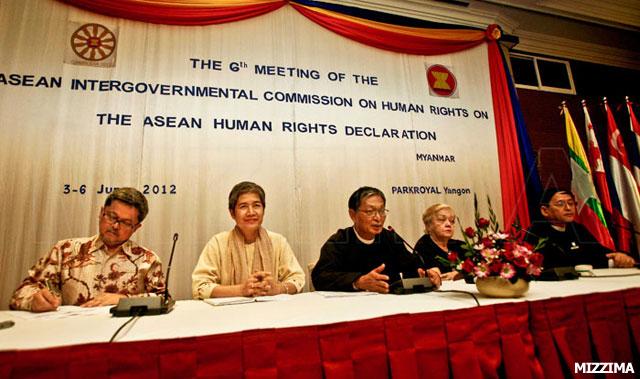
The sixth meeting of the Asean Intergovernmental Commission on Human Rights discussed the drafting of the Human Rights Declaration at the Park Royal Hotel in Rangoon on Wednesday, June 6, 2012.
Photo: Mizzima
In the meeting, AICHR continued its deliberations on the Asean human rights draft following the guidelines given to it by the Asean foreign ministers and the views it received during the first regional consultation meeting in May in Bangkok. The final draft will be submitted to the 45th Asean Foreign Ministers Meeting (AMM) in July 2012.
On May 30, Mizzima reported that the Aean Inter-Parliamentary Myanmar Caucus (AIPMC) had called on the commission to delay the draft declaration on human rights pending “a fully inclusive, meaningful and transparent consultation of civil society and other stakeholders.”
AIPMC said it is concerned by the secrecy in which the drafting process has been conducted. “The transparency and level of consultation with NGOs and civil society has been sadly lacking to date,” it said.
“The discussion of human rights cannot be complete or credible without meaningful input from civil society and national human rights institutions and AIPMC fully understands the frustrations of civil society organizations in being shut out of the drafting process,” it said in a statement.
“Hosting this meeting in Myanmar is a brave step. Grave human rights concerns remain in that country, as they do in many Asean states today,” said Eva Kusuma Sundari, AIPMC President and Indonesian Member of Parliament. “It is regrettable that the process for drafting this most important of declarations is being carried out in a less than transparent manner – we are missing an opportunity to set the tone for a more inclusive Asean that truly regards human rights as a guiding pillar for progress. The principles of transparency, accountability, and consultation have been sadly lacking.”
AIPMC welcomed AICHR's upcoming consultation with NGOs and other groups in Kuala Lumpur, but said it believes the drafting process to date has fallen short of international standards and must be conducted in a more open and transparent manner, that allows for the input from an active, intelligent and capable civil society during the drafting process, not after it is already complete.
“AICHR should make the draft of the declaration publicly available and postpone the draft reading by Asean foreign ministers in June pending a full and meaningful consultation with Asean civil society,” it said.
AIPMC urged a process in which the views of broad-based civil society organizations representing the full range of human rights can be heard and incorporated into a declaration on rights that is fully comprehensive and meets the aspirations and needs of the people of Asean.
The Asean region continues to go through rapid political and economic development and change, and nowhere is this more apparent than in Burma, it said.
On May 17, Mizzima reported the remarks of United Nations High Commissioner for Human Rights Navi Pillay, who called for a meaningful consultation on the draft with the widest spectrum of people in the region before it is presented to Asean foreign ministers in July.
Pillay expressed hope that the declaration will play an important role in improving human rights for people in Southeast Asia.
“Regional human rights instruments should complement and reinforce international human rights standards,” Pillay said in a statement. “But my hope is that that the Asean Human Rights Declaration will go further by setting the bar higher for governments to ensure full protection and promotion of human rights through their policies, legislation and practices.”
Pillay emphasized that engaging early in a transparent process of inclusive and meaningful consultation will help the drafting process acquire the status and popular support it deserves.
“The process through which this crucial declaration is adopted is almost as important as the content of the declaration itself,” Pillay said. “I very much hope that AICHR recognizes the value of holding meaningful consultations with people from all walks of life, in every country across the Southeast Asia region.”
bnionline.net
-
08-07-2012, 07:02 AM #20Thailand Expat
- Join Date
- Aug 2007
- Last Online
- @
- Posts
- 1,405
Asean human rights draft to get airing
8/07/2012
Asean's human rights body will today submit its controversial rights declaration to the grouping's foreign ministers in Phnom Penh.
Cambodia is hosting the 45th Asean Foreign Ministers' Meeting from tomorrow until Thursday.
The six-page declaration, drawn up by the Asean Inter-governmental Commission on Human Rights (AICHR) was shrouded in secrecy, civil groups claim.
The AICHR, launched when Thailand chaired Asean, was mandated under Article 4.2 of its Terms of Reference to develop an Asean Human Rights Declaration with a view to establishing a framework for human rights cooperation through various Asean conventions and other instruments dealing with human rights.
At the sixth meeting of the AICHR in Vientiane last year, a drafting committee was officially established to prepare a draft declaration. In January, the group submitted the draft to the AICHR for deliberation and debate.
Many Asean human rights groups have expressed disappointment with the AICHR, as the general public was largely excluded from the drafting. There had not been any substantive and broad-based regional consultation with the people in the region, except at the national level in Thailand, Indonesia, Malaysia and the Philippines.
Consultations did not take place in Brunei, Laos, Myanmar, Vietnam or Cambodia, which has the Asean chair this year.
On June 22, the first formal meeting with civil groups was held in Kuala Lumpur, but the draft was not revealed to the non-government organisations from each member country.
Sriprapha Petcharamesree, Thailand's AICHR representative, said despite the draft not being shared, the consultation was meaningful and participatory.
Ms Sriprapha said the AICHR did not agree with the minority voices like her's in advocating an open policy.
After the meeting, human rights activists continued to push for the declaration to be made public ahead of its adoption in November.
Shiwei Ye, a Bangkok-based representative of the International Federation for Human Rights (FIDH), said the AICHR promised in Kuala Lumpur that the declaration would not fall below international standards. But he remained critical of its contents.
"The 10 Asean representatives on the AICHR may be happy with the Kuala Lumpur forum, but hundreds of civil society groups across the region are still shut out and waiting to have their input heard," Mr Ye said.
He said the declaration was supposed to be for the more than 500 million people of Asean.
By hiding the text behind a wall of secrecy and unsubstantiated promises, AICHR has exposed its fundamental flaws, that most of its commissioners do not seem interested in the people of Asean.
Ms Sriprapha said she did not feel the declaration was that bad as among the principles mentioned in it were the rights to development and peace.
On civil and political rights, the Asean declaration also mentions fair trials and judicial rights.
However, she noted that certain clauses showed limitations on how far the 10-member grouping will go in the preservation of national security and public morality.
bangkokpost.com
-
10-07-2012, 04:44 PM #21Thailand Expat
- Join Date
- Aug 2007
- Last Online
- @
- Posts
- 1,405
Asean human rights document closer to adoption
Tuesday, 10 July 2012
The Asean draft Human Rights Declaration is scheduled to be adopted at the 21st Asean Summit to be held in Cambodia in November, according to a Cambodian senior official.
He said Asean foreign ministers have urged the Asean Intergovernmental Commission on Human Rights (AICHR) representatives to have the final draft ready by October.
Human rights groups have consistently called for the draft document to be made public, but Asean has kept the process and contents shrouded in secrecy.
“This landmark document will reflect Asean's aspirations and commitments to the promotion and protection of human rights,” said a press release.
The declaration is part of the Asean unification process in order to build the grouping along the lines of the EU, along with a unified financial and development system under the theme “One Community, One Destiny.”
U.S. Secretary of State Hillary Clinton is scheduled to appear at Asean meetings now underway in Phnom Penh.
The meetings include the 45th ASEAN Foreign Ministers' Meeting, Post Ministerial Conferences, the 19th ASEAN Regional Forum (ARF), and the 2nd East Asia Summit Foreign Ministers' Meeting (EAS FMM) that will be held in Phnom Penh from July 9-13.
The Asean group is made up of Brunei, Cambodia, Indonesia, Laos, Malaysia, Myanmar, the Philippines, Singapore, Thailand and Vietnam.
On Sunday, an article in The Bangkok Post noted that at the first formal input meeting on the human rights document with civil groups in Malaysia on June 22, the draft document was not revealed to the nongovernment organizations from each member country.
Sriprapha Petcharamesree, Thailand's representative, said despite the draft not being shared, the consultation was meaningful and participatory.
Sriprapha said human rights activists continued to push for the declaration to be made public ahead of its adoption in November.
Shiwei Ye, a Bangkok-based representative of the International Federation for Human Rights (FIDH), said the AICHR promised that the declaration would not fall below international standards. But he remained critical of its contents.
He said hundreds of civil society groups across the region have been “shut out” of the process.
mizzima.com
-
02-10-2012, 07:10 PM #22Thailand Expat
- Join Date
- Aug 2007
- Last Online
- @
- Posts
- 1,405
OPEN LETTER TO ASEAN FOREIGN MINISTERS AT INFORMAL ASEAN FOREIGN MINISTERS MEETING (IAMM) ON THE ASEAN HUMAN RIGHTS DECLARATION
OPEN LETTER TO ASEAN FOREIGN MINISTERS AT INFORMAL ASEAN FOREIGN MINISTERS
MEETING (IAMM) ON THE ASEAN HUMAN RIGHTS DECLARATION
To,
1. His Royal Highness Prince Mohamed Bolkiah, Minister of Foreign Affairs,
Brunei Darussalam
2. His Excellency Hor Namhong, Minister of Foreign Affairs, Cambodia
3. His Excellency Dr. Marty Natalegawa, Minister of Foreign Affairs,
Indonesia
4. His Excellency Dr. Thongloun Sisoulith, Minister of Foreign Affairs,
Laos PDR
5. His Excellency Dato’ Sri Anifah Aman, Minister of Foreign Affairs,
Malaysia
6. His Excellency U Wunna Maung Lwin, Minister of Foreign Affairs, Myanmar
7. His Excellency Albert F. Del Rosario, Secretary of Foreign Affairs, the
Philippines
8. His Excellency K. Shanmugam, Minister of Foreign Affairs, Singapore
9. His Excellency Dr. Surapong Tovichakchaikul, Minister of Foreign
Affairs, Thailand
10. His Excellency, Pham Binh Minh, Minister of Foreign Affairs, Vietnam
cc to
1. His Excellency Om Yentieng, Chair of ASEAN Intergovernmental
Commission on Human Rights
2. His Excellency Surin Pitsuwan, Secretary General of ASEAN
Date: 26 September 2012
Your Excellencies,
We, the undersigned organizations, thank the ASEAN Intergovernmental
Commission on Human Rights (AICHR) for holding the second consultation
meeting with civil society on the ASEAN Human Rights Declaration (AHRD) in
Manila on 12 September 2012. For the first time in this meeting, civil
society organizations were able to make comments and inputs based on the
actual official draft of the declaration dated 23 June 2012. This is a
positive step in the right direction in enhancing transparency and public
participation and the AICHR must be encouraged to continue to strengthen
and expand such practices in the future and in other areas of its works.
In reviewing the draft declaration dated 23 June 2012, we are however very
concerned with some of what we perceive are serious flaws in the document.
If the draft declaration is to be adopted in its current form, it will fall
below international human rights law and standards. This certainly does not
bode well for the reputation and credibility of the ASEAN human rights
mechanism, the first of its kind in the Asia Pacific region.
In view of your upcoming meeting on 27 September 2012 in New York to review
the AHRD and that the AHRD will be adopted officially at the 21st ASEAN
Summit in November 2012, we would like to urgently draw your attentions to
some of these infirmities in the draft declaration.
Firstly, Article 7 of the draft declaration attempts to bring back the
discourse of “Asian Values” and “regional particularities” by stipulating “the
realization of human rights must be considered in the regional and national
context bearing in mind different political, economic, legal, social,
cultural, historical and religious backgrounds.” This clearly runs
contrary to the principle of the universality of human rights as enshrined
in the Vienna Declaration and Program of Action in 1993, which stated
that “While the significance of national and regional particularities and various
historical, cultural and religious backgrounds must be borne in mind, it is
the duty of States, regardless of their political, economic and cultural
systems, to promote and protect all human rights and fundamental freedoms.”
Secondly, Article 6 of the draft declaration stipulates “the enjoyment of
human rights and fundamental freedoms must be balanced with the performance
of corresponding duties as every person has responsibilities to all other
individuals, the community and the society where one lives.” While
international human rights law and standards acknowledge that every person
has responsibilities to his or her community, the notion of
“balancing”them against human rights is alien to the concept of
“inalienable” human rights as enshrined in the Universal Declaration of
Human Rights (UDHR). No existing international or regional human rights
instrument seeks to define a mutual relationship in terms of
“balancing”the human rights of individuals on the one hand and their
“duties” or “responsibilities” on the other. ASEAN must not denigrate
itself in the international community by adopting this stance.
Thirdly, Article 8 subjects all the rights proclaimed in the declaration to
limitations based on considerations such as “the just requirements of
national security, public order, public health, public safety, public
morality, as well as the general welfare of the peoples in a democratic
society.” This sweeping provision ignores the non-derogability of certain
rights as well as the very narrow scope for restrictions allowed under
international law and standards on others.
Fourthly, several universally recognised rights are not included in the
draft declaration, among them the right to self-determination and the
prohibition of enforced disappearance. Rights of specific marginalised
groups, such as indigenous peoples, persons with disabilities, minorities,
migrant workers, domestic workers (both local and migrant) and gay,
lesbian, bi-sexual and transgender peoples are glaringly missing from the
document as well.
ASEAN should learn the lessons from the Arab League of States and avoid
proclaiming regional human rights declaration that is below international
human rights law and standards. The Arab Charter of Human Rights released
by the Arab League of States in 1994 ran in contradiction with human rights
and stirred controversial debates on its credibility. This resulted in no
ratification by Member States of the said Charter.
We therefore urge you to immediately address the flaws of the draft
declaration by adopting our recommendations as outlined in our submission
to AICHR to remedy the serious flaws in the draft declaration. This shall
include amending the sub-standard General Principles, ensuring that it
includes the full spectrum of human rights and adopting a final clause that
explicitly and unequivocally precludes the interpretation of the
Declaration as providing lower protections than the Universal Declaration
of Human Rights (UDHR), Vienna Declaration and Program of Action (VDPA) or
international human rights treaties to which ASEAN Member States are party.
For other concerns with regards to the draft declaration and our
corresponding recommendations, we encourage you to refer to our submission
made to the AICHR on 12 September 2012 as attached.
We entreat you to uphold the highest standards in your deliberation of the
ASEAN Human Rights Declaration. It is our hope that the Declaration will
result in both the promotion and protection of human rights such that the
full realization of human dignity and a higher quality of life for ASEAN
peoples can be truly achieved.
It is time for ASEAN to be in step with the rest of the world in Human
Rights promotion and protection.
Sincerely,
1. Aliansi Masyarakat Adat Nusantara
2. Amnesty International Philippines
3. Arus Pelangi Indonesia
4. ASEAN Disability Forum
5. ASEAN SOGI Network
6. ASEAN Watch Thailand
7. Asian Federation Against Involuntary Disappearance
8. Asian Forum for Human Rights and Development (FORUM-ASI
9. Asia Indigenous Peoples Pact
10. Asia-Pacific Solidarity Coalition (APSOC)
11. Asylum Access Thailand
12. Balay Rehabilitation Centre
13. Cambodian Human Rights Action Committee (CHRAC)
14. Cambodian Human Rights and Development Association
15. Cambodian Food and Service Workers’ Federation (CFSWF)
16. Cambodian Workers Centre for Development (CWCD)
17. Cambodia Youth Network (CYN)
18. Center for Advocacy, Learning and Livelihood (CALL) Foundation of
the Blind Inc.
19. Centre for Migrant Advocacy
20. Child Rights Coalition Asia
21. Coalition of Cambodian Farmer Community (CFCC)
22. Development Environment Community Association
23. Development Alternatives with Women for a New Era
24. Disabled Peoples International /Asia Pacific
25. Global Partnership for the Prevention of Armed Conflict (GPPAC/SEA)
26. Government Union for the Integration of Differently-Abled
Employees of the Philippines(GUIDE)
27. Independent Democratic of Informal Economic Association (IDEA)
28. Indigenous Peoples Task Force on ASEAN
29. Indonesian LGBTIQ Forum
30. Initiatives for International Dialogue
31. International Gay and Lesbian Human Rights Commission (IGLHRC)
32. Kampanya Para sa Makataong Pamumuhay
33. Katipunan Ng Maykapansanansa Pilipinas, Inc.
34. Lembaga Bantuan Hukum Jakarta (Jakarta Legal Aid Institute)
35. Malaysian Bar Council
36. Mekong Legal Network
37. Migrant Forum in Asia
38. Mindanao Human Rights Action Center
39. Myanmar People’s Forum (MPF)
40. Network of Indigenous Peoples of Thailand (NIPT)
41. NGO Coordinating Committee on Development (NGO-COD) - Thailand
42. People’s Empowerment Foundation
43. Philippines Alliance of Human Rights Advocates
44. Philippines Coalition for the International Criminal Court
45. Philippines Coalition on the United Nations Conventions on the
Rights of Persons with Disabilities
46. The Philippine NGO Coalition on the UN Convention on the Rights of
the Child
47. Southeast Asian Committee for Advocacy
48. Suara Rakyat Malaysia (SUARAM)
49. Sulong Comprehensive Agrarian Reform Program ER
50. Task Force Detainees of the Philippines
51. The Commission for Missing Persons and Victims of Violence
(KontraS)
52. Thai Committee for Refugees Foundation (TCR)
53. Thai Volunteer Service Foundation
54. Think Center
55. Women’s Legal and Human Rights Bureau
56. Woman Health Philippines
57. Women’s Legal Education Association
mekongmigration.org
-
14-10-2012, 12:11 AM #23Out there...

- Join Date
- Jul 2009
- Last Online
- @
- Location
- BKK
- Posts
- 40,029
Civil groups fail to delay adoption of declaration | Bangkok Post: news
HUMAN RIGHTS
Civil groups fail to delay adoption of declaration
- Published: 13/10/2012 at 02:30 AM
- Newspaper section: News
Thai civil society organisations have failed in a last-ditch effort to derail the ratification of the Asean Human Rights Declaration (AHRD) at the 21st Asean Summit, to be held in Phnom Penh next month.
Chalida Tajaroensak of the People's Empowerment Foundation led a group of civil society members to the Foreign Ministry to express their concerns over the "low standard" of the draft declaration. They pushed for a postponement of its adoption.
"We would like to see if Thailand could make a separate or additional statement to either pledge for a higher standard of rights promotion and protection, and/or call for member countries to review their internal laws to ensure concrete effectiveness of the AHRD," Ms Chalida said in a Thursday meeting with the Foreign Ministry's Asean Department head, Arthayudh Srisamoot.
Mr Arthayudh said none of the Asean foreign ministers had expressed concerns about the AHRD during their recent meeting in New York, though he said the Thai minister had suggested senior officials could "look into" the draft again if the ministers wished to do so.
"The declaration will be adopted, but whether any signature upon the declaration will be required and by whom is not yet known," Mr Arthayudh told the 20-member civil society delegation, which comprised lesbian, gay, bisexual and transgender (LGBT) groups, community radio groups, refugee and stateless groups, Muslim students and members of the International Commission of Jurists.
He said members of the Asean Intergovernmental Commission on Human Rights had worked tirelessly throughout the year to finalise the draft, adding that the Thai commissioner has asked domestic NGOs for input.
"Thailand has told the Asean ministers that if there is any chance of future amendment, we will support discussion at the first possible occasion. But the overall momentum is for the [declaration's] adoption," Mr Arthayudh said.
"Asean members are worried that if negotiations were to reopen, the adoption could not be made in time for the scheduled Phnom Penh summit in the middle of next month."
Veerawit Tianchainan, executive director of the Thai Committee for Refugees Foundation, said that despite claiming to be people-centred, Asean leaders rarely engaged in meaningful public participation when formulating policy.
"Thailand should provide further room for discussion and set a precedent of engaging with people," Mr Veerawit said. He also expressed concern that some 2 million stateless people in the Asean region would not be protected under the "lopsided state-security-oriented" human rights declaration.
Pongthorn Chanlearn, from the Chiang Mai-based Sexual Diversity Network, said the AHRD had a limited vision and did not reflect changing regional attitudes towards marriage and family planning.
"Rights to marriage should be recognised for those other than the conventionally defined male-female relationship. The LGBT group should not be excluded from the AHRD," Mr Pongthorn said.
In a separate development, Asean civil society organisations were comparing notes about the alternative people-drafted declaration which they plan to issue in parallel with the government-sponsored draft, according to Suntree Saeng-ging, chairwoman of the NGO Coordinating Committee on Development.
Ms Suntree said the controversial AHRD would also be discussed at the Asean People Forum, which will be held prior to the 21st Asean Summit."Slavery is the daughter of darkness; an ignorant people is the blind instrument of its own destruction; ambition and intrigue take advantage of the credulity and inexperience of men who have no political, economic or civil knowledge. They mistake pure illusion for reality, license for freedom, treason for patriotism, vengeance for justice."-Simón Bolívar
-
14-10-2012, 06:35 AM #24Thailand Expat
- Join Date
- Aug 2007
- Last Online
- @
- Posts
- 1,405
As expected in the home of the mundane and LCD Originally Posted by StrontiumDog
-
17-11-2012, 05:43 PM #25Thailand Expat
- Join Date
- Aug 2007
- Last Online
- @
- Posts
- 1,405
ASEAN to Sign ‘Flawed’ Rights Pact
Reported by RFA’s Khmer service.
Translated by Samean Yun.
Written in English by Rachel Vandenbrink.
2012-11-15
Leaders of Southeast Asian nations are set to ink a much-criticized human rights declaration.

Cambodians ride their bikes on Nov. 15, 2012 past the Peace Palace in Phnom Penh, the site of the ASEAN Summit and related meetings.
AFP
Southeast Asian nations are set to sign a human rights declaration at a summit next week despite objections by rights groups who say the document is “fundamentally flawed.”
The Association of Southeast Asian Nations (ASEAN) Human Rights Declaration, which would be the first pact on rights by the 10-member grouping in a region notorious for rights abuses, is on the agenda for the bloc’s annual leaders meeting that starts Sunday in Cambodia.
Cambodian Foreign Minister Hor Namhong told reporters at a press briefing Thursday that the leaders "will adopt the declaration" when they gather in Phnom Penh on Nov. 18-20.
But international rights and civil society groups have called for a delay until the text of the document is revised to meet global standards.
Over 60 grassroots, national, regional, and international civil society groups issued a statement on Thursday calling on ASEAN member states to postpone adopting the declaration, saying the document in its current form “is not worthy of its name.”
“The Declaration as it stands now unquestionably fails to meet existing international human rights standards, let alone add value to them,” said the statement by the groups, which include Amnesty International and Human Rights Watch.
“It flies in the face of the international consensus on human rights principles that have been in place for more than six decades,” it said.
The declaration includes stipulations that make rights subject to “national and regional contexts” and other provisions, eroding the protection for them, the statement said.
The groups warned that the bloc’s adoption of the pact during the summit in Phnom Penh would “reflect negatively” on the Cambodian government, which as the current ASEAN chair is hosting the annual summit as well as the East Asia Summit.
Lack of consultations
United Nations human rights chief Navi Pillay had voiced similar concerns about the rights declaration last week, urging the bloc "to take the necessary time to develop a declaration that fully conforms with international human rights standards.”
She expressed concern about the lack of input from civil society groups.
In an open letter Wednesday to U.S. President Barack Obama, who will attend the East Asia Summit next week, the New York-based Committee to Protect Journalists asked him to urge ASEAN governments “to take the time to draft the declaration with the participation of human rights and civil society groups, and ensure that it fully conforms with international human rights standards.”
Obama is also scheduled to meet the leaders of ASEAN, which comprises Brunei, Burma, Cambodia, Indonesia, Laos, Malaysia, the Philippines, Singapore, Thailand, and Vietnam.
ASEAN diplomats have called the declaration a milestone in the region despite its imperfections, saying that it could help cement emerging reforms in some member countries such as Burma, emerging from decades of harsh military rule.

Foreign Minister Hor Namhong (r) speaks to reporters in Phnom Penh, Nov. 15, 2012.
Credit: RFA.
Hor Namhong said ASEAN was not surprised with the opposition to the declaration from international rights groups.
"Of course, this declaration will not totally satisfy some civil society groups," Hor Namhong said, according to Agence France-Presse.
"This is the first step," he said, adding that ASEAN might consult with civil society groups in the future to improve the text.
rfa.org

 Reply With Quote
Thread Information
Users Browsing this Thread
There are currently 1 users browsing this thread. (0 members and 1 guests)
