

Banker: Asia needs US$1tril infrastructure investment in next five years
BANGKOK: Asia requires infrastructure investment of about US$1tril in the next five years.
This will present vast business opportunities for investors and new partnerships.
Aseambankers (M) Bhd chief executive officer Surachet Chaipatamanont said this uptrend for investments would benefit the region with high savings and surpluses, as it would allow the mobilisation of surplus funds into this region.
"Last year, mega transactions involving corporate acquisitions and real estate purchases from the Gulf to Asia were estimated to total more than US$18bil.
"Going forward, the value of such investments are expected to increase," he said in his speech at the opening of Thailand's first Islamic banking conference here on Thursday.
Thailand Deputy Finance Minister Sommai Phasee said Thailand expects to roll out infrastructure projects that require investment of more than US$50bil over the next decade.
"... there will be major project expansions in electricity, petrochemicals and large-scale property development and manufacturing projects," he said in his keynote address.
Sommai said by launching Islamic Shariah compliant bonds, Sukuks, Thailand would be able to gain a vast pool of Asian and Middle Eastern funds, adding that Thailand could learn from the Malaysian experience.
Surachet said amidst these economic and financial developments, it would allow more co-operation between Thailand and Malaysia, particularly in Islamic finance.
biz.thestar.com.my
Results 1 to 25 of 83
Thread: Thailand : Infrastructure
-
06-09-2007, 02:56 PM #1Thailand Expat



- Join Date
- Aug 2007
- Last Online
- @
- Posts
- 1,405
Thailand : Infrastructure
-
06-09-2007, 03:07 PM #2I'm in Jail
- Join Date
- Aug 2007
- Last Online
- 15-12-2012 @ 03:35 PM
- Posts
- 5,908
Oh good. Some wonderful financial news for Thailand at last. And here, I was concerned that direct foreign investment was at serious risk. Silly me.
-
06-09-2007, 03:10 PM #3Thailand Expat
- Join Date
- Aug 2007
- Last Online
- @
- Posts
- 1,405
one begins to understand the local style of bull fighting ...................
Last edited by Mid; 06-09-2007 at 03:43 PM. Reason: stand
-
06-09-2007, 03:34 PM #4Member
- Join Date
- Aug 2007
- Last Online
- 23-09-2007 @ 11:56 AM
- Location
- Bangna , heading for Cambo
- Posts
- 332
When I saw this I thought the US was going to start investing in it's own infrastructure.
Lat I saw of NY (some years ago) a lot of the bridges looked a bit ribby
When that bridge went splat recently there were no end of talking heads on the box detailing the lamentable state of bridges , dams etc.
Still , the EEC built some great roads in Ireland
If the US wants to build some in SEA - good on ya lads
-
06-09-2007, 03:47 PM #5ding ding ding

- Join Date
- Jul 2006
- Last Online
- @
- Posts
- 12,604
Oh look, the money is welcome but the guys to oversee the elections are not.
No fokin surprises there then.
-
06-09-2007, 03:49 PM #6Thailand Expat
- Join Date
- Aug 2007
- Last Online
- @
- Posts
- 1,405
I'm convinced ,Sommai said by launching Islamic Shariah compliant bonds, Sukuks, Thailand would be able to gain a vast pool of Asian and Middle Eastern funds, adding that Thailand could learn from the Malaysian experience.
most only read headlines .......................
-
18-10-2010, 01:05 AM #7Out there...

- Join Date
- Jul 2009
- Last Online
- @
- Location
- BKK
- Posts
- 40,029
'Focus more on infrastructure'
http://www.nationmultimedia.com/home...-30140276.html
'Focus more on infrastructure'
By Achara Deboonme
The Nation
Published on October 18, 2010

Arkhom
Thailand should emphasise more on infrastructure development, to accomplish the national goal of turning the Kingdom into a service-oriented economy.
The goal can be met and sustained only with lower operating costs and a better-quality workforce, said the new chief of the National Economic and Social Development Board.
In an interview with The Nation, Arkhom Termpittayapaisith, who became the new secretary-general on October 1, said that at the end of the 11 th national economic and development plan or during the next plan, the foundation for the service economy should be established.
The plan will be implemented during 2012-2016.
"Certainly, this would take a long time. In the past 40 years, we witnessed that it took 15-20 years to shift our focus from the agricultural sector to the industrial sector. Our goal now is the service sector, which now accounts for half of GDP and will grow to 60 per cent. Yet, this depends on which sector would grow faster. Our key goal is to boost domestic demand through better logistics, which will introduce more products and leisure activities," he said.
The agricultural sector now contributes 10 per cent of GDP, against 30 per cent 40 years ago. Now, the industrial contribution is about 30 per cent.
The infrastructure needed to support the goal entails transportation infrastructure, human resource development, greater focus on a green economy and better wealth distribution mechanisms.
Logistics improvements would reduce the national cost, as logistics account for nearly 20 per cent of gross domestic product. Under the human resources development plan, quality improvement will be the highlight, as service industries need people with higher skills. The green economy would also support the national agenda to help combat global warming, while assuring the country's openness to the industrial sector, which can create quick income for the country.
"Being a service economy will ensure the lower exploitation of raw materials," he said.
Arkhom acknowledged that this needs huge public investment. To ensure the appropriate allocation of budgets to the prioritised projects, the NESDB is working closely with the Budget Bureau and the Finance Ministry.
He noted that one of his jobs is to prioritise investment projects, which will lead to appropriate budget allocations and higher efficiency for the economy.
"We need to ensure that fixed expenditures and social programme financing do not eat into public investment budgets," he said.
How to increase the public investment budget to 25 per cent in the next five years, from less than 20 per cent now [is another crucial problem]," Arkhom said.
Together with the Budget Bureau, the NESDB hopes to show the direction where public money should go. Some projects could eventually be awarded to private companies, thanks to a clear policy.
The new chief admitted that the NESDB is now overloaded with projects waiting for screening and the government's approval. Despite his tight workforce, the new chief is pleased, as this shows the government's readiness to proceed with only justified and rational projects.
Arkhom is convinced that 2010 will be the base year for steady economic growth. Thailand's economy is expected to expand 7.5 per cent this year, and 4 per cent annually in the next few years.
"Our focus is not on the growth rate, but on the quality of growth. The expansion should not come at the cost of environmental exploitation while human quality must be improved. To achieve this, we need to focus more on science and innovation, and establishing connectivity with the industrial sector," he said."Slavery is the daughter of darkness; an ignorant people is the blind instrument of its own destruction; ambition and intrigue take advantage of the credulity and inexperience of men who have no political, economic or civil knowledge. They mistake pure illusion for reality, license for freedom, treason for patriotism, vengeance for justice."-Simón Bolívar
-
30-04-2011, 02:33 PM #8Thailand Expat



- Join Date
- Jan 2011
- Last Online
- @
- Location
- A "non-existent" Thai PsyOps unit
- Posts
- 4,550
Fragmented innovation | Business Report Thailand
Apr 30, 2011
Too many bright ideas?
All the talk in Thailand these days is of creative economy – see the new Department of Export Promotion (DEP) advertisements on BBC World – and Thailand has competitive advantages it can leverage in R&D: a large agro-industrial, petrochemical, automotive, electronics and, increasingly, digital content and software base form fertile ground for research.
Yet to reach the government’s stated target of 1 per cent GERD/GDP (Gross Expenditure on R&D/GDP) ratio by 2016, Thailand will need to extend its existing 2007 Board of investment (BOI) incentives to differentiate itself further from regional competitors such as Malaysia or China, which grant more generous incentives including lifetime tax breaks and cash-for-R&D schemes.
To compete in this global innovation market, Thailand will also have to match regional competitors’ ability to attract private investment, undermined on home turf by domestic political volatility that makes long-term planning difficult. An investment dilemma exacerbated by that venture capital here remains in its infancy and is steered mainly by funding from government agencies with some very limited foreign participation from the likes of the Japan Asia Investment Co. (JAIC).
Despite plans to develop 5-year exit strategies through the stock exchange’s Market for Alternative Investment (MAI), that fact less than ten R&D-related start-ups have been listed in the last decade speaks volumes of the current lack of private sector support in the government’s new master-strategy. Discussions are underway between the Ministry of Finance, SEC, SET and NSTDA to encourage more MAI listings, but the government remains the key backer.
[Much more - continues at link above]
* Business Report Thailand specifically requested that only the first few paragraphs be reproduced - with a link to the rest of the article.Last edited by SteveCM; 30-04-2011 at 04:49 PM.
-
11-01-2012, 11:15 AM #9Out there...
- Join Date
- Jul 2009
- Last Online
- @
- Location
- BKK
- Posts
- 40,029
Cabinet okays B2.27 trillion in spending-Infrastructure, flood rehab work is priority
Bangkok Post : Cabinet okays B2.27 trillion in spending
Cabinet okays B2.27 trillion in spending
Infrastructure, flood rehab work is priority- Published: 11/01/2012 at 12:00 AM
- Newspaper section: News
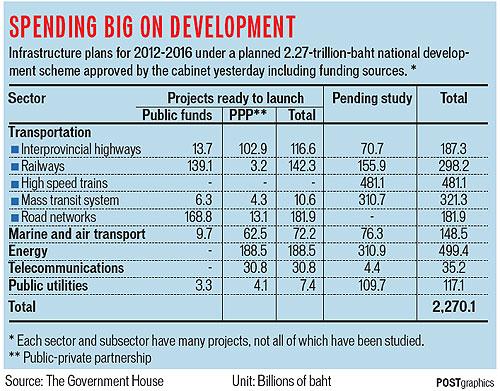
The projects, which would be launched starting this year through to 2016, include new inter-city road links, high-speed train networks, urban mass transit systems, as well as marine, air transport and telecommunication development.
The cabinet also endorsed four executive decrees to enable it to borrow 400 billion baht to pay for water management projects and an insurance fund to restore investors confidence.
The approved decrees are:
- An executive decree to transfer the interest-payment burden on a 1.14-trillion-baht debt left over from the 1997 crisis from the Finance Ministry to the Financial Institutions Development Fund (FIDF), an institution set up under the Bank of Thailand to manage the bank crises.
- An executive decree to seek 350 billion baht in loans for water management projects and flood restoration and rehabilitation work.
- An executive decree to set up a 50-billion-baht fund to offer flood insurance to the business sector.
- An executive decree to amend central bank regulations to extend 300 billion baht in soft loans to financial institutions.
The endorsements are aimed at clearing the way for the government to borrow funds for water management projects and restore confidence in the country, said Council of State secretary-general Atchaporn Jaruchinda.
Deputy Prime Minister Kittiratt Na-Ranong said that under the debt-transfer decree, the FIDF would be authorised to collect fees of up to 1% of the deposit base from local banks to generate cash to make interest payments on the debt.
However, Mr Kittiratt said the fees would not be more than the 0.4% fee currently collected by Deposit Protection Agency (DPA).
Finance Minister Thirachai Phuvanatnaranubala said the new fees would not affect local banks because they would benefit from a government policy that will cut the corporate tax rate to 23% from 30%.
The central bank is likely to earn about 20 billion baht from its currency management activities this year.
Mr Kittiratt said the government expected to sell 400 billion baht in bonds before June 2013 to raise funds for long term water management projects _ 350 billion baht for water management and 50 billion baht for an insurance fund to help restore confidence among insurance companies so they will continue selling policies to industrial firms in flood-prone areas.
Of the 350 billion baht investment, 300 billion baht will be used for water management projects along the Chao Phraya river basin, 40 billion baht will be slated for projects on 17 related river basins, and 10 billion baht will be used for related infrastructure.
Details of the long-term projects will be presented to investors on Jan 14.
Mr Kittiratt also said that of 17 billion baht in short-term flood prevention plans, about 12.6 billion will be implemented this year and the rest next year.
He reiterated that borrowing 400 billion will not affect to the country's fiscal discipline.
The national debt was 4.27 trillion baht as of Sept 30, 2011, the end of the last fiscal year, accounting for 40.2 % of gross domestic product. Adding 400 billion baht in debt is projected to increase the public debt to 43% of GDP.
Mr Kittiratt said the transfer of the debt to the FIDF would help ease the government's fiscal burden.Last edited by StrontiumDog; 11-01-2012 at 11:22 AM.
-
11-01-2012, 11:08 PM #10Out there...
- Join Date
- Jul 2009
- Last Online
- @
- Location
- BKK
- Posts
- 40,029
Japan, Thailand to jointly aid flooded businesses | CanadianBusiness.com
Japan, Thailand to jointly aid flooded businesses
By AP
January 11, 2012
BANGKOK (AP) — Thailand and its biggest foreign investor, Japan, agreed Wednesday to jointly help businesses of both countries damaged by major flooding in the Southeast Asian nation last year.
The measures include dispatching experts to damaged facilities, exempting import duties on machinery and parts, continuing to allow workers from closed Japanese-owned facilities in Thailand to work in Japan, and giving financial support to flood-affected Japanese companies in Thailand.
Japan's Trade and Industry Minister Yukio Edano discussed the initiatives during a visit with Thai Commerce Minister Kittirat Na-Ranong in Bangkok.
About 300 out of 1,200 Japanese companies formally registered in Thailand were affected by the country's worst flooding in half a century, according to the ministers. Sixty-five of Thailand's 77 provinces were affected by the monthslong flooding, which took more than 800 lives.
Economic damage was estimated at more than 200 billion baht ($6.3 billion). Especially hard hit were industrial estates near Bangkok, where many Japanese companies, including automakers such as Honda, have factories. Japanese companies complained they were not clearly warned of the risks as the floodwaters poured downstream from the north.
"The Japanese private sector intend to continue their investment in Thailand, but they are also keeping an eye on assistance and flood-prevention measures from the Thai government," Edano told reporters.
Kittirat said the Thai government planned to invest 35 billion baht ($1.1 billion) to flood-prevention schemes and to set up an insurance fund worth at least 50 billion baht ($1.57 billion) to help boost Japanese investors' confidence.
-----
http://www.mcot.net/cfcustom/cache_page/317093.html
PM assures Japan of Thai govt support for Japanese entrepreneurs
วันพุธ ที่ 11 ม.ค. 2555
BANGKOK, Jan 11 --Thai Prime Minister Yingluck Shinawatra on Wednesday reassured Japan’s visiting Minister of Economy, Trade and Industry Yukio Edano that Thailand would complete its rehabilitation of flood-damaged infrastructure within six months.
She also told the Japanese minister that the government has prepared a credit line of US$1.2 million for Japanese entrepreneurs and investors whose factories have been impacted by the flood crisis last year.
Ms Yingluck welcomed Mr Edano at Government House Wednesday afternoon as he formally thanked Thailand for extending assistance to Japanese victims of the massive earthquake and tsunami of March 11 last year.
The Japanese minister also expressed sympathy for Thailand’s flood victims and asked about rehabilitation measures for the industrial sector and the international business community which operate their businesses in Thailand.
Thailand's plan for economic revival was important for the entire region and was in the spotlight by many countries worldwide, he said.
The Japanese minister advised that Thailand should put comprehensive flood-prevention measures in place in the future.
Ms Yingluck took the opportunity to thank Japanese Prime Minister Yoshihiko Noda, government and people for helping Thailand during its hardships in the form of financial assistance, relief supplies and experts.
The flood crisis caused extensive damage, but the country's strong economic fundamentals as well as helping hands from all parties have helped Thailand get back to its feet quickly, the Thai premier said.
The government targeted achieving gross domestic product (GDP) growth at 4-5 per cent and its post-flood revival plan has focused on industry and investment, she said.
Thailand has prepared a credit line of US$1.2 million for Japanese investors who were affected by the flood, Ms Yingluck said, adding that damaged infrastructure, including roads and hospitals, would be returned to normal within six months.
Other measures include tax exemption for imported machinery, and fast tracks for experts on flood prevention who would facilitate quick revival, said the premier.
As for short term water management measures, Ms Yingluck said her government will invest Bt120 billion this year to improve flood-prevention dykes and dams while some Bt300 billion would be spent for sustainable water management programme to deal with floods in the future. (MCOT online news)
-
11-01-2012, 11:32 PM #11euston has flown
- Join Date
- Jun 2009
- Last Online
- 10-06-2016 @ 03:12 AM
- Posts
- 6,976
^^^Its rather nice to see that they have worked out that to really rape the tax payer you have to use PPP.
-
12-01-2012, 12:01 AM #12Thailand Expat

- Join Date
- Sep 2009
- Last Online
- @
- Location
- Next door to digit
- Posts
- 11,174
That's a nice big pot of money to syphon off, should be plenty to round, I'll bet Toxin is gaging to get back now.
-
15-01-2012, 07:38 PM #13Out there...
- Join Date
- Jul 2009
- Last Online
- @
- Location
- BKK
- Posts
- 40,029
Bangkok Post : Flood mitigation plan 'Unlikely to be in place in three years'
Flood mitigation plan 'Unlikely to be in place in three years'
- Published: 15/01/2012 at 12:00 AM
- Newspaper section: News
Up to 50 billion baht has been allocated to build dams under the classification of "forest restoration and conservation", according to a preliminary draft of the government's water management plan.
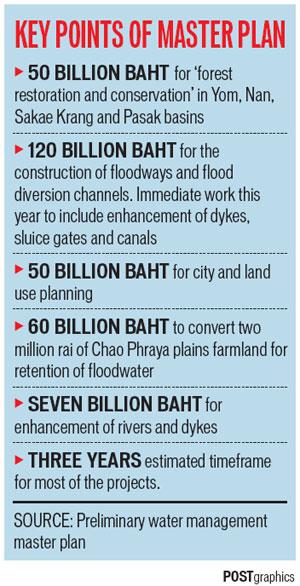
The long-term dam projects are in the Yom and Nan basins in the North and Sakae Krang and Pasak basins in the lower North, according to the plan seen by the Bangkok Post Sunday.
But the much-publicised multi-billion baht plan to manage and control water resources and flooding will not be in place in three years as promised, a source close to the project says.
Without feasibility studies, which could take up to two years, it is impossible to predict what to do and where to start.
The source from the Strategic Formulation Committee for Water Resources Management (SCWRM), which is drawing up the master plan, said details of the government's initiatives have begun circulating amid outcries from environmentalists and villagers.
The cabinet on Jan 10 backed the borrowing of 350 billion baht to pay for the water management projects. Finance Minister Thirachai Phuvanatnaranubala said 300 billion baht would be allocated for water management projects along the Chao Phraya river basin, 40 billion baht for 17 related river basins, and 10 billion baht for related infrastructure.
The master plan gives no details of other dam projects, however Kaeng Sua Tan and Mae Wong are given as examples of possible constructions.
The draft says feasibility studies should take one or two years to complete, with preparations carried out in the second year.
Locals and environmentalists are especially incensed about the controversial Kaeng Sua Ten dam planned for the Yom River, the last undeveloped tributary of the Chao Phraya.
The SCWRM source said the report was preliminary and more study was needed on specific projects.
But it would be impossible for the plan to be ready within three years as projected by some government figures.
"It's not going to be easy [to put the plan into practice]," he said. "It will take time, and need human resources and money. As long as we don't have feasibility studies, we won't know what to do next."
The government will fund the water management projects by selling bonds before June 2013. Mr Thirachai said that of 17 billion baht ear-marked for short-term flood prevention plans, about 12.6 billion baht will be spent this year and the rest next year.
The SCWRM source said all agencies should have flood mitigation plans in place for next year. He said the current network of irrigation canals, water pump stations and sluice gates were not adequate to deal with the flooding problem.
Sometimes these structures obstructed the natural flow of floodwater from the North, he said, citing Khlong Hok Wa canal north of Bangkok as an example.
The master plan is expected to cover immediate flood mitigation and long-term strategies to prevent flooding, especially in the Central Plains, in the next three years.
The long-term strategy comprises five infrastructure improvement and development plans including "forest and ecosystem restoration and conservation", and three non-infrastructure plans.
Pramote Maiklad, former chief of the Royal Irrigation Department, who is a member of the committee, questioned the feasibility of some projects and the timeframe for the master plan.
Mr Pramote said some projects, such as construction of dams on the Chao Phraya tributaries, were probably not feasible as there were no appropriate sites for major dams to be built.
Combined with strong opposition from locals and environmentalists, those projects would become almost impossible, he said.
Mr Pramote said locating major dams on tributaries was unlikely to stem floodwater from reaching the Central Plains as their respective capacities would be too limited.
He said the priority was to develop floodways and water retention areas so the flow could be discharged into the sea as quickly as possible.
He doubted whether floodways could be completed within three years as a large number of people would have to be moved.
At least 10 major flood zones in the Central Plains covering around two million rai were being considered for this.
Mr Pramote said he was worried the urgency of the need to act may soon be forgotten or side-tracked by politics.
Seree Supratid, a lecturer on disaster management at Rangsit University, said the master plan needed to take into account social and environmental aspects.
More importantly, the public should understand that proposed measures were to mitigate the impact of floods, not prevent them happening.
"It's impossible to prevent flooding, even if you have floodways, new retention areas or new reservoirs," he said. "We can never say that flooding will not occur, nor that it will not have an impact if we have those measures."
-
15-01-2012, 07:40 PM #14Out there...
- Join Date
- Jul 2009
- Last Online
- @
- Location
- BKK
- Posts
- 40,029
Bangkok Post : Govt seeks to reassure Japanese investors on water management
Govt seeks to reassure Japanese investors on water management
- Published: 15/01/2012 at 12:00 AM
- Newspaper section: News
A member of the government's water management committee has told Japanese investors to have confidence in its short-term plan to prevent future flooding of industrial estates.
Chukiat Sappaisal, a water expert at Kasetsart University's Faculty of Engineering, said the short-term plan will cost 17 billion baht.
"This investment will be able to help prevent industrial estates from being affected by floods if the amount of water this year is similar to last year," Mr Chukiat yesterday told Japanese investors. They were among 500 participants from different organisations who attended a seminar on "Integrated Water Resources Management for the Chao Phraya River Basin", jointly held by the Strategic Formulation Committee for Water Resources Management (SCWRM) and the Japan International Cooperation Agency (Jica).
Mr Chukiat said apart from flood measures at industrial estates, the short-term plan will include more effective water management tools, including sluice gate management along the irrigation system.
Seven industrial estates in Pathum Thani and Ayutthaya provinces were badly hit by floodwater during last year's crisis.
The government set up the SCWRM, chaired by Deputy Prime Minister and Commerce Minister Kittiratt Na-Ranong, to draw up short and long-term water management plans.
Last month, the cabinet agreed to raise 350 billion baht to create basic infrastructure for long-term water management.
Mr Kittiratt, who attended the seminar, said it was necessary to spend that much because of the economic loss Thailand faces from the flood crisis.
"We need to invest not only to protect economic zones, but also people. We can't evaluate the cost of losses by the poor from the flood," he said.
Mr Kittiratt said the 17 billion baht for short-term plans this year will come from the fiscal year budget while 350 billion baht for long-term projects will come from loans.
Japanese Ambassador Seiji Kojima said the master plan on water management, especially flood prevention, will be a significant step for the country to review and regain trust among international investors.
He said Japan and the Thai government would work together on various things, including updating Chao Praya River basin water management.
"We received kind support from Thai people during the recent earthquake and tsunami. This is why Japanese people will do something in return for Thai people."
Mr Kojima thanked the government for helping to limit the impact on Japanese firms from the floods.
Kimio Takeya, a senior adviser to Jica, said a mix of structural and non-structural measures is needed to reduce flood impacts. Investment alone on structural measures, including dams, is not enough as climate variability is effecting water management.
-
15-01-2012, 10:49 PM #15ding ding ding
- Join Date
- Jul 2006
- Last Online
- @
- Posts
- 12,604
36 million baht? Originally Posted by StrontiumDog

-
16-01-2012, 10:26 AM #16Out there...
- Join Date
- Jul 2009
- Last Online
- @
- Location
- BKK
- Posts
- 40,029
Bangkok Post : Cabinet OKs 128 projects for the North
Cabinet OKs 128 projects for the North
- Published: 16/01/2012 at 12:00 AM
- Newspaper section: News
CHIANG MAI : The cabinet has approved 128 projects to upgrade infrastructure in the northern region, including a 230-billion-baht high-speed railway line between Bangkok and Chiang Mai.
The cabinet agreed to allocate nearly 400 billion baht in total to projects in the North, including the railway development, other public transport systems and flood prevention schemes, deputy Prime Minister Kittiratt Na-Ranong said after the two-day cabinet meeting in Chiang Mai, which ended yesterday.
The high-speed railway has already made some progress. Prime Minister Yingluck Shinawatra last last year signed an agreement with China's Vice-President Xi Jingping for China to help develop the 745km project.
The state agencies involved in the railway and other infrastructure development projects have been told to work out their budgets, Mr Kittiratt said.
Other approved projects included post-flood infrastructure repairs and developments worth 15 billion baht, said government spokeswoman Thitima Chaisang. The cabinet also yesterday appointed a new committee to deal with the chronic problems of landless farmers.
The committee will "review all past cabinet resolutions" on the matter to help ensure equality in land use.
Some civic groups and NGOs staged rallies near the meeting venue at the northern office of the central bank and the sports field of the 11th Military Circle to air their problems and ask for help.
The labour union for the electronic parts and electrical appliance sectors called on the government to help more than 1,600 staff laid off when their factories flooded last year.
Meanwhile, Deputy Prime Minister and Interior Minister Yongyuth Wichaidit played down criticism the government was wasting money in organising cabinet meetings upcountry.Meetings at Government House in Bangkok also incur expenses, he said. The mobile cabinet meetings would provide a chance for ministers to visit the public. The government plans to hold a cabinet meeting in Udon Thani on March 18, Mr Yongyuth said.
-
18-01-2012, 03:02 AM #17Out there...
- Join Date
- Jul 2009
- Last Online
- @
- Location
- BKK
- Posts
- 40,029
Post-flood funding key task for Kittiratt - The Nation
Post-flood funding key task for Kittiratt
WICHIT CHAITRONG,
PETCHANET PRATRUANGKRAI,
WATCHARAPONG THONGRUNG
THE NATION January 18, 2012 1:00 am
The main job of Kittiratt Na-Ranong in his new post as finance minister is to secure funding for post-flood reconstruction and other investment projects.
When he was deputy prime minister and commerce minister, Kittiratt worked closely with Virabongsa Ramangkura, chairman of the strategic committee for reconstruction and future development.
He totally supported Virabongsa's move to make use of the country's international reserves to pay off the Bt1.14-trillion debt of the Financial Institutions Development Fund (FIDF), despite strong opposition from Finance Minister Thirachai Phuvanatnaranubala and the central bank.
The two sides finally reached a compromise when Kittiratt agreed to delete a controversial clause out of the emergency decree.
The general public also disapproved of the clause that gave the Cabinet a greater role in asset management of the central bank. Now, the central bank has agreed to amortise the FIDF debt with its profits from market operations and from higher premiums its plans to collect from commercial banks.
Virabongsa yesterday suggested that Kittiratt should sell the government's stakes in PTT and Thai Airways International in order to cut public debt, as the two state enterprises have a combined debt of about Bt900 billion.
Lower public debt would give the government more room to borrow to finance post-flood recovery projects costing about Bt350 billion. The government also needs to run a budget deficit for the next fiscal year to spend more on infrastructure projects.
Kittiratt said the reshuffle would benefit the country and increase the work efficiency of the government.
"I am confident about the premier's decision. There will be some new ministers, while some ministers will have to take more serious jobs," he said.
Deputy Finance Minister Boonsong Teriyapirom will replace Kittiratt at the Commerce Ministry. He has a close relationship with Yaowapa Wongsawat, Thaksin's sister and wife of former prime minister Somchai Wongsawat.
The permanent secretary of the Justice and Labour ministries during the Thaksin Shinawatra administration, Charupong Ruangsuwan, has been named as transport minister.
Charupong, 66, has been a member of the Pheu Thai Party since it was called the People Power Party after his retirement as party secretary-general.
His background in the two ministries will allow him to help the party with budget allocations. The Transport Ministry is handling many mega-projects that are pending Cabinet approval.
Compared with ousted transport minister Sukampol Suwannathat, who party members found hard to reach, party operations now should run more smoothly.
Charupong is also believed to be better able to advance the party's populist policies for sealed roads and other infrastructure projects countrywide.
-
21-01-2012, 09:59 AM #18Out there...
- Join Date
- Jul 2009
- Last Online
- @
- Location
- BKK
- Posts
- 40,029
Bangkok Post : Clearing the decks for more debt
IN Print
Clearing the decks for more debt
- Published: 21/01/2012 at 12:00 AM
- Newspaper section: News
The Pheu Thai-led government is embarking on massive borrowing to rehabilitate infrastructure damaged by last year's floods, at the possible cost to fiscal stability, Post Today said.
The government is cutting public debt by reducing its stakes in state enterprises PTT and Thai Airways, to less than 50%, so the two publicly listed companies will no longer enjoy government enterprise status. At the same time, however, it is embarking on a massive spending programme, which some economists say could endanger fiscal stability.
Its new fondness for debt stands in stark contrast to when the Pheu Thai Party was in opposition.
Then, the party blasted the Abhisit Vejjajiva administration for borrowing to cover budget shortfalls.
The party vowed that if it was elected to office, it would pay off the country's debt so the present generation would not be saddled with public debt.
Now the Pheu Thai Party is in office, it has conveniently forgotten the rhetoric of its opposition days.
The government has decided to borrow large amounts to repair and build infrastructure after the floods, to assure the disaster will not happen again.
When the Yingluck Shinawatra government took power five months ago, public debt was about 4.2 trillion baht, or at 40% of the country's gross domestic product (GDP).
The Finance Ministry has laid out a fiscal framework under which public debt should not exceed 60% of GDP.
It also sets a ceiling for debt servicing at 15% of the annual budget.
The government allocates about 11% of its budget to pay the interest burden on the debt, which is still less than the ministry's ceiling.
The country's GDP is about 10 trillion baht, which means the government can borrow another 2 trillion baht before the limit is reached.
Post Today believes that 2 trillion baht is more than enough to lubricate the economy in normal times.
However, since the floods struck, the government has approved various plans to accelerate spending that may jeopardise the ministry's fiscal framework.
The government's spending plans will take the deficit from 350 billion baht to 400 billion baht.
As there are only about seven months left before the next budget round begins in October, the government will have to take care that the money is spent well, it said.
The government last week issued four emergency decrees empowering the Finance Ministry to borrow money to manage the country's water resources and to implement various projects, to the tune of about 350 billion baht.
One of the emergency decrees establishes the National Disaster Insurance Fund, with seed money of 50 billion baht.
The government this week also approved plans to revive and build infrastructure and logistics to the tune of 2.27 trillion baht, with the private sector chipping in about 1 trillion baht.
The government will need to borrow about 1.27 trillion baht.
For next year's budget, the government plans to continue running a deficit of no less than 400 billion baht to stimulate the economy.
Suchart Thadathamrongvej, a former finance minister in the Somchai Wongsawat government, and newly appointed education minister in the government cabinet reshuffle this week, remarked: "The government will not borrow excessively and the country will grow faster if more money is invested. Worrying too much about a fiscal deficit and adopting austerity measures will stagnate the country's economy."
Mr Suchart is a key man in Pheu Thai's economic team.
Post Today said that judging from the government's spending and borrowing plans, public debt may soon exceed 6 trillion baht, or 60% of GDP, as well as exceeding the 15% debt servicing ceiling set by the ministry.
This has necessitated prompt action in the form of an emergency decree to transfer the Financial Institutions Development Fund's (FIDF) 1.14 trillion baht worth of debt, currently shouldered by the Finance Ministry to the Bank of Thailand.
This will ease the ministry's debt servicing burden by some 65 billion baht a year.
The decree enables the government to immediately lower public debt equivalent to about 10% of GDP, which will give the Yingluck administration more room to service public debt, so payments make up no more than 15% of the budget.
Earlier, the government had planned to issue legislation to empower the government to use the central bank's reserves to gradually pay off the FIDF's 1.12 trillion baht debt incurred during the 1997 financial crisis, but the measure was widely opposed for fear it could jeopardise monetary stability.
The government retreated and last week issued an emergency decree to transfer the debt liability to the central bank as well as empowering the central bank to ask commercial banks to make additional contributions in deposit insurance.
The current rate of 0.4% on deposits will rise to the ceiling rate of 1%, which will go into servicing the FIDF's debt.
The government is trying to reduce its public debt liability further by reducing its stakes in PTT and Thai Airways to less than 50%, so the two publicly listed companies will no longer enjoy government enterprise status.
In that event, the government would not have to guarantee their borrowings, which stand at 1 trillion baht. Public debt would fall by a further 10% of GDP, which would give the government more room to borrow further.
Post Today said the government's attempts to reduce public debt by spinning some debt off to various entities will make it harder to manage the public debt as a whole.
After the 1997 financial crisis, the Chuan Leekpai government combined all public debt from various entities to come under the Finance Ministry's management.
The government believed it could service the public debt more effectively with all debt brought under the ministry's Public Debt Management Office (PDMO).
It seems the Pheu Thai government wants to take us back to the situation which existed before 1997, when debt was spread over many entities, and was harder to scrutinise, and manage.
A PDMO source said while borrowing to invest in infrastructure is necessary, this government is placing too much emphasis on borrowing, which may jeopardise fiscal discipline and compromise debt servicing.
Instead of finding more tax revenues to balance the increased borrowings the government is doing the opposite, reducing corporate tax and embarking on other tax other reduction policies including the First Car and First Home schemes.
The government could increase value-added tax, raise taxes on tobacco and alcohol, land and inheritance taxes, but chooses not to do for fear of hurting the party's financiers and support base.
It is not enough to hope that tax revenues will increase automatically with economic growth, without the need to raise taxes, as this has rarely happened under any government over the past 10 years.
If the increased borrowing is to stimulate the economy, resulting in growth in tax collection revenue to balance the shortfall, the government must invest only in essential infrastructure that will boost competitiveness, the paper argued.
-
21-01-2012, 10:01 AM #19Out there...
- Join Date
- Jul 2009
- Last Online
- @
- Location
- BKK
- Posts
- 40,029
Bangkok Post : Abhisit vows to fight executive decrees
Abhisit vows to fight executive decrees
- Published: 21/01/2012 at 12:00 AM
- Newspaper section: News
Democrat Party leader Abhisit Vejjajiva is vowing to block four government-issued executive decrees issued to facilitate 400 billion baht in borrowing by asking the Constitution Court to rule on their constitutionality.
"Once they are published in the Royal Gazette, the Democrat Party will certainly lodge a complaint with the Constitution Court for interpretation. We are confident those executive decrees are unconstitutional," he said yesterday.
Mr Abhisit said the decrees have not been announced in the Royal Gazette and have yet to take effect.
"There are no justified reasons why it is an urgent need [as required by the constitution] for the government to issue the decrees to serve its economic rehabilitation plan or water management plan," Mr Abhisit said.
He also opposed a government plan to fully privatise energy giant PTT Plc and Thai Airways International Plc (THAI) by allowing the Finance Ministry to sell its stakes in the companies.
"The share sales would definitely affect consumers and make the companies more profitable," he said.
Chairman of the Strategic Committee for Reconstruction and Future Development Virabongsa Ramangkura said the planned borrowing of 400 billion baht would definitely not make Thailand suffer a public debt crisis like Greece now and Argentina in the past because the loans would be used to finance infrastructure development.
He said the government plan to sell its holdings in PTT and THAI to the state-controlled Vayupak Fund would end their status as state enterprises and the companies' debts, particularly those of PTT at 700 billion baht, would not be considered as public debt.
"The reduction of public debt would restore investor confidence in the country," he said.
He said he has talked with PTT executives and they agreed with the plan. For THAI, it needs to discuss it with its labour union first.
-
23-01-2012, 10:36 PM #20Out there...
- Join Date
- Jul 2009
- Last Online
- @
- Location
- BKK
- Posts
- 40,029
Bangkok Post : PM orders strict use of flood funds
PM orders strict use of flood funds- Published: 23/01/2012 at 09:06 PM
- Online news:
Ms Yingluck issued the warning at a meeting with permanent secretaries of cabinet ministries at the National Intelligence Agency.
The premier ordered ministries to move quickly on disbursing their allotted budgets from the flood restoration and rehabilitation funds so that proposed projects can get moving and be completed before the rainy season hits in May, Mrs Thitima said.
She stressed all agencies stick to their proposed flood restoration projects as planned, especially those scheduled to take place this month and next month such as the repair of roads and bridges.
‘’If any project which has been scrutinised and found not to have been started within two weeks of being allocated a budget, then the government will rescind the money because it has a restricted amount and wants to see the agencies make the most effective use of it,’’ Mrs Thitima said.
-
24-01-2012, 11:25 AM #21Out there...
- Join Date
- Jul 2009
- Last Online
- @
- Location
- BKK
- Posts
- 40,029
Bangkok Post : Thirachai says govt debt data massaged
Thirachai says govt debt data massaged
Kittiratt rejects charge of hoodwinking public
- Published: 24/01/2012 at 12:00 AM
- Newspaper section: News
The government may be misleading the public about the country's public debt to further its case to pass four emergency decrees to finance new spending, says former finance minister Thirachai Phuvanatnaranubala.

Mr Thirachai, who was removed from the cabinet in a reshuffle last week, implied that deputy premier Kittiratt Na-Ranong misled the cabinet with the use of economic data to push for the passage of the decrees financing investment of hundreds of billions of baht in new water management infrastructure.
But Mr Kittiratt, who remains deputy prime minister for economic policy in the new cabinet and who is also the new finance minister, dismissed the criticism and expressed personal disappointment with Mr Thirachai.
"Why doesn't [Mr Thirachai] understand? He should. I think I have the right to expect that, given that I have more work than he [did]," Mr Kittiratt told the Bangkok Post.
"Frankly, I don't think it's my job to have to explain this to [Mr Thirachai], the person who is actually directly responsible for this issue."
The war of words lays bare what was a simmering conflict of personalities between the two during the first six months of the Yingluck Shinawatra government.
Mr Thirachai, in a posting yesterday on his personal Facebook page, said the government had argued that current budget restrictions and the level of debt service spending would restrict new investment.
The cabinet earlier this month approved a decree shifting responsibility for 1.14 trillion baht in bailout debt from the 1997 economic crisis to the Financial Institutions Development Fund, a move potentially saving the government up to 65 billion baht a year in interest payments. Three other decrees have also been drafted, including one that will establish a 350 billion baht investment fund for new water management projects. The four decrees are awaiting publication in the Royal Gazette before they take effect.
But Mr Thirachai wrote that the figures used to justify the decrees by Mr Kittiratt are misleading and could potentially result in a conflict with the constitution.
"Mr Kittiratt reported to the cabinet that the debt-service ratio is currently 12% [of budget expenditures], and as a result, urgent action is needed to address the Financial Institutions Development Fund debt otherwise insufficient room would be available in the budget to take out new loans to finance the water management projects," Mr Thirachai wrote.
"I myself have also used the 12% figure to explain the issue in the media. But before I left my post, I received a report from the Public Debt Management Office that the actual debt service figure for fiscal 2012 is 9.33%, not 12% as reported by [Mr Kittiratt] to the cabinet."
Mr Thirachai wrote that under the current budget, 7.36% of budget expenditure is earmarked for interest payments, with another 1.97% allocated for principal repayments. Under the law, debt repayments, both interest and principal payments, are limited to no more than 15% of total annual budget expenditure.
"I have to admit being shocked once I learned of the actual figures, since it means that the rationale for the emergency decrees has been undermined completely," he wrote.
Mr Thirachai noted that the debt service figures stemmed from the National Economic and Social Development Board (NESDB), the agency responsible for collating economic data and which reports directly to Mr Kittiratt.
"As [Mr Kittiratt] now oversees both the NESDB and the Public Debt Management Office, I hope that he studies the figures and how they are collated well, so that the correct data is used to comply with constitutional requirements."
But Mr Kittiratt said Mr Thirachai's concerns were misplaced, arguing that the debt service figure of 9.33% of total spending is an adjusted figure based on the assumption that the four decrees are approved.
Otherwise, debt service obligations under the 2012 budget would reach 12% of total spending, on par with last year, he said.
Chakkrit Parapuntakul, the director-general of the Finance Ministry's Public Debt Management Office, said current debt service obligations under the 2012 budget was earmarked at 9.33% of total spending. The debt service ratio had fallen as the previous government, under the 2011 budget, pre-paid 42 billion baht worth of debt using funds in the treasury accounts, he said.
"Without these payments, then yes, the actual ratio for the current year would be around 12%," Mr Chakkrit said, adding that since 2002, debt service spending had averaged around 11-12% of total annual budget expenditures per year.
He said, however, that actual repayment of the public debt was relatively small. In fiscal 2011, 8% of budget spending was earmarked for principal debt payments, but only 0.5% was made, with maturing debt renewed into new debt.
Under the 2012 budget, principal payments have been earmarked at just one billion baht, a miniscule fraction of the 2.38 trillion baht budget overall.
In any case, the debate over debt spending and the budget highlights the challenges faced by policymakers in financing new investment programmes.
Somphob Manarungsan, an economist and rector of the Panyapiwat Institute of Technology, said current expenditures, which include civil service salaries and debt service payments, account for more than 80% of the total budget, resulting in little remaining for future investment programmes.
"The key question when considering new government debt is whether the debt is used productively or not," he said.
"Large infrastructure projects are costly and, as of now, we have yet to see a clear investment blueprint. Another concern is that the government needs quite a bit of social capital as well to push these investments, such that the public can be reassured the projects will be run transparently and with good governance."
-
24-01-2012, 11:27 AM #22Out there...
- Join Date
- Jul 2009
- Last Online
- @
- Location
- BKK
- Posts
- 40,029
Thai-ASEAN News Network - PM Explains Draft Budget Bill to Parliament
PM Explains Draft Budget Bill to Parliament
UPDATE : 24 January 2012
The prime minister has assured senators that the government's spending of the central budget on the flood rehabilitation and prevention projects will be transparent and efficient.
During yesterday's senate meeting on the draft bill on the government's spending of 2.4 trillion baht, several senators raised concerns that the government's central fund of 400 billion baht may be abused for politicians' personal gain.
Some senators worried that the allocation of the 120 billion baht flood-prevention measures may create diffiiculties in monitoring the government's spending and lead to corruption.
They suggested the government implement additional measures to monitor the transparency of spending in the flood prevention and recovery projects funded by the 350 billion baht-loan decree.
Meanwhile, Prime Minister Yingluck Shinawatra said the budget for each ministry has been cut by 10 percent for devotion to financial assistance for flood victims.
Yingluck maintained the 2012 budget will be spent efficiently and transparently.
She said the central fund will be divided into two parts. One will be for rehabilitation and the other for construction the flood-prevention system.
Yingluck added she is prepared to adopt suggestions from the senators for the management of the budget.
-
26-01-2012, 10:59 AM #23Out there...
- Join Date
- Jul 2009
- Last Online
- @
- Location
- BKK
- Posts
- 40,029
Kittiratt's 'figures are wrong' | Bangkok Post: news
Kittiratt's 'figures are wrong'
Thirachai reiterates debt shift not needed
- Published: 26/01/2012 at 12:00 AM
- Newspaper section: News
Former finance minister Thirachai Phuvanatnaranubala continued his social media feud with the government yesterday by repeating his opposition to plans to finance hundreds of billions of baht in new water management projects through an emergency decree.
Mr Thirachai, who left the cabinet last week, wrote on his personal Facebook page that Kittiratt Na-Ranong, the deputy premier and new finance minister, was plainly mistaken in his use of financial data to justify the decree.
"My purpose is only to give the right information, not to throw a bomb [to the government] or because I am bitter. My concern is for the country, and I feel that the public should know the truth," Mr Thirachai wrote.
The government wants to shift responsibility for 1.14 trillion baht in bailout debt to the Financial Institutions Development Fund (FIDF), freeing up some 65 billion baht in funds from the annual budget. An emergency decree calling for the transfer has been approved and is awaiting publication in the Royal Gazette before taking effect.
Mr Kittiratt has argued that the transfer is necessary to free up room in the budget to take out new loans to help finance 350 billion baht in planned water management projects.
Under the law, the government must maintain debt service payments below 15% of total budget spending if it is to raise new debt. Mr Kittiratt, in a briefing to the cabinet earlier this month, said the debt service level under the current 2012 budget was 12% of total spending, leaving little room for new debt obligations unless the FIDF debt was shifted.
But Mr Thirachai says the debt service ratio is actually 9.33% of total spending, meaning that room exists for new borrowing without transferring the FIDF obligations.
He said Mr Kittiratt was mistaken in assuming the 9.33% figure represented the debt ratio after the transfer.
"Interest payments for the FIDF debt has been set at 68.424 billion baht under the current budget, or 2.87% of total spending," Mr Thirachai said.
"Looking through the budget that only just passed parliament, we see that 68.424 billion baht is earmarked for FIDF debt payments. It has already been set into the budget. And if we calculate total debt payments under the budget, we arrive at a debt service ratio of 9.33%.
"Or stated plainly, the 9.33% figure already includes the FIDF obligations."
Mr Thirachai said if the FIDF obligations are excluded from the budget, then the actual debt service level drops further to just 6.46% of spending for the current year.
"When calculating figures, you need to be careful. Otherwise it can lead to misunderstandings and the FIDF interest expenses could be counted twice, just as [Mr Kittiratt] has done," he said.
"But we can't lie about the figures. It's embedded already into the budget law."
Mr Thirachai said given the actual state of the country's finances, the argument that an emergency decree is necessary to finance the water management projects is mistaken.
-
26-01-2012, 01:39 PM #24Out there...
- Join Date
- Jul 2009
- Last Online
- @
- Location
- BKK
- Posts
- 40,029
Thai-ASEAN News Network - Insurance Fund: A Sign of Mistrust from Foreign Community
Insurance Fund: A Sign of Mistrust from Foreign Community
UPDATE : 26 January 2012
It has been 2 months since the Strategic Committee for Reconstruction and Future Development (SCRF) under the leadership of Virapongsa Ramangkura and the Strategic Committee for Water Resources Management (SCWRM) under the leadership of Deputy Prime Minister Kittirat Na Ranong, as ordered by Prime Minister Yingluck Shinawatra, started work. Its achievement so far consists of window dressing public debt under the excuse that the country needs to borrow trillions of baht to invest in flood prevention and rehabilitation to rebuild the country.
There hasn't been any concrete measures on flood prevention except for short-term, medium-term and long-term plans to reflect the necessity to take out loans. There are no details yet as to what is to be done, who will do them and when they will be carried out.
The only concrete measure seen so far is the construction of dams to protect various industrial estates that were flooded. Kittirat says construction should start in February and be completed by August before a new round of flooding hits.
Now this leads to questions posed by communities surround those industrial estates as they've been left out of the SCRF and the SCWRM's flood prevention plan. Entrepreneurs inside the industrial estates also questioned what is the use if the industrial estate is not flooded but all roads around it are. How will employees travel to work and how will raw material be transported in and finished products be transported out?
Confidence in the SCRF and the SCWRM can be measured by the viewpoints of investors and businesspeople on the government's flood prevention plan.
Vice President of the Federation of Thai Industries Wallop Witnakorn stated most investors are worried about flooding during the upcoming rainy season on how well the government's measures will work. They don't see any concrete details of the flood prevention plan and time is running out. What's most important now is to link information and work of related agencies as soon as possible.
This is just one of the official viewpoint given by a representative of the industrial sector. There's a whole lot more Thai and foreign businesspeople who lack confidence in the government that it'll be able to prevent flooding as nothing substantial has been done, but they don't want to voice it out to the media.
Another gauge of the confidence the business sector has in the government is a report that 14 out of 43 factories in the Saharattananakorn Industrial Estate in Ayutthaya, most of which are owned by the Japanese, have decided to relocate to other areas as they are not certain if they'll be flooded again this year.
The best indicator of the level of confidence in the government's flood prevention scheme is the establishment of the insurance fund by the government via the issuance of an executive decree. The fund has 50 billion baht and was initially slated to provide flood insurance only for houses and SME businesses. However, Kittirat has ordered the service to cover large industries that were hit by the flooding as well. Damage compensation is set for as high as 500 billion baht.
Aon Benfield, the world's largest reinsurance firm which was brought on board as an adviser, was shocked at the amount of damage compensation. It stated that other countries offer damage compensation at just 200 billion baht so it's asked the Thai government to bring the figure down to that.
The government had to extend the insurance fund's services to cover large industries because a lot of leading global reinsurance firm has refused to take on flood insurance in Thailand while those that do, triple the premium from the rate of 5% of the total damage compensation to 16%.
Domestic insurance firms say reinsurance firms have had to pay out flood compensation for factories at a total of 200 billion baht as the flooding hit massively and for a long period of time.
These firms are not certain the government will be able to prevent flooding at such massive scale from happening again so they either turn away flood insurance or else charge exorbitant premiums due to the higher risks. The Finance Ministry tried to send officials to talk to a couple of reinsurance firms in Singapore but they refused to budge on the issue.
Kittirat himself admitted that talks with foreign reinsurance firms reflect their concern about the non-clarity of the government's flood prevention plan, therefore, the best solution is for the government to provide the insurance by itself as it's confident it has the situation under control.
Looking back at when Virapongsa took up his post with the SCRF, he said he'd talked to global insurance giant Lloyd's and Japanese insurance firms and claimed they all have faith in the government's flood management plans and will be happy to provide reinsurance for Thai firms.
Between the 2 of them, someone must be lying!
The insurance fund is being set up with 50 billion baht of taxpayers' money and there's room for it to increase its capital without any limit. If flooding does occur and the government doesn't have control of the situation like what happened last year, it means the public will have to shoulder the burden of paying compensation for the government's failure to handle the crisis.
The insurance industry is abuzz right now with speculation as to who will manage the insurance fund as it must be a very capable individual who is knowledgeable about the insurance industry. Whoever gets this job will have to have close ties to Virapongsa and people in the government.
The key achievement of the SCRF and the SCWRM is certainly the establishment of the insurance fund which ironically reflects the failure of the government to inspire confidence in its flood prevention plan among foreign investors. Now that foreign reinsurance firms have turned Thailand away, the government needs to use the public's tax money to cover the risk from its flood management failure.
Translated from Manager Online editorial
-
27-01-2012, 12:44 AM #25Out there...
- Join Date
- Jul 2009
- Last Online
- @
- Location
- BKK
- Posts
- 40,029
http://www.nationmultimedia.com/nati...-30174619.html
Govt issues four controversial decrees
The Nation January 27, 2012 1:00 am
The government issued four emergency decrees to set in motion flood-relief efforts after they were published in the Royal Gazette yesterday.
The most controversial decree requires the Bank of Thailand to service Bt1.14 trillion in public debt incurred by the Financial Institutions Development Fund (FIDF). The decree demands the central bank contribute at least 90 per cent of its total net profit to pay off the debt.
The central bank will also have to transfer the remaining assets in its annual yield account to pay the debt by not transferring them to the special reserve account. The central bank has to make use of the FIDF's money or assets for debt repayment according to the Cabinet's order.
Two decrees authorise the central bank to provide Bt300 billion in soft loans and the Finance Ministry to borrow Bt350 billion to finance post-flood reconstruction projects.
The other decree creates a Bt50-billion insurance pool for flood-damaged companies.

 Reply With Quote
Thread Information
Users Browsing this Thread
There are currently 1 users browsing this thread. (0 members and 1 guests)
