

Now the floor above the floor that is on the ground floor is generally made out of concrete beams or plynths, these are 30cms wide, 5cms deep and as long as you want made, these are laid on top of the supporting beams then rebar put on top then a concrete pour on top of that, but bathrooms are different.
For a upstairs Thai bathroom shuttering will be put up, rebar put on top and then a concrete pour, this is to try and make the floor as water proof as possible.
Here is a picture of the underneath of a floor of a normal room.
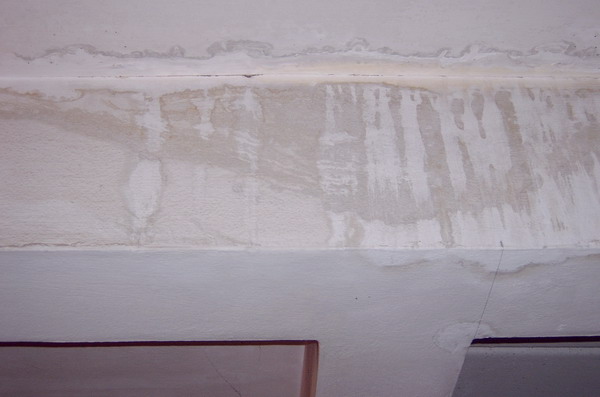
What happens when you get a leak, most common is when the grouting starts deteriorating, the water seeps under the tiles and finds the easiest way to escape.
You can see in the above picture the bathroom floor at the bottom, the water has seeped across the top of the beam and made it through the floor of the other side of the bathroom wall, so is it worth bothering shuttering for bathroom floors? It does take a lot longer for the water seepage to get through, but that also means it won't be fixed for a lot longer so rebar both in the floors and in structural beams will be exposed to the dampness for lot longer periods.
Yep, thats one hell of a damp patch, but hell it aint causing any problems that I can see, shame I can't see the rebar though
Results 1 to 11 of 11
-
08-05-2009, 12:27 AM #1

R.I.P.



- Join Date
- Jun 2005
- Last Online
- @
- Location
- Pattaya Jomtien
- Posts
- 58,763
Thai upstairs bathroom floor leaks and construction
-
08-05-2009, 08:53 AM #2Thailand Expat

- Join Date
- Jun 2005
- Last Online
- 08-09-2014 @ 10:43 AM
- Location
- Simian Islands
- Posts
- 34,807
Are you going to fix it or not?
-
08-05-2009, 09:01 AM #3Member

- Join Date
- Jan 2007
- Last Online
- 31-01-2021 @ 09:25 PM
- Location
- Surin
- Posts
- 922
The whole bathroom floor , either up or downstairs should be sealed before tiling , fitting the baths, shower tubs etc etc.
Heaps of product available here to do the job , one of the best , a milky adhesive that sets to rubber. Apply a thick coat to the entire floor first , include about 100-150mm up the walls , then lay in some fibreglass sheet , rolling , brushing it into the adhesive.
Let sit for a few hours and go back in and give it all another coat ... work it down inside the floorwastes so water cant escape around it.
Its so ez and done in a day for the avg bathroom , but , typically in thai cost cutting style its not done here unless you oversee it.
3000 baht max , and simple enuff for DIY.
-
08-05-2009, 09:06 AM #4On a walkabout


- Join Date
- Jun 2008
- Last Online
- @
- Posts
- 30,635
Yep looks like you have a problem there DD and if you let it go the rebar will rust and the main structure can get what's called concrete cancer.
Best you look at your shower recess and hope the leak is coming from that area. If not your pipes are most likely leaking and without seeing the job massive jack-hammering may be necessary.
Good luck mate and the right man for the job.
-
08-05-2009, 09:29 AM #5
R.I.P.
- Join Date
- Jun 2005
- Last Online
- @
- Location
- Pattaya Jomtien
- Posts
- 58,763
Have you seen the price of fiberglass in Thailand? Aint gonna get a bathroom done for 3,000baht. Originally Posted by shaggersback
The leak is already fixed, just needed some grout in the tiles, the thread was really about whether it really is a good idea to do bathroom floors as they do here, or would it be better to use concrete plinths so any leaks show straight away rather than months or years later.
-
08-05-2009, 10:54 PM #6Thailand Expat

- Join Date
- Nov 2005
- Last Online
- 25-03-2014 @ 05:29 PM
- Location
- yes
- Posts
- 32,008
If you tile the floor properly and grout it well, there shouldn't be any leaks
however, due to earthquakes and/or traffic vibration, you can get some movement between the walls and floor
so, after grouting run a decent bead of silicon all around the room, in the corners
that stops any leaks for a while!
DD I also think the floors are laid like that so you get a step down into the bathroom, so you can have a wetroom sort of bathroom
seems to work.
As for leaks taking longer to show,maybe, but if the floor is poured properly etc, then you shouldn't get any leaksI have reported your post
-
09-05-2009, 05:36 PM #7Member
- Join Date
- Jan 2007
- Last Online
- 31-01-2021 @ 09:25 PM
- Location
- Surin
- Posts
- 922
Yep. Originally Posted by dirtydog

Metre wide 20 metres long roll of coarse weave fibreglass 800b. Thats Farang price.
Dont really matter how you do the floor ... if it aint sealed its gunna leak!
-
09-05-2009, 06:17 PM #8
R.I.P.
- Join Date
- Jun 2005
- Last Online
- @
- Location
- Pattaya Jomtien
- Posts
- 58,763
Last time I bought a roll of fibreglass it was just under 3,000baht, it was imported from Korea, you also needed the resin, a hardener and a fixer, completely different to what I have used in the UK, also set off in less than 5 minutes so not much working time with it

-
09-05-2009, 07:21 PM #9Member
- Join Date
- Jan 2007
- Last Online
- 31-01-2021 @ 09:25 PM
- Location
- Surin
- Posts
- 922
3000b !!! very exi!
The guy i get it from builds glass canoes and does boat /car repairs from his small shop in Bang tao.
So i got a roll off him at 800b ... he must be getting it way cheaper.
-
01-11-2011, 06:13 AM #10Member
- Join Date
- Oct 2011
- Last Online
- 29-11-2011 @ 07:53 AM
- Posts
- 2
Bathroom Leaks
We coma across many leaking bathrooms and in most cases it is the tile joints that aloow water to run through.
We have a wonderful product called SHOWERSEAL that will positively SEAL showers and Bathrooms.
If you have showers that leak give me a yell
-
03-11-2011, 08:18 PM #11Member

- Join Date
- Feb 2009
- Last Online
- 17-09-2022 @ 12:14 PM
- Location
- Krabi
- Posts
- 682
Check out the thread I posted about my bathroom - Originally Posted by Hans Graf
https://teakdoor.com/construction-in-...n-the-los.html
Would your product be any help?


 Reply With Quote
Thread Information
Users Browsing this Thread
There are currently 1 users browsing this thread. (0 members and 1 guests)
