

The benfits of integration and a liberal (sympl) approach to migration
Migrant children hired by crime gang to hurl grenades around Oslo
‘Foxtrot’ crime syndicate controlled from Iran entices teenagers to carry out contract hits
It is just after nightfall in Bislett, a quiet student neighbourhood in central Oslo, when two children armed with hand grenades step off a bus and approach their target.
As undergraduates pile out of bars and stumble to their dorms, the 13-year-old boys arrive at a nail salon and hurl the grenades at the shop front.
The blast shatters windows, riddles brick walls with shrapnel and triggers a bomb alert on Oslo’s emergency text message system. The boys vanish into the night.
They have just completed their first major operation for Foxtrot, a crime syndicate that originated in Sweden but is now expanding across the border into Norway.
Foxtrot is one of Europe’s most ruthless criminal networks linked to dozens, if not hundreds, of bomb attacks and attempted contract killings as its foot soldiers vie for control of the Scandinavian drug trade.
Grenade attacks and shootings are thought to be an effort to scare off their new competition for organised crime in passive Norway, investigators told The Telegraph.
Since it was founded in Stockholm around 2010, the syndicate has proved virtually impossible to dismantle. Rawa “Kurdish Fox” Majid, the syndicate’s leader, issues his orders from Iran – where he lives under the protection of the Ayatollah’s regime.
A legal loophole in Denmark, Norway and Sweden means that children under the age of 15 cannot be prosecuted for even the most serious offences, such as murder – making them ideal recruits.
The boys who carried out the attack on the nail salon are understood to have been approached on social media by a middleman, or “handler” for the Foxtrot gang, which was looking for under-15s to bomb the salon.
Here, The Telegraph understands, they were given a pair of Bosnian army-issue hand grenades, which had been smuggled into Norway.
Some time after they were arrested, one child was placed in juvenile care and the other was released.
Norwegian privacy laws mean that neither child can be named publicly.
However, Norwegian MPs and investigators say the vast majority of such children come from a migrant background; many feel poorly integrated into Norwegian society, which makes them easy for Foxtrot to manipulate.
Damage to Xi Chi Beauty
The broken windows left by the grenade attack on XiChi Beauty Credit: Ben Montgomery
At the scene of the nail salon attack, it is clear how lucky the residents of Bislett are not to be injured or killed.
The blast from the first grenade sent debris and shrapnel across a radius of perhaps 20 yards, leaving broken windows and street lights in its wake.
After a few minutes, a well-dressed, older Norwegian woman, who identifies herself as the owner of the building that houses the salon, arrives and lets herself in.
Elisabeth Rye, 79, is happy to speak about the attack, but maintains she has no idea why it was carried out.
Her Vietnamese tenant, who ran the salon, had been ill and had not been seen for several months.
Elisabeth Rye outside Xi Chi Beauty salon
‘Crime is taking off in all areas here now,’ said Elisabeth Rye outside the salon Credit: Ben Montgomery
“The police know who did this, but they let them go because they were so young, that’s why they [Foxtrot] hired them,” Ms Rye says.
“Crime is taking off in all areas here now,” she adds, before phoning her insurers about the shattered windows in the salon.
The Bislett grenade attack was alarming enough, but it was just the first of three Foxtrot-linked acts of violence committed by children in late September and early October.
Advertisement
It was followed by a similar grenade attack on a sushi restaurant in Strømmen, a suburb 12 miles east of Oslo.
A 15-year-old linked to the Foxtrot network was suspected of hurling a grenade at the restaurant on the night of Oct 7.
In stark contrast with middle-class, student-oriented Bislett, Strømmen is a rundown suburb where child truants cruise around on e-scooters and local businesses shun reporters.
“I don’t want to talk about this and no one else here speaks English,” says one female worker chopping up raw fish at the restaurant hit by the grenade, Strømmen Sushi & Thai Mat, which still has a broken window.
A stern, middle-aged man who appears to be the restaurant’s owner then turns up in his car. He refuses to identify himself or answer questions about the attack and asks The Telegraph to stop taking photographs.
On the other side of the road, a barber shop owner only smirks when asked about the grenade attack.
“This place is not a dream place to live in,” he says. “You should go home.”
The third Foxtrot-linked attack, a shooting, occurred on Sept 30 at a home in the southern city of Sarpsborg. It was reportedly carried out by three boys aged 12, 13 and 14.
According to Norwegian broadcaster NRK, a man in his 30s has also been arrested for planning to give grenades to the children, allegations that mirror the Bislett attack.
As Norwegians struggle to fathom the idea of children hurling grenades in the street, many are looking to the Kripos, the Norwegian equivalent of the FBI, for tougher action.
Kristin Ottesen Kvigne, the Kripos chief, said her investigators are closely watching Foxtrot’s preferred social media channels to intercept future attacks.
Her staff shared with The Telegraph a series of recent social media posts by Foxtrot handlers trying to recruit children.
“If you want to work for Foxtrot, message me here!” says one of the posts.
“You will be paid well and you will get protection from Fox,” it continues, with several emojis of a fox and a gun. “Jobs are available in Sweden, Denmark, Norway and abroad.”
A social media post looking for young recruits
Ms Kvigne warns that gangs like Foxtrot are targeting Norway out of a cynical view that its justice system cannot cope with violence of this nature when it is committed by children.
“In Norway, the age limit [for prosecution] is 15, so anyone under 15 cannot stand trial. As they cannot be penalised, there is a willingness of these Swedish criminals to use very young people to commit violence against their competitors within the criminal markets,” she says.
As for why Foxtrot is now expanding into Norway, “one working theory is that they are trying to get into the Norwegian market by scaring off their competition or buying off their competition”, she adds.
She stresses that the problem extends far beyond Foxtrot, which is just one of around 70 Swedish gangs now operating in Norway: “Every police district in Norway has some form of Swedish organised crime present.”
The distrust and fear that Foxtrot’s grenade attacks have brought to the region is particularly hard for Norwegians to swallow.
It is a grim new chapter for a country that prides itself on having close-knit, trust-based communities, perhaps best embodied by the tradition of “dugnad” where Norwegian neighbours meet up for communal chores like leaf-raking or litter-picking.
The rise of child gang crime has also coincided with a major increase in mass migration. In the early 1990s, the number of immigrants living in Norway stood at around 4 per cent of the population; as of January 2024, it has reached 16 per cent.
“We have to be honest about something here: most of these kids have migration backgrounds,” says Mahmoud Farahmand, an MP for the opposition Conservative party who sits on the justice committee of the Storting, the Norwegian parliament.
Despite repeated warnings by Norwegian security services, “the government has not been able to put up a formidable defence... they’ve become blind to the situation”, he says.
As a former army intelligence officer whose parents fled the Iranian Revolution, the MP is concerned about Tehran’s support of Foxtrot from a national security perspective.
MP Mahmoud Farahmand
MP Mahmoud Farahmand says the Norwegian government has ‘become blind to the situation’ Credit: Ben Montgomery
The rise of child assassins has also forced one of the most respected community support groups in Norway, the Night Ravens, to shift its tactics in helping young people.
Founded in 1990, the Night Ravens are yellow bib-clad volunteers who patrol their communities on Friday nights, keeping an eye out for the vulnerable, which typically would be those who have had too much to drink.
Now, the group is shifting its focus towards children from a migrant background who are at risk of being turned into teenage killers by Foxtrot.
“I am a little bit worried about the future, actually,” Lars Norbom, the secretary-general of the Night Ravens, says in his office in the Gronland district of Oslo.
“We have issues with cultural differences, and with social differences but most of all we have failed at integrating immigrants.”
A former prison officer, he has reluctantly concluded that jailing child criminals in Norway is a necessary next step, even if it seems alien to a country with such a strong emphasis on rehabilitation and community service.
Like any major crime syndicate, Foxtrot is primarily driven by profit, and its main source of income is drugs – it is the biggest supplier of heroin in Sweden.
But in Norway, Foxtrot seems to prefer trading in party drugs and has been linked to a tremendous increase in cocaine after the pandemic.
The gang has a large network of drug mules that operate in Sweden, Denmark and increasingly Norway, taking advantage of the region’s remote and relatively open borders.
In 2023, Norwegian police intercepted an 800kg shipment of cocaine, which had been hidden in banana crates from South America.
It was the largest drug seizure that Norwegian customs officials, who are more accustomed to sniffing out bootleg alcohol, had ever seen.
“We’ve seen a rapid and dramatic change... it is now easier for a 17-year-old to get cocaine in Norway than alcohol,” says Karin Tanderø Schaug, the president of the Norwegian Customs Union.
Karin Tanderø Schaug, president of the Norwegian Customs Union
Karin Tanderø Schaug, the president of the Norwegian Customs Union, is concerned at the rise in drug smuggling Credit: Ben Montgomery
The explosion in cocaine smuggling has exposed severe staff shortages in Norway’s border force, which also lacks patrol boats and key equipment such as electronic scanners to check fruit crates for cocaine.
Foxtrot’s cocaine smuggling has become so brazen that it has even sent thugs to carry out surveillance at a warehouse owned by Bama, a fruit delivery company, which the gang has tried to exploit as a seaboard drug stash.
Some border guards are now wondering if they need to follow Sweden’s lead by taking firearms to work to defend themselves against the gang’s mules and enforcers.
“We’re getting smaller and the criminals are getting bigger,” says Ms Schaug, who has called on the Norwegian government to hire an additional 400 customs officers to keep watch at land borders and Norway’s sea border, the longest in the world after Canada’s.
Astri Aas‑Hansen, the Norwegian justice minister, said her focus was on the safety of Norway and she was looking at how government agencies could work together to share information.
“Crime must be combated, including criminal acts committed on demand, as a service,” she said.
“It is crucial to target efforts towards the criminal economy, as money is the criminal networks’ impetus.”
Ms Aas‑Hansen has previously described the grenade attacks as “unacceptable” and said it was “extremely serious that we experienced explosions in the centre of Oslo”.
Lack of communication from ministers
But that is not enough for Mr Farahmand, who has grown exasperated with the lack of communication from ministers about what they intend to do about Foxtrot.
“It is frightening... I pass that street regularly myself, going back and forth to my apartment,” he says of the grenade that blew up outside the salon in Bislett.
But he is also saddened by a deeper and more troubling phenomenon: the country that he loves is beginning to resemble the war zones he served in as a young soldier.
“As a former army officer, who did five, six combat deployments... I never thought I would see grenades being thrown in the streets of Oslo,” he says.
The nail salon attack in Bislett is still raw in the memory of its witnesses.
Thea Langnes recalls cleaning her apartment with her boyfriend when the grenade went off in the streets below.
“We heard a big bang and thought maybe it was a car crash. We jumped, we were scared,” the 23-year-old PR and communications student says.
“We looked out the window and saw people running outside. I thought, my God, what is happening? We went out, and minutes later the police came and were screaming at us that there was another grenade still in the street.”
Thea Langnes
‘We heard a big bang. We jumped, we were scared,’ says Thea Langnes Credit: Ben Montgomery
After Ms Langnes and her boyfriend scrambled back inside, police carried out a controlled explosion of the second, undetonated grenade, which was lying on the street next to the nail salon.
“Our building was locked down, we got texts from the police saying: ‘Close the curtains, don’t open the windows,’” added Ms Langnes.
“Then we heard this was done by young criminals, hired by older gangs. We were so shocked.”
The next day, Oslo police arrested two 13-year-old boys over the attack. Slowly, detectives pieced together the tale of how two children came to be hired as grenade-wielding would-be assassins.
Access Denied
Results 1 to 19 of 19
-
03-11-2025, 07:38 PM #1Thailand Expat



- Join Date
- Jan 2010
- Last Online
- @
- Posts
- 33,069
Coming to another European country soon
-
03-11-2025, 08:46 PM #2hangin' around


- Join Date
- Oct 2006
- Last Online
- @
- Location
- Home
- Posts
- 41,209
You have absolutely no idea what my approach to migration is.
In my opinion it's more constructive to approach it unclouded by racism.
Why not start a sensible thread about it if it interests you?
Here you're just honouring numpt's lengthy track record as a silly, racist dick.
-
03-11-2025, 09:01 PM #3Member

- Join Date
- Nov 2009
- Last Online
- @
- Location
- Bangkok
- Posts
- 38,005
Sweden has not done well from Merkel's immigration policy... &, it's well document how Russia and other "nations" use these ploys in their destabalizing the West doctrine.
-
03-11-2025, 09:07 PM #4Arahant

- Join Date
- Apr 2020
- Last Online
- @
- Location
- Nibbana
- Posts
- 21,203
What is your approach to migration? Originally Posted by cyrille

-
03-11-2025, 11:39 PM #5Thailand Expat

- Join Date
- Nov 2006
- Last Online
- @
- Posts
- 22,910
his approach would be sit sneering on the sidelines as the uk fills up with asylum seeking undocumented male trash inclined towards violent criminality and sexual assault, whilst the doctors and professionals are assimilated legally into germany, france and the netherlands.
-
04-11-2025, 12:06 AM #6Thailand Expat
- Join Date
- May 2008
- Last Online
- @
- Posts
- 14,694
Don't know about Norway, but.... Originally Posted by NamPikToot
If you waltz around town in Denmark throwing handgrenades, you won't be going home to your parents, no matter what age you are
Sweden now has jail for down to 13 yearlings.
Ofcourse Originally Posted by NamPikToot
They are kids
Soldiers....the younger the better
But......Sweden is fucked
Malmø might be the worst
-
04-11-2025, 12:40 AM #7Thailand Expat

- Join Date
- Aug 2011
- Last Online
- @
- Location
- Fuente del Berro
- Posts
- 27,925
Nothing wrong with Blekinge,Kalmar Karlshamn, Tarno since the Danes left , far safer than my beloved Nørreport or Vanløse these days. Originally Posted by helge
-
04-11-2025, 12:49 AM #8Thailand Expat
- Join Date
- May 2008
- Last Online
- @
- Posts
- 14,694
I doubt that Originally Posted by david44
But do put up the numbers
You're welcome to exclude the swedish assasins from the danish score
-
04-11-2025, 06:07 AM #9Thailand Expat
- Join Date
- Aug 2011
- Last Online
- @
- Location
- Fuente del Berro
- Posts
- 27,925
a fair point venner but the tutf wars are real in both Malmo and Norrebro Originally Posted by helge
Cannot recall last crime on Tarno theres no cops no grills and of course no bridge!!
I am sure odd illegal spliff or riding a bike drunk but that's only when I'm there!! Originally Posted by harrybarracuda
-
05-11-2025, 03:26 PM #10Thailand Expat

- Join Date
- Sep 2009
- Last Online
- @
- Posts
- 108,245
I doubt religion is involved in their drugs trade.
If you can't prosecute the kids, perhaps render them somewhere where a good thrashing can extract the identities of those that hired them and tell the four by twos they want to blow up Tel Aviv.
The rest will be taken care of.The next post may be brought to you by my little bitch Spamdreth
-
08-11-2025, 02:30 AM #11Thailand Expat
- Join Date
- May 2008
- Last Online
- @
- Posts
- 14,694
Hmm ... Originally Posted by david44
Police report: 67,500 people are connected to criminal gangs in Sweden
Of
Frederik Mahler Bank
In Sweden, the authorities have today provided an updated picture of gang crime and its extent.
The situation report for 2025, which has been prepared by the Swedish police, shows that 67,500 people can be linked to criminal gangs in Sweden. This is what SVT writes.
Last year was the first time such a report was presented. At the time, the figures showed that 62,000 people were connected to the criminal networks.
"We in the police will do everything we can to reverse this trend," says the Swedish National Police Commissioner, Petra Lundh.
The new figures show that there are 17,500 active gang criminals in Sweden and 50,000 people who are considered to have links to gang crime. According to the Swedish authorities, the new figures do not necessarily reflect a real increase, as new methods have been used in the preparation of the report, writes SVT.
At the end of 2023, 1,257 people were registered as affiliated with a biker or gang group in Denmark, writes the Crime Prevention Council.
-
08-11-2025, 03:08 AM #12Thailand Expat
- Join Date
- May 2008
- Last Online
- @
- Posts
- 14,694
Originally Posted by helge
Foreign country
In Sweden, they are still struggling with massive gang crime: 'A problem that you as an authority cannot handle at all'
A new report shows that there are 67,500 people in Sweden who are either active gang criminals or in contact with gang crime.

Swedish police investigate a number of gang-related shootings and explosions every single year. Here, a police station in the city of Helsingborg has been affected. (Photo: © Johan Nilsson, AFP/Ritzau Scanpix)
Of
Tim TørnqvistAccess Denied
It is no secret that Sweden struggles with gangs and not least the crime they commit.
Therefore, it was not exactly uplifting news for Swedes when Swedish police today announced at a press conference that the country currently has about 17,500 active gang criminals.
The average age of them is 28 years, 81 percent of them are Swedish citizens, and 94 percent are men.
And behind these numbers are a myriad of crimes, says Berlingske's Nordic correspondent, Peter Suppli Benson.
- It is drug crime, it is welfare crime, i.e. where they empty the public coffers, and then there are murders, explosions and the buying and selling of assassins. It is a bestial string of services and people, says the Berlingske correspondent.
That should not be possible, because we are comparable countries.
Peter Suppli Benson, nordisk korrespondent, Berlingske
In addition to the active gang criminals, Swedish police estimate that another 50,000 are in contact with gang crime. These include people who come into criminal environments close to the active gang criminals. According to the police, these people risk becoming even more involved in gang crime in the future.
That figure reveals how big a problem the Swedes really face, according to Peter Suppli Benson.
"If you have 67,500 people, which is the equivalent of a very, very large Swedish provincial town, then you have a problem that you as an authority cannot handle at all," says the Nordic correspondent.
And the problem only becomes even greater when you look at what the Swedish government has had as its stated goal in recent years, points out Joakim Reigstad, who is a Nordic correspondent for the Norwegian public service media NRK.
"What is worrying for the Swedish police and Swedish politicians is that there do not seem to be fewer gang criminals. The nonsocialist government in Sweden has promised since 2022, when it was elected, to overcome the problem, says the NRK correspondent.
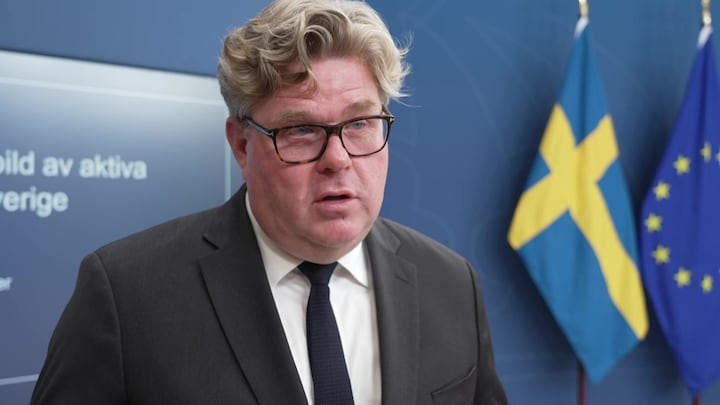
The Swedish Minister of Justice, Gunnar Strömmer, believes that Sweden has an "extensive" problem with gang crime. Photo: SVT.
Far more than in Denmark
Last year, Swedish police counted the number of gang criminals in Sweden for the first time. At that time, the police estimated that 14,000 people were active in criminal networks, while another 48,000 people could be linked to the networks.
Thus, there are now a total of 5,500 more gang criminals and people in contact with gang crime, but this does not necessarily indicate an increase, explains Petra Lundh, who is the National Police Commissioner in Sweden.
"We do not see any clear indications of either an increase or a decrease, even though this year's figures appear to be higher," the National Police Commissioner said at the press conference earlier today, according to the Swedish public service broadcaster SVT. She refers to the fact that the police have used new - and better - methods to calculate the number this year.
But regardless of whether more have arrived or not, Sweden still has a lot of gang criminals - especially when you compare with Denmark, for example.
Our Nordic neighbour has about eight times as many as we have in Denmark, and this is striking, says Peter Suppli Benson.
Because of this, parallel societies have also largely developed in Sweden, where people have had poor conditions for having a good life.
Joakim Reigstad, Nordic correspondent, NRK
- It should not be possible, because we are comparable countries.
- One possible explanation is that Sweden has received far more migrants, refugees and immigrants than Denmark has. This means that they now have a total population of about 10 million, and of these, more than 2.2 million are of ethnic origin other than Swedish and born outside the country, he explains, pointing out that criminal networks and gangs have been able to abuse them:
- Because people have often been brought in who are poorly educated, who have no experience of being in a welfare society like the Swedish one, and who are socially vulnerable, as they often end up in peripheral areas around the big cities in Sweden, where many are unemployed and where many do not get an education.
Joakim Reigstad also points out that Sweden - unlike Denmark - has for many years not made demands on migrants, refugees and immigrants.
- This has been seen as racist in the past in Sweden. You did not have to make demands, and therefore you did not demand that you take an education, you did not demand language learning, and you did not demand participation in society, as has been done in Denmark, for example.
"And because of that, parallel societies have also largely developed in Sweden, where people have had poor conditions for having a good life. Therefore, they have been exposed in relation to being recruited, he says.
© Ritzau Scanpix
Gang crime in Sweden versus Denmark
The approximately 17,500 people in Sweden who, according to the police, are active gang criminals, make up 0.17 percent of the total Swedish population.
In comparison, at the end of 2023, there were 1,257 people registered as affiliated with a biker or gang group in Denmark, according to the Danish Crime Prevention Council. This corresponds to 0.02 percent of the Danish population.
This means that Sweden has relatively eight times as many active gang criminals as Denmark.
Has made several initiatives
At the press conference earlier today, National Police Commissioner Petra Lundh made it clear that "the police will do everything we can to reverse this trend".
And this statement comes on top of the fact that the authorities and the government have already done a large number of things to try to get rid of the problem of gang crime, says Joakim Reigstad.
"For example, they have started with secret eavesdropping on criminals and the people they suspect as criminals," says the Nordic correspondent and adds:
- There has also been a lot of camera surveillance around the exposed areas, where we know that there are many criminals who are staying. In addition, both tougher penalties for gun possession and a number of social measures have been implemented in relation to preventing the recruitment of young people and children.
Recently, the Swedish government has also set out to investigate how to give higher sentences to people who are members of a criminal gang.
"So there are a lot of things that are being done in Sweden to alleviate the problem, but it will take time, as the Swedish Prime Minister, Ulf Kristersson, has also said. We are not talking about three years. We are talking about maybe ten years, says Joakim Reigstad.
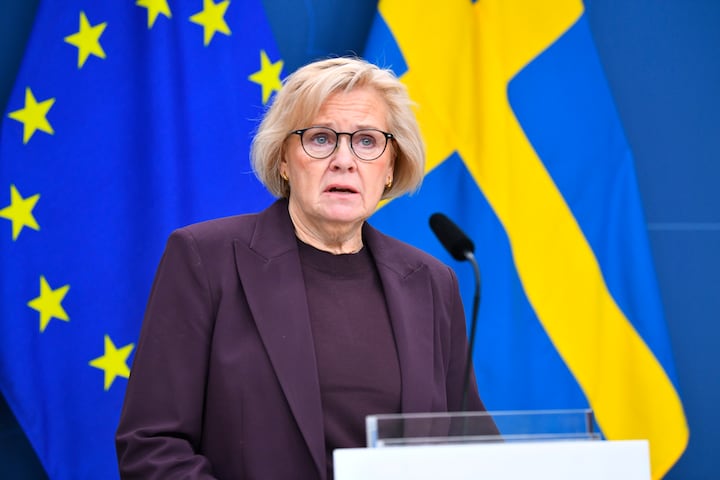
The National Police Commissioner in Sweden, Petra Lundh, held a press conference today to present a new report on the number of active gang criminals and people who are in contact with gang crime. (Photo: © Lars Schröder, TT/Ritzau Scanpix)
Could be a major election theme
In the parliamentary elections in Sweden three years ago, the nonsocialist parties won government power - not least by promising that there would now be order in the streets of Sweden, Peter Suppli Benson reminded.
"The figures tell us that fewer people are killed in Sweden during these three years than there were before. But behind it are some other figures; namely a very high number of shootings and many explosions still, he says.
And therefore gang crime may well become an issue again when Swedes go to the parliamentary elections in September, according to the Berlingske correspondent.
- The problem is still huge, and it has moved from the suburbs and into "white areas" where the ordinary, classic Swedes live. And therefore it is something you talk about, and therefore it can again become decisive. But can you trust a nonsocialist government that has not succeeded in the last three years? That is the big question, says Peter Suppli Benson.
Joakim Reigstad shares the assessment that the problem has the potential to once again become the big issue in the election campaign.
"It is clear that if the government does not get better results and greater effect from the measures it has introduced, it may well be that the opposition - the Social Democratic and Socialist parties - will use it as an argument in the election campaign to explain why the nonsocialists' recipe for solving the problem was not the right one, and that it should therefore be better to think more about social measures and prevention." says the NRK correspondent.
It is not only the number of gang criminals and people in contact with them that has increased in the past year in Sweden. So is the number of explosions. You can read more about that in this article:
-
08-11-2025, 03:22 AM #13Thailand Expat
- Join Date
- Nov 2006
- Last Online
- @
- Posts
- 22,910
regarding cyrille, there's a village somewhere .......... you know the rest. Originally Posted by cyrille
-
08-11-2025, 07:04 AM #14Thailand Expat

- Join Date
- Jan 2006
- Last Online
- @
- Posts
- 79,118
A trite answer avoiding the actual invitation because all you have is your silly bigoted diatribes mixed in with a healthy dose of self loathing inspired homophobia.
-
08-11-2025, 09:56 AM #15hangin' around
- Join Date
- Oct 2006
- Last Online
- @
- Location
- Home
- Posts
- 41,209
Let's face it...it's pretty much all he has. Originally Posted by kingwilly
-
08-11-2025, 11:36 AM #16Arahant
- Join Date
- Apr 2020
- Last Online
- @
- Location
- Nibbana
- Posts
- 21,203
Ban all Muslim immigrants.
Actually, just ban all immigrants until they ship out the ones there illegally now.
Redirect all funds for immigrants to local's heath care, welfare and educational systems.
Makes sense dun'nit.
Once they've looked after their own, then maybe look at allowing in skilled and educated non-Muslims in small numbers.
-
08-11-2025, 03:30 PM #17Thailand Expat
- Join Date
- Nov 2006
- Last Online
- @
- Posts
- 22,910
^
exactly.
islam is totally incompatible with western christian society. there is no compromise with islam. submit or suffer the consequences.
cyrille got rich by abandoning any principles he had and submitting, and willy married a muslim, so maybe he converted or was a muslim himself, but he drinks alcohol and i think he eats pork so at best he is only a pound shop muslim.
-
08-11-2025, 07:56 PM #18Thailand Expat
- Join Date
- Sep 2009
- Last Online
- @
- Posts
- 108,245
It's like reading the comments section on GB News.
-
08-11-2025, 09:21 PM #19hangin' around
- Join Date
- Oct 2006
- Last Online
- @
- Location
- Home
- Posts
- 41,209
Interspersed with
 talk about someone in the pub he doesn't like.
What a silly, feeble old fool.

 Reply With Quote
Thread Information
Users Browsing this Thread
There are currently 1 users browsing this thread. (0 members and 1 guests)
