

Why the expropriation of Russian assets could become a global financial crisis
March 14, 2024 Bernd Müller
"In the question of the frozen Russian assets, the EU is playing with fire. Why an expropriation of the global financial system may be damaged.
Still, the Russian assets are frozen to the values in the European Union, and still there is no agreement about what should be done with this money. Leading politicians in Germany, the USA and the EU is toying with the idea to pass the Ukraine.
For moral reasons, they think they are right. Finally, the Ukraine international was attacked unlawful and must be rebuilt. However, this idea suffers from the reality and the devastating consequences they would have.
The economic risks of expropriation.
The risks for the US Dollar and the Euro is much been written. The expropriation of the national Bank balances of a country with which it is not in the war, likely in violation of international law and the trust in the Western currencies undermine.
Impending global financial crisis.
In the worst case it could lead to a global financial crisis – namely, when Russia will take counter-measures. It pointed to an EU official told the Reuters news Agency the way.
Nearly 70 percent of all from the West blocked Russian assets are located at the Belgian CSD Euroclear. There's securities and cash of the Russian national Bank in the value of 190 billion euros store.
Legal and economic consequences for Euroclear.
In the Moment in which these assets to the Ukraine would pass, would be Euroclear, even with the considerable demands of EU officials. The Russian Central Bank would then make in the Russian courts claims to Euroclear-money claim.
In Moscow, around 33 billion euros store and it is unlikely that Russian courts would not recognize the claims."
https://www.telepolis.de/features/Wa...e-9654949.html
Results 14,926 to 14,950 of 15714
Thread: Ukraine war mega thread
-
15-03-2024, 09:57 PM #14926Thailand Expat



- Join Date
- Jul 2010
- Last Online
- 24-07-2024 @ 09:54 PM
- Location
- Where troubles melt like lemon drops
- Posts
- 26,242
A tray full of GOLD is not worth a moment in time.
-
15-03-2024, 11:22 PM #14927Thailand Expat
- Join Date
- Jul 2010
- Last Online
- 24-07-2024 @ 09:54 PM
- Location
- Where troubles melt like lemon drops
- Posts
- 26,242
Why Russia Has Been So Resilient to Western Export Controls
STEVEN FELDSTEIN, FIONA BRAUER
MARCH 11, 2024
"With a global network of more than 150 experts across twenty countries, Carnegie is renowned for its independent analysis of major global problems and understanding of regional contexts. "

Three factors are helping to sustain Moscow’s military technology procurement efforts.
"Following Russia’s invasion of Ukraine, the United States imposed an unprecedented package of sanctions intended to make Russia pay a high economic cost for its aggression and to constrain the Russian military. U.S. President Joe Biden declared that Russia would “bear the consequences” for the invasion and emphasized that sanctions were designed to reverse Russia’s military modernization, degrade its critical industries, and impair its ability “to compete in a high-tech 21st-century economy.”
These sanctions—coordinated with allies including the EU, Japan, and the UK—spanned several industries and economic sectors, including energy and raw materials exports, and the Russian financial system. The measures also included a stringent set of technology export controls aimed at denying Russia access to components that could be used for its war machine. They targeted a wide range of technologies, from ball bearings to electrical transformers, but were particularly focused on a set of high-priority dual-use items such as integrated circuits and radio frequency transceiver modules that “have extensive commercial applications but have also been found in Russian missiles and drones on the battlefield in Ukraine.”
Yet, Russia has proved exceptionally resilient to the West’s measures. This is true of the Russian economy as a whole but is particularly germane when it comes to Russia’s unexpected success in acquiring advanced technology components. In theory, Western technology export controls should have had more impact. Take semiconductor chips—critical to a range of items including drones, radios, precision missiles, and armored vehicles. Russia’s domestic chips industry is outdated and undersized. Plagued by disinvestment, Russian factories operate at 65-nanometer chip technology—about fifteen years behind the United States. As the U.S. Department of Commerce says in its description of the export controls, the highest priority items were selected in part because of “Russia’s lack of domestic production.” Given Russia’s reliance on imports of critical technology, policymakers were not unrealistic to expect that technology sanctions would significantly degrade Russia’s military capability. But after experiencing a steep drop in the imports of transistors and microprocessors in 2022, Russia’s supplies have rebounded to prewar levels.
How is it that Russia has been so effective in acquiring critical technology used for military weapons, often from Western manufacturers, despite export controls?
Three factors are primarily responsible for sustaining Russia’s military technology procurement efforts.
"First, Russia is powering its weapons systems by procuring run-of-the-mill computer chips and components, often sourced from U.S. manufacturers, found in consumer products that are rarely subject to export restrictions.
Second, Russia has shown an adaptive ability to exploit globalized supply chains and leverage a network of third-country traders to access dual-use components for its tanks, missiles, and drones.
Third, shifting geopolitical incentives have motivated many countries—such as China, India, Türkiye, and the UAE—to ignore Western sanctions and sustain trading ties with Russia.
THE SIGNIFICANCE OF COMMON TECHNOLOGIES
One aspect that has surprised experts is the extent to which Russia has ramped up its defense industrial production. Although Russia imports a variety of military items, from Iranian drones to North Korean artillery shells, its domestic manufacturing base has quickly pivoted to a war footing. An estimated 7.5 percent of Russia’s GDP is now dedicated to defense spending, and the industry employs 3.5 million Russians, or 2.5 percent of the country’s population. The increased defense spending has led to surprising distortions: as The Guardian reports, “Machinists and welders in Russian factories producing war equipment are now making more money than many white-collar managers and lawyers.”
The key to powering Russia’s military industrial machine is obtaining critical components such as electronic integrated circuits. Although the West has denied Russia access to advanced models, its factories have made do with lower-grade substitutes. In many cases, the same chips found in common appliances like microwaves are also sufficient to power Russian cruise missiles and battle tanks. As U.S. Commerce Secretary Gina Raimondo has testified, “We have reports from Ukrainians that when they find Russian military equipment on the ground, it’s filled with semiconductors that they took out of dishwashers and refrigerators.” Relying on lower-grade chips can result in functionality trade-offs. For example, military-grade versions of chips are designed to be resilient to high temperatures (and therefore hard to obtain due to sanctions). Instead, Russia is using ordinary chips but supplementing them with heat sinks and thick insulation seals so that the electronic components inside will stay cool.
The ubiquity and breadth of these components make them more than merely dual-use technologies—items with distinct military and civilian applications. Rather, they should be considered to be “omni-use” technologies, present in every area of the modern economy. These technologies tend to be developed and controlled by private industry (rather than overseen by sanctioning governments), in contrast to dual-use controlled goods. Their widespread availability and the evolving nature of their end uses are not well suited to the inflexibility of export controls.
Russia’s Orlan-10 drone, used to locate Ukrainian troops and vehicles for rapid strikes, illustrates the military utility of commonplace technologies. It also highlights how much Russia relies on dual-use components sourced from U.S. manufacturers. The Orlan-10’s generator is powered by a Texas Instruments chip—one commonly found in HVAC systems. Components from the Swiss companies STMicroelectronics and U-blox are found in the flight controller and GPS module. The flight controller also contains multiple microcircuits produced by Dutch-owned (formerly U.S.-owned) company Freescale Semiconductor, whose components are commonly used in weather stations, washing machines, and respiratory equipment. One of the few Russian-made components, a navigation receiver in the GPS module, is built onto a U.S. chip made by Analog Devices.
Analyses reveal that the bulk of Russia’s sourced components—whether microprocessors or GPS units—originate from U.S. companies such as Intel, AMD, and Texas Instruments. Customs records indicate that from February 2022 through the end of that year, Russian companies entered into more than 3,000 semiconductor import transactions worth at least $100,000 each—70 percent of which were products from U.S. chipmakers. As one Russian weapons manufacturer put it, he has “no problems” getting chips because “it is impossible to isolate Russia from the entire global electronic component base. It’s a fantasy to think otherwise.”
GLOBALIZED SUPPLY CHAINS
Russia has also successfully leveraged global trading networks to access needed components. Because Russia faces major constraints when it comes to directly importing critical technologies, it obtains 98 percent of its components via third countries. To bolster this strategy, Moscow has “tapped webs of intermediaries” who hide their transactions through shell companies and rely on neutral third-country ports to receive and ship goods. According to the New York Times, Russian trade officials share tips in weekly emails about international ports willing to transfer goods as well as those that will conduct transactions in rubles or allow repairs to Russian-flagged vessels.
In Morocco, the Times notes, the Russian government trade office contacted the general director of the port of Tanger Med soon after Russia’s invasion. By November 2022, Russian trade officials had turned the port into an “electronics transshipment hub.” Products from manufacturing centers, including China and Taiwan, were unloaded at the state-run port and placed on Russia-bound ships. According to leaked emails, the volume of supplies running through Tanger Med “could amount to about $10 million per year.”
Beyond microelectronics and semiconductors, similar patterns of illicit procurement allow Russia to access other key technologies for security uses. For instance, CNC machine tools—robotic equipment used for precision manufacturing that can include making parts for nuclear warheads—continue to flow into Russia, despite being subject to export controls.
CNC machines are not as ubiquitous or as numerous as the chips found in appliances. But their widespread use in nondefense manufacturing and their adaptability allow them to be repurposed and sourced on the secondhand market. The Washington-based nonprofit C4ADS has uncovered evidence of Russian defense contractors sourcing previously used CNC machine tools from secondhand resellers. As C4ADS analyst Allen Maggard explained in a February interview, Russian defense contractors have “offshored” the procurement of CNC tools using third-country intermediaries in jurisdictions not committed to enforcing sanctions. C4ADS identified several instances where third-country intermediaries arranged for South Korean or Chinese resellers—some of whom list CNC tools for purchase on open websites, such as South Korean business-to-business commerce platform Daara—to ship previously used tools directly or indirectly to Russian defense contractors.
Crucially, Moscow does not have to reinvent the wheel to access needed technologies. Economic relationships between international defense contracting firms and Russian defense end users predate earlier export controls imposed in 2014 (in response to Russia’s occupation of Crimea). Russia can leverage existing relationships with manufacturers and suppliers and merely has to introduce a new layer into the transactions—shipping the technology via third countries—in order to evade export controls. As Maggard noted in the February conversation, Russia’s prior integration into the global markets, and its demand for foreign technology, has created durable relationships between importers and foreign manufacturers. “Export controls can’t and don’t erase those relationships overnight,” Maggard said. Instead, the controls add a level of complexity to those relationships, creating new links with third-country intermediaries while preserving the business interests of Russian importers and, in some instances, of overseas manufacturers eager to maintain their presence in the Russian machine tool market.
Russia’s success in evading sanctions is also due in part to deficiencies with the export control regimes themselves. While all U.S. microelectronics exports are subject to controls, once the components leave America’s shores, they face far fewer constraints. Existing multilateral frameworks tend to focus on military applications and lack enforcement mechanisms to control dual-use technology. Frameworks that focus on dual-use technologies, such as the Wassenaar Arrangement, can be problematic. Wassenaar operates on a consensus basis, and Russia remains part of the group, so members who desire to sanction Moscow must rely on other mechanisms for restricting dual-use goods.
The difficulties in creating and enforcing comprehensive export controls for these components has resulted in the United States and other countries continually expanding their controls. Despite the widening net, new holes also appear. The Department of Commerce’s Bureau of Industry and Security (BIS), responsible for implementing and enforcing U.S. export controls, has added new companies to its entity list of violators but acknowledges that it is failing to keep pace with the creation of shell companies. Given the sophistication of global procurement networks alongside BIS’s lack of funding and outdated procedures (analysts primarily rely on Google searches and Excel spreadsheets to track violators), it is little wonder that Moscow has found ample room to exploit leaky supply chains. Yet, even improved BIS enforcement would not solve the problem. As the next section lays out, one of the most pivotal drivers enabling Russia’s transshipment of controlled technology is not individual companies but third countries, such as China, Iran, Türkiye, and the UAE.
SHIFTING GEOPOLITICS
Far from being isolated, Moscow relies on a shifting web of countries that are reluctant to cut ties with Russia. This dynamic is doubtlessly driven by economic incentives for companies and states that profit from Russia’s dependence on imports. Both governments friendly to the United States (such as South Korea and Taiwan), as well as more neutral governments (Brazil and the UAE) have found it financially advantageous to continue selling products to Russian outlets despite Western export controls. But Moscow’s circumvention of technological controls is also enhanced by growing geopolitical fragmentation and a willingness by governments to hedge their bets against the West.
As Matias Spektor writes in Foreign Affairs, secondary powers have “simultaneously” developed robust diplomatic and economic ties with China, Russia, and the United States, which provides an “insurance policy” in case conflict breaks out among major powers. While these economic and political relationships predate the Ukraine war, they have taken on added importance for Russia as the United States and its allies attempt to isolate Moscow.
Such hedging has benefited Russia, allowing it to circumvent Western controls with relative ease. An obvious partner is China. Sanctions have further spurred Russia into the arms of China. Beijing’s central role in semiconductor supply chains has helped Russia to offset the impact of Western sanctions. One analysis found that in the fourth quarter of 2022 alone, “more than three-fourths of sales to Russia were conducted via an intermediary in China,” compared to only 22 percent the previous year. When it comes to U.S.-made chips, exports to Russia via Hong Kong and China have increased tenfold from preinvasion levels.
But this is not just a story about Russia’s and China’s burgeoning relationship. Middle-power states are providing vital lifelines for Russia. The UAE is a good illustration. The trading hub has become an essential transshipment node for Russia. A “cottage industry” of traders has settled in Dubai, with the job of sourcing integrated circuits, microchip processors and controllers, radio navigational aids, and other electronics for export to Russia. One former broker says, “The circus moves where liquidity is. You can do business here, that’s what’s benefiting Dubai.” In 2022, the UAE exported fifteen times more chips to Russia than in the previous year. More recently, news outlets reported that Russian forces are procuring Starlink terminals from the UAE and other Arab countries for approximately 200,000 rubles, or $2,200, per unit. It should come as little surprise that Russian President Vladimir Putin paid a special visit to the Emirates in December 2023 and said that relations between the countries were at “an unprecedented level.”
Even countries friendly to the United States are at times providing critical technology to Russia. A 2024 investigative piece from the Washington Post disclosed how Russian firm I Machine Technology imported more than $20 million worth of sophisticated CNC machine tools from Taiwan. These tools were sent in sixty-three separate shipments from an array of Taiwanese trading firms; some were directly sent to Moscow, while other shipments followed a more circuitous route, coming through China and Türkiye.
CONCLUSION
Russia has demonstrated considerable adaptation in evading Western export controls relating to critical technologies, retooling dual-use components, and leveraging third countries to import sanctioned items. The failure of Western export controls has spurred calls for reforms to better stem the flow of components, including proposals to reinforce export controls with more serious sanctions, impose stricter requirements on companies and manufacturers, and exert more geopolitical pressure on third-country trading hubs. These steps may make it harder for Russia to obtain critical technologies, yet the factors driving Russia’s adaptation—the ubiquity of digital technology, globalized supply chains, and geopolitical fragmentation—are not mere loopholes to be closed. They are enduring, structural features of today’s world. Russia’s adaptation to export controls may be unexpected, but it is less reflective of any weakness of the sanctions themselves than of the new realities of the global technology marketplace and the implications of geopolitical fragmentation."
Why Russia Has Been So Resilient to Western Export Controls - Carnegie Endowment for International Peace
-
16-03-2024, 04:20 AM #14928Heading down to Dino's



- Join Date
- Jun 2009
- Last Online
- @
- Posts
- 35,438
Russia Is Burning Up Its Future
From March 15 to 17, Russia will hold a presidential election to refresh Russian President Vladimir Putin’s hold on power. There have never been any real doubts about the outcome, which will herald his fifth term in office. But the Kremlin has taken extraordinary steps to make sure: on February 8, the Central Election Commission announced that the antiwar candidate Boris Nadezhdin was disqualified from running. Eight days later, Alexei Navalny died in an Arctic prison colony, an event widely blamed on the Russian state, eliminating Russia’s most prominent opposition leader. Navalny was not running in the election, but Russian politics had been until recently reduced to a Navalny-Putin confrontation. Now Putin is alone on the political Olympus. With such figures as Navalny and Nadezhdin out of the way, the vote can provide a resounding affirmation of Putin and his pet project, the war in Ukraine.
Russia is neither stable nor normal. The presidential election brings to maturity the late-stage Putinism that began with the constitutional referendum in the summer of 2020, when Putin’s potential mandate was extended until 2036. There is more to this stage, however, than mere autocracy. Putin has made clear that Russia is fighting a permanent background war with the West, which gives him both an ideological raison d’être and a way for his ruling elite to maintain power. And to keep it all going, he must continually burn up the country’s resources, financial, human, political, and psychological. All of which points to the country’s political and economic fragility.
Consider the financial and economic situation. Although it retains market fundamentals, the Russian economy is increasingly dependent on government investment. The military-industrial complex has become the overwhelming driver of this unhealthy and unproductive economy, as the 2024 budget makes clear: military expenditures will be 1.7 times higher even compared with last year’s inflated figures, to reach 25 percent of all spending. Meanwhile, Russian exports, primarily of oil and gas resources, are providing diminishing returns because of the closure of Western markets and discounted sales. Nonetheless, these nonrenewables are not exhausted yet, and Putin, at least, seems to hope they will be enough to last his lifetime.
Stay informed.
A larger problem is demography. Along with the long-term trend of population aging, the demand for soldiers and the collapse of migrant inflows are pitching the country into demographic crisis. Economists note that all these pressures will combine in the medium term to a decline in labor productivity. Although the artificial growth of wages through the military economy has improved the situation for now, it has also distorted it. Putin is preoccupied with raising the birth rate at any cost, but there are few signs this can be changed. A modernized and urban Russian society will not produce as many children as Putin needs to fuel the military-industrial complex. Besides, how can a Russian family plan for the future in a permanent state of war?
One of the scarcest resources, however, is psychological. Unable to satisfy the public’s hunger for peace and normality, the regime has resorted to gigantic social expenditures and preferential treatment for the poor, turning Russia into Putin’s Barbieland. Russian society in turn has been reduced to adapting and surviving, rather than developing. But civil society, which is different from an indifferent society, unable to protest openly, has shown moral resistance: people openly stood in line to give their signatures for Nadezhdin; after Navalny’s death, they carried flowers and candles to memorials for the victims of Stalinist repressions. And the line to say goodbye to Navalny, the man who embodied an alternative to Putin, was enormous.
Russia’s path to abnormality did not begin in 2022. Putin’s system has been moving in an authoritarian direction ever since it began more than two decades ago. Already in December 2000, Putin had brought back the old Stalinist anthem: the words might have been different, but the future autocrat was offering an early indication of where he intended to go. The difference was that back then, the regime’s antimodern authoritarianism was partly hidden; now, it is in full view. Quite simply, Putin and his team appear to assume that Russia will have enough reserves of all types—including the forbearance of its population—to last their own lifetimes. What happens after does not matter.
An Ordinary Kremlin
Twenty years ago in Foreign Affairs, Andrei Shleifer and Daniel Treisman called Russia a “normal country.” Noting the rise of a market economy and the beginnings of Western-style institutions, they argued that the Russian Federation was becoming a “typical middle-income capitalist democracy”—less than perfect, but far from the “evil empire” that had once threatened people “at home and abroad.” Ten years later, they published another article in Foreign Affairs, “Normal Countries,” referring to the relative success of the larger group of the states of the former Eastern bloc. “Market reforms, attempts to build democracy, and struggles against corruption did not fail, although they remain incomplete,” they wrote.
Given what has happened to Russia in the years since, these views might be considered naive. In any case, Russia certainly no longer qualifies as “normal.” But Shleifer and Treisman were not entirely wrong: they conceded that Russia might still follow an authoritarian path. As for other post-Soviet states in eastern Europe, despite all the difficulties of their transitions to a market economy and democracy, that transition did happen, even if it wasn’t flawless. Moreover, in those countries, multiparty democracy and peaceful transfers of power have worked: Poland’s October 2023 election, which brought the liberal centrist Donald Tusk to power after years of rule by the right-wing Law and Justice Party, is proof of that.
But history tends to move in unpleasant ways. In Europe at the start of the twentieth century, for example, the first great era of global trade appeared to have taken the threat of war off the table. Then came 1914 and World War I. A similar reversal followed Russia’s early moves toward normality: the West cheered on the reforms of the 1990s and later put high hopes on Dmitry Medvedev, who during his single term as Russian president from 2008 to 2012 seemingly initiated a new wave of modernization efforts and even a “reset” of relations with the United States.
Indeed, the mass pro-democracy protests that swept the country in 2011 and 2012 might have led Russia toward full democratization. For a time, that goal appeared to be within reach. But Putin’s return to the presidency in 2012 marked the beginning of a swift, brutal, and irrevocable shift toward autocracy. State and society became less, not more, normal.
Authoritarian Reflexes
Back in 2004, Russia’s apparent emergence as a capitalist democracy was not a pure illusion. But it was precisely around the moment—the beginning of Putin’s second presidential term—that Russia began to lose its chances for normal development. In fact, the economic achievements that seemed so noteworthy at the time had nothing to do with Putin: they were the result of Russia’s earlier transition from socialism to capitalism, and of the radical economic reforms of the early 1990s. The real architect of those reforms, Yegor Gaidar—the economist who was, briefly, acting prime minister under President Boris Yeltsin—was cursed by the general public, who blamed him for destroying the Soviet economy and impoverishing the population. This allowed Putin to style himself as the true builder of the post-Soviet economy, although he had played no part in it. During his first two years in office, Putin did take economic reforms more or less seriously, but after that, he lost interest. What was really driving the Russian economy was the deluge of petrodollars that suddenly flooded the country—another factor he had nothing to do with.
There were other early signs that Putin was no reformer. In 2001, the independent NTV television channel—a symbol of 1990s democratization and a frequent critic of Putin—was taken over by Gazprom and transformed into an arm of official state media. In 2003, the tycoon Mikhail Khodorkovsky was arrested and his enormously successful oil company, YUKOS, subsequently dismantled by the government in a series of forced sales. Business could be done and fortunes made but, for the biggest projects, only if you had the right political connections.
Russia effectively became a one-party state following the defeat of the Union of Right Forces and Yabloko democratic parties in the 2003 parliamentary election, a vote that failed to meet democratic standards, according to both the Council of Europe and the Organization for Security and Cooperation in Europe. With the rise of the ruling United Russia party, the remaining major parties—the Communist Party and Vladimir Zhirinovsky’s populist Liberal Democratic Party of Russia—became appendages of the Kremlin. From this point on, the Duma ceased to function as an independent legislative body.
Authoritarian reflexes returned to the political system, which began to control more and more aspects of social life. For instance, in 2003, the Russian Public Opinion Research Center, or VTsIOM, the country’s main center for social research, was seized by the state, and brought under government control. (VTsIOM’s old team formed the independent Levada Center, named after its founder, Yuri Levada.) Already, the state was seeking to control Russians’ knowledge of themselves.
Such a system could hardly be considered normal, but Russian elites and many in the West convinced themselves that it was. Many assumed that the authorities would not risk overt moves toward repression that might backfire and thus jeopardize their privileged lives. These assumptions persisted even after the Kremlin had neutralized all political competition and invaded Georgia in 2008. The West then staked its hopes for renewed liberalization on the new president, Medvedev, whom many assumed would break from Putin and become an independent figure.
Around this time, Russia was also beginning a further stage of so-called authoritarian modernization—an approach that sought to emphasize technocratic economic reforms ahead of political liberalization, which the Kremlin generally regarded as unnecessary. In fact, Medvedev established a new center, the Institute of Modern Development, to oversee the cautious liberalizing not only of the economy but also of politics, in what was supposed to be a road map for Russia’s future. But not much came of it. Simultaneously, more or less the same experts went on to prepare Strategy 2020, a plan to vault Russia into one of the world’s top economies by 2020. And even after Putin was preparing for his official fourth term, as late as 2016–17, there was another modernization program, this one led by the former Finance Minister Alexei Kudrin. Each time, however, these efforts were thwarted by lack of political will, and it became clear that any attempt at authoritarian modernization would end simply in authoritarianism—without the modernization. It is symptomatic that many of the experts who led these efforts in the last two years have been pushed aside or forced to leave the country.
Consumers Into Conformists
In fact, Putin was by this point actively seeking the demodernization of Russia. After his return to the presidency in 2012, he began dismantling democratic institutions and putting in place repressive laws. In 2014, he seized Crimea, which he justified by ultraconservative imperialist ideology. Economic reforms had stopped. By the 2018 presidential election, many Russians had become passive and were voting mechanically, realizing that they could not influence the situation. Still, Putin’s ratings suffered after the election when the government raised the retirement age, and then, the mere existence of the pandemic further eroded his popularity. It was time to take emergency measures. In the summer of 2020, he held a referendum to change the constitution, reset his presidential terms, and potentially extend his rule until 2036, and the conformist majority approved. Putin’s consolidation of a semitotalitarian regime was symbolically complemented, just two months later, by the attempted poisoning of Putin’s main opponent, Alexei Navalny.
But it was the next step that destroyed Russia’s modernization all the way down to its foundations: the war in Ukraine. In launching the “special military operation,” Putin was rejecting the democratic heritage of not only Boris Yeltsin but also Mikhail Gorbachev. Everything that had been achieved in Russia since 1985—from the establishment of democratic institutions to the abolition of censorship and the reunification of Russian and European cultures—Putin swept off the table in one fell swoop. The war took the brakes off the regime, which in a short time crushed the remnants of these institutions and returned to Soviet-scale repression. Indeed, it would also involve breaking with the world order that had first emerged after 1945 and then become dominant after 1989.
Astonishingly, during this 20-year descent into an autocratic abyss, the majority of Russians, not to mention the time-serving elites, were not overly disturbed. To them, each step along the way was just a new normal. Even after 2014, when all socioeconomic indicators—including real household income—began to stagnate, few Russians saw a direct link between the regime’s tightening grip and the country’s failing economy. In any case, many had given up the fight for modernization after Crimea, choosing instead to join in the national-imperialist euphoria that swept over the country. It is hard to swim against the tide.
There was still a political opposition in those years, with people taking to the streets and civil society groups swinging into action. Many took significant risks, including being labeled a “foreign agent”—a legal designation devised by the Kremlin in 2012 for anyone who receives support from outside Russia or otherwise appears to be influenced by external sources. But the more fiercely people resisted, the harsher the government cracked down on them. In 2020, Navalny’s poisoning showed how far the authorities were willing to go; to avoid arrest, many opposition figures began to leave the country. Navalny’s return to Russia in early 2021 and his own arrest sparked a new wave of powerful protests. But the Putin system did not stop and no longer had any restraints. It was moving toward an external expansion and an internal war with what was left of civil society.
The main social problem was that Russia’s market economy had turned Russians into garden-variety capitalist consumers without making them engaged citizens. Having adapted to the new market conditions during the post-Soviet transition, they did not see the inextricable connection between an open market and political democracy. In big cities, no one saw the point of democracy, the rotation of power, or human rights, because even under enlightened authoritarianism, many people felt just fine. Despite the decline in average real incomes and problems among the working classes, the consumerist boom continued. Middle-class Russians had gotten used to vacationing in Europe. Russians became discerning connoisseurs of French, Italian, and Spanish wines, and eagerly adopted the latest technologies—and then they were proclaimed by Putin the heirs of a great empire by taking Crimea without a shot fired. To many of them, it was easy to discount the importance of democracy in all this.
Putin, in any case, never believed in modernization, so when he felt that it was not working, he made a conscious choice in favor of archaism and demodernization instead. First the regime began to close itself off, and gradually it rejected everything that came from the West, reembracing the medieval concept of the “Russian path” that perceives European influence as heresy.
No More Children’s Books
Putin would be surprised to be called a Marxist. But he is at least partly an economic determinist, since his primary tactic for preserving power is maintaining a sufficient level of socioeconomic well-being—in particular, by buying the loyalty of the lower-middle classes with social support. If economic failures can be overcome through political repression and an archaic national-imperial ideology, it is possible to rule for a long time. Still, as the Russian demographer Anatoly Vishnevsky has argued, in the long term, demographics will always trump economics. It’s unlikely that Putin has read Vishnevsky; his government has certainly ignored Vishnevsky’s warnings about the risks to human capital caused by Russia’s long-term demographic trends.
Putin is already failing in this most important area. The Kremlin now spends human capital profligately, as if it were a mere commodity. And all the while, the regime talks of “saving the people”—a phrase coined by the Soviet dissident Aleksandr Solzhenitsyn to mean respect for human life—appropriated by Putin as a hypocritical call for greater fertility. To further this goal, the Kremlin continues the fight against same-sex relationships and abortion while promoting “traditional” families. It is no coincidence that Putin declared 2024 the Year of the Family and devoted much of the 2024 presidential address to supporting large families.
But “saving the people” is an awkward promise for an architect of a deadly war to make. As the wives of men mobilized to fight in Ukraine have observed in a statement back in November 2023, “Wives have been left wailing for their husbands, children are growing up without fathers, and many have been orphaned.” It is hard to escape the impression that Putin has begun a reverse demographic transition, in which a death for the motherland has greater value than a life for the motherland; in which death from “external causes”—a bureaucratic euphemism for deaths from road traffic accidents, alcohol, and, probably, duty in the trenches—looms disproportionately large. (The actual figures for combat fatalities remain unknown.)
Both government statistics and indirect indicators show that the birth rate in Russia has been falling since 2016–2017. Book publishers, for example, complain of a vanishing audience for children’s books: by 2027, demographers predict a 23 percent reduction in the key age group of five- to nine-year-olds, based on the same decline in the zero-to-four age group between 2017 and 2022. Birth rates, of course, follow long-term trends, and one explanation is the inexorable demographic consequences of becoming a postindustrial country: Russian society started to become modern—with people moving to cities, becoming more educated, and having fewer children—back in the 1960s. But another reason Russia’s birth rate is so low today is that Putin needs soldiers and workers at military-industrial complex factories, and fewer Russians today want their children to grow up to become soldiers and workers.
Meanwhile, the decline of the working-age population—primarily from population aging and smaller numbers entering the labor market—has already caused an enormous labor shortage. In 2023, there were two million more vacancies than there were workers. According to forecasts by labor market specialists and demographers, by 2035 there will be three million to four million fewer Russians employed, the proportion of young people in the labor market will steadily decline, and the level of education of the labor force will stagnate. Under the most pessimistic scenario modeled by the state statistics service, by 2046, the population of Russia (excluding the four territories whose annexation from Ukraine was announced by the Kremlin in September 2022) will shrink by a total of 15.4 million people, equivalent to an average annual population decline of 700,000.
The government’s efforts to address this demographic time bomb are becoming more and more absurd. No ban on abortions—which are no more common in Russia than in developed European countries—is going to revive the birth rate. Nor will getting people to move to rural areas to live a “traditional life,” given that, far from cities and economic infrastructure, it is even harder to support a larger family. Even Russians who can work have been compromised by the war: military demands have diverted money away from critical sectors such as health care and education. Russia faces a shortage of important medications such as insulin, and for the first time in many years, the rate of alcoholism has gone up, a testament to the stress brought on by the country’s abnormality.
A Fight Against the Future
Building the economy around goals other than improving the quality of human life makes the economy unproductive. In 2022, labor productivity decreased by 3.6 percent over the previous year, according to government statistics. (Data for 2023 is not yet available.) Funded largely at taxpayer expense and by commodities revenues, the intensifying output of “metal goods”—the government’s euphemism for weapons—is making the economy more primitive. By now, a large share of Russia’s GDP growth—one-third, by some estimates—can be attributed to the military-industrial complex and related industries. Putin hopes that military industries will stimulate the development of civilian technologies. But this so-called conversion scheme already failed during the Soviet years and the early post-Soviet reform era.
Putin started his war to change the world order and force everyone else to live by his rules. For that, he needed to position his country and its zone of geopolitical influence against the West and the modernizing project it represents. These goals account for Putin’s readiness to embark on territorial expansion: many other countries are moving forward, transitioning to other types of energy precisely so that there will be resources left for the future. But Russia is defending a dying model of development, one that requires a totalitarian and imperial ideology—and that necessitates using up resources now, including the same old oil and gas.
For Putin, it appears to be a wager worth making: his costly project in Ukraine has laid a minefield under the country’s economic and demographic future, but it is entirely possible that these mines will explode only after he has left the scene. Call it the King Louis XV model of governance: Après moi, le déluge. (“After me, the flood.”) Putin’s war is a fight against the future.
https://www.foreignaffairs.com/russi...mail-prospects
-
16-03-2024, 04:47 AM #14929Days Work Done!

- Join Date
- Oct 2007
- Last Online
- Yesterday @ 04:48 PM
- Location
- Roiet
- Posts
- 36,082
Excellent series on how the US and Russia got to where we are today. Highly recommend a watch!
-
16-03-2024, 10:08 AM #14930Thailand Expat

- Join Date
- Apr 2006
- Last Online
- 24-06-2026 @ 07:46 PM
- Location
- Not far from Ratchada.
- Posts
- 1,897
I hate to say it, but given the high probability of Trump being elected, the Ukrainians should start thinking about the best peace agreement they can negotiate. They might even want to get it in place before November!
I think that they might be able to get both banks of the Dneiper in exchange for giving up Melitapol and a highway & Rail corridor from Russia to Crimea. The Donbas is gone forever.
-
16-03-2024, 05:07 PM #14931Thailand Expat
- Join Date
- Jul 2010
- Last Online
- 24-07-2024 @ 09:54 PM
- Location
- Where troubles melt like lemon drops
- Posts
- 26,242
-
16-03-2024, 08:43 PM #14932hangin' around

- Join Date
- Oct 2006
- Last Online
- @
- Location
- Home
- Posts
- 41,240
Epic c & p here.

Are people missing spamdreth?
-
16-03-2024, 09:47 PM #14933Thailand Expat
- Join Date
- Feb 2011
- Last Online
- Today @ 12:54 AM
- Location
- In the EU
- Posts
- 13,784
^ Looks like Snubby and ohoh have taken his place...
-
16-03-2024, 10:20 PM #14934Thailand Expat

- Join Date
- Aug 2011
- Last Online
- @
- Location
- Fuente del Berro
- Posts
- 27,925
Imho
russia impoverished, a lost generation
ukraine same eve if it were to recover all lot despoiled land
winners india israel turkey china all pretty vile regimes
arms maufacturers thai tourism
czechia hungary georgia armenia influx of rich young movile draft dodgers
-
17-03-2024, 12:18 AM #14935Thailand Expat
- Join Date
- May 2008
- Last Online
- @
- Posts
- 14,694
If you have an opinion, then by all means share it. Originally Posted by cyrille

Do you have one ?
-
17-03-2024, 10:56 AM #14936hangin' around
- Join Date
- Oct 2006
- Last Online
- @
- Location
- Home
- Posts
- 41,240
Yeah, you're a wanker.
-
17-03-2024, 10:58 AM #14937hangin' around
- Join Date
- Oct 2006
- Last Online
- @
- Location
- Home
- Posts
- 41,240
Now spend another week slagging me off.
Wanker.
-
17-03-2024, 01:39 PM #14938Thailand Expat
- Join Date
- Jul 2010
- Last Online
- 24-07-2024 @ 09:54 PM
- Location
- Where troubles melt like lemon drops
- Posts
- 26,242
The German-American Strategic Depth Clown Show
Pepe Escobar
March 15, 2024
"The Four Stooges saga of Bundeswehr officers plotting to blow up the Kerch bridge in Crimea with Taurus missiles and getting away with it is a gift that keeps on giving.
President Putin, in his comprehensive interview to Dmitry Kiselev for Russia 1/RIA Novosti, did not fail to address it:
“They are fantasizing, encouraging themselves, first of all. Secondly, they are trying to intimidate us. As for the Federal Republic of Germany, there are constitutional problems there. They correctly say: if these Taurus hit that part of the Crimean Bridge, which, of course, even according to their concepts, is Russian territory, this is a violation of the constitution of the Federal Republic of Germany.”
Yet it gets curioser and curioser.
When the transcript of the Taurus leak was published by RT, everyone was able to hear Brigadier General Frank Gräfe – head of operations of the German Air Force – speaking with Lieutenant Colonel Fenske from the German Space Command Air Operations on the plan to deploy Taurus systems in Ukraine.
A key point is that during the plotting, these two mention that plans were already discussed “four months ago” with “Schneider”, the successor of “Wilsbach”.
Well, these are German names, of course. Thus it did not dawn on anyone that (Kevin) Schneider and (Kenneth) Wilsbach could instead be… Americans.
Yet that did raise the eyebrows of German investigative journalist Dirk Pohlmann – who I had the pleasure to meet in Berlin years ago – and his fellow researcher Tobias Augenbraun.
They found out that the German-sounding names did identify Americans. Not only that: none less than the former and the current Commanders of the U.S. Pacific Air Forces.
The Four (actually Six) Stooges element gets an extra boost when it is established that Liver Sausage Chancellor Scholz and his Totalenkrieg Minister Pistorius learned about the Taurus plan no less than four months later.
So here apparently we have a clear cut case of top German military officers taking direct orders regarding an attack on Crimea – part of the Russian Federation – directly from American officers in the Pacific Air Forces.
That in itself opens the dossier to a large spectrum ranging from national treason (against Germany) to casus belli (from the point of view of Russia).
Of course none of that is being discussed on German mainstream media.
After all, the only thing that seems to disturb Brigadier General Gräfe is that German media may start seriously prying on the Bundeswehr’s Multiple Stooges methods.
The only ones who actually did proper investigation were Pohlmann and Augenbaun.
It would be too much to expect from German media of the “Bild” type to analyze what would be the Russian response to the Multiple Stooge shenanigans against Crimea: a devastating retaliation against Berlin assets.
It’s so cold in Alaska
During the jolly Bundeswehr conversation yet another “plan” is mentioned:
“Nee, nee. Ich mein wegen der anderen Sache.” (“No, no. I mean the other matter.”) Then: “Ähm … meinst du Alaska jetzt?” (“Ahm, you mean Alaska now?”)
It all gest juicier when it is known that German Space Command Air Operations Centre officer Florstedt will meet none other than Schneider next Tuesday, March 19, in Alaska.
And Gräfe will also “have to go back to Alaska” to explain everything all over again to Schneider as he is “new” in the post.
So the question is: Why Alaska?
Enter American shadowplay on a lot of “activities” in Alaska – which happen to concern none other than China.
And there’s more: during the conversation still another “plan” (“Auftrag”, meaning “mission”) also surfaces, bearing a not clearly understandable code name sounding like “Kumalatra”.
What all of that tells us is that the Crash Test Dummy administration in the White House, the CIA and the Pentagon seem to betting, in desperation, on Total War in the black soil of Novorossiya.
And now they are sayin’ it out loud, with no shadow play, and coming directly from the head of the CIA, William Burns, who obviously sucks at secrecy.
This is what Burns told the members of the U.S. Senate Intelligence Committee earlier this week:
“I think without supplemental assistance in 2024, you’re going to see more Avdeevkas, and that – it seems to me – would be a massive and historic mistake for the United States.”
That spells out how much the Avdeevka trauma is impressed on the psyche of the U.S. intel apparatus.
Yet there’s more: “With supplemental assistance, Ukraine can hold its own on the front lines through 2024 and into early 2025. Ukraine can continue to exact costs against Russia, not only with deep penetration strikes in Crimea, but also against Russia’s Black Sea Fleet.”
Here we go: Crimea all over again.
Burns actually believes that the humongous $60 billion new “aid” package which must be approved by the U.S. Congress will enable Kiev to launch an “offensive” by the end of 2024.
The only thing he gets right is that if there’s no new package, there will be “significant territorial losses for Ukraine this year.”
Burns may not be the brightest bulb in the – intel – room. A long time ago he was a diplomat/CIA asset in Moscow, and seems to have learned nothing.
Apart from letting cats and kitties galore out of the bag. It’s not only about attacking Crimea. This one is being read with surpreme delight in Beijing:
“The U.S. is providing assistance to Ukraine in part because such activities help curb China.”
Burns nailed his Cat Out of the Bag Oscar win when he said “if we’re seen to be walking away from support for Ukraine, not only is that going to feed doubts amongst our allies and partners in the Indo-Pacific; it’s going to stoke the ambitions of the Chinese leadership in contingencies ranging from Taiwan to the South China Sea”.
The inestimable Andrei Martyanov perfectly summed up the astonishing incompetence, peppered with tawdry exceptionalism, that permeates this performance by Burns.
There are things “they cannot grasp due to low level of education and culture. This is a new paradigm for them – all of them are ‘graduates’ of the school of ‘beating the crap from defenseless nations’ strategic ‘studies’, and with the level of economic ‘science’ in the West they cannot grasp how this all unfolds.”
So what is left is panic, as expressed by Burns in the Senate, mixed with the impotence in understanding a “different warrior culture” such as Russia’s: “They simply have no reference points.”
And still they choose war, as masterfully analyzed by Rostislav Ishchenko.
Even as the acronym fest of the CIA and 17 other U.S. intel agencies have concluded, in a report shown to Congress earlier this week, that Russia is “almost certainly” seeking to avoid a direct military conflict with NATO and will calibrate its policies to steer clear of a global war.
After all the Empire of Chaos is all about Forever Wars. And we are all in the middle of a do or die affair. The Empire simply cannot afford the cosmic humiliation of NATO in Novorossiya.
Still every “plan” – Taurus on Crimea-style – is a bluff. Russia is aware of bluff after bluff. The Western cards are now all on the table. The only question is when, and how fast will Russia call the bluff."
https://strategic-culture.su/news/20...th-clown-show/
-
17-03-2024, 05:22 PM #14939Thailand Expat
- Join Date
- May 2008
- Last Online
- @
- Posts
- 14,694
Good old Pepe

-
17-03-2024, 05:26 PM #14940Thailand Expat
- Join Date
- May 2008
- Last Online
- @
- Posts
- 14,694
FOREIGN COUNTRY
Matilde Kimer after drone strike: The war has moved very close to the Russians
Opposition figures are calling for protests against Putin today.
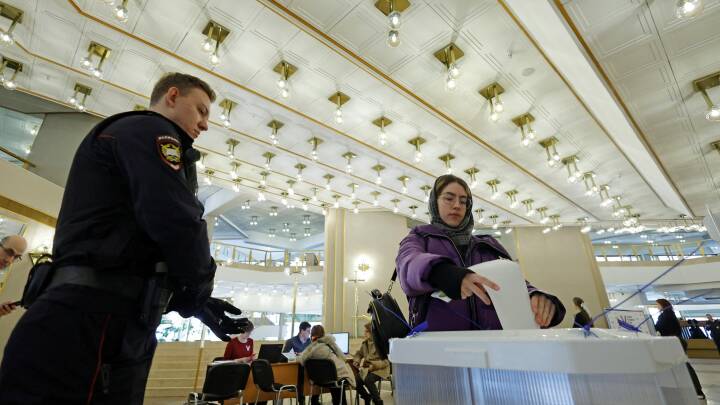
A woman is voting in Moscow today. (Photo: © MAXIM SHEMETOV, Ritzau Scanpix)
OFCamilla Markvardsen
Matilde Kimer efter droneangreb: Krigen er rykket helt taet pa russerne | Udland | DR
While Russians today have their last chance to vote in the presidential election, which is being called both a spectacle and a farce, the war in Ukraine has come close.
Russia has repeatedly accused Ukraine of trying to sabotage the presidential election with what it calls "terrorist activities".
And last night, 35 Ukrainian drones were intercepted in eight regions, according to Russian federal authorities, as well as drone strikes on the capital Moscow.
"Right now, videos are circulating from one of the largest international airports in Moscow, where you can hear the sound of a drone, an explosion and people obviously getting scared. For Muscovites, this means that the war has moved all the way into Russia, says DR's Russia correspondent, Matilde Kimer.
That experience stands in stark contrast to the authorities' narrative that the war in Ukraine is a distant mission, a so-called "special military operation."
- But this gives a somewhat different picture. Whether that will deter people from going down and voting against Putin is doubtful. I think many will see it as a call to go down and back the strong man who is able to defend Russia," Kimer said.
No serious opponents
There are no serious opponents to President Vladimir Putin in the elections, which is why Russian opposition figures have sent out a call to show up in protest at the polling stations at 12 noon.
READ TOO:Three days, four candidates and 93,920 polling stations: Understanding the Russian elections
What will or will happen remains to be seen. However, it is quite conceivable that the authorities will punish people for this, according to Matilde Kimer, who has not been allowed to enter Russia herself and therefore covers the election from Latvia.
"If you define it as an illegal assembly, you can arrest people for days. And yesterday we already saw a number of opposition figures arrested because they had called for an illegal assembly," she said.
Only three other candidates - all supporters of Russia's invasion of Ukraine - have been allowed to stand by the Russian electoral authorities.
At the same time, international election observers from the OSCE have not been allowed to monitor whether the elections are going smoothly.
-
17-03-2024, 05:31 PM #14941Thailand Expat
- Join Date
- May 2008
- Last Online
- @
- Posts
- 14,694
Medvedev: Russians protesting at polling stations are 'traitors' who support Ukraine
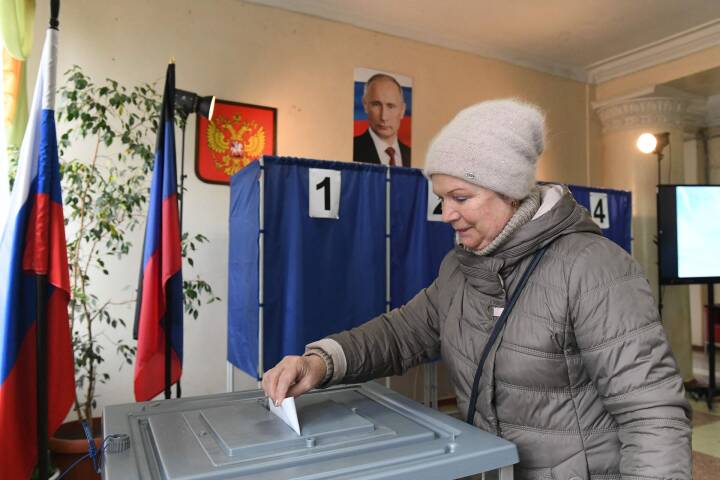
A woman votes in Donetsk in Russian-controlled Ukraine. © ( AFP/SCANPIX)
OF
Carsten Thomsen
Former Russian President Dmitry Medvedev lashed out at Russians who have protested and tried in various ways over the past day to prevent the presidential elections in Russia.
In Moscow, among other things, a woman set fire to a polling booth, while several others have poured paint into a ballot box. This has led to nine arrests around Russia.
Russian authorities in Saint Petersburg have also reported an attack on a polling station with a petrol bomb.
Medvedev calls them "traitors" who help Russia's enemies.
"This is direct support for the degenerates who are shelling our cities today," he said in a post on the social media site Telegram, referring to Ukrainian attacks.
-
17-03-2024, 05:34 PM #14942Thailand Expat
- Join Date
- May 2008
- Last Online
- @
- Posts
- 14,694
NEWS IN BRIEFI DAG KL. 04:46
Drone rain over several Russian regions tonight
OF
Sofie Dyjak
35 drones were shot down in eight different Russian regions last night.
This is reported by the state-controlled Russian media outlet RIA, among others.
"During March 17, the Kyiv regime's attempts to carry out terrorist attacks using UAVs against targets on the territory of the Russian Federation were stopped," the Russian Defense Ministry said in a statement.
Among other things, drones have been shot down around the Russian capital Moscow.
The city's mayor, Sergei Sobjanin, said on the messaging service Telegram.
Meanwhile, one person has died in a Ukrainian attempt to attack an oil refinery with drones in the Russian city of Slavyansk, in the Krasnodar region.
A fallen drone also caused a fire. It's off now.
83 people have been involved in extinguishing the fire.
It writes the emergency authority in the area on Telegram.
It is not possible for DR to verify the Russian accusations that the Ukrainians are behind it.
-
17-03-2024, 10:07 PM #14943Thailand Expat
- Join Date
- May 2008
- Last Online
- @
- Posts
- 14,694
Russians in Denmark queue at the Russian embassy to vote
Several have turned up to show dissatisfaction with President Vladimir Putin.
OF
Nanna Nørby Hansen
Russere i Danmark star i ko ved den russiske ambassade for at stemme | Indland | DR
There is a queue in front of the Russian embassy in Østerbro in Copenhagen today.
On the occasion of the Russian presidential election, Russians living in Denmark can cast their votes until 8 p.m. this evening.
The elections, which according to Claus Mathiesen, an expert in Russian and Ukrainian affairs, are more in the nature of an election rather than a real, democratic election, are also ending in Russia today.
The association Danish Friends of a Democratic Russia has also shown up at the embassy to conduct an exit poll of the referendum in Denmark.
Daria Wagner, chairwoman of the association, said two-thirds of those caught so far on their way out of the embassy had reported their votes.
There are some who have voted for Putin or the other candidates, while some have said that they have invalidated their vote by putting more crosses.
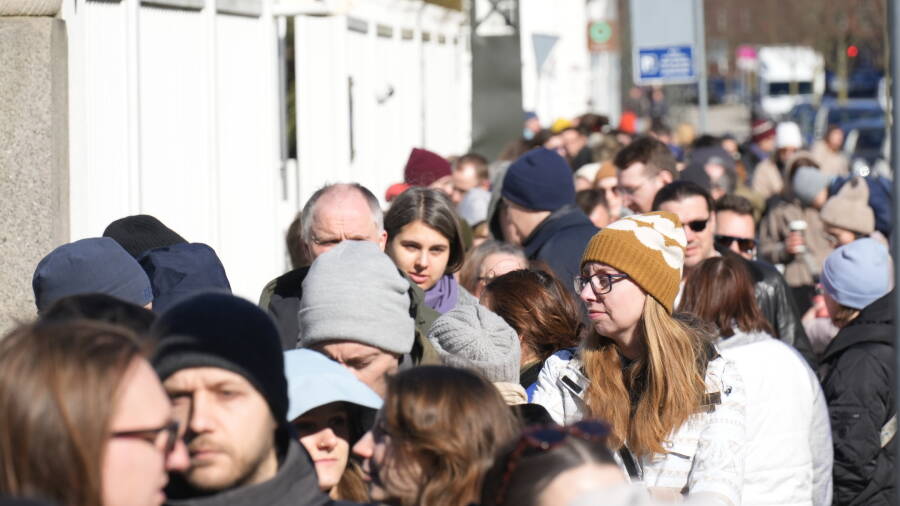
The queue in front of the embassy stretches down the road in Østerbro. (Photo: © Emil Helms, Ritzau Scanpix)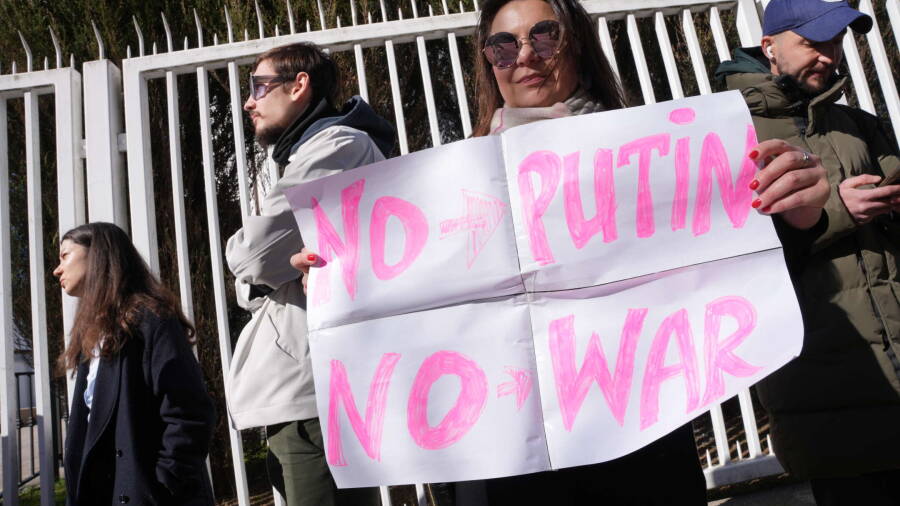
Several had turned up to show dissatisfaction with Vladimir Putin. (Photo: © Emil Helms, Ritzau Scanpix)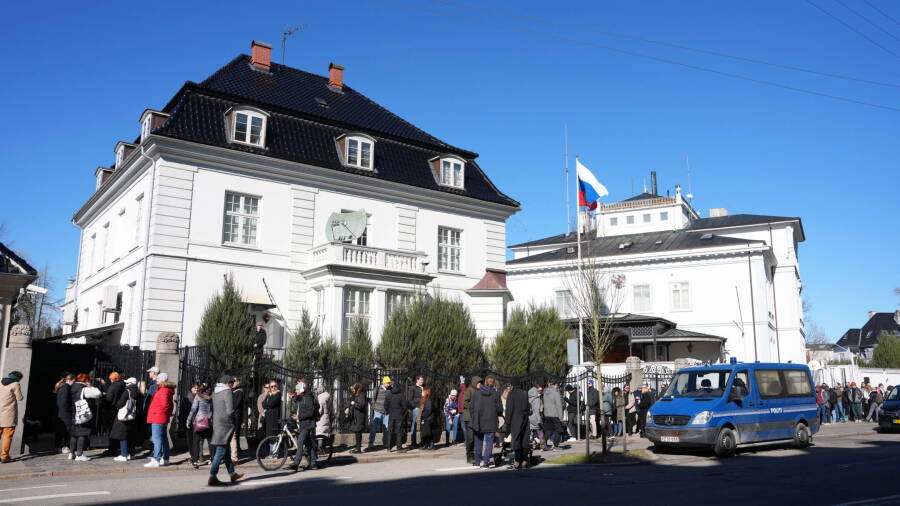
In addition to Vladimir Putin, the other candidates who have been allowed to stand all come from parties friendly to Putin's regime. All opposition figures who could have challenged President Putin are either imprisoned or in exile, the AP news agency said. (Photo: © Emil Helms, Ritzau Scanpix)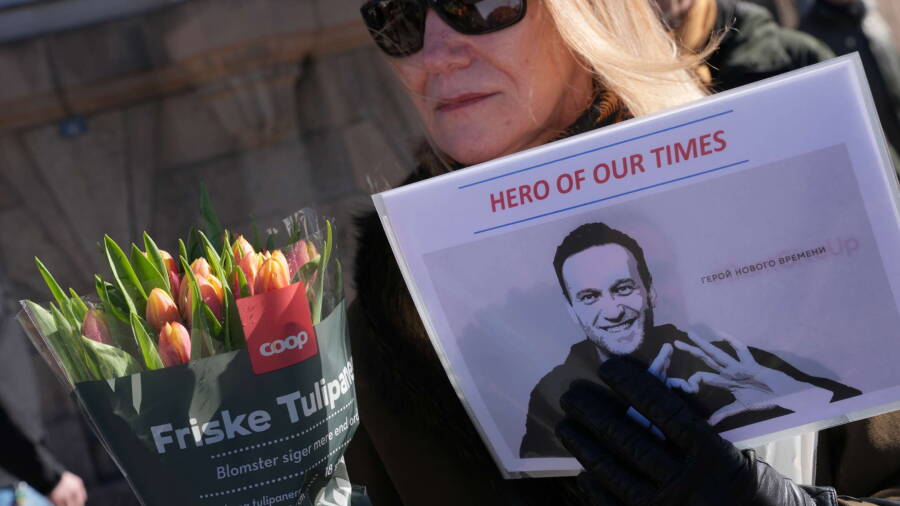
One person turned up with a picture of opposition politician Alexei Navalny, who died last month in a Russian penal colony at the age of 47. (Photo: © Emil Helms, Ritzau Scanpix)
The queue in front of the embassy stretches down the road in Østerbro. (Photo: © Emil Helms, Ritzau Scanpix)
One of those who has turned up to vote is Irina Nielsen, who has lived in Denmark since 2015.
Along with many others, she stood in line at the embassy at 12 o'clock, and the time was certainly no coincidence for Irina Nielsen.
Putin critics around the world have been urged by the opposition to show dissatisfaction with the current regime by, for example, invalidating the ballot paper.
"We don't have many other options to do anything. Neither when you are in Russia nor outside Russia. Putin now has so much power that you can't do much, she says.
"But this particular day and this time is an opportunity to show that you are against.
READ ALSO:Russia's last election day: Long lines and 47 Putin critics detained
Danish Friends of a Democratic Russia would have liked to observe the election inside the embassy, but they were not allowed to.
"Therefore, the exit poll is our only opportunity to see whether embassy figures will be sloppy or accurate, and we would like to know how Russians living here vote today," she said.
Daria Wagner herself has chosen to cast her vote, although she believes it is an insult to the concept to call it an election. Read why here.
-----------------------------------------------------------------------------------------------------------------------------------------------------------------
If I see an exitpoll, I'll post it
(if I like it )
-
17-03-2024, 10:51 PM #14944Elite Mumbler

- Join Date
- Apr 2008
- Last Online
- @
- Location
- Isolation
- Posts
- 8,846
^
You will now be referred to as Scandreth.
-
17-03-2024, 11:01 PM #14945Thailand Expat
- Join Date
- May 2008
- Last Online
- @
- Posts
- 14,694
Go right ahead Originally Posted by pickel
I try to put some Ukraine related stuff into a Dog House thread.
Any inputs from you ?
Or do you have to check with Justin Trudeau first ?

-
17-03-2024, 11:15 PM #14946Elite Mumbler
- Join Date
- Apr 2008
- Last Online
- @
- Location
- Isolation
- Posts
- 8,846
I should have included a
Then I could errantly say "whoosh".
-
17-03-2024, 11:18 PM #14947Thailand Expat
- Join Date
- May 2008
- Last Online
- @
- Posts
- 14,694
......
-
18-03-2024, 01:18 AM #14948Thailand Expat
- Join Date
- May 2008
- Last Online
- @
- Posts
- 14,694
Breaking breaking breaking
Read all about it
FOREIGN COUNTRY
Polling stations in Russia are now closed: Putin stands to get 87 percent of the vote
Putin gets his fifth term as Russian president.
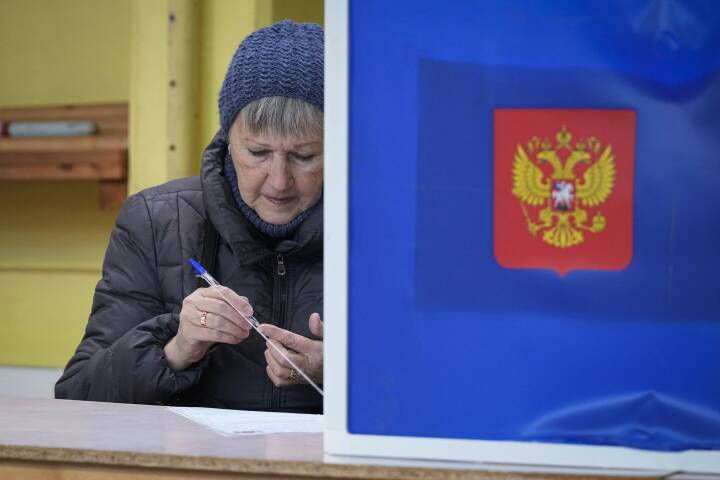
Russians abroad can continue voting until 20:00 local time. (Photo: © Dmitri Lovetsky, Associated Press)
OF
Tobias Leth Klinge
Valgstederne i Rusland er nu lukket: Putin star til at fa 87 procent af stemmerne | Udland | DR
All polling stations in Russia are now closed. The last ones, in western Russia, closed at 19:00 Danish time, and Putin is on his way to an expected big victory in the Russian presidential election.
A choice that is not described by many as a real choice.
The first exit poll shows Putin getting 87 percent of the vote. This gives Vladimir Putin his fifth term as Russian president.
Putin's goal was to get above 80 percent, and according to Charlotte Flindt Pedersen, director of the Danish Foreign Policy Society, it is "extremely important" for him to exceed that goal.
READ TOO:Russia's last election day: Long queues and 75 Putin critics detained
He must show that there is support from the population for the course he is taking with the war and isolation from the West.
And then he has to prove that there is support for the amendment to the constitution that allows him to run again.
The constitutional amendment Charlotte Flindt Pedersen refers to dates from 2020. It means Putin will be able to serve as president until 2036.
READ TOO:Russia connoisseur: 'The new constitution is not going to change much. On the contrary'
Without the change, Putin would not have been able to run in this year's elections at all, as he has already served four terms.
Protester verden over
Russian opposition politician Alexei Navalny's widow, Yulia Navalnaya, has urged voters to use the election to show opposition to Vladimir Putin by turning up at noon to create long queues and cast an invalid vote.
According to the dpa news agency, she herself wrote her deceased husband's name on the ballot paper when she cast her vote in exile in Berlin.
Throughout the day, quite a few people have heeded that call.
"No matter who we vote for, the result will be the same. The elections are purely symbolic. The state does what benefits the state, said a person who had turned up at a polling station in Novosibirsk.
In Copenhagen, Russians living in Denmark could vote at the Russian embassy. Dmitri Solevev did, among others. He had heeded the call and had turned up at noon, along with a host of others.
"It's about showing that not everyone supports that man in the Kremlin.
READ ALSO:Russians in Denmark queue at the Russian embassy to vote
And it has been a success for the opposition, according to Charlotte Flindt Pedersen.
"We have seen long queues from Vladivastok to Moscow and Saint Petersburg. The same has also been seen in a country such as Armenia.
Russians abroad can continue voting until 20:00 local time.

-
18-03-2024, 05:46 AM #14949Heading down to Dino's
- Join Date
- Jun 2009
- Last Online
- @
- Posts
- 35,438
Free and fair election. Originally Posted by helge

You are a fucking clown, Helga.
-
18-03-2024, 05:55 AM #14950Heading down to Dino's
- Join Date
- Jun 2009
- Last Online
- @
- Posts
- 35,438
Voting in Donetsk...
https://twitter.com/JayinKyiv/status...33983923306677

 Reply With Quote
Thread Information
Users Browsing this Thread
There are currently 2 users browsing this thread. (0 members and 2 guests)
