

For a millenium the askenazi heatland more jews than africa, germany, poland or entire mid east
Ukraine - European Jewish Congress
European Jewish Congresshttps://eurojewcong.org › CommunitiesIn the 1990s, many Ukrainian Jews emigrated to Israel. In spite of this Aliyah, the Jewish community of Ukraine is today the fifth largest in the world ..
The Ironies of History: The Ukraine Crisis through the Lens of Jewish History | Herbert D. Katz Center for Advanced Judaic Studies
History Is Not Destiny: Thoughts about the Russian War against Ukraine and the Jewish Past in the Region
Elissa Bemporad, Queens College and The CUNY Graduate Center
As a scholar of Eastern European Jewry, I am intimately familiar with some of the darkest pages in the history of the Jewish communities of Ukraine. I’ve recently written about the pogroms of the Russian Civil War, an exceptionally brutal conflict that broke out following the October Revolution of 1917 and lasted until 1921, between different armies and troops vying to control the territories of the former Russian Empire. Among them were Ukrainian troops, desperately struggling for independence against the Red Army. I’ve chronicled the violence experienced by many Jewish settlements west of the River Dnipro, as Ukrainian forces resented Jews for their alleged pro-Communist position, as saboteurs of the Ukrainian dream of independence.
The tragic pages that tell the story of more than 100,000 Jews murdered in the towns and cities of Ukraine during the civil war are preceded by other painful ones: the anti-Jewish violence perpetrated during the 1648–49 Cossack uprising led by Bohdan Khmielnitsky—and then, more than a century later, the massacres carried out by Ivan Gonta, as both leaders fought against the Polish-Lithuanian Commonwealth. Some of these pages have fortified Jewish collective memory for centuries, as Jewish identity and the history of these catastrophes became closely intertwined.
Other bouts of violence against the Jewish communities of Ukraine took place in the long nineteenth century, when waves of anti-Jewish pogroms occurred in the midst of extraordinary political upheaval: in 1881–82, unleashed by the assassination of Tsar Alexander II, and then in 1905, during the failed first Russian Revolution.
The culmination of the darkness came during World War II, when the Germans invaded the Soviet Union. With an estimated one and a half million Jews killed in Ukraine from June 1941–44, with thousands of Ukrainians assisting Germans in slaughtering their Jewish neighbors (deceived by the German promise of independence), the Holocaust remains the most somber page in the history of the Jews in the region. In his 1943 account the great writer Vasily Grossman described a Ukraine in which “there are no Jews. Nowhere—not in Poltava, Kharkov, Kremenchug, Borispol, not in Iagotin… Stillness. Silence. A people has been murdered.”[1]
It would, however, be an immeasurable distortion to reduce the history of the Jews in Ukraine to a narrative of pogroms-cum-Holocaust, imposing on the region a teleology of anti-Jewish violence. The towns and cities of Ukraine were far from being mere sites of destruction and suffering; most of the time they were places of coexistence, where Jews produced some of the greatest chapters in the history of Eastern European Jewish life, achieving a grandeur and originality in the spheres of culture, religious life, and politics, ranging from Hasidism and Hebrew poetry to Yiddish literature and Socialist Zionism.
The names of the same towns and cities that form such an important part of the Eastern European Jewish past have been resounding consistently in the media since February 24, 2022, when Russia launched a full-scale invasion of Ukraine: Uman, Cherkasy, Kyiv, Dnipro, Odessa, Zhytomir, Lviv, Chernivtsy. The horrific war of aggression against the independent state of Ukraine, which is but the latest link in the chain of Russian and Soviet imperialism, as well as a continuation of Putin’s war of 2014 that resulted in Russia’s annexation of Crimea, is having a deep effect on Jewish life and history. The war, which has already triggered the greatest refugee crisis in Europe since World War II, with its indiscriminate shelling of civilians, also affects the approximately 100,000 Jews living in Ukraine today.
When reading accounts about Ukrainians taking refuge in a mikvah in Uman together with their Jewish neighbors, or about Hasidic Jews taking up arms to defend their country alongside Ukrainian soldiers, one might be tempted to explain all this by calling attention to a common enemy, which can eliminate preexisting tensions and heal the wounds of the past. But the truth is that following the collapse of the Soviet Union, Ukraine has not only become the most democratic state in the post-Soviet landscape outside of the Baltics, it has also inaugurated a new chapter in the Jewish history of the region, reminding us that history evolves and should not always be written through the specter of the violence of the past.
The peak of this evolution over the past thirty years has been the democratic election of a Jewish president, Volodymir Zelensky, who in 2019 won with an overwhelming majority of 73 percent of the votes—something implausible in any other country in Eurasia—and whose Jewishness was never instrumentalized by his political opponents in Ukraine, but only recently by Putin and his puppet government in Belarus. Zelensky not only passed a law against antisemitism, which was approved by the Ukrainian Parliament in the fall of 2021, but also dedicated the Ukrainian government’s support to fund a memorial complex at Babyn Yar, the site of the single largest massacre in the history of the Holocaust. The site was neglected and abused for decades under the Soviets, and has recently been damaged by the Russians in their indiscriminate shelling. While antisemitism does exist in Ukraine today, all things considered, life might be more dangerous for Jews in American cities than Ukrainian ones.
I’ve visited Ukraine multiple times over the course of twenty years, to conduct archival research and teach, and have come to appreciate these changes by engaging with the wonderful scholarly communities of students in Kyiv and Lviv. Siding with Ukraine today does not entail in any way dismissing or forgetting the dark pages of anti-Jewish violence in the region. It is rather a reminder that we can start turning those pages, writing new ones in the book of the Jews of Ukraine.
Results 14,126 to 14,150 of 15707
Thread: Ukraine war mega thread
-
04-09-2023, 05:04 AM #14126Thailand Expat



- Join Date
- Aug 2011
- Last Online
- @
- Location
- Fuente del Berro
- Posts
- 27,925
 Originally Posted by harrybarracuda

-
04-09-2023, 05:09 AM #14127Thailand Expat

- Join Date
- May 2008
- Last Online
- @
- Posts
- 14,694
And Ukraine has issued postal stamps with the leader and head-murderer, Bandera. Originally Posted by david44
(just thought that your article lacked that little detail)
Bon appetit
-
04-09-2023, 05:10 AM #14128Thailand Expat
- Join Date
- Aug 2011
- Last Online
- @
- Location
- Fuente del Berro
- Posts
- 27,925
Despite aliyah for older ashkenazis, the pale, Belarus Rhyz Ruthenia, Podolia, Masuria, Memel,Karkhiv and Odeca were the core it is still is real, even if Putin's 'denazification' claim isn'tNot acknowledging this threat means that little is being done to guard against it.
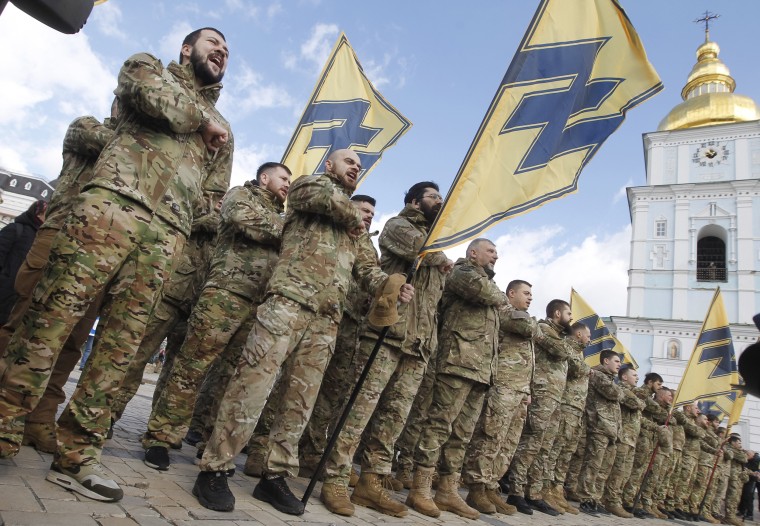
Ukrainian veterans of the Azov Battalion, formed by a white supremacist and banned from receiving U.S. aid, attend a rally in Kyiv on March 14, 2020.Vladimir Sindeyeve / NurPhoto via Getty Images
March 5, 2022, 10:38 AM GMT
By Allan Ripp
Of the many distortions manufactured by Russian President Vladimir Putin to justify Russia’s assault on Ukraine, perhaps the most bizarre is his claim that the action was taken to “denazify” the country and its leadership. In making his case for entering his neighbor’s territory with armored tanks and fighter jets, Putin has stated that the move was undertaken “to protect people” who have been “subjected to bullying and genocide,” and that Russia “will strive for the demilitarization and denazification of Ukraine.”
Putin’s destructive actions — among them the devastation of Jewish communities — make clear that he’s lying when he says his goal is to ensure anyone’s welfare.
On its face, Putin’s smear is absurd, not least because Ukrainian President , especially from a leader who favors disinformation campaigns and wants to stir up feelings of national vengeance against a WWII foe to justify conquest.
But even though Putin is engaging in propaganda, it’s also true that Ukraine has a genuine Nazi problem — both past and present. Putin’s destructive actions — among them the devastation of Jewish communities — make clear that he’s lying when he says his goal is to ensure anyone’s welfare. But important as it is to defend the yellow-and-blue flag against the Kremlin’s brutal aggression, it would be a dangerous oversight to deny Ukraine’s antisemitic history and collaboration with Hitler’s Nazis, as well as the latter-day embrace of neo-Nazi factions in some quarters.
Related
 OPINION
Why are fleeing Ukrainians being talked about with such sympathy? They are white.
On the eve of World War II, Ukraine was home to one the . Soon after, nearly 34,000 Jews — along with Roma and other “undesirables” — were rounded up and marched to fields outside the city on the pretext of resettlement only to be massacred in what became known as the “Holocaust by bullets.”
The at the site.
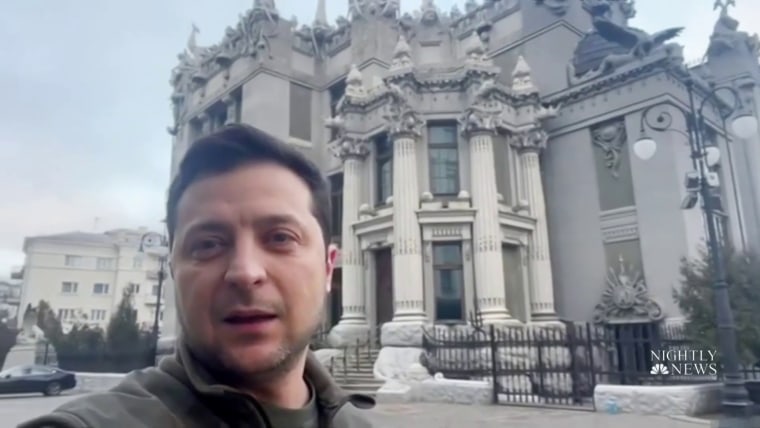
Who is President ZelenskyyNowadays, Ukraine counts between 56,000 to 140,000 Jews, who enjoy freedoms and protections never imagined by their grandparents. That includes an updated law passed last month criminalizing antisemitic acts. Unfortunately, the law was intended to address a pronounced uptick in public displays of bigotry, including swastika-laden vandalism of synagogues and Jewish memorials, and eerie marches in Kyiv and other cities that celebrated the Waffen SS.
In another ominous development, Ukraine has in recent years erected a glut of statues honoring Ukrainian nationalists whose legacies are tainted by their indisputable record as Nazi proxies. The Forward newspaper cataloged some of these deplorables, including Stepan Bandera, leader of the Organization of Ukrainian Nationalists (OUN), whose followers acted as local militia members for the SS and German army. “Ukraine has several dozen monuments and scores of street names glorifying this Nazi collaborator, enough to require two separate Wikipedia pages,” the Forward wrote.
.
Another frequent honoree is Roman Shukhevych, revered as a Ukrainian freedom fighter but also the leader of a feared Nazi auxiliary police unit that the Forward notes was “responsible for butchering thousands of Jews and … Poles.” Statues have also been raised for Yaroslav Stetsko, a one-time chair of the OUN, who wrote “I insist on the extermination of the Jews in Ukraine.”
-
04-09-2023, 05:11 AM #14129Thailand Expat
- Join Date
- Aug 2011
- Last Online
- @
- Location
- Fuente del Berro
- Posts
- 27,925
patience read next post Originally Posted by helge
-
04-09-2023, 05:21 AM #14130Thailand Expat
- Join Date
- May 2008
- Last Online
- @
- Posts
- 14,694
Done Originally Posted by david44
Quarters like the ukranian postal service ? Originally Posted by david44
How boring and ordinary
Paid for and approved of by the official Ukraine ? Originally Posted by david44
Thanks for the articles
-
04-09-2023, 05:25 AM #14131Thailand Expat
- Join Date
- Oct 2019
- Last Online
- @
- Posts
- 12,608
West Ukrainians were bullshitted into provoking a fight they never had a chance of winning. And sweet-talked by every possible means into sacrificing themselves to the last. Russia the aggressor, sanctions will destroy Russia, Western wunderwaffen, and so on.
But ultimately it's on them. They live in a separate informational reality of their own making (well represented here by Bsnub) and have done for some decades by now, and neither their elites robbing and impoverishment of their resource-rich and once economically advanced country, nor the nationalists' barbarity, nor the lopsided losses in the current war have clued most of them in as yet. They need to take a sober look at things and the sooner the better.
-
04-09-2023, 03:01 PM #14132Heading down to Dino's

- Join Date
- Jun 2009
- Last Online
- @
- Posts
- 35,412
Except that they are winning. Taking territory every day. The ruzzians have been getting their teeth kicked in for months now. Originally Posted by Backspin
Separate from your kremlin propaganda echo chamber, you vatnik retard. What you are spewing as usual is nothing more than spoon-fed ruzzian propaganda, but you are too stupid to realize it. Originally Posted by Backspin
That applies to the ruzzians so well said. They have been getting their shit packed in for months. Too bad they are just as stupid as you are. When Tokmak is liberated soon, I am sure you will disappear again like you always do when ruzzia is getting its ass kicked. Your entire post reeks of the desperation and panic that is being posted on ruzzian telegram channels right now. Originally Posted by Backspin
It is getting bleak for you vatnik.
-
04-09-2023, 04:19 PM #14133Thailand Expat

- Join Date
- Jan 2016
- Last Online
- @
- Location
- Palace Far from Worries
- Posts
- 14,962
I thought this was good, an unbiased assessment of the state of play in the War. Apologies I haven't been around much, just busy with work and coaching the Boys with their sports.
-
04-09-2023, 10:40 PM #14134Thailand Expat

- Join Date
- Nov 2008
- Last Online
- Today @ 07:55 PM
- Location
- Berlin Germany
- Posts
- 7,494
If nothing else were wrong, Ukraine did not provoke a fight. They were brutally invaded and fought back. Originally Posted by Backspin
-
04-09-2023, 11:47 PM #14135Thailand Expat
- Join Date
- May 2008
- Last Online
- @
- Posts
- 14,694
Oh dear; you shouldn't have posted that. Originally Posted by David48atTD
I fear I would be dissapointed. An "unbiased assessment" ?
Would be the first one...from all sides
Welcome back, David Originally Posted by David48atTD
-
05-09-2023, 11:47 PM #14136Thailand Expat

- Join Date
- Feb 2011
- Last Online
- Today @ 10:06 AM
- Location
- In the EU
- Posts
- 13,763
First Challenger 2 tank destroyed today. Not sure of exact location but appears to have been on the front line and may have been hit by artillery fire. Any further info Snubs?
The Russians are still managing to hold their lines, albeit under a lot of pressure. I think Tokmak may be out of reach for this counteroffensive.
I can't see either side backing down, so it's going to continue to be a long a brutal war until one side runs out of troops.
-
06-09-2023, 01:20 AM #14137Thailand Expat
- Join Date
- May 2008
- Last Online
- @
- Posts
- 14,694
Remember when the Centurion was top of the pops ? Originally Posted by Troy
Rolls Royce Centurion V12, 27 Litre Engine starting up - Bing video
-
06-09-2023, 01:28 AM #14138Thailand Expat
- Join Date
- Feb 2011
- Last Online
- Today @ 10:06 AM
- Location
- In the EU
- Posts
- 13,763
^ Make Smoke!!!
I was just surprised it was caught in the open during the day. Thought it would be making use of superior night optics to move position and long range anti armour duties.
-
06-09-2023, 01:34 AM #14139Thailand Expat
- Join Date
- Feb 2011
- Last Online
- Today @ 10:06 AM
- Location
- In the EU
- Posts
- 13,763
^ Or was it because ISW stated they wouldn't accept Russian front lines had been breaxhwd until there was evidence of heavy armour being observed in the area.
It wouldn't be the first time political points have come before sensible military tactics.
-
06-09-2023, 01:54 AM #14140Thailand Expat
- Join Date
- May 2008
- Last Online
- @
- Posts
- 14,694
Outside Robotyna Originally Posted by Troy
3 mins in
-
06-09-2023, 06:31 AM #14141Thailand Expat
- Join Date
- Oct 2019
- Last Online
- @
- Posts
- 12,608
If they recognized Minsk 1 or 2, they'd still have the Donbass. If they refused to fight , the only thing they would have lost was the Donbass. A Russophone population that the west Ukraine partisans hate anyway. But since they decided to fight , they also lost Kherson and Zaporizhzhia. The more they fight , the smaller the country gets. Originally Posted by Takeovers
But the fighting and the propaganda gave young men who grew up in a failed state , a sense of purpose. It is all very sad indeed.
-
06-09-2023, 07:28 AM #14142Heading down to Dino's
- Join Date
- Jun 2009
- Last Online
- @
- Posts
- 35,412
You fucking epic scale moron, take your propaganda horseshit and shove it up your ass. Everything in that post is pure kremlin talking point bullshit. Originally Posted by Backspin
-
06-09-2023, 07:35 AM #14143Heading down to Dino's
- Join Date
- Jun 2009
- Last Online
- @
- Posts
- 35,412
It was outside Verbove. Where the Ukrainians are making a deep push and reportedly have breached the third line. They have pushed so far south that the ruzzians in Novoprokopika could possibly be getting rolled up. Originally Posted by Troy
I disagree. Originally Posted by Troy
No way of knowing what time of day it was destroyed. But these things happen. Originally Posted by Troy
-
06-09-2023, 07:36 AM #14144Heading down to Dino's
- Join Date
- Jun 2009
- Last Online
- @
- Posts
- 35,412
ROBOTYNE-VERBOVE / UKR forces have taken control of Russian defensive positions between Robotyne and Verbove. RU reported to have committed reserves. UKR counter-battery fire effective.
-
06-09-2023, 08:42 AM #14145Thailand Expat
- Join Date
- Mar 2013
- Last Online
- @
- Location
- Last but who gives a shit.
- Posts
- 13,587
I sure do. I was in the last British regiment to have them. It was the 'Royal Hussars' based at Tidworth, Hamp[shire. The Centurion was the tank that defeated the Egyptians in the 6 day war. The Centurion was replaced by the crap/useless diesel powered 'Chieftain'. Originally Posted by helge
I also had the pleasure of working on the then, Chobham armour trials, mid 70's, at AW/MVEE Kirkcudbright, Scotland for 5 years. No tank is bullet proof.
-
06-09-2023, 08:49 AM #14146Heading down to Dino's
- Join Date
- Jun 2009
- Last Online
- @
- Posts
- 35,412
Don’t Let Russia Fool You About the Minsk Agreements
Once again, I will post the same article I did last time you posted this lie. Of course none of this matters now because Ukraine is in the process of liberating its territory under force of arms, but exposing your lies is important... Originally Posted by Backspin
Following US President Joe Biden’s phone call with Russian President Vladimir Putin on December 7, there is a renewed focus on the implementation of the Minsk Agreements as a way of defusing the current Russian military build-up and finding a lasting settlement of Russia’s war in eastern Ukraine.
Minsk is deeply flawed and open to wildly different interpretations. So, the positions of Germany and France (which were midwives to the deal), and especially of the United States are of critical importance in preventing Russia from imposing a unilateral interpretation of the Agreements in ways that were never agreed by Ukraine.
Despite their flaws, however, the Minsk Agreements are essential to the current diplomatic process surrounding Ukraine for two reasons: First, they are the most recent formal, written document to which Russia has subscribed, which affirms Ukraine’s sovereignty and territorial integrity; second, Russia’s failure to implement the deal is the basis for keeping EU sanctions in place against Russia. These sanctions must be sustained and strengthened if there is any hope of persuading Russia to end the war.
If the implementation of Minsk is to be given a fresh impetus in international diplomacy under the Biden Administration and a new German government, it is important to debunk Russian disinformation about the Agreements and reiterate exactly what they mean.
There are several key points:
1. There are two Minsk Agreements, not just one. The first “Minsk Protocol” was signed on September 5, 2014. It mainly consists of a commitment to a ceasefire along the existing line of contact, which Russia never respected. By February 2015, fighting had intensified to a level that led to renewed calls for a ceasefire, and ultimately led to the second Minsk Agreement, signed on February 12, 2015. Even after this agreement, Russian-led forces kept fighting and took the town of Debaltseve six days later. The two agreements are cumulative, building on each other, rather than the second replacing the first. This is important in understanding the importance, reflected in the first agreement, of an immediate ceasefire and full monitoring by the Organization for Security and Cooperation in Europe (OSCE), including on the Ukraine-Russia border, as fundamental to the subsequent package of agreements.
2. Russia is a Party to the Minsk Agreements. The original Minsk signatories are Russia, Ukraine, and the OSCE. Russia is a protagonist in the war in Ukraine and is fully obliged to follow the deal’s terms. Despite that, however, Russia untruthfully claims not to be a party and only a facilitator — and that the real agreements are between Ukraine and the so-called “separatists,” who call themselves the Luhansk and Donetsk Peoples’ Republics (LPR and DPR), but are in fact Russian supplied and directed.
3. The LPR and DPR are not recognized as legitimate entities under the Minsk Agreements. The signatures of the leaders of the so-called Luhansk and Donetsk Peoples’ Republics were added after they had already been signed by Ukraine, Russia, and the OSCE. They were not among the original signatories, and indeed Ukraine would not have signed had their signatures been part of the deal. There is nothing in the content or format of the Agreement that legitimizes these entities and they should not be treated as negotiating partners in any sense. Russia alone controls the forces occupying parts of eastern Ukraine.
4. Russia is in violation of the Minsk Agreements. The deals require a ceasefire, withdrawal of foreign military forces, disbanding of illegal armed groups, and returning control of the Ukrainian side of the international border with Russia to Ukraine, all of this under OSCE supervision. Russia has done none of this. It has regular military officers as well as intelligence operatives and unmarked “little green men” woven into the military forces in Eastern Ukraine. The LPR and DPR forces are by any definition “illegal armed groups,” that have not been disbanded. The ceasefire has barely been respected by the Russian side for more than a few days at a time.
5. Russian-led forces prevent the OSCE from accomplishing its mission in Donbas as spelled out in the Minsk Agreements. It is an unstated irony in Vienna — understood by every single diplomatic mission and member of the international staff — that Russia approves the mandate of the OSCE Special Monitoring Mission (SMM) in Ukraine when it votes in Vienna, but then blocks implementation of that same mission on the ground in Ukraine. Because Russia is a member of the OSCE, and the SMM wants to preserve what little access it has to the occupied territories, the mission is guarded in what it says about ceasefire violations and restrictions on its freedom of movement. Privately, however, they acknowledge that some 80% of such violations and restrictions come from the Russian-controlled side of the border, and those that occur on the Ukrainian side are largely for safety reasons (e.g., avoiding mined approaches to bridges.)
Don’t Let Russia Fool You About the Minsk Agreements - CEPA
-
06-09-2023, 09:38 AM #14147hangin' around

- Join Date
- Oct 2006
- Last Online
- @
- Location
- Home
- Posts
- 41,075
Must be some new type of 'importance'. Originally Posted by bsnub

-
06-09-2023, 10:10 AM #14148Heading down to Dino's
- Join Date
- Jun 2009
- Last Online
- @
- Posts
- 35,412
#Russian sources continue to complain that Russian forces lack sufficient counterbattery capabilities and artillery munitions in the face of ongoing UKR counteroffensive activities, which the #Kremlin & the Russian MoD are reportedly attempting to combat. https://isw.pub/UkrWar090523
https://twitter.com/TheStudyofWar/st...18354681028652
-
06-09-2023, 10:27 AM #14149Thailand Expat

- Join Date
- Nov 2005
- Last Online
- @
- Location
- Jomtien
- Posts
- 11,947
Yowza … when did this thread get Doghoused?
-
06-09-2023, 02:06 PM #14150Thailand Expat
- Join Date
- Feb 2011
- Last Online
- Today @ 10:06 AM
- Location
- In the EU
- Posts
- 13,763
^^ My experience has been that if someone is still cimplaining then they still care and will continue to perform as best they can. When they stop complaining, then they're defeated and all is lost.


 Reply With Quote
Thread Information
Users Browsing this Thread
There are currently 1 users browsing this thread. (0 members and 1 guests)
