
Scientists discover gene that decides whether to 'switch on' immune system and could control HIVPUBLISHED: 14:58 GMT, 27 November 2012 | UPDATED: 15:50 GMT, 27 November 2012
- Gene, called Arih2, makes decides whether to switch on the immune response to an infection
- Researchers are looking at the effect on the immune response of switching gene off for short periods
- Say it has potential to help treat chronic conditions
A newly discovered gene could hold the key to treating and potentially controlling chronic infections such as HIV, hepatitis and tuberculosis. The gene, called Arih2, is essential for embryo survival. Now scientists have found it controls the function of the immune system – making critical decisions about whether to switch on the immune response to an infection.It could help in the development of treatments for infections that 'overwhelm' the immune system like HIV as well as conditions that cause chronic inflammation such as rheumatoid arthritis.
Dr Marc Pellegrini (left) and Dr Greg Ebert were part of a research team that discovered a gene which is essential to the immune response to infection
The gene was discovered in dendritic cells by a team from the Walter and Eliza Hall Institute in Australia. These cells act as an early warning system raising the alarm if they detect foreign invaders. 'Arih2 is responsible for the most fundamental and important decision that the immune system has to make - whether the immune response should be initiated and progressed or whether it should be switched off to avoid the development of chronic inflammation or autoimmunity,' research leader Dr Marc Pellegrini, said.'If the wrong decision is made, the organism will either succumb to the infection, or succumb to autoimmunity.'
Dr Pellegrini said although our immune system works well against many infections, some organisms have developed mechanisms to evade or counteract the immune system, allowing them to persist in the body.
'During evolution, some organisms have evolved ways of exhausting our immune system to the point where the immune system just switches off, and this is what happens in HIV, hepatitis B and tuberculosis,' he said. 'These organisms counter the immune response – exhausting T cells which are stimulated over and over again by the infection and becoming exhausted or paralysed. 'With this current discovery, what we should be able to do is circumvent these mechanisms and reinvigorate the immune response temporarily to boost the immune system and help clear these infections.'Dr Greg Ebert said the research team was now looking at the effect on the immune response of switching off Arih2 for short periods of time during chronic infections. 'We are investigating how manipulating Arih2 and associated pathways promotes immunity in chronic overwhelming infections, where we know the immune response is inadequate,' he said.
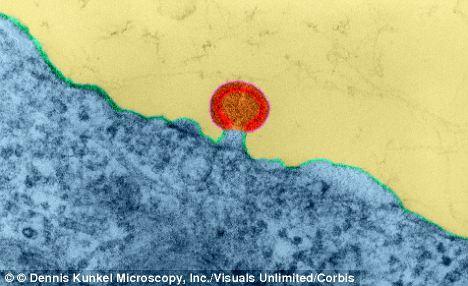
HIV budding in human lymphatic tissue. The new gene discovery could pave the way for new treatments for the precursor to AIDS
He said Arih2 had significant promise as a drug target. 'Arih2 has a unique structure, which we believe make it an excellent target for a therapeutic drug, one that is unlikely to affect other proteins and cause unwanted side-effects,' Dr Ebert said. 'Because Arih2 is critical for survival, we now need to look at the effect of switching off the gene for short periods of time, to see if there is a window of opportunity for promoting the immune response to clear the infection without unwanted or collateral damage or autoimmunity.'Dr Pellegrini said they were very excited about their discovery but it would take many years to translate the discovery to a drug that could be used in humans.However, he added: 'It is probably one of the few genes and pathways that is very targetable and could lead to a drug very quickly.'The study was supported by the National Health and Medical Research Council of Australia and the Victorian Government.
Read more: Gene discovered that decides whether to 'switch on' immune system and could control HIV | Mail Online


Results 1 to 21 of 21
-
30-11-2012, 09:01 AM #1I am in Jail


- Join Date
- Aug 2012
- Last Online
- 11-07-2014 @ 08:15 PM
- Location
- quarantine
- Posts
- 2,919
Scientists discover gene that decides whether to 'switch on' immune system and could
Last edited by alitongkat; 30-11-2012 at 09:08 AM.
-
30-11-2012, 09:05 AM #2Have you got any cheese


- Join Date
- Jan 2006
- Last Online
- @
- Location
- Mousehole
- Posts
- 20,893
This from an English newspaper. Originally Posted by alitongkat
As bad as the Bangkok Post.
-
30-11-2012, 04:31 PM #3I am in Jail
- Join Date
- Aug 2012
- Last Online
- 11-07-2014 @ 08:15 PM
- Location
- quarantine
- Posts
- 2,919
the arih2-gene...
ARIH2 - Wikipedia, the free encyclopedia
nothing found, how to INCREASE that protein (by herbs), but a very good info on increasing/metabolism of TOTAL proteins...
Herbs for the Liver
The liver plays a key role in protein metabolism, converting toxic ammonia into more benign urea so that protein may be metabolized and either utilized by the cells immediately for energy, or converted into energy reserves in the form of glucose, or carbohydrates, and lipids, or fats. Among the more common of the hepatic herbs, or those with a tonic effect on the liver, are agrimony, balm, cascara sagrada, celery, cleavers, fennel, horseradish, hyssop, motherwort, prickly ash, yarrow and yellow dock. Bitters like wormwood, golden seal and gentian are also said to benefit the liver's metabolic functions.
Herbs for the Pancreas
The pancreas secretes digestive enzymes that help metabolize dietary macronutrients, including protein, in the small intestines. According to the University of Maryland, herbs that support pancreatic health include cat's claw, grape seed, green tea, holy basil, rhodiola and Indian gooseberry. Certain Chinese herbs that may support the pancreas include Asian ginseng, cinnamon Chinese bark, as well as ginger, licorice and peony roots.
Herbs for the Kidneys
A common characteristic of kidney disease is trouble with blood protein synthesis. A 1995 study on nephrotic patients, or individuals with kidney disease, published in the "Chinese Journal of Internal Medicine" found that two common herbs in Chinese medicine, dong quai, otherwise known as angelica, and astragali, when combined with a high-protein diet, could facilitate improvement in a protein metabolism disorder and raise blood protein levels by increasing protein synthesis.
Ayurvedic Herbs
In Indian ayurvedic medicine, the herbs amalaki rasayan and chyawanprash are often used for their anabolic effects, including promoting protein synthesis. Amalki rasayan, or Emblica officinalis, also known as amla, is said to stimulate protein metabolism and increase total serum protein levels at the expense of fats, encouraging the creation of lean muscle mass. A clinical trial on the use of chyawanprash to improve the immune status of patients with recurring cold and cough symptoms confirmed that it raises total protein levels, another product of anabolic protein synthesis.
-
30-11-2012, 04:39 PM #4I am in Jail
- Join Date
- Aug 2012
- Last Online
- 11-07-2014 @ 08:15 PM
- Location
- quarantine
- Posts
- 2,919
even though, its about improvement of the immune system, i cant see this gene any helpful in elmination of parasitic infections, as malaria or toxoplasmosis...
those parasites, once infected, are impossible to be killed within their host (without killing the host...)...
though, the parasite in the blood can be destroyed (by that gene manipulation), but they breed heavily when the going gets tough and there is nothing that does kill the cysts...Last edited by alitongkat; 30-11-2012 at 04:54 PM.
-
30-11-2012, 06:00 PM #5euston has flown
- Join Date
- Jun 2009
- Last Online
- 10-06-2016 @ 03:12 AM
- Posts
- 6,978
Him, tough call on the bkk post mail thing. However look on the bright side, it's got a photo HIV to wind up git Originally Posted by Thetyim

-
30-11-2012, 06:07 PM #6Thailand Expat

- Join Date
- Aug 2007
- Last Online
- @
- Posts
- 1,411
Embryo Survival Gene May Fight Range Of Diseases: Study
Tan Ee Lyn
(Reporting by Tan Ee Lyn; Editing by Nick Macfie)
11/26/2012

HONG KONG (Reuters) - A gene that keeps embryos alive appears to control the immune system and determine how it fights chronic diseases like hepatitis and HIV, and autoimmune diseases like rheumatoid arthritis, scientists said on Monday.
Although the experts have only conducted studies on the gene Arih2 using mice, they hope it can be used as a target for drugs eventually to fight a spectrum of incurable diseases.
Lead author Marc Pellegrini at the Walter and Eliza Hall Institute of Medical Research in Australia said the gene appears to act like a switch, flipping the immune system on and off.
"If the gene is on, it dampens ... the immune response. And if you switch it off, it greatly enhances immune responses," Pellegrini said in a telephone interview.
"It is probably one of the few genes and pathways that is very targetable and could lead to a drug very quickly."
Arih2 was first identified by another group of scientists in the fruit fly but it drew the interest of Pellegrini's team because of its suspected links to the immune system.
In a paper published in Nature Immunology, Pellegrini and his team described how mice embryos died when the gene was removed.
Next, they removed the gene from adult mice and noticed how their immune systems were boosted for a short period of time. But it quickly went into an overdrive and started attacking the rodents' own healthy cells, skin and organs.
"The mice survived for six weeks quite well. Then they started developing this very hyperactive immune responses and if you leave it for too long, it starts reacting against the body itself," Pellegrini said.
Pellegrini and his colleagues hope that scientists can study the gene further and use it as a drug target to fight a large spectrum of diseases.
"It's like an accelerator. In infectious diseases, you want to slam on the brakes on this gene, and for autoimmune diseases, you want to push the accelerator to make it work much harder to stop the whole immune response," said Pellegrini.
"The more the gene works, the less of an immune response there is. And the less active the gene is, the more the immune response is."
huffingtonpost.com
-
30-11-2012, 06:08 PM #7Thailand Expat
- Join Date
- Aug 2007
- Last Online
- @
- Posts
- 1,411
..... Originally Posted by huffingtonpost.com
-
30-11-2012, 06:14 PM #8I am in Jail
- Join Date
- Aug 2012
- Last Online
- 11-07-2014 @ 08:15 PM
- Location
- quarantine
- Posts
- 2,919
that it does do in humans what it does do in mice (on the immune system) they knew already...
extremely likely it will be therapy for humans
-
30-11-2012, 06:21 PM #9I am in Jail
- Join Date
- Aug 2012
- Last Online
- 11-07-2014 @ 08:15 PM
- Location
- quarantine
- Posts
- 2,919
its really all a bit difficult to understand... Originally Posted by Mid
if you have an infection (chronic), then a lot of people take anti-histamines, what should have a similar (allegedly "positive") effect as shutting down the gene (?) ... or taking an anti-histamine would follow basically the same logic as shutting down the gene...(?)
but all that shut-down doesnt change the fact, that you DO HAVE an infection...
shutting down the gene would just help, to prevent the (killer etc)-cells from wearing down and developing autoimmune diseases, "but something" has to attack the infection... ?
-
30-11-2012, 06:27 PM #10Thailand Expat

- Join Date
- Nov 2005
- Last Online
- @
- Posts
- 22,684
Are you sure you dont mean antibiotics? Originally Posted by alitongkat
I dont mean to stalk you at all. But damn you post some weird shit, and in general dont read other posts the post without reading let alone editing what you post. Please, I know you are trying hard. Try harder.
-
30-11-2012, 06:29 PM #11Thailand Expat
- Join Date
- Aug 2007
- Last Online
- @
- Posts
- 1,411
cite , link or wishful thinking ? Originally Posted by alitongkat
I'll take wishful thinking for 50 thanxs Originally Posted by alitongkat

-
30-11-2012, 07:57 PM #12I am in Jail
- Join Date
- Aug 2012
- Last Online
- 11-07-2014 @ 08:15 PM
- Location
- quarantine
- Posts
- 2,919
its about human embryos... Originally Posted by Mid
-
30-11-2012, 09:27 PM #13Thailand Expat

- Join Date
- Jun 2005
- Last Online
- 08-09-2014 @ 10:43 AM
- Location
- Simian Islands
- Posts
- 34,827
Idiot. Originally Posted by alitongkat
-
01-12-2012, 01:10 AM #14euston has flown
- Join Date
- Jun 2009
- Last Online
- 10-06-2016 @ 03:12 AM
- Posts
- 6,978
Given that just a few years ago some healthy people were given a drug that was supposed to suppress part if their immune system, as it had done very safly in all the prior animal testing. As a result of this dose, one gent died, the rest ended up in intensive care and now how to worry about a serious risk of cancer for e rest of their lives.... As a result of this drug stimulating their immune systems to the point of killing them.
I suspect it's going to be a very very long time before anything in the op gets anywhere near a human
-
01-12-2012, 08:18 AM #15I am in Jail
- Join Date
- Aug 2012
- Last Online
- 11-07-2014 @ 08:15 PM
- Location
- quarantine
- Posts
- 2,919
sorry hazz, what did the drug?
suppress or (over)stimulate the immune system?
its a bit contradictory, our post...
-
01-12-2012, 02:33 PM #16euston has flown
- Join Date
- Jun 2009
- Last Online
- 10-06-2016 @ 03:12 AM
- Posts
- 6,978
and there in is the problem.... which is why its very unlikely that any drugs that modify immune system behaviour are going to be tested on humans in the near to medium term
-
01-12-2012, 03:13 PM #17I am in Jail
- Join Date
- Aug 2012
- Last Online
- 11-07-2014 @ 08:15 PM
- Location
- quarantine
- Posts
- 2,919
as this concerns in the first line people that are doomed to death (or severe illnesses) as a consequence of immune failure, i think this will be tested as soon as any possible...
-
01-12-2012, 03:28 PM #18Thailand Expat

- Join Date
- Nov 2009
- Last Online
- 30-03-2013 @ 10:45 AM
- Location
- Somewhere over the rainbow
- Posts
- 4,654
??? Originally Posted by aging one

-
01-12-2012, 03:39 PM #19I am not a cat

- Join Date
- Jun 2008
- Last Online
- @
- Posts
- 18,333
Not quite sure what you mean there hazz. There are dozens of drugs that specifically modify immune system behaviour - Originally Posted by hazz
-
01-12-2012, 04:03 PM #20I am in Jail


- Join Date
- Oct 2012
- Last Online
- 14-09-2014 @ 08:11 AM
- Posts
- 484
Well said. Originally Posted by Marmite the Dog
-
01-12-2012, 04:06 PM #21I am in Jail
- Join Date
- Oct 2012
- Last Online
- 14-09-2014 @ 08:11 AM
- Posts
- 484
Better watch out - ali's manning the trollbooth again. Originally Posted by alitongkat
yeah, when he doesn't even know the difference between anti-histamines and anti-biotics, then the rest of his credibility is pretty much shot. Par for the course.... par for the damn course with trolls like him. Originally Posted by aging one


 Reply With Quote
Thread Information
Users Browsing this Thread
There are currently 1 users browsing this thread. (0 members and 1 guests)
