

My wife died 17 months ago from AIDS. She contracted HIV while giving birth by caesarian section at a Thai hospital. My son and I, who now live in Canada, did not contract the virus; we've been tested three times each, most recently 6 months ago.
I am writing this now as it came up on another thread and I'm fed up dealing with the hospital in question, a reputable, private hospital a friend recommended. If you want more specific details, PM me.
Suffice to say her family was ready to kill me when they found out, but fatalistically accepted her fate after I'd been poked and jabbed repeatedly without success. Things didn't exactly end on the best of terms. At least my wife and I saw her death coming. We were all with her at the end when she refused further treatment (a tracheotomy). She hugged all of us that afternoon and died the next morning.
I've been in contact with the hospital, which conducted an investigation which unsurprisingly absolved themselves of all responsibility. They claimed they never gave her blood products. I find that hard to believe. I'm willing to publish our medical statement which they claim does not include blood products.
In any case my wife wasn't having an affair; she was pregnant and then after my son's birth taking care of him at home. That's the sad thing: we never knew she was sick. If we had, she might still be with us, getting proper treatment, and suing the f*cking hospital. I can't sue them from Canada. My plan now is to make a website featuring the hospital in question quite prominently. I hope they try and sue me. I would love nothing more than the publicity.
The point is that:Contamination of blood products still happens across SEA, China and India; in fact I have emails from said hospital admitting just that, which I'm now willing to make public on the website I mentioned, including copies of my most recent HIV tests. The blood supply is not foolproof.
- if you're going to have surgery make sure you have a stock of your own blood ready
- if you've had surgery in Thailand you should get yourself tested
Moreover, should this happen to you:I did not contract the virus, which strenthens my case. As for my wife, one does not test negative for HIV and then die of AIDS 21 months later for no reason.
- no-one will believe you
- you won't be able to prove anything
- you may inadvertantly infect a loved one
I have tried contacting the Thai Red Cross and the Ministry of Health and received no response. Not surprising; they don't want to address this issue in writing in any shape, manner or form.
If you have any questions, I'd be happy to answer them. I brought this up before on the ajarn forum and got flamed. I can't remember if I mentioned it here; if I did, sorry to bring it up again.
I'm not looking for expressions of sympathy or anything, it's just important to make this public again at this stage as I'm now completely sure.
That's what Sopine would have wanted.
I'll post some pictures from my work computer tomorrow.
Results 1 to 25 of 71
-
15-03-2007, 10:37 AM #1Thailand Expat


- Join Date
- Oct 2006
- Last Online
- 08-12-2011 @ 06:20 PM
- Location
- West Coast Canada
- Posts
- 2,908
HIV Transmission in Thai Hospitals
-
15-03-2007, 10:45 AM #2Banned
- Join Date
- Feb 2007
- Last Online
- 03-11-2007 @ 07:53 PM
- Posts
- 358
You're in Canada , post the hospital name
-
15-03-2007, 11:04 AM #3Member

- Join Date
- Aug 2006
- Last Online
- 13-03-2012 @ 10:43 PM
- Location
- At Home
- Posts
- 226
I don't know what to say but please let me extend my deepest symathies on your loss
-
15-03-2007, 11:05 AM #4Thailand Expat

- Join Date
- Dec 2005
- Last Online
- 05-01-2026 @ 03:50 AM
- Location
- Nontaburi
- Posts
- 4,633
My condolences!
Last edited by Whiteshiva; 15-03-2007 at 01:53 PM.
-
15-03-2007, 11:27 AM #5watterinjaGuest
HB, my condolences to on your tragic loss. That is awful.
If I may ask, how certain are you that she did contract AIDS from that hospital? Why I ask, is that, apparently the AIDS virus can lie dormant in some people for up to 20 years, all the while being diagnosed negative, until it decides to surface. (This information came from a nursing consultant friend who researched a thesis in this area after she came into contact with blood products from a patient.)
It could be that, perhaps, the AIDS infection entered the loop at some other prior time - in either partner. Never believe an AIDS test directly after the fact, it may show negative.
-
15-03-2007, 11:42 AM #6better looking than Ned

- Join Date
- Mar 2006
- Last Online
- 17-01-2018 @ 12:27 PM
- Posts
- 7,898
Then his son would have been born with the virus I belive so this can be ruled out no ???? Originally Posted by watterinja
-
15-03-2007, 11:52 AM #7watterinjaGuestIt cannot be ruled out, unfortunately, as it may also be a false-negative in the youngster. In fact, kids sometimes move from positive, to negative within the first year, or so, of birth, or the other way, from AIDS-affected parents. So, one shouldn't rely on the kid's status too much. Originally Posted by Rigger

AIDS can be very deceptive.
-
15-03-2007, 11:55 AM #8Thailand Expat

- Join Date
- Feb 2007
- Last Online
- 14-11-2013 @ 02:53 PM
- Posts
- 1,205
Sorry to hear your story HB
-
15-03-2007, 12:13 PM #9RIP

- Join Date
- Dec 2006
- Last Online
- 08-07-2010 @ 08:33 PM
- Location
- Phetchabun city
- Posts
- 15,471
From what I have heard, Aids/HIV can also be transmitted thru tools that are not properly sterilized, and I do not believe that Thai believe this as I see all forms of possibilities for this to happen in dirty atmospheres here..
-
15-03-2007, 01:24 PM #10Thailand Expat
- Join Date
- Oct 2006
- Last Online
- 08-12-2011 @ 06:20 PM
- Location
- West Coast Canada
- Posts
- 2,908
It's not directly after the fact, the last time I my son and I were tested was over a year after my wife died. Originally Posted by watterinja
Moreover, my family doctor here in Canada, who has all the facts, does not share your opinion. Believe me, I asked him.
My son and I have had three different tests, all rated 99% effective, including the antibody and the PCR test, which tests for the virus particle itself. He's told me the odds of neither my son nor I testing positive after all this time means neither of us have it, period, and to stop worrying about it. Also, my wife and I did not have sex while she was pregnant and only a few times after having the baby.
I appreciate your wanting to be thorough, but the odds simply do not add up. Moreover, I was a faithful husband, and we did both have a test when we were pregnant (ironically at the same hospital) and both tests were negative.
I have copies and scans of all these tests.
The other crucial - and scary - point my doctor made was that for someone to get so sick so quickly points directly at some sort of blood-bourne transmission. As I said, the odds of someone contracting HIV through sex and then dying 30 months later of AIDS are extremely remote. Add to that the negative 3 negative tests my son and I had after my wife developed AIDS, and the 2 negative tests my wife and had we were pregnant, and there's only one plausible explanation.
Window period
Antibody tests may give false negative results during the window period, an interval of three weeks to six months between the time of HIV infection and the production of measurable antibodies to HIV (so-called seroconversion). Most people develop detectable antibodies approximately 30 days after infection, although some seroconvert later. The vast majority of people (99%) have detectable antibodies by three months after HIV infection; a six-month window is extremely rare with modern antibody testing.[3]
HIV test - Wikipedia, the free encyclopedia
I'm having real problems posting this, TD keeps crashing...
When you say "never believe an AIDS test directly after the fact, it may show negative" I would put it to you to never believe a developing country when they say their blood supply is completely safe - it isn't.
Here's one I just googled - there are plenty more:
Tainted Blood Supply Spreads HIV/AIDS In Poor Nations
Tainted Blood Supply Spreads HIV/AIDS In Poor Nations
By Alan Mozes
2-23-2
NEW YORK (Reuters Health) - A combined fear of disease and lawsuits have led most wealthy developed nations to adopt a "zero tolerance" policy regarding HIV contamination of the blood supply, researchers have found.
But 10% of all new HIV infections in developing countries, they say, are now due to transfusions of tainted blood. Meanwhile, governments of these developing nations are struggling to develop and enforce measures to make their blood supplies safer.
"In the developed countries I think the blood supply situation is well handled," said study co-author Dr. Charles Bennett of Northwestern University in Chicago, Illinois. "But in the developing countries it's a completely different story. It's just a tragedy."
Bennett and his colleagues reviewed over 20 years of blood safety records, testing standards and legislative histories in several developed countries, including the US, France, Great Britain, Japan, Canada and Germany, and developing countries including India, Pakistan, China, Vietnam and Thailand. The research team found that in developed nations the initial lack of coordination among competing public health agencies has for the most part given way to an increasingly centralized process for blood screening for HIV, hepatitis C virus (HCV) and other infectious diseases. They note that recent criminal investigations have revealed that in most nations the organizations responsible for blood safety made many mistakes when the AIDS epidemic began in 1981. Delays in recognizing the risks and implementing adequate testing resulted in thousands of HIV infections among hemophiliacs who received tainted transfusions. The investigators found that more than 20 developed nations have acknowledged such mistakes and have provided financial compensation to victims and their families. And in their report published in the Annals of Internal Medicine, Bennett's team concludes that cutting-edge screening technology has made the risk of such infections extremely low today.
But the authors paint a very different picture when it comes to blood safety in the developing world. Upwards of 45% of all blood donations in poor nations go unscreened for HIV, HCV or hepatitis B, they note. Such donations, the researchers say, are directly responsible for the infections of hundreds of thousands of transfusion recipients. Bennett and his colleagues note that as recently as 1996, roughly 95% of the blood supply in India was deemed unsafe. And they point to the problem of paid blood donors, who supply a major portion of the blood pool in many developing nations. These donors, the authors note, have an incentive to donate as much and as often as possible regardless of their health status.
China is particularly vulnerable, they point out; 60% of that nation's blood supply comes from paid donors. The researchers observed that HIV infections in China often result from the use of old needles to draw blood, as well as the mixing of multiple donations and readministration of the potentially tainted blood to donors so they can give blood again more quickly. "The China story is really one of the most tragic stories you can identify," Bennett told Reuters Health. "And at the end of the day it could be hundreds of thousands who become infected with HIV."
Bennett stressed that countries that have achieved a safe blood supply need to reach out to help those who have yet to do so. "The blood supply system in the developing countries need a partnership with richer nations to develop the infrastructure," he said. "They just can't do it on their own."Last edited by Hootad Binky; 16-03-2007 at 01:13 AM.
-
15-03-2007, 01:46 PM #11Thailand Expat
- Join Date
- Oct 2006
- Last Online
- 08-12-2011 @ 06:20 PM
- Location
- West Coast Canada
- Posts
- 2,908
My son is over three years old. He's been tested three times in the last 2 years, the last time 6 months ago. Moreover, my wife became infected while giving birth to him, not while she was pregnant. Even pre-natal children of HIV positive mothers do not necessarily become HIV positive. My doctor has instructed me quite seriously to stop worrying (you can imagine). With all due respect, given the wiki link I provided, are you really sure it "cannot be ruled out?" More importantly, are you a medical professional? Originally Posted by watterinja
Last edited by Hootad Binky; 15-03-2007 at 02:26 PM.
-
15-03-2007, 01:50 PM #12Thailand Expat
- Join Date
- Dec 2005
- Last Online
- 05-01-2026 @ 03:50 AM
- Location
- Nontaburi
- Posts
- 4,633
Well we have absolutely no idea which hospital this took place. There are so many hospitals in Thailand. I am not saying it could be Camillian Hospital is in Bangkok, Sukhumvit Soi 55 (Thong Lor).
-
15-03-2007, 01:59 PM #13Thailand Expat
- Join Date
- Oct 2006
- Last Online
- 08-12-2011 @ 06:20 PM
- Location
- West Coast Canada
- Posts
- 2,908
In our heart of hearts, can we really trust Thailand in regard to the blood supply? Can we truly say Thailand is incapable of getting sloppy? I think if HIV transmission does occur in Thailand as a result of infected blood or infected medical equipment, most people would figure they acquired the virus themselves, and if they said they got it from a hospital, they couldn't prove it, and no-one would believe them anyway.
My wife's sister told me when my wife explained to a doctor that she thought she became infected from a hospital, he verbally abused her as she lay in her hospital bed. He's very, very lucky I wasn't there.
Anyway, be careful; I wouldn't wish this experience on anyone.
-
15-03-2007, 02:18 PM #14watterinjaGuest
HB, every country has risk in terms of blood supply, given that most countries do not screen 100%. In South Africa, for instance, the screening rate was not 100%, allowing contaminated blood to slip through occasionally.
I have no doubt that Thailand would become sloppy the moment money came into play. The chance of a patient successfully suing a doctor here would be pretty close to nil. The ethics here are very questionable, as is the level of competence - so I've recently found out. These local doctors seem not to be the best-trained around & many would not obtain international accreditation - period. I used to think differently, but a friend of mine showed me evidence to the contrary - pretty scary stuff it was.
I'll certainly be a lot more careful, after having read your story. I wish the very best for you & your son.
-
15-03-2007, 02:28 PM #15Thailand Expat
- Join Date
- Oct 2006
- Last Online
- 08-12-2011 @ 06:20 PM
- Location
- West Coast Canada
- Posts
- 2,908
Thanks, I appreciate that.
I contacted some lawyers in Thailand who told me according to Thai law I couldn't sue for punitive damages or even pain and suffering.Last edited by Hootad Binky; 15-03-2007 at 02:31 PM.
-
15-03-2007, 02:30 PM #16Thailand Expat
- Join Date
- Oct 2006
- Last Online
- 08-12-2011 @ 06:20 PM
- Location
- West Coast Canada
- Posts
- 2,908
Can one sell their blood in Thailand? Originally Posted by watterinja
-
16-03-2007, 01:16 AM #17Thailand Expat
- Join Date
- Oct 2006
- Last Online
- 08-12-2011 @ 06:20 PM
- Location
- West Coast Canada
- Posts
- 2,908
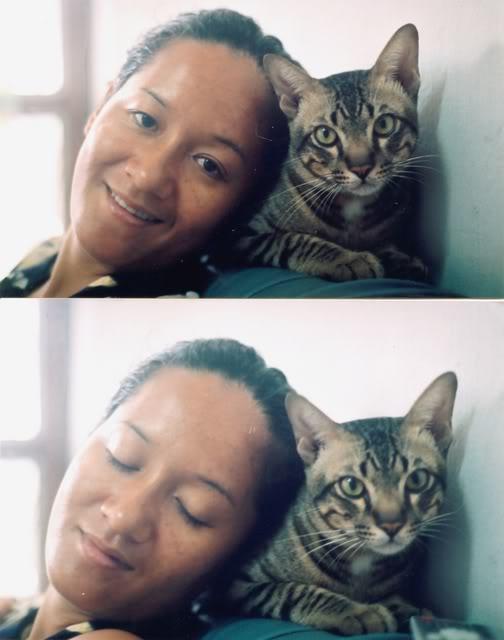
Happier times:

A Proud mother:

A beautiful Thai smile:
In the hospital:

Growing boy!

-
16-03-2007, 04:01 AM #18Thailand Expat

- Join Date
- Jan 2006
- Last Online
- 10-05-2017 @ 11:52 AM
- Posts
- 5,099
Terrible story. Fortune favours the brave HB.
-
16-03-2007, 09:44 AM #19Thailand Expat
- Join Date
- Feb 2007
- Last Online
- 14-11-2013 @ 02:53 PM
- Posts
- 1,205
Good luck HB, your son looks a top little fella
-
16-03-2007, 11:03 AM #20I'm in Jail

- Join Date
- Oct 2005
- Last Online
- 14-05-2014 @ 05:06 PM
- Posts
- 6,815
He looks like his mum.
That is nice for you and he.
-
16-03-2007, 11:57 AM #21Thailand Expat

- Join Date
- Nov 2005
- Last Online
- 09-03-2020 @ 08:28 AM
- Location
- By the flippos and roaming
- Posts
- 2,880
Very sad story ! but thank you for sharing !
This can help us being more carefull round here !!
What about those new HIV test strips, cheap and easy to use at home, anybody seen it yet ?
-
16-03-2007, 06:59 PM #22Member
- Join Date
- Aug 2006
- Last Online
- 13-03-2012 @ 10:43 PM
- Location
- At Home
- Posts
- 226
Just logged back in today. I am nearly in tears. You are a brave lad. I would be shouting and screaming and making no sense at this stage. again my sympathies, and my best to you and your son for the future
-
17-03-2007, 02:06 AM #23Thailand Expat
- Join Date
- Oct 2006
- Last Online
- 08-12-2011 @ 06:20 PM
- Location
- West Coast Canada
- Posts
- 2,908
Yes, he has her eyes! Originally Posted by Lily
I guess some might find my posting this a bit shocking but Sopine would have wanted people to see how she suffered, because the worst thing is to die for nothing.
I'm starting to feel better now, my feet are starting to touch the ground again. the strongest lingering feeling was one of shock, for both Sopine and I, because we were like "What the hell happened?" And after that, sadness of course. Originally Posted by Homer
Well, today my school is having a St. Patrick's Day party, and I'll be singing this, which I heard Sinead O'Connor singing on the radio last week and then found it on the internet:
She Moved Through the Fair
My young love said to me, "My mother won't mind
And my father won't slight you for your lack of kind."
And she stepped away from me and this she did say
It will not be long, love, till our wedding day."
As she stepped away from me and she moved through the fair
And fondly I watched her move here and move there
And then she turned homeward with one star awake
Like the swan in the evening moves over the lake.
The people were saying, no two e'er were wed
But one had a sorrow that never was said
And I smiled as she passed with her goods and her gear
And that was the last that I saw of my dear.
Last night she came to me, my dead love came in
So softly she came that her feet made no din
As she laid her hand on me and this she did say:
It will not be long, love, 'til our wedding day.
This is a bit haunting and reminds me of one night Michael and I were playing with cars/books etc. when Michael suddenly jumped off the couch and began pointing to the door. He kept saying: "Mommy coming! Mommy coming!" and pointing to the back door. I hadn't heard him say either word before, and certainly not in that order. I followed him to our back entrance and Michael kept pointing and saying the same thing.
So I opened the back door and he ran into the rear foyer and kept on pointing and saying the same thing, now at the outside back door. I was feeling a little apprehensive at this point, and slowly opened the back door.
It was night. Michael then exclaimed "Mommy!" and pointed right in front of him into the night, as if she were right there. I looked around and into the back yard but didn't see anything. I said a few words as if Sopine were really there, that we're doing ok. and are you there? and that we miss her, etc. Then Michael got scared and ran back inside. I followed him in and he was fine, smiling, ready to play again.
A few days later I was at the video store with Michael to rent some movies like we always do. I had 4 films but could get another one free so standing near the front counter I said to Michael, "you pick one out." He turned around in his chair and grabbed a movie out of the Canadian section, in this case a French-Canadian film called "Heart of Stone."
So anyway I finished watching this movie. It was a tragic love story in which the heroine dies at the end with her true love at her side, much as Sopine did with me in the hospital. It was pretty hard to watch and all the old real feelings of that time came back to me. The following scene showed her funeral procession with a voice-over of words from her last letter to her beloved:
"You're here, too, so close, your presence is like rays of light in the darkness. I feel at peace. This time I shall be with you, at last."
My last test:
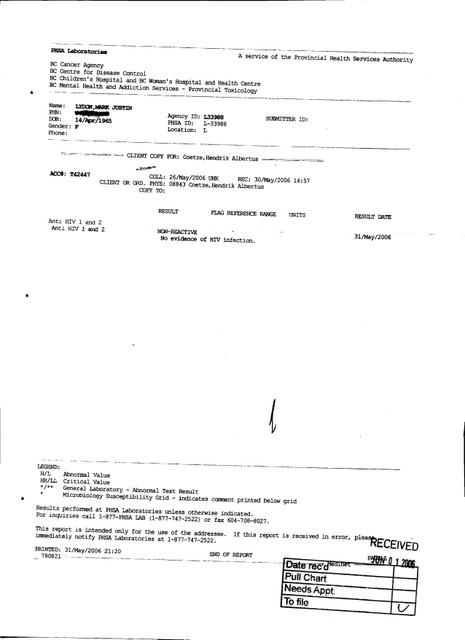
My son's: these are from 9 months ago, actually.
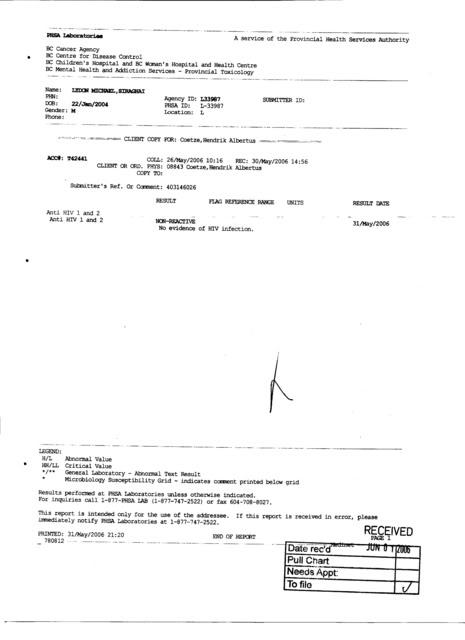
My wife's original HIV neg. test, done at the same hospital when we were pregnant:

My son and I were also very LUCKY and I don't forget that.Last edited by Hootad Binky; 17-03-2007 at 03:50 AM.
-
17-03-2007, 05:47 AM #24Thailand Expat
- Join Date
- Oct 2006
- Last Online
- 08-12-2011 @ 06:20 PM
- Location
- West Coast Canada
- Posts
- 2,908
Something we inexplicably never had access to anyway:
E Canada Now - Breaking News » Thailand Excluded From New Drugs
Boston (eCanadaNow) - Protests are beginning to grow very quickly after news broke that new medicines would no longer be launched in Thailand to try and fight AIDS and other diseases.
The decision came after Thailand announced in January that they would purchase and produce generic versions of the HIV/AIDS drug Kaletra.
The AIDS Healthcare Foundation stated that “W are clearly saddened by this development.” “We’re beyond saddened, We’re horrified.”
The worry is that many people will begin to suffer from AIDS without new drugs such as a new form of Kaletra which does not need to be refrigerated.

Many other drug companies may be following this trend of not wanthing their drugs to be made into generic versions as well as Novartis is now beginning to challenge the patent system in India.
-
18-03-2007, 02:19 AM #25
R.I.P.

- Join Date
- Jun 2005
- Last Online
- @
- Location
- Pattaya Jomtien
- Posts
- 58,763
Actually Thai Hospitals are a nightmare, my girlfriend a couple of years ago damaged her lung by picking up the female Rottie, ie the lung got torn and filled up with fluid, so there we are in hospital in Sattahip and her having her lungs drained, then some new doctor had this great idea of draining her lungs real quick, within 12 hours her lungs collapsed(I think) they started giving her heart drugs ie under the tongue stuff, and the cnuts brought her back to life, so yes these cnuts nearly killed her, you really got to consider your health care here quite seriously.

 Reply With Quote
Thread Information
Users Browsing this Thread
There are currently 1 users browsing this thread. (0 members and 1 guests)
